



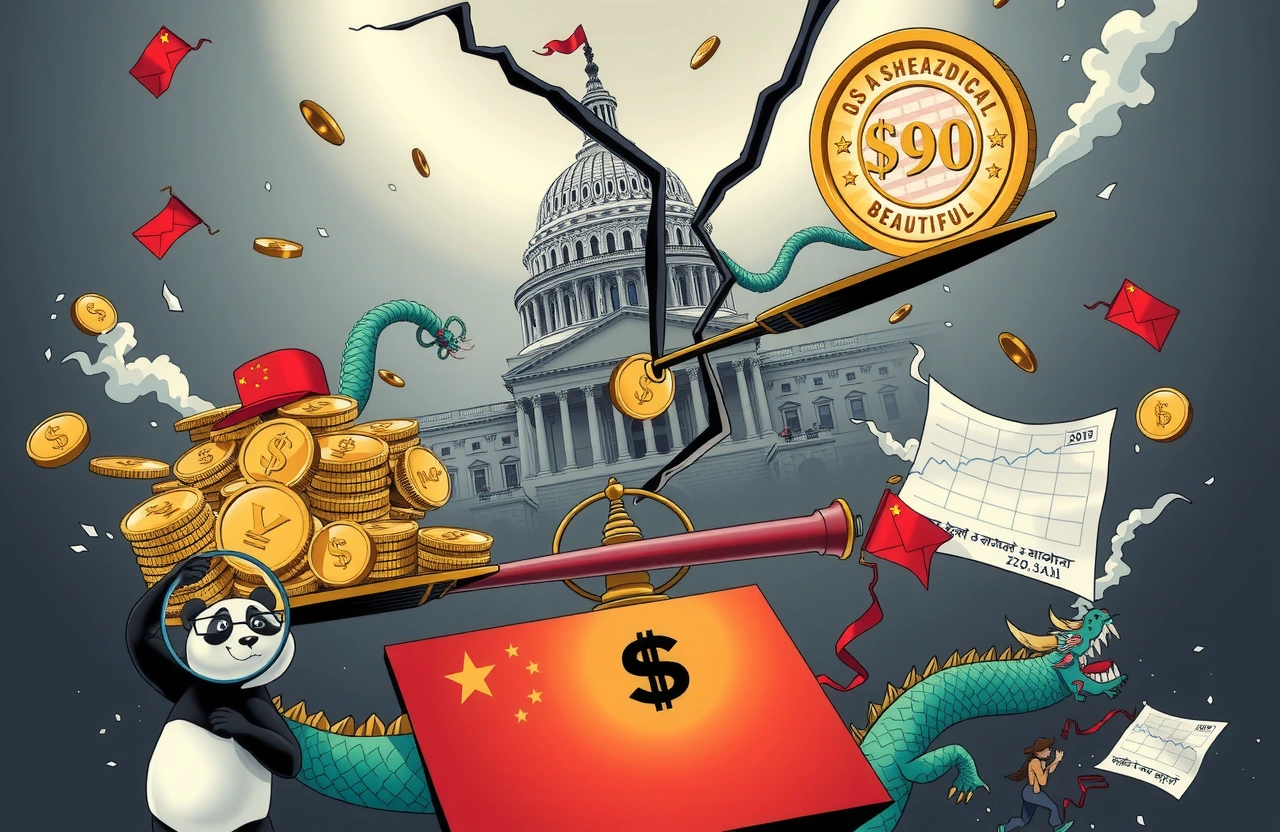
– House Republicans secured narrow 219-213 procedural vote on Trump’s ‘Big and Beautiful’ bill after convincing defectors
– Legislation includes permanent corporate tax cuts funded by $1.2 trillion Medicaid/food stamp reductions
– Nonpartisan analysis projects 11.8 million uninsured Americans and $3.3 trillion deficit increase
– Democrats launch unified opposition while economists warn of widening wealth inequality
As Capitol Hill plunged into late-night sessions, the U.S. House delivered a seismic political maneuver: Republican lawmakers narrowly propelled former President Trump’s flagship economic legislation forward through a critical procedural gatekeeper vote. This 219-213 tug-of-war victory enables full debate on the controversial ‘Big and Beautiful’ bill – sweeping legislation combining permanent tax extensions with dramatic healthcare funding reductions. The knife-edge margin required House Speaker Johnson to personally negotiate with dissenting Republicans after four party members initially threatened rebellion.
Deliberations unfold amid projections that President Trump’s ‘Big and Beautiful’ framework could reshape America’s fiscal landscape. Congressional Budget Office modeling reveals potential ramifications including 11.8 million losing health coverage and federal deficits ballooning by $3.3 trillion. While corporate executives anticipate significant relief from permanent tax reductions, rural hospitals face existential threats from Medicaid reimbursement changes. This legislative chess move places American families at the intersection of tax policy and healthcare accessibility debates.
The Razor-Thin Procedural Victory
Republicans secured passage by the narrowest possible margin – 219 votes to 213 – after intensive eleventh-hour negotiations on July 2nd. House procedural rules required Speaker Johnson to flip at least one of four Republican dissenters who opposed advancing the legislation. This parliamentary hurdle preceding full debate routinely passes along party lines, making the Republican defections exceptionally notable.
The breakthrough underscores Johnson’s legislative maneuvering skills while exposing fissures within GOP ranks. Representative dissent centered on Medicaid reimbursement impacts affecting rural healthcare providers in members’ districts. Procedural approval doesn’t guarantee final passage but initiates amendment debates preceding a conclusive House vote.
Unpacking the ‘Big and Beautiful’ Bill
This comprehensive legislation combines tax policy with healthcare spending adjustments targeting deficit reduction:
Tax Extension Framework
– Permanent corporate rate lock at 21% (versus scheduled 2025 expiration)
– Indefinite individual tax cuts benefiting top income tiers
– Elimination of taxes on tip-based income
The permanent nature of these extensions differs markedly from previous temporary measures, with Joint Committee on Taxation estimating costs exceeding $4.5 trillion over 10 years.
Healthcare Funding Adjustments
– $930 billion reduction in Medicaid reimbursements
– Revised food stamp/SNAP qualification thresholds
– Altered federal matching formulas affecting state-level healthcare funding
Journal of American Medical Association modeling links these changes to predictions of 510 additional annual deaths tied to healthcare service reductions as documented in peer-reviewed journal Lancet.
Democratic Opposition Strategy
Unified Democratic resistance solidified during a Capitol steps press conference preceding debates. House Minority Leader Hakim Jeffries (哈基姆·杰弗里斯) framed the ‘Big and Beautiful’ agenda as hazardous, declaring: ‘We’re witnessing the embodiment of Robin Hood in reverse – pillaging programs supporting vulnerable families to perpetuate advantages for ultra-wealthy households’. Democratic messaging emphasized frontline impacts:
– Medicaid reductions disproportionately harming elderly long-term care
– Rural hospital closures accelerating healthcare deserts
– Tax benefits concentrating within top 5% income earners
Representative Alexandria Ocasio-Cortez (亚历山德里娅·奥卡西奥-科尔特斯) characterized the bill as ‘institutionalizing theft from working-class Americans’, highlighting Congressional Budget Office findings that poorest quintiles absorb income losses averaging 2.3%.
Economic Impact Analysis
Beyond congressional scoring, economists project multidimensional consequences:
Wealth Distribution Consequences
Yale Budget Lab analyses confirm regressive outcomes:
– Top 20% earners gain average $7,300 annually
– Bottom 20% lose average $1,500 yearly
– Net income shift exceeding $120 billion annually toward top earners
Federal Reserve research suggests such disparities historically associate with consumer spending contraction according to National Bureau of Economic Research studies.
Healthcare System Strains
National Rural Health Association projections indicate:
– 283 rural hospitals operating below sustainable margins
– Rural facility Medicaid funding dropping 20%+ in 31 states
– Service reductions impacting 23 million residents
The Peterson Center on Healthcare cites Medicaid reductions potentially triggering cascading nursing home closures as documented in Medicare evaluation reports.
Federal Debt Trajectory
The ‘Big and Beautiful’ bill necessitates significant debt ceiling expansion:
– Immediate $5 trillion borrowing authorization
– Interest payments consuming 14% of federal revenue by 2034
– CBO projects public debt swelling to 159% of GDP by 2054
Research by Brookings Institution indicates debt servicing requirements historically crowd out productive infrastructure spending.
The Legislative Pathway Forward
Despite House approval, the ‘Big and Beautiful’ bill faces procedural labyrinths:
– Senate reconciliation requires precise parliamentary navigation
– Byrd Rule limitations may necessitate substantive revisions
– Conference committee resolution timelines potentially stretching through election season
Notably, Senate amendments previously transformed temporary House tax extensions into permanent measures. Political analysts at OpenSecrets.org track lobbyist engagement across healthcare sectors exceeding last quarter totals by 37%.
Potential Stakeholder Outcomes
Industry impacts demonstrate profound divergence:
– Healthcare providers facing Treasury Department reported sequestration effects
– Wall Street anticipating corporate earnings surges exceeding 12%
– Municipal bond market yields shifting with federal reimbursement changes
Individual household scenarios include:
– Median-wage families retaining $500-$900 annually
– Medicaid-dependent households absorbing $2,000+ healthcare cost transfers
– Retirement portfolio holders experiencing volatility during debt ceiling debates
National Economic Implications
Global capital markets show sensitivity:
– Dollar index declining 0.54% during committee voting
– Treasury yields hitting 8-month highs
– Equity markets signaling preference shift toward import-exposed sectors
The Peterson Institute for International Economics warned deteriorating fiscal metrics could prompt bond vigilante responses undermining dollar reserve status.
Beyond spreadsheets and actuarial tables, flesh-and-blood consequences emerge: seniors facing extended waiting periods for long-term care admissions; clinics reducing oncology services; families scrambling for subsidized marketplace alternatives eliminated through ‘Big and Beautiful’ provisions. District hospitals in Appalachia prepare contingency closure calendars affecting hundreds of thousands.
Legislative skirmishing extends beyond parliamentary procedure toward competing economic visions with profoundly different human costs. The narrow procedural victory initiating ‘Big and Beautiful’ debates places fundamental questions before voters: Which deficit curve matters most – fiscal or human? Whose security ultimately underwrites prosperity doctrines?
Track congressional voting records through GovTrack.us alerts and assess personalized impacts via Tax Policy Center calculators. Engage representatives through Town Hall Project forums as this economic restructuring advances toward decisive votes.