



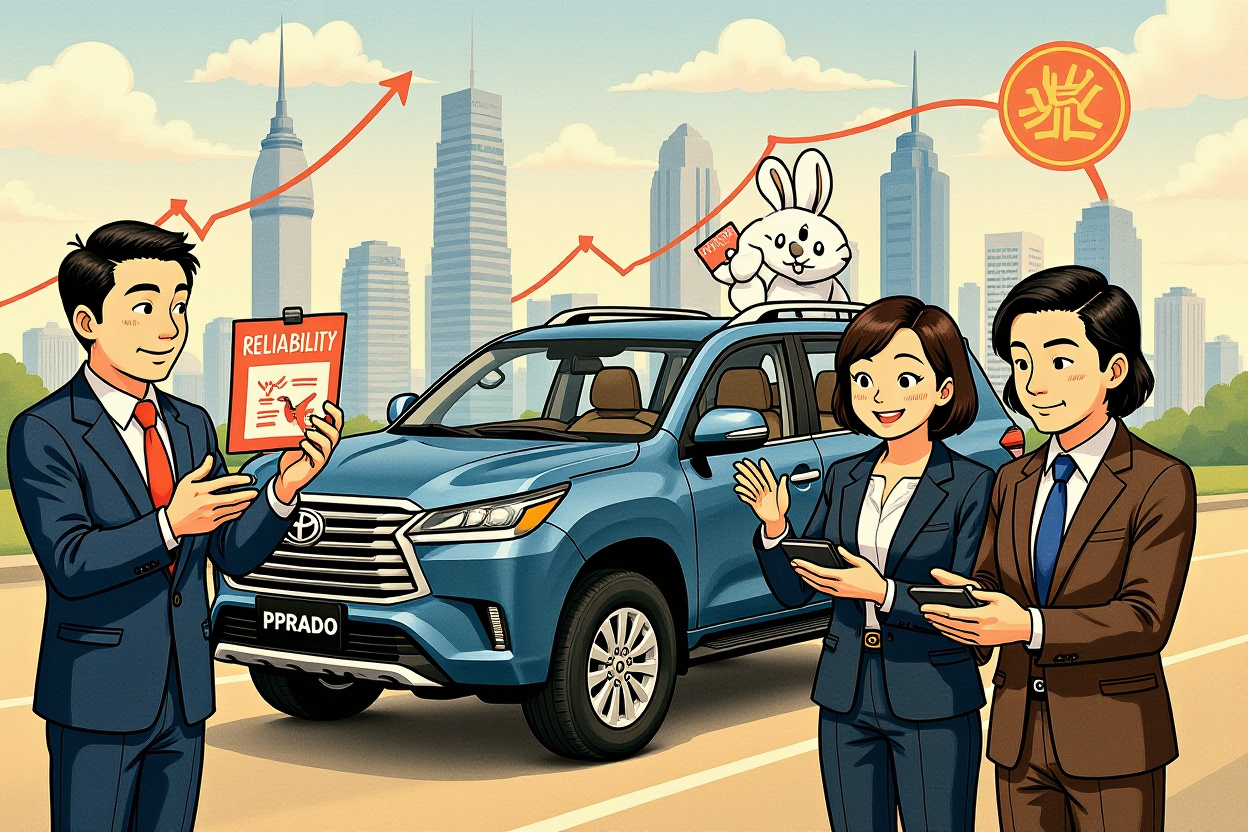
– FAW Toyota planning head Zhao Dong defends Prado’s sales performance despite market criticism
– Executive claims Prado remains sales champion in premium off-road segment above 400,000 RMB
– Full-time 4WD with Torsen differential cited as unbeatable technical advantage over competitors
– Zhao dismisses rival vehicles’ focus on luxury features like refrigerators and entertainment systems
– Statement argues that deceiving consumers about product capabilities isn’t acts of patriotism
Premium Off-Road Vehicle Segment Leader Defends Position
Amid swirling market rumors about disappointing sales figures, FAW Toyota’s Planning Department General Manager Zhao Dong has issued a forceful video response defending the Toyota Prado’s market position. Contrary to circulating reports, Zhao asserts that the Prado actually leads sales in the premium off-road vehicle segment priced above 400,000 RMB. His comments come during a period of intensified competition in China’s SUV market, where domestic brands have been gaining significant ground with feature-rich offerings.
Zhao’s statement represents a rare public rebuttal from an automotive executive regarding specific sales performance claims. The timing suggests growing pressure on international joint ventures as Chinese consumers increasingly consider domestic alternatives that offer more technology and comfort features at competitive price points.
The Core Technology Advantage: Full-Time 4WD
Technical Superiority Over Competitor Systems
At the heart of Zhao’s defense lies what he describes as an insurmountable technological advantage: the Prado’s full-time four-wheel-drive system with Torsen limited-slip differential. This system continuously monitors traction conditions and automatically distributes torque between front and rear axles as needed, without requiring driver intervention. Unlike part-time 4WD systems that operate primarily in two-wheel drive mode, or automatic 4WD systems that engage only when slippage is detected, the Prado’s system provides constant power to all four wheels.
The Torsen (Torque-Sensing) differential represents proven technology that has been refined over decades. It uses helical gears to automatically redirect power from wheels with less traction to those with more grip, providing superior performance on mixed-surface conditions where traction constantly varies. This mechanical system doesn’t rely on electronic sensors or computer controls that can introduce lag or failure points in extreme conditions.
Why Full-Time 4WD Matters for Real-World Use
Zhao specifically addressed the practical advantages of full-time 4WD for typical off-road enthusiasts. While many consumers might imagine extreme rock crawling or mud bogging when they think of off-roading, most actual usage involves traversing unpaved roads, gravel paths, riverbeds, and desert terrain at moderate speeds. These conditions require constant traction management that full-time 4WD provides seamlessly.
He noted that driving on corrugated dirt roads at 30 km/h for extended periods becomes exhausting in vehicles without proper suspension and drivetrain systems. The Prado’s combination of robust chassis design and intelligent torque distribution creates a more comfortable and controlled experience during long-distance overland adventures, which represents the primary use case for most owners rather than extreme obstacle conquest.
Market Reality Check: Consumer Spending Patterns
Voting With Wallets
Zhao made a compelling point about market economics: “Users aren’t fools—they vote with their own money.” Despite numerous competitors entering the premium SUV space, he claims the Prado faces no direct competition at its price point. This statement suggests that while other vehicles might offer similar size or appearance, none match the Prado’s specific combination of capability, reliability, and resale value that has defined the model for generations.
Consumer behavior in China’s automotive market has shown increasing sophistication, with buyers carefully evaluating long-term ownership costs rather than just initial purchase price. The Toyota Prado has historically maintained exceptional resale value, often commanding prices years later that embarrass competitors’ depreciation rates. This economic reality factors heavily into purchasing decisions for vehicles in this segment.
The Price-Performance Equation
The executive’s comments about price proximity being insufficient suggest that even vehicles approaching the Prado’s cost fail to deliver equivalent capability. This implies that competitors either charge similar prices for inferior systems or must charge significantly less to compensate for technical shortcomings. In either case, Zhao positions the Prado as occupying a unique market position that cannot be easily challenged merely through competitive pricing strategies.
Addressing the Patriotism Question
Perhaps the most striking portion of Zhao’s statement came when he addressed nationalism in automotive purchasing: “Deceiving consumers isn’t patriotic.” This appears to be a response to marketing messages from some domestic brands that frame buying Chinese vehicles as acts of patriotism. Zhao suggests that true patriotism involves giving consumers honest information about product capabilities rather than appealing to nationalistic sentiments.
This commentary enters delicate territory in China’s automotive market, where government policies have actively promoted domestic brands while international joint ventures face increasing pressure. By framing the issue as one of consumer transparency rather than national origin, Zhao attempts to elevate the discussion above simple patriotism arguments and focus on technical merits.
The Changing Landscape of SUV Consumer Expectations
From Capability to Comfort
Zhao’s dismissive comments about “refrigerators, color TVs, and big sofas” reference the current trend toward luxury amenities in SUVs, particularly among Chinese manufacturers. Brands like Li Auto, NIO, and others have emphasized rear-seat entertainment systems, premium audio, refrigerated compartments, and lavish interior materials to differentiate their offerings.
This represents a fundamental shift in what consumers prioritize in vehicle purchases. Where traditional off-road vehicles emphasized mechanical capability and durability, newer entrants focus on comfort and technology features that appeal to urban and family users who may never seriously venture off pavement. The Prado’s positioning struggles somewhat in this environment, as its rugged engineering delivers less obvious daily benefits for mainstream consumers.
The Specialization Spectrum
The automotive market has increasingly segmented into specialized vehicles for specific use cases. Where the Prado once served as a capable all-rounder, consumers now can choose from ultra-efficient city SUVs, luxury-focused road cruisers, and extreme off-road machines. This specialization forces vehicles like the Prado to defend their middle ground more vigorously as buyers gravitate toward purpose-built options.
Technical Deep Dive: Understanding 4WD Systems
Full-Time 4WD Mechanics
The Prado’s full-time 4WD system represents a different philosophy from the part-time systems found in many competitors. Rather than operating primarily in two-wheel drive mode and engaging four-wheel drive only when needed, the Prado constantly sends power to all four wheels through a center differential that allows for speed differences between axles during normal driving.
This system provides several advantages: better traction in all conditions (including wet pavement), reduced wear on drivetrain components when engaging/disengaging 4WD, and seamless operation without driver intervention. The trade-off is typically slightly reduced fuel efficiency compared to systems that operate primarily in two-wheel drive.
Comparison to Alternative Systems
Part-time 4WD systems, common on more budget-oriented off-road vehicles, cannot be used on dry pavement without risking damage to drivetrain components because they lack a center differential to accommodate speed differences between axles. Automatic 4WD systems (sometimes called on-demand 4WD) use computers and clutch packs to engage the front axle when rear wheel slippage is detected, but these systems can exhibit hesitation and aren’t designed for prolonged use in demanding conditions.
The Prado’s system sits at the top of this hierarchy, offering the always-ready capability of full-time 4WD with the robustness of mechanical rather than electronic control systems. For serious off-road enthusiasts who value predictability and reliability in challenging conditions, this difference justifies the price premium over systems that prioritize cost savings or fuel efficiency.
The Future of Off-Road Vehicles in an Electrifying Market
Hybrid and Electric Off-Road Capability
The automotive industry’s rapid shift toward electrification presents both challenges and opportunities for off-road vehicles. Electric motors offer instant torque and precise control that could theoretically surpass traditional mechanical systems in off-road applications. Several manufacturers are developing electric off-road vehicles with independent torque control to each wheel, potentially revolutionizing traction management.
However, current battery technology presents limitations for serious overlanding and remote travel where charging infrastructure is nonexistent. Range anxiety becomes particularly acute when venturing far from civilization, where running out of power could become dangerous rather than merely inconvenient. The Prado’s conventional powertrain, while less technologically flashy, offers the reliability and range that adventure travelers require.
Market Position in Transition
As consumer preferences evolve and regulatory pressures increase around emissions, vehicles like the Prado face mounting challenges. Stricter fuel economy standards disadvantage body-on-frame vehicles with higher weight and aerodynamic drag. The industry-wide push toward electrification favors new entrants without legacy powertrain commitments.
Despite these headwinds, a dedicated market segment continues to value proven capability over cutting-edge technology. The question remains whether this segment will remain large enough to sustain vehicles like the Prado at their current price points, or if manufacturers will need to adapt their offerings to blend traditional robustness with modern efficiency and features.
Validating the Executive’s Claims
Sales Data Context
While specific sales figures for the Prado in China are not publicly broken out in detail, industry analysts note that the premium off-road segment has indeed remained relatively stable despite overall market shifts. Vehicles like the Toyota Prado, Land Cruiser, and similar offerings from luxury brands continue to find buyers among specific consumer groups who prioritize capability over features.
The executive’s claim that no direct competitors exist at the Prado’s price point appears substantiated when examining the market landscape. Vehicles with similar off-road capability typically cost significantly more (Land Rover Defender, Mercedes G-Class), while vehicles at similar price points typically offer less serious off-road hardware (Volvo XC90, BMW X5). This positioning creates the niche that the Prado has occupied for decades.
Technical Assessment
Automotive engineers generally confirm the superiority of full-time mechanical 4WD systems for serious off-road use, particularly the Torsen differential system used in the Prado. While electronic systems have improved dramatically in recent years, they still cannot match the predictability and robustness of purely mechanical systems in extreme conditions where electronic sensors might fail or computers might overheat.
The Prado’s reputation for reliability in remote areas stems from this mechanical simplicity—there are fewer components to fail, and those that exist have been proven over decades of use in challenging environments worldwide. This reputation contributes significantly to the vehicle’s strong resale value, creating a virtuous cycle that reinforces its market position.
Broader Implications for the Automotive Industry
Product Truth in Marketing
Zhao’s comments about deceiving consumers not being patriotic reflect growing tension in automotive marketing between emotional appeals and technical realities. As vehicles become increasingly complex and differentiated primarily through software and features rather than mechanical fundamentals, marketers face temptation to overemphasize capabilities that exist primarily in controlled conditions rather than real-world usage.
This tension becomes particularly acute in the off-road segment, where claims about capability can directly impact consumer safety when taken at face value in challenging environments. Vehicles marketed as adventure-ready based primarily on appearance rather than mechanical substance potentially put owners at risk when they venture beyond the capability of their vehicles’ systems.
Nationalism Versus Product Merit
The intersection of consumer patriotism and product quality represents a delicate balance for international joint ventures operating in China. While supporting domestic industry benefits the national economy, consumers ultimately deserve products that meet their needs regardless of origin. Zhao’s framing suggests that true national interest lies in fostering competitive products that can succeed on their own merits rather than relying on protectionist sentiment.
This perspective aligns with China’s broader ambitions to develop globally competitive automotive brands that can compete on technology and quality rather than just price or nationalism. The success of companies like BYD and Geely in international markets demonstrates that Chinese manufacturers can indeed produce world-class vehicles that succeed through merit rather than patriotic appeal.
Final Assessment: Substance Over Hype
Zhao Dong’s defense of the Toyota Prado presents a compelling argument for valuing engineering substance over marketing hype. In an era where automotive purchasing decisions increasingly focus on features visible on showroom floors rather than capability demonstrated in challenging conditions, vehicles with genuine mechanical excellence risk being overlooked by consumers seduced by luxury amenities and technological gimmicks.
The Prado’s continued success despite increasing competition suggests that a segment of the market still values proven capability and reliability above all else. These consumers recognize that when faced with truly challenging conditions far from assistance, mechanical robustness matters more than entertainment systems or interior ambiance.
As the automotive industry continues its rapid transformation toward electrification and autonomy, the fundamental requirements for capable adventure vehicles remain unchanged: reliability, durability, and predictable performance when conditions deteriorate. The Toyota Prado’s enduring appeal demonstrates that for certain applications, traditional engineering excellence continues to outweigh technological novelty.
For consumers considering a vehicle for serious adventure travel, the message remains clear: evaluate actual capability rather than marketed features. Test drive vehicles in conditions similar to those you intend to encounter, research reliability data from long-term owners rather than just initial reviews, and prioritize mechanical systems that have proven themselves over decades rather than unproven new technology. Your safety and enjoyment in remote locations depend on choosing substance over speculation.