



– Tesla’s Q2 2025 deliveries plunged 13.5% YoY amid fierce competition from Chinese EV makers
– Elon Musk’s (埃隆·马斯克) political battles with Donald Trump triggered stock volatility and buyer backlash
– Robotaxi pilot launch faces regulatory hurdles while India entry carries premium pricing challenges
– Executive shakeup sees Musk directly managing sales operations across critical markets
– Second-half 2025 pivotal for validating Tesla’s turnaround strategy
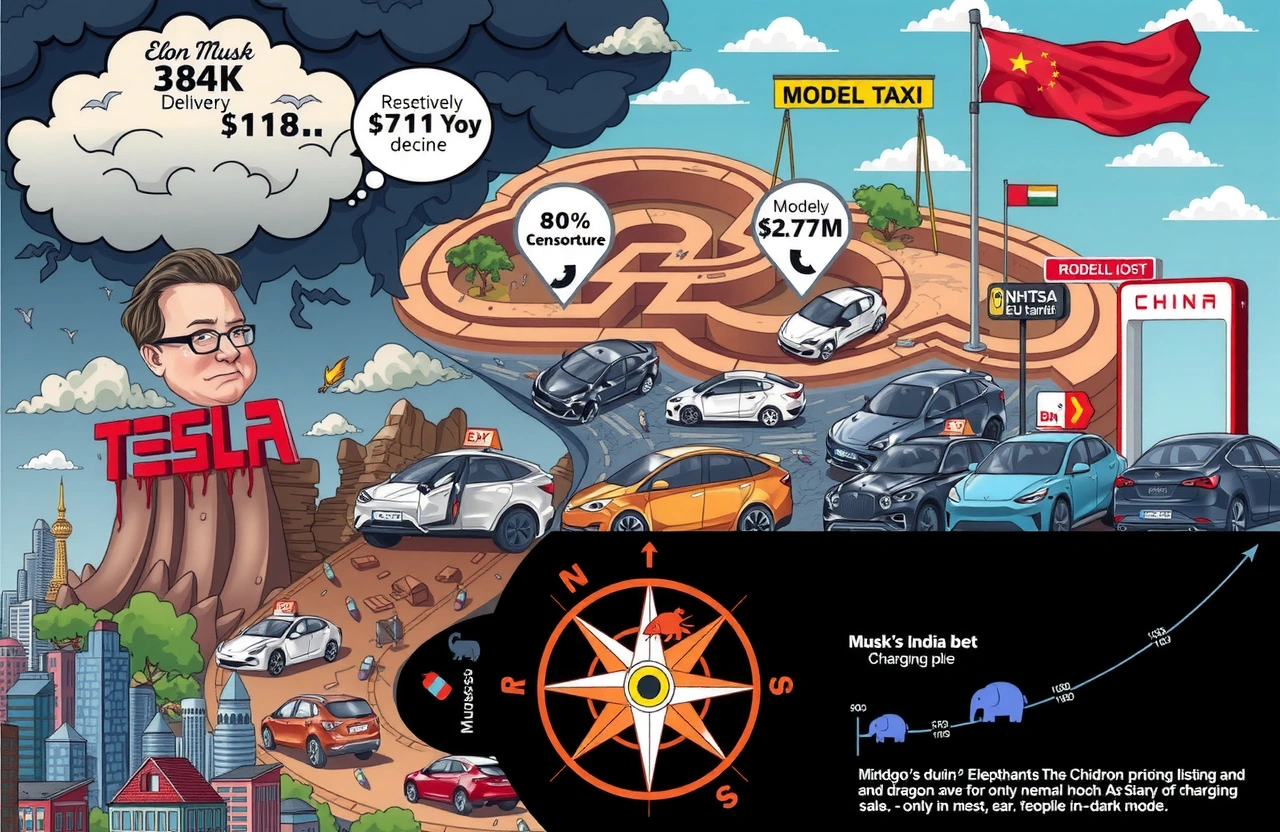
On a tense July morning in 2025, Tesla investors held their breath as the company reported its worst quarterly delivery performance in nearly three years. The numbers told a sobering story: 384,100 vehicles delivered globally in Q2, a 13.5% drop from 2024 levels that missed already diminished market expectations. This disappointing result punctuated a turbulent period where Tesla finds itself navigating not just market pressures but unprecedented political turbulence stemming from CEO Elon Musk’s (埃隆·马斯克) escalating feud with former President Donald Trump (唐纳德·特朗普). As Chinese rivals like BYD accelerate their European offensive and domestic competitors including Xiaomi surpass Tesla in key segments, Tesla’s response—a high-risk bet on autonomous Robotaxi technology and premium-priced entry into India—represents one of the automotive industry’s most consequential strategic pivots. Tesla’s crisis and breakthroughs in the coming months will determine whether this innovation icon can regain its growth trajectory or face structural decline.
Delivery Declines and Executive Shakeup
Tesla’s 2025 first-half global deliveries of 720,800 vehicles represented an 11,000-unit shortfall compared to the previous year, with startling losses across its core markets. The sales slump has triggered significant organizational changes and exposed deepening competitive vulnerabilities.
Regional Weaknesses Exposed
European registrations collapsed over 40% year-on-year in May 2025 as Chinese automakers aggressively expanded their foothold. BYD outsold Tesla in Europe starting April 2025, leveraging competitive pricing and established local partnerships. The numbers illustrate the shift: BYD delivered 1,023,400 EVs globally during H1 2025 compared to Tesla’s 720,800 pure-electric vehicles—a gap exceeding 300,000 units.
In China, Tesla momentarily stabilized in June with modest Shanghai factory output increases, but couldn’t reverse the broader decline. China Passenger Car Association Secretary-General Cui Dongshu (崔东树) revealed that BYD (21%), Geely (12%) and Tesla (11%) led global BEV market share rankings for Q2 2025. The rise of domestic players has systematically eroded Tesla’s pricing power and feature advantages.
![Image: https://finance.ifeng.com/c/8kiZ0xy1Zhe]
Leadership Restructuring
The sales crisis prompted significant executive changes. Omead Afshar, Tesla’s longstanding North American and European operations chief, departed in late June after overseeing key projects. As Afshar was considered one of Musk’s trusted lieutenants, his exit signaled deeper organizational shifts. Musk personally assumed oversight of North American and European sales, service, and manufacturing functions—an extraordinary move reflecting the urgency.
Asia-Pacific leadership remains under Zhu Xiaotong (朱晓彤), Tesla’s global VP and head of Greater China operations. Zhu continues supervising regional expansion after successfully establishing Shanghai’s Gigafactory and local supply chains.
Musk’s Political Firestorm
Beyond sales figures, Tesla faces mounting collateral damage from Elon Musk’s (埃隆·马斯克) deepening political entanglements. His actions have polarized consumers, attracted regulatory scrutiny, and directly impacted Tesla’s market valuation.
The DOGE Controversy
Musk’s appointment as head of the U.S. government’s “Department of Government Efficiency” (DOGE) surprised many, granting him access to federal databases while positioning him as a partisan actor. His prolific conservative advocacy on social media platform X drew intense criticism regarding corporate-political boundary violations. A U.S. survey revealed 57% of adults held unfavorable views of Musk specifically, while half expressed negative sentiment about Tesla overall—including nearly one-third of Republican supporters.
![Image: https://finance.ifeng.com/c/8kiZ0xy1Zhe]
The Trump Feud Fallout
The Musk-Trump confrontation escalated dramatically in early June 2025 through public exchanges on X:
– Musk criticized key components of the “Big Beautiful Bill” including EV tax credit reductions and stricter procurement rules
– Trump threatened revocation of Tesla’s government subsidies while initiating conflict-of-interest probes regarding Musk’s DOGE role
Market reaction proved severe: Tesla shares plummeted over 5% on July 1 following renewed exchanges, wiping ~$7 billion from Musk’s net worth. European backlash also intensified:
– German politicians demanded EU-level investigations
– Tesla owners in France and Netherlands reported vehicle vandalism
Robotaxi Gambit: Autonomous Aspirations
With conventional vehicle sales lagging, Tesla has accelerated its autonomous technology push—positioning itself not merely as an automaker but as a mobility platform provider. This technological wager carries existential implications for its valuation story.
Progress and Pitfalls
The June 2025 debut of Tesla’s Robotaxi pilot service featured a Model Y completing a 72 mph driverless transit across Austin. This demonstration boosted investor confidence momentarily:
– Fixed pricing: $4.20 per ride
– Geofenced operational zone
– No safety drivers required
Despite visible progress, major obstacles remain:
– Musk projects millions of Robotaxis by 2026
– U.S. National Highway Traffic Safety Administration hasn’t yet established L4+ regulatory frameworks
– NHTSA launched new investigations into FSD braking controls and urban navigation capabilities
The promise: Autonomous technology represents Tesla’s most viable path to restoring premium market valuations amidst intensifying competition.
The peril: Regulatory timelines remain uncertain while technical challenges persist.
![Image: https://finance.ifeng.com/c/8kiZ0xy1Zhe]
India Strategy: High-Cost Entrenchment
Tesla’s quest for growth is increasingly global, with India representing perhaps its boldest emerging-market initiative. Yet daunting economic realities confront this effort from day one.
Market Entry Economics
The Mumbai showroom opening scheduled for July 2025 initiates Tesla’s Indian journey:
– Initial shipment: Five China-built Model Y RWD SUPs
– Base price: ₹2.77 million (~$32,000)
– After 210% import taxes: Expected consumer price >$56,000
Logistical investments:
– Supercharger imports
– Parts and service infrastructure
– Policy engagement teams
The strategy acknowledges India’s embryonic EV adoption:
– Current EV penetration: ~5%
– Luxury EV segment: <2% market share
Tesla India's pricing positions it well above volume competitors:
| Market | Model Y Price Equivalent
|-----------------|-------------------------------
| U.S. | $43,990
| India (projected)| >$56,000
Political Dimensions
Musk met personally with Indian Prime Minister Narendra Modi (纳伦德拉·莫迪) in February 2025:
– Accelerated tariff negotiation
– Localization incentives discussions
– Infrastructure coordination
Despite Musk’s public lobbying, Heavy Industries Minister specifically noted:
“No immediate manufacturing plant planned, emphasis remains on sales/service foothold”
The Pivotal Second Half Outlook
Tesla enters autumn 2025 facing multiple inflection points:
Critical Timelines
1. Product cadence: Cybertruck ramp-up and anticipated refreshed Model releases
2. Delivery recovery: Achievement of 1 million annualized run rate
3. Regulatory milestones: Robotaxi operation scale approval
4. Market validation: Sales recovery in China and India
Each milestone carries profound implications:
| Success Threshold | Failure Risk
|——————-|—————–
| Q3/Q4 deliveries > 400K/quarter | Market share erosion accelerates
| Robotaxi permits secured | Autonomous narrative credibility damaged
| India retail exceeds targets | Premium pricing strategy questioned
For investors and industry observers alike, Tesla’s crisis and breakthroughs won’t be measured merely in delivery scrolls but in strategic execution against compounding pressures.
Tesla’s continuing performance reveals a company at war on multiple fronts: market share battles with ascendant Chinese rivals like BYD and Xiaomi; political crossfire between Elon Musk (埃隆·马斯克) and Donald Trump; regulatory battles surrounding autonomous technology; and economic risks from premium-price emerging market entries. As these intersecting pressures build intensity—evident in $100B+ market cap fluctuations within weeks—investment now hinges on conviction in Tesla’s distinct dual identity: Can it effectively operate as both conventional automaker and mobility technology pioneer?
The strategic commitments made today—whether Mumbai showrooms or Texas robotaxis—demand scrutiny beyond quarterly sales numbers. Savvy industry watchers should monitor:
– NHTSA’s evolving autonomous driving regulations
– India’s tariff reform timetable
– Key executive retention signals
– Consumer sentiment polling
The second half of 2025 promises resolution: Tesla’s crisis and breakthroughs will definitively reveal whether its audacious bets deliver sustainable growth or affirm structural decline.