



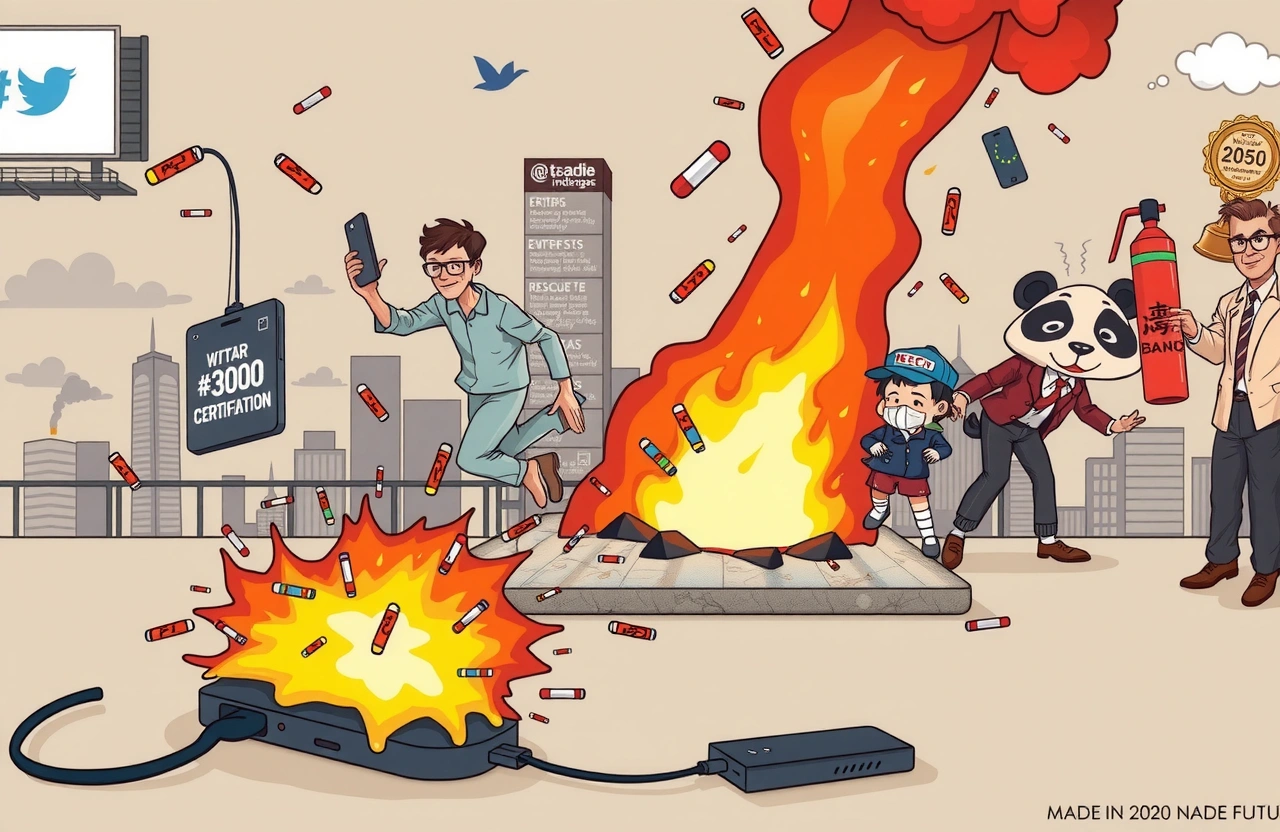
The alarming reports read like horror stories: ‘Woke up to flames shooting from my bedside charger,’ or ‘Found my pillow on fire from a charging power bank.’ These aren’t isolated incidents but part of a growing power bank safety crisis shaking consumer confidence in devices once considered essential lifelines for our digital lives.
From Convenience to Catastrophe: Horror Stories Emerge
Social media platforms flooded with firsthand accounts of power bank explosions in recent weeks. Consumers reported terrifying middle-of-the-night incidents where their charging devices spontaneously ignited:
Real-Life Danger Scenarios
- A Guangzhou resident described being ‘sprayed awake by fire’ at 6 AM when their bedside power bank exploded
- Multiple university students documented 30cm flame radiuses from burning devices near their pillows
- One Beijing user nearly fainted upon exiting the shower to find their room filled with black smoke from a melting power bank
These incidents aren’t just frightening close calls – they’ve caused significant property damage. According to fire department reports, some victims faced thousands in renovation costs after fires spread to bedding and furniture.
The Trigger: Academic Bans Go Viral
The power bank safety crisis escalated rapidly after security alerts spread across Chinese campuses:
- 21 universities including Beijing Union University issued campus-wide warnings specifically targeting Romex 20,000mAh models
- Internal testing revealed these devices had 300% higher spontaneous combustion rates than industry averages
- The academic warnings triggered widespread social media panic using hashtags like #ChargingBomb and #PowerBankSafety
Industry Giants Crumbling: Mass Recalls Begin
Following campus alerts and viral incident reports, regulatory agencies forced action:
Unprecedented Recall Scale
- Romex recalled 491,700 units manufactured between June 2023-July 2024 after Shenzhen Market Supervision Administration intervention
- Anker Innovation voluntarily recalled 710,000 units of their basic power bank line days later
- Market watchdogs identified 3C certification anomalies in Xiaomi, Ugreen, and Baseus models shortly after
Chen Dali (陈大力), consumer electronics analyst at Counterpoint Research, notes: ‘On Friday they’re charging your phone, by Monday they’re recalling millions. This power bank safety crisis shows how quality control failures can instantly vaporize brand equity.’
The Refund Fiasco
Even recognized brands faltered in handling the power bank safety crisis:
- Consumers reported Romex’s official Taobao store had insufficient funds to process refunds
- Multiple buyers confirmed their return requests were ‘stuck for weeks’ due to merchant account deficits
- Platform customer service admitted: ‘We’re urging deposit replenishment but cannot guarantee timelines’
A Taobao user posted screenshots showing staff responses: ‘Seller’s balance is empty – we’ve escalated to regulators.’ This operational collapse amplified frustrations among consumers trapped with dangerous devices.
The Silent Killer: Decades of Safety Failures
This power bank safety crisis stems from systemic industry issues documented since 2021:
Historical Incidents Warning Signs
- 2021 Guiyang fire traced to overnight charging session
- 2022 Guangxi tragedy killed four when counterfeit power bank ignited a home
- 2023 State Administration for Market Regulation found 37.5% failure rate in shock protection tests
Quality Control Collapse
Market pressures created hazardous compromises according to battery engineer Zhang Wei (张伟):
- Premium lithium cells cost ¥40-50 – impossible to source for sub-¥100 retail products
- Failure rates increased annually: from 19.8% (2020) to 44.4% (2023) in safety tests
- Manufacturers prioritized capacity claims over heat management systems
The China Consumer Association documented these disturbing trends in their 2023 Product Hazard Analysis Report.
Corporate Downfall: When Market Leaders Implode
The power bank safety crisis triggered extraordinary corporate consequences:
The Romex Collapse
Just months after celebrating their 11th consecutive Double Eleven sales championship:
- Romex halted production nationwide as of July 1
- Employees verified mass furloughs with ‘indefinite operation suspension’
- Three leadership changes occurred within 90 days as Lei Shexing (雷社杏) resigned as CEO
Company statements insisted ‘We haven’t gone bankrupt’ while scrambling for solutions.
Supplier Chain Reaction
Anker’s official recall notice revealed the crisis’ root cause:
‘Certain battery cell batches from suppliers contained unauthorized material changes causing insulation failure.’ Industry sources identified Amprius as the problematic supplier – whose clients included Xiaomi, Ugreen and Baseus.
Amprius Technology America CEO Kang Sun (孙康) confirmed: ‘We’ve initiated full investigations with regulatory oversight.’
The True Cost: Users Bear the Burden
China’s ¥680 million power bank market now faces existential questions:
Squeezed Safety Margins
Manufacturing cost breakdowns explain the power bank safety crisis:
- Tier-1 lithium cells consume 75% of production budget
- Circuit protection systems often sacrificed during pricing wars
- Marketing budgets exceeded R&D spending at major brands
Li Ming (李明), engineering professor at Zhejiang University, clarifies: ‘When profit margins shrink below 15%, safety components become budgetary casualties.’
The Regulatory Response
Government agencies launched sweeping interventions:
- Ministry of Industry and Information Technology drafted Mobile Power Safety Technical Specifications
- New mandatory standards include enhanced puncture, crush, and thermal runaway testing
- Materials tracing requirements added for all lithium-ion components
New testing protocols simulate battery aging to detect dendrite formation – a leading cause of internal shorts.
Rebuilding Trust: The Path Forward
Averting future power bank safety crises requires fundamental changes:
Protecting Yourself Now
Safety experts urge these precautions immediately:
- Verify your model against official recall lists at SAMR.gov.cn
- Discontinue using swelling batteries – recycle at designated battery collection points
- Avoid overnight charging without fireproof containment trays
The China Household Electrical Appliances Association recommends UL-certified models despite higher prices.
Industry Transformation
The power bank safety crisis might catalyze necessary evolution:
- New national standards effective 2025 mandate third-party dendrite testing
- Major e-commerce platforms now require safety certification disclosures before listing
- Export markets including EU enacting lithium transport restrictions
Despite short-term pain, transparency reforms could position Chinese manufacturers for global leadership in safe energy storage solutions.
Your charging device shouldn’t be a ticking time bomb. Check those recall notices immediately, dispose properly of suspect models, and scrutinize certifications before trusting any portable charger again. Email official reporting portals anonymously if encountering refusal of legitimate refund claims. Prioritize certified products with transparent material origin disclosures.