



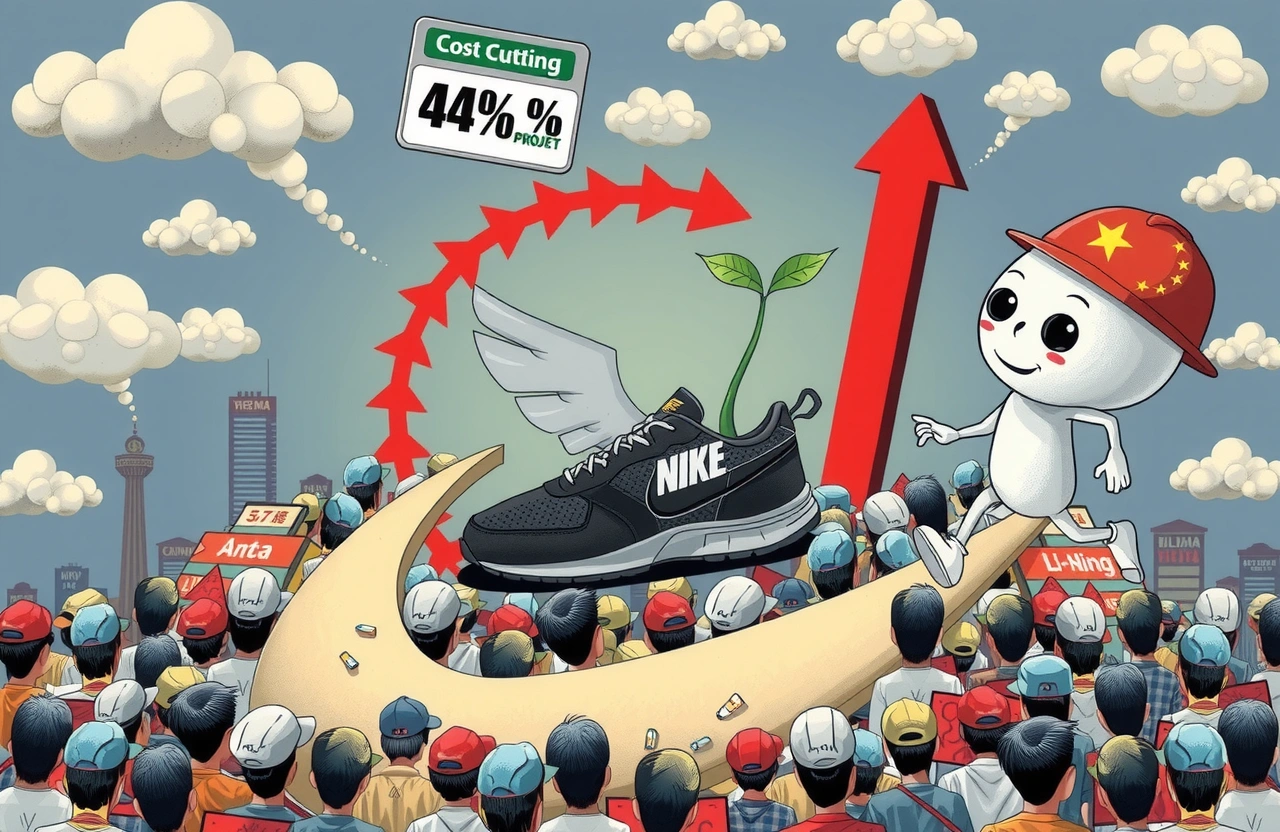
– Nike’s 2025 fiscal year profits plummeted 44% to $3.2 billion with revenue down 10% globally
– $7.5B inventory glut forces discount rates up to 35%, damaging brand prestige and margins
– Failed DTC strategy reduced retail partners by 66% since 2018 while rivals gained ground
– Quality issues with Vietnam manufacturing and China market collapse exacerbate crisis
– New CEO Elliott Hill launches ‘Win Now’ restructuring amid 15% stock surge
Once an unstoppable force in sportswear, Nike now faces a perfect storm of financial and operational challenges. The company’s latest earnings revealed shocking statistics: a 44% nosedive in net profit to $3.2 billion and a 10% revenue decline during its 2025 fiscal year. This dramatic downturn for Nike stems not from temporary market conditions but fundamental cracks in its business model – including an over-reliance on direct-to-consumer sales, innovation stagnation and a $7.5 billion inventory backlog. As factory shift issues and political headwinds further complicate the picture, newly appointed CEO Elliott Hill faces what analysts call Nike’s greatest test since the 1990s. This report examines how America’s athletic giant lost its footing globally and whether it can still reclaim its dominance amid intensifying competition.
Fiscal Year 2025: Assessing the Damage
Financial Freefall
Spoiler
Nike’s 2025 financial report reveals an alarming downturn for the sportswear titan. Revenue crashed to $46.3 billion – nearly 10% lower than the prior year. The company’s net profit suffered an even more brutal contraction, collapsing 43.53% to $3.2 billion. This represents Nike’s worst profitability performance in five years. Gross margins likewise contracted by 1.9 percentage points, which Nike’s CFO attributed directly to three factors:
– Aggressive discounting required to move excess inventory
– Unfavorable channel mix shifts
– Increased inventory write-offs
This financial decline forms just one dimension of Nike’s downturn – the company’s inventory valuation remains stubbornly elevated at $7.5 billion despite a modest 2% reduction year-over-year.
Global Market Contraction
Examining regional performance highlights how widespread Nike’s challenges are:
– **Greater China**: Sales cratered 13% to $6.586 billion, reaching multi-year lows
– **North America**: Revenue declined 4% to $7.58 billion
– **Europe/Middle East/Africa**: Down 10%
– **Asia-Pacific/Latin America**: 11% contraction
This geographic spread confirms that Nike’s downturn extends far beyond market-specific issues to systemic challenges impacting operations worldwide. Once a formidable global presence, Nike now shows double-digit declines across most major regions.
Product Category Breakdown
Product declines reveal weaknesses in core segments:
– Footwear: Global sales down 13%, led by:
– Air Force 1: >20% decline
– Dunk series: >20% decline
– Apparel: 12% revenue drop
– Converse: 18% collapse
Our analysis underscores how Nike’s downturn impacts even historically dependable segments, with iconic franchises losing their cultural momentum and vintage styles showing clear signs of consumer fatigue.
The Anatomy of Nike’s Decline
Strategic Missteps: The DTC Debacle
The most damaging internal factor accelerating Nike’s downturn resides in former CEO John Donahoe’s aggressive direct-to-consumer pivot. By slashing wholesale partnerships from 30,000 retail doors (2018) to under 10,000 (2024), Nike aimed at margin enhancement but instead decimated its physical presence. Consequences include:
– Dramatically reduced brand visibility in malls and shopping districts
– Failed digital channel growth unable to compensate for brick-and-mortar losses
– Wholesale revenue void exploited by rivals:
– Adidas: Wholesale revenue up 17% in Q2 2024
– On Running & Hoka: Gained specialty retailer shelf space
Despite partially reversing the policy by returning classic lines (Air Force 1, Air Max) to Foot Locker and others, rebuilding partner trust remains uphill work.
Product Pipeline Breakdown
Decades of innovation leadership evaporated as Nike was overtaken in critical categories:
– Running: Hoka and Asaisu seized technical leadership
– Lifestyle: Retro fatigue decimated Air Force and Dunk sales
– Technology: New platforms like Nike React failed to match cultural impact of earlier breakthroughs (Air, Flyknit)
Even basketball veteran Kevin Durant’s signature KD 18 reboot only minimally offset category stagnation. This innovation deficit fundamentally underlies Nike’s downturn by ceding product enthusiasm to agile competitors.
Supply Chain Disruptions
Nike’s gamble on manufacturing relocation introduced new vulnerabilities:
– Vietnamese production quality issues sparked complaints on Chinese platforms like Black Cat (17,000+ complaints)
– Tariffs on Chinese goods forced uncompetitive price hikes
– The bifurcated manufacturing model created logistical nightmares
As Nike warned of further shifts away from Chinese shoe production, resolving Vietnam’s quality control challenges has become critical to reversing the downturn.
China Crisis: Epicenter of Nike’s Downturn
No market reflects Nike’s downturn as starkly as China:
– Black Cat complaints detail rampant product failures (separating soles, fading colors)
– Xinjiang cotton crisis (2021) sparked consumer boycotts
– Revenue trajectory:
– 2021 Peak: $8.257 billion
– 2022: $7.547 billion (-9%)
– 2023: $7.248 billion (-4%)
– 2024: $7.5 billion (promotion-driven)
– 2025: $6.586 billion (record low)
Chinese consumers cite diminishing “value perception” for American products against premium domestic brands. Though Nike responds with China-exclusive collections and sports marketing, the path to recovery appears lengthy absent fundamental identity recalibration.
The Rescue Mission: Strategies to Stop the Slide
Leadership Transition and ‘Win Now’ Framework
New CEO Elliott Hill – a 32-year company veteran who resurrected the Jordan brand – represents Nike’s most hopeful transition. His immediate actions include:
– Running category simplification: 3 core performance families
– Cost-cutting: $2 billion savings targeted within three years
– Channel reset: Improved wholesale engagement alongside DTC refinements
– Sponsorship reinvestment: Renewed NBA, WNBA, NFL partnerships
Financial Market Response
Recent Q4 results ($111.0B revenue vs. $107.2B expected) sparked a 15.19% stock surge. Yet this potential inflection point shouldn’t be overstated:
– Full-year performance remains weak
– Morgan Stanley maintains neutral rating citing 16% downside risk
– Investors demand evidence ‘Win Now’ delivers sustained trajectories
Manufacturing Re-routing Risks
Nike’s plan to further decrease Chinese footwear exports faces hurdles:
– Southeast Asian alternatives require quality control overhauls
– Raw material, skilled worker shortages in new regions
Active mitigation will determine whether production shifts ultimately soften or deepen the operational downturn.
Some analysts characterize Nike’s current impasse as a near-death experience for a complacent market leader. The unprecedented co-occurrence of brand dilution, consumer defections and operational miscalculations created this downturn; its resolution demands equally comprehensive solutions. Nike must rebirth its innovation legacy through genuine performance breakthroughs while mending relationships with abandoned wholesale allies. For shareholders: Wait for Q1 proof points before overcommitting to recovery narratives. For observers: Witness corporate reinvention in real-time as either cautionary tale or masterclass.