



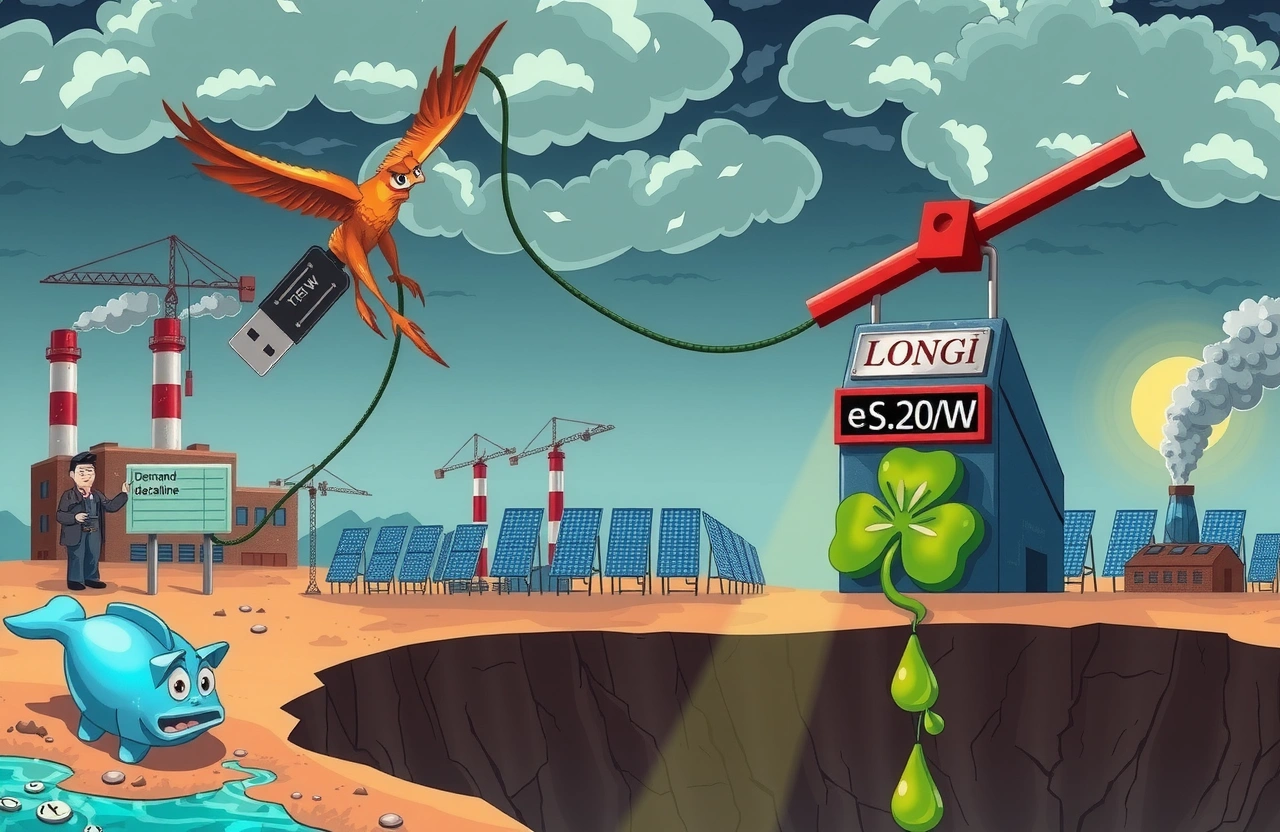
Solar Leader’s Financial Warning Signal
China’s photovoltaic giant LONGi Green Energy has issued a critical financial alert, projecting staggering losses exceeding 2.4 billion yuan ($330 million) for the first half of 2024. This comes despite narrowing losses compared to 2023’s bleak figures, revealing unrelenting systemic pressure within the solar manufacturing sector. The company’s preliminary analysis reveals photovoltaic module prices have crashed through industry cost thresholds – a catastrophic development jeopardizing profitability across the entire solar supply chain.
Summary of Key Developments
- – Projected net losses between 2.4-2.8 billion yuan ($331-386M) for H1 2024
- – Quarterly losses accelerated to 1.44 billion yuan ($198M) in Q1 despite narrowing YoY deficit
- – Critical trigger: PV module prices collapsing below industry-wide production cost line
- – Government policy deadlines failed to sustain anticipated price recovery
- – Industry-wide financial reports due in August expected to reveal full damage
Industry Cost Line Breach
LONGi explicitly attributes its dire outlook to market anomalies unseen in recent solar industry history. Module prices have plunged below sustainable manufacturing thresholds – what industry analysts call breaching the cost floor. This unprecedented phenomenon makes profitable operation impossible even for technological leaders. Solar manufacturers face a brutal choice: either sell below production cost or halt operations entirely. Production shutdowns spiked worldwide recently according to EnergyTrend data, with panel output plunging below 40% capacity across Southeast Asia as inventory accumulation reached critical levels.
Price Freefall Dynamics
The solar industry faces dual destructive forces: Massive manufacturing overcapacity meeting slowing installation demand. Production-capacity-to-demand ratios exceeded 300% globally last quarter. What peers hoped would be temporary oversupply has metastasized into structural imbalance. Factors fueling this crisis include:
- – Chinese manufacturers adding 380 GW new capacity in 2023 alone
- – US inflation legislation triggering global factory race
- – Cash-burning facilities operating below production cost thresholds
- – Demand growth refusing 2022 predictions
BloombergNEF research director Jenny Chase warns: “We’re witnessing industry cannibalization where manufacturers collectively sabotage pricing structures built over decades.” This price devastation ripples through supply chains, paralyzing suppliers of polysilicon, wafers, and raw materials.
Policy Disappointment Impact
The industry pinned recovery hopes on China’s mid-year policy acceleration. Developers raced to commission projects before June 30 subsidy deadlines provided temporary demand. However, price recovery evaporated before policies took full effect, according to LONGi reports.
Failed Stimulus Mechanisms
Government interventions proved insufficient against structural imbalances:
- – Installation timing merely pulled forward existing demand
- – Inventory clearance discounts outweighed policy benefits
- – Smaller manufacturers discounting below fundamental cost basis
- – Offshore markets remained plagued by import restrictions
Renewables analyst Frank Haugwitz observes: “Stopgap policy measures can’t solve fundamental cost-line breaches. This requires coordinated production discipline the solar sector lacks.” Industry consolidation appears imminent as weaker players hemorrhage cash.
Broader Repercussions Forecast
When LONGi releases audited August financials, the broader ramifications will clarify:
- – Full assessment of damage across tier-1 suppliers
- – Technical debt accrued during loss-generation periods
- – Supply chain partnership viability assessments
- – Project cancellations due to pricing volatility
Harvard Business Review identifies such cost-line breaches as industry inflexion points preceding consolidation waves. Expect dominant manufacturers to leverage this crisis through strategic acquisitions and accelerated capacity retirement programs.
Path Forward Analysis
Industry-wide profitability recovery requires synchronized capacity discipline eliminating dumping below operational expenses. Focus must include:
- – Temporary production halts to rebuild pricing leverage
- – Collaborative supply chain cost reduction programs
- – Innovation investments concentrating on premium market segments
- – Diversification toward project development and maintenance revenue
The solar industry demonstrated incredible cost-reduction achievement over a decade – but genuine sustainability requires maintaining viability above fundamental production economics. As LONGi’s warning confirms, sub-cost-line pricing fights create collective destruction without victors. Industry stakeholders must urgently implement corrective measures before August’s reports quantify the full devastation. Investors watching solar equities should demand transparent recovery plans addressing cost-line defenses before committing additional capital.