



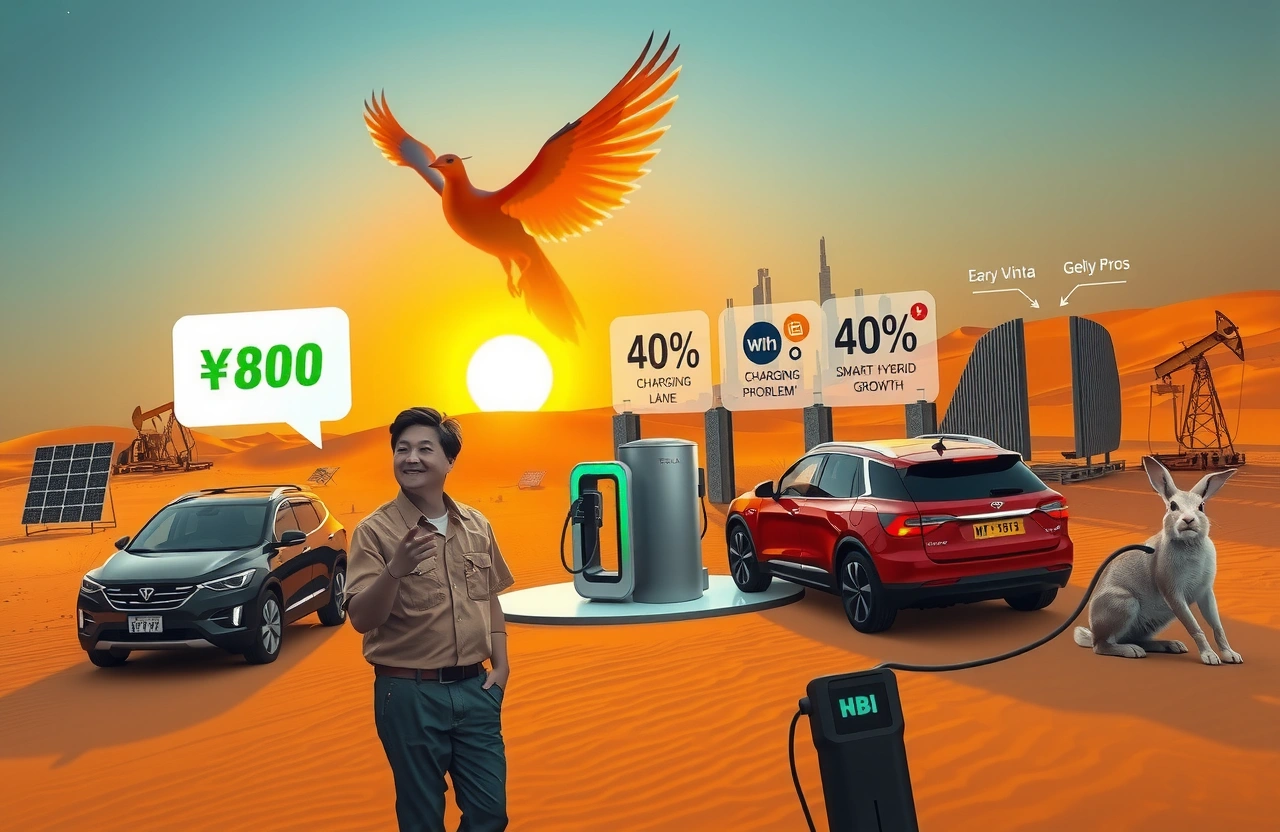
The Middle East’s automotive market presents a fascinating contradiction: amidst globally leading oil production that keeps gasoline prices remarkably low, electric vehicles face an uphill battle. According to Yan Linhui (严林辉), China Regional Representative of KEZAD GROUP and Venture Partner at Fosun Capital, this environment creates the perfect conditions for hybrid vehicles to serve as the practical solution. Speaking at the recent 2025 Global Expansion Summit for Chinese Companies in Shenzhen, Linhui highlighted the urgent realities facing automakers. While EVs struggle with infrastructure limitations, hybrids uniquely satisfy regional preferences by blending fuel flexibility with smarter functionality.
Article Summary
- Middle Eastern EV adoption remains low due to scarce charging stations, ultra-low fuel costs (~¥5/liter), and insufficient EV education
- Hybrid vehicles emerge as the solution by offering smart capabilities without charging dependency
- Chinese brands like Chery Jetour, Changan, and Geely lead hybrid SUV popularity in the region
- Automakers must prioritize hybrid models and localized marketing to succeed
Understanding the Middle East Automotive Landscape
Autos Middle East automotive trends differ significantly from global patterns due to abundant hydrocarbon resources directly impacting consumer behavior. With most countries producing oil domestically, gasoline costs remain astonishingly low compared to international averages.
Electric Vehicle Adoption: Current Reality
The region’s EV market shows underwhelming traction despite governmental initiatives like Saudi Arabia’s push for 30% EV penetration by 2030. Sales figures reveal slow growth even in developed markets like Qatar. According to Yan Linhui (严林辉), consumer apprehension persists due to practical concerns rather than ideological resistance. Charging accessibility issues compound limited public awareness campaigns. Tesla’s Dubai experience exemplifies this struggle.
Three Key Barriers to EV Penetration
Yan identifies critical obstacles hindering widespread EV embrace:
- Charging Infrastructure Gap: Unlike China or Europe, charging stations remain sparse outside major urban centers
- Economic Disincentive: Gasoline averaging ¥4.9-5/liter (68 US cents) makes combustion engines cost-efficient
- Educational Shortfall: Cultural misunderstandings prevent effective EV benefit communication
Together, these conditions create prime market conditions for hybrid vehicles as the solution.
The Charging Infrastructure Deficiency
The Middle East’s charging network development lags significantly behind vehicle advancement. Government and private investments face practical hurdles including grid limitations and urban planning complexities.
Dubai’s Charging Gridlock: A Case Study
Dense urban hubs like Dubai reveal infrastructure bottlenecks unmistakably. As Yan Linhui (严林辉) observed, scenes of ten-plus Tesla owners lining up at single charging stations illustrate systemic inadequacies. Service deserts emerge beyond business districts. Renewables-powered stations only partially alleviate concerns.
Why Fuel Prices Dictate Consumer Choices
With Qatar and UAE featuring among the world’s cheapest gasoline markets, cost logic dominates transportation decisions. Most citizens consider ¥800/month fuel budgets manageable.
The Economics of Car Ownership
Upfront EV pricing struggles to offset long-term savings when petrol costs so little. Battery replacement fears exacerbate risk perceptions. Maintenance networks favor internal combustion expertise.
Why Hybrid Vehicles Are the Solution for Middle East Markets
Hybrid technology emerges as the ideal pivot for automakers targeting Gulf Cooperation Council countries. Yan Linhui (严林辉) emphasizes these models bridge practical realities and technological aspirations perfectly.
Bridging Both Energy Worlds Effectively
Hybrids function reliably regardless of charging availability while delivering advanced features EVs pioneered. Key advantages:
- Zero charging-anxiety during desert travel
- Lower fuel consumption than traditional SUVs
- Regenerative braking systems conserve energy
Moreover, hybrids generate lifecycle cost savings attracting pragmatic buyers.
Smart Features Meet Local Expectations
Unlike basic combustion engines, hybrid vehicles constitute a technologically robust solution. Integrated AI assistants prevent distracted driving during long desert journeys. Driver fatigue detection and navigation smooth transitions between cities.
Chinese Automakers Leading Hybrid Adoption
Several China-based brands have identified hybrids as their Middle East strategic priority. Competitive pricing and targeted designs facilitate market penetration.
Dominant Models Reshaping Preferences
Hybrid SUVs dominate regional sales charts. Preferred examples include:
- Chery Jetour: Compact crossovers emphasize durability
- Changan UNI-K: Smart cockpit interfaces
- Geely Boyue Pro: Reliability-focused engineering
AutomakersMust localize designs for desert conditions. Enhanced air filtration systems combat sand ingress. Corona diagnostics detect fuel contamination.
Strategic Pathways Forward
Overcoming current limitations requires coordinated industry approaches targeting infrastructure and perception.
Marketing Hybrid Benefits Effectively
Communicate advantages like remote control cooling systems via climate-tailored campaigns. Partner with influencers like Dubai’s Sultan Al Neyadi.
Infrastructure Collaboration Models
Automakers should forge partnerships:
- Joint ventures with Aramco on hydrogen-blended fuels
- Charging installation partnerships across NEOM construction zones
- Solar-integrated dealership charging stations
Simultaneously develop quick-charge highway networks.
The Road Ahead
The Middle East’s auto transformation demands patience and precision. While EVs may achieve prominence long-term, hybrid technology stands as today’s indispensable solution balancing economic incentives and practical constraints. Automakers should urgently:
- Scale hybrid production lines by 40% before 2026
- Establish regional R&D centers addressing heat resilience
- Co-develop charging corridors with oil companies
Yan Linhui (严林辉) concludes pragmatically: embrace transitional solutions where ideals face practical realities. Hybrid sophistication continues advancing while satisfying market fundamentals no competitor can ignore.