



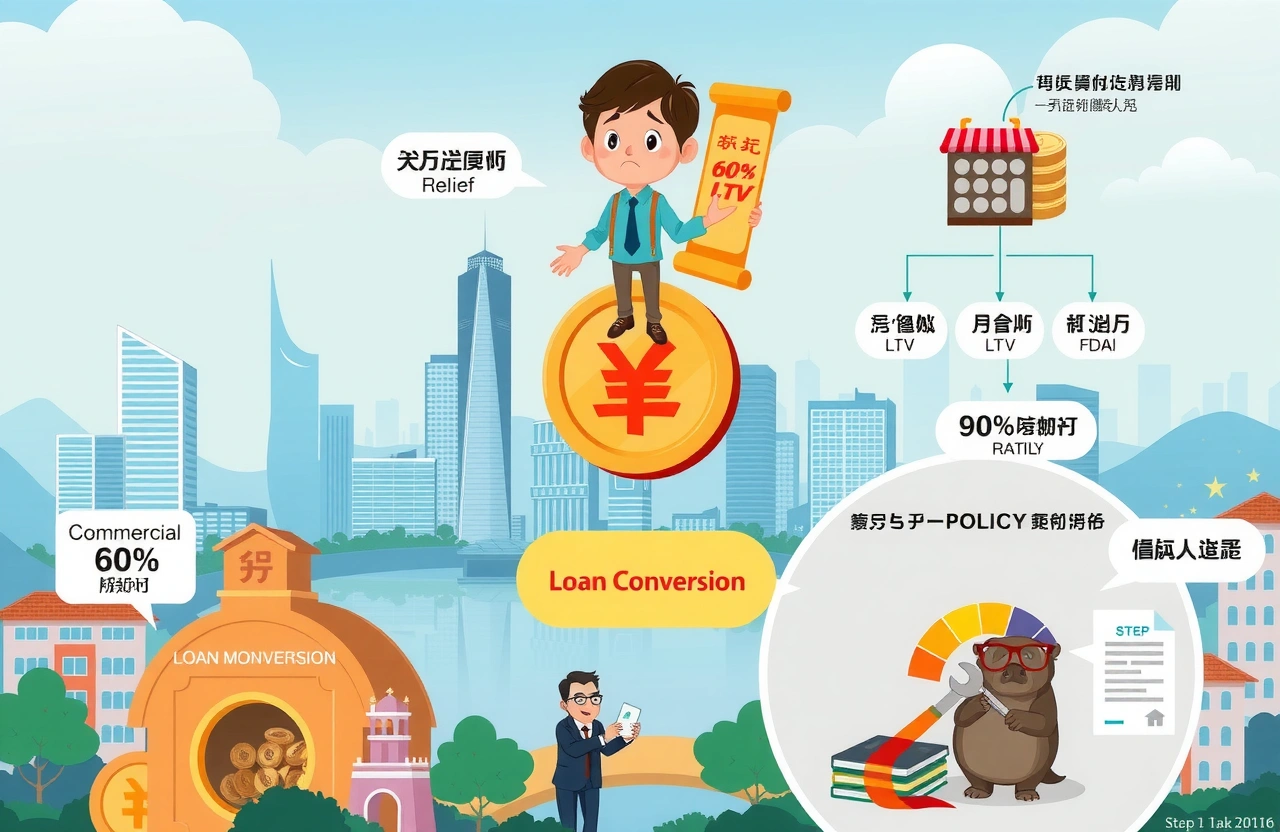
Guangzhou homeowners facing mortgage stress just received potential relief as local authorities propose groundbreaking loan conversion rules. The Guangzhou Housing Provident Fund Management Center unveiled draft regulations on July 2, 2025 allowing qualified residents to swap high-interest commercial mortgages for lower-rate public fund loans – a strategic move to stimulate consumption amid sluggish economic recovery. This commercial to public housing loan conversion initiative could slash monthly payments by hundreds while injecting vitality into China’s third-largest housing market. Public consultation on the proposal runs through July 11th.
Guangzhou Housing Loan Policy Overview
Threshold Triggers and Operation Mechanism
The policy activates commercial to public housing loan conversion when Guangzhou’s housing loan-to-deposit ratio dips below 75%, with automatic suspensions triggering at 90%. This safeguard prevents fund depletion while ensuring sustainable operations:
-
– Operating Window: Conversion available when individual loan ratio <75%
– Caution Phase: Loan curbs activate at ≥85% ratio (volume limits, appointment systems)
– Suspension Trigger: Full halt at ≥90% loan ratio
The tiered approach balances homeowner relief with financial stability, contrasting with Shenzhen’s blanket 85% cutoff.
Economic Context and Market Impact
Economists like Tsinghua University professor Li Daokui (李稻葵) estimate Guangzhou’s measure could release 4-7 billion yuan annually into consumer spending – vital fuel as retail growth stagnates at 2.1% (National Bureau of Statistics Q1 2025). Property analysts at Centaline Group note Guangzhou’s secondary market inventory reached 140,000 units in June, with conversion eligibility motivating fence-sitting buyers. Since Wuhan launched China’s first commercial to public housing loan conversion in 2022, five major cities have adopted variants averaging 17.2% participation rates among eligible homeowners.
Eligibility Criteria Explained
Core Qualification Requirements
The draft specifies seven non-negotiable conditions for commercial to public housing loan conversion:
-
– 60+ months cumulative Guangzhou housing fund contributions
– No prior housing fund loans nationwide (including subsidized/commercial conversions)
– Property ownership certificate issued, no secondary liens/encumbrances
– Original commercial loan issued ≥5 years ago with lender’s written consent
– Mortgage property is family’s sole Guangzhou residence
– Zero 90+ day delinquencies in past 24 months
Property-Specific Conditions
The policy exclusively covers self-occupation properties meeting conditions:
-
– Located within Guangzhou administrative zone
– Originally financed via pure commercial mortgage (no hybrid loans)
– Lender must be housing fund partner bank (ICBC, CCB, ABC, etc.)
– Retains commercial mortgage obligation during application
Investment properties, rural homesteads, and non-residential assets are explicitly excluded.
Loan Conversion Financial Parameters
Amount Calculation Methodology
Conversion amounts follow stringent caps preventing asset appreciation arbitrage:
-
– Maximum: Lower value of (a) 60% property value or (b) loan balance minus next 3 principal payments
– Property value = Min(purchase price, current appraisal)
– Shortfall coverage: Applicants must cover gaps exceeding policy limit
Case example: A 2.5M yuan apartment purchased in 2020 with 1.8M balance could convert max 1.5M (60% of value) instead of 1.78M (balance minus 3 payments).
Duration and Rate Structure
Loan terms combine restraint with flexibility:
-
– Maximum term: Lower of (a) original loan’s remaining duration or (b) 30 minus elapsed years
– Mortgage rates: PBOC housing fund loan rates apply, adjusting annually on January 1
Current Guangzhou housing fund loan rates (as of June 2025):
-
– ≤5 years: 2.75%
– >5 years: 3.25%
Contrasted with average commercial mortgage rates: 4.35-5.15%. The 160-190 basis point spread could save borrowers 168-236 yuan monthly per 500,000 yuan converted.
Conversion Process Flow
Preparation Phase
Steps to solicit lender approval and documents:
-
– Obtain conversion consent letter from commercial lender
– Secure repayment account containing 3 monthly payments (principal + interest)
– Compile: Property deeds, ID cards, marriage certificates, payment history
Approval timing worries applicants – Guangzhou’s draft lacks processing deadlines unlike Beijing’s 15-day pledge.
Formal Approval Procedure
The integrated six-stage conversion pathway:
-
1. Preliminary bank approval secured
2. Documentation submission to Housing Fund Center
3. Qualification review (typically 7 days)
4. Mortgage signing/notarization
5. Second-rank collateral registration
6. Fund disbursement and prior loan clearance
Post-conversion, borrowers coordinate lien transfers housing fund loans become primary collateral.
Safeguards and Sustainability Measures
Risk Management Framework
The policy embeds crisis triggers:
-
– Rolling suspension: If loan ratio surpasses 90% for 3 consecutive months
– Volume controls: Caps allocating ≤30% monthly inflows to conversions
– Priority queue: Applications sequenced by submission timestamp
The Guangzhou Housing Provident Fund Management Center retains adjustment authority as property economist Ren Zeping (任泽平) warns of liquidity strains during downturns.
Funding Allocation Strategy
Conversions tap pooled resources:
-
– Monthly/annual conversion quotas predetermined
– Reserves designate <25% liability coverage – Secondary collateral requirements maintained
Housing fund balances face pressure – Guangzhou’s April 2025 report showed individual-loan ratio already at 82.6%.
Broader Market Implications
Housing Market Stimulus Effect
Analysts predict multi-dimensional impacts:
-
– Resale momentum: Conversion access motivates 22% prospective sellers (Savills Q1 survey)
– Price stabilization: Premium condos gain liquidity edge from high-value conversions
– Development shift: Builders emphasize mid-market projects meeting 60% LTV margin
Mirroring Changsha’s 2023 rollout which lifted transactions 14.3% annually.
Consumer Economics
The National Institute for Finance estimates Guangzhou households could reclaim:
-
– Avg annual savings: 7,000-11,300 yuan
– Equivalent stimulus: 0.8-1.2% projected retail sales growth
Notably constrained by strict eligibility – only 34% Guangzhou mortgages predicted to qualify by Everbright Securities.
Procedural Next Steps
Guangzhou’s consultation period concludes July 11th via:
-
– Mail: Loan Management Department, 3F San Yin Plaza, 12 Hua Jiu Road, Tianhe District, Guangzhou (510623)
– Email: caijh@gz.gov.cn
Final verification awaits after public input integration and provincial government endorsement.
Action Plan for Eligible Homeowners
Homeowners should strategically prepare for Guangzhou’s commercial to public housing loan conversion:
-
– Calculate eligibility gap: Verify cumulative housing fund contributions exceed 60 months
– Obtain mortgage statements: Document payment history showing 24 clean months
– Commission appraisals: Establish current market valuation
– Consult lenders: Pre-negotiate conversion approvals with banks
While Guangzhou’s housing breakthrough requires careful implementation tracking, its precedent-setting approach may guide future urban mortgage innovations across China’s major markets.