



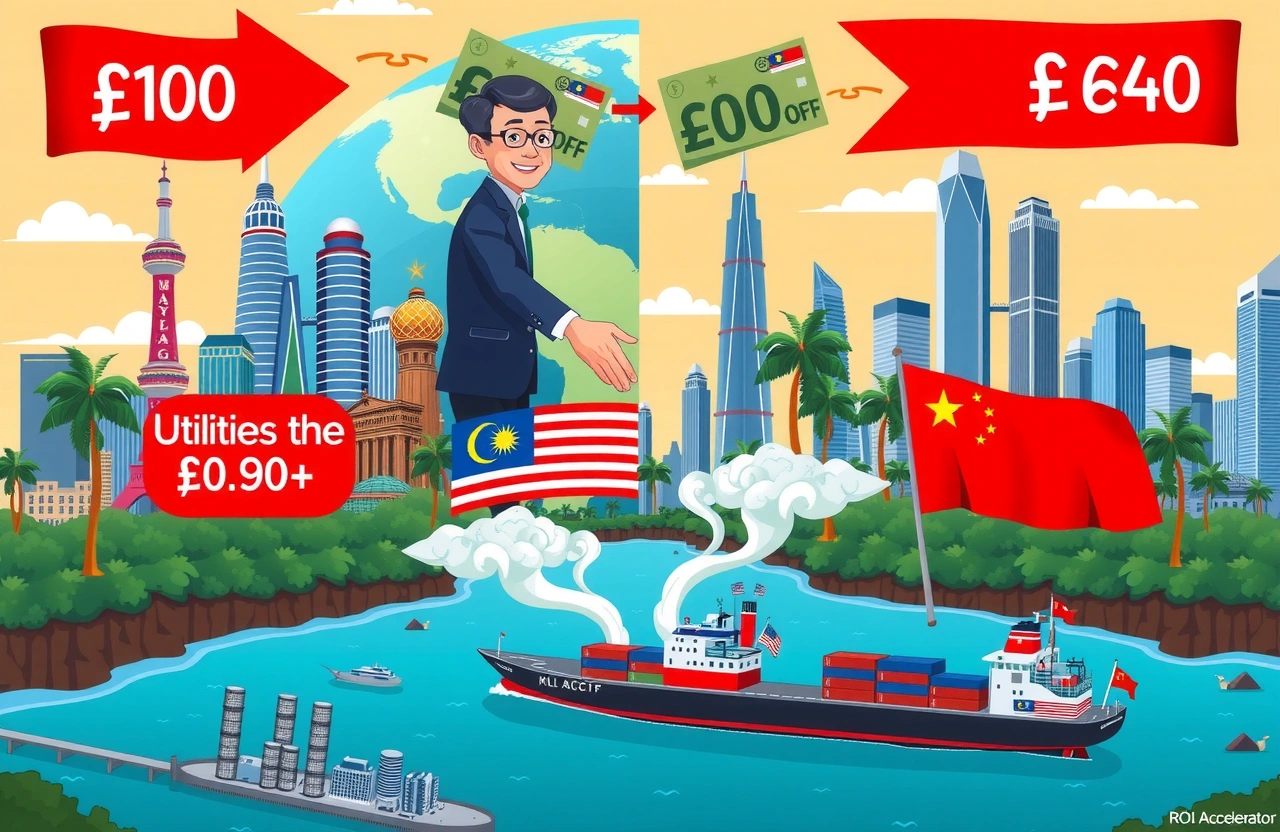
– Malaysian business leader Yap Shao Chuan (叶绍全) reveals Chinese enterprises achieve 40% operational cost savings in Malaysia
– Significant reductions come from affordable utilities, labor, and premium commercial real estate priced under RMB 50,000/sq.m
– Malaysia serves as strategic gateway for Chinese companies targeting ASEAN’s 650 million consumer market
– Lower tax burdens and specialized industrial zones accelerate ROI compared to Chinese operations
Malaysia’s Golden Opportunity for Chinese Enterprise Efficiency
With global supply chains shifting and US-China trade tensions escalating, foresighted Chinese enterprises discover their competitive advantage lies beyond domestic borders. During the landmark 2025 China Enterprise Global Expansion Summit in Shenzhen, prominent Malaysian business strategist Yap Shao Chuan (叶绍全) delivered compelling data: Enterprises relocating operations achieve immediate cost reduction of at least 40% when choosing Malaysia as their Southeast Asian base. This striking figure isn’t theoretical aspiration—it’s validated by current benchmarks where Kuala Lumpur’s premium commercial real estate costs just RMB 50,000 per square meter while industrial electricity rates hover near RMB 0.40/kwh.
The mathematics of international competitiveness now favors Malaysia’s proposition fundamentally. Beyond raw numbers, Malaysia’s cultural familiarity via its 23% ethnic Chinese population builds natural bridges for managerial transitions. Coupled with ASEAN’s projected GDP growth of 4.6% through 2025 and ratification of RCEP trade agreements, this creates perfect conditions for cost efficiency paired with market access. Our analysis details precisely where these savings originate and how Chinese enterprises systematically capture them.
Cost Reduction Breakdown: Where The 40% Savings Materialize
Human Capital Economics Rewriting Margins
Labor constitutes the most substantial difference, with skilled Malaysian manufacturing wages averaging 38-45% below equivalent Chinese industrial regions according to 2024 JETRO Asia-wide surveys. Crucially, Malaysia’s multilingual workforce uniquely combines Mandarin capabilities alongside fluent English—cutting training expenditures significantly compared to other ASEAN destinations requiring language training.
– Minimum monthly manufacturing wage: Malaysia RMB 1,540 vs China RMB 2,420
– Engineering staff salaries: 42% lower than Shenzhen equivalents
– Administrative support costs: Reduced by 35-39%
Operational Utilities Slashing Overhead
Unlike China’s complex tiered industrial utility pricing, Malaysian utility costs remain government-subsidized for export-oriented manufacturers. Water rates average RMB 5.60/cubic meter versus RMB 9.80 across China’s manufacturing hubs—creating vital savings for electronics, semiconductor, and FMCG enterprises where water consumption drives expenses.
Strategic Entrances: Malaysia’s Industrial Pathway Advantage
Free Trade Zone Optimization
The Malaysian government pioneered specialized enclaves positioning Chinese enterprises for optimal cost reduction scenarios:
– Penang Free Trade Zone: Electronics manufacturing focused with 10-year tax holidays
– Iskandar Development Region: Infrastructure integration with Singapore featuring energy subsidies
– East Coast Rail Link Corridor: Strategic logistics arteries completing 2026 for China-ASEAN supply chains
Legal Frameworks Expediting Setup
Joint venture establishment completes on average within 17 working days via One-Stop Centres coordinated by MIDA (Malaysian Investment Development Authority), contrasting sharply with China’s average 43-day registration processes. Companies acquire:
– Foreign ownership permission in targeted manufacturing sectors
– Import duty exemptions on machinery
– Reinvestment allowances up to 60% on expansion projects
The Real Estate Equation: Commercial Space at Value Pricing
Yap Shao Chuan’s (叶绍全) revelations about premium Kuala Lumpur properties costing approximately RMB 50,000 per square meter—compared to Shanghai’s RMB 120,000+—create unprecedented capital efficiency for Chinese enterprises establishing regional headquarters. This pricing disparity extends to industrial land parcels in Iskandar Malaysia, where plots sell for 60% below comparable Shenzhen locations while offering direct port access and cross-border logistics integration.