



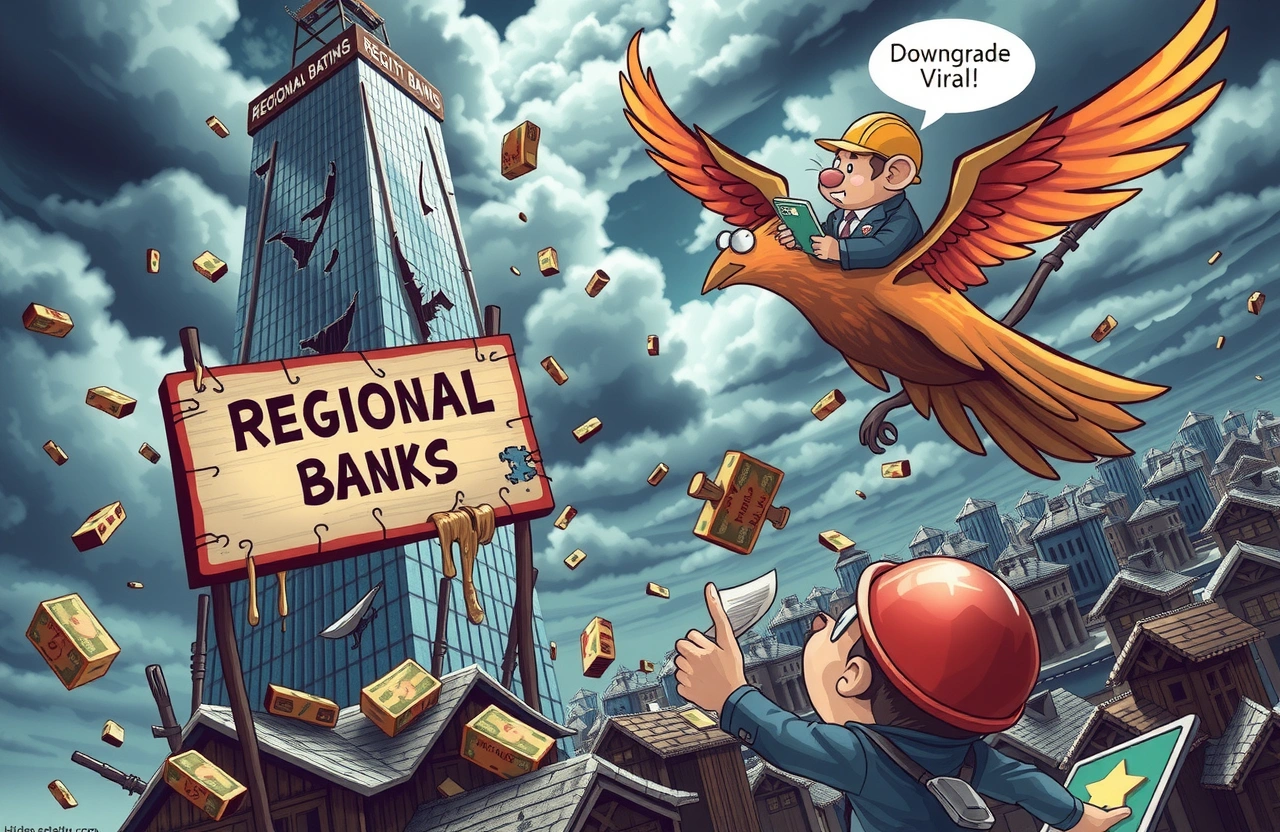
When China Cheng Xin International Credit Rating Co. (中诚信国际) announced its downgrade of Hunan Changde Rural Commercial Bank (湖南常德农商行) on July 17, 2025, it became the second Chinese lender to suffer a credit rating cut this year – illuminating persistent vulnerabilities in the country’s regional banking system. This latest downgrade follows months after Shanxi Yuci Rural Commercial Bank (山西榆次农商行) received similar treatment, highlighting patterns of stress that extend beyond isolated institutions. Despite reforms aimed at fortifying smaller lenders through provincial consolidation and state-backed capital injections, analysts note that factors like real estate exposure and profitability pressures continue complicating risk management across China’s fragmented financial landscape.
The Changde Rural Commercial Bank Downgrade Analysis
China Cheng Xin International lowered Changde Rural Commercial Bank’s credit rating from AA to A+, citing three critical vulnerabilities:
Asset Deterioration:
– Non-performing loans (NPL) surged to 4.8% by 2024
– Overdue loans climbed to 11.4% of total portfolio
– Special mention loans nearly double annually to 10.76%
Commercial real estate sectors proved most problematic, with manufacturing, construction, real estate, and wholesale accounting for 57% of distressed loans. Persistent industry conditions suggest continued asset quality pressure.
Profitability Collapse:
Net interest margin compression reduced earnings dramatically in 2024. With non-interest revenue unable to offset the decline,
the bank scraped by with a marginal ¥3 million net profit – signaling liquidity risks.
Capital Deficiency:
Core capital adequacy ratios plunged below regulatory thresholds:
– Core Tier 1 capital ratio: 6.75% (vs 7.5% requirement)
– Capital adequacy ratio: 8.08% (vs 10.5% requirement)
Complications arose from tertiary collateral – commercial properties accounting for 82% of difficult-to-liquidate recovery assets.
Broader Implications of Bank Credit Downgrades
Changde now joins Yuci Rural Commercial Bank as the second provincial lender subjected to such action in 2025. Together, these operations hold over ¥40 billion ($5.5 billion USD) in combined assets. As reported by S&P Global, China constitutes over 75% of Asia-Pacific banking downgrades since 2020.
Chronic Vulnerabilities: The Yuci Rural Commercial Bank Case
The Shanxi-based lender endured three successive credit rating downgrades:
– Initial downgrade (2020)
– Second cut (2023)
– Third reduction to BB- (May 2025)
Persistent triggers included:
– Double-digit annualized loan loss provision gaps
– Compound profitability declines since 2019
– Capital erosion noting Tier 1 ratios below 5%
The Shanxi government recently intervened through minority investment from Shanxi Rural Credit Union Bank – atypical support for banks not under imminent restructuring.
Small Bank Risk Mitigation Approaches
China has prioritized rural bank reforms via provincial schemes:
– Mergers consolidating county-level cooperatives
– Provincial banking unions carrying implicit state backing
– Injecting ¥382 billion ($52.6B) equity across 2022–2024
Counterbalancing Downgrades: The Upgrade Narrative
Simultaneously, four banks achieved rating enhancements:
| Bank | Rating Action Catalyst |
|---|---|
| Wuhan Rural Commercial Bank | State capital injection/loan portfolio cleanup |
| Hankou Bank (汉口银行) | ¥3.5B capital raise |
| Qinhuangdao Bank | Local government recapitalization |
| Jiangsu Changjiang Commercial Bank | Asset diversification beyond real estate |
These demonstrate viability of recovery trajectories when paired with strategic reorganization.
Provincial Consolidation Trends Reshaping China’s Landscape
Central directives prioritize “one-province-one-policy” reorganization:
– Zhejiang, Henan, Liaoning merging rural credit unions
– Sichuan creating provincial banking holding groups
– >60 merger transactions since 2020 (PBoC data)
Economists note mergers temporarily freeze valuation reassessments but warn consolidation alone doesn’t resolve structural imbalances.
The Regulatory Calculus
Under Banking Regulation Commission framework, ratings downgrades trigger:
– Higher loan loss reserve mandates
– Restrictions on interbank funding access
– Operational activity limitations
Why Bank Ratings Matter Beyond Balance Sheets
Credit decisions impact regional economies through:
– Corporate lending constraints
– Municipal financing ability
China’s interbank lending markets penalize downgraded participants through:
– Larger collateral requirements
– Shortened lending tenors
– Interest rate premiums
Complex restructuring dynamics now define China’s banking evolution cycle. Ultimately, regional bank credit rating downgrades expose fault lines requiring bespoke solutions reflecting local economic dependencies and governance capacities alike.