



Summary
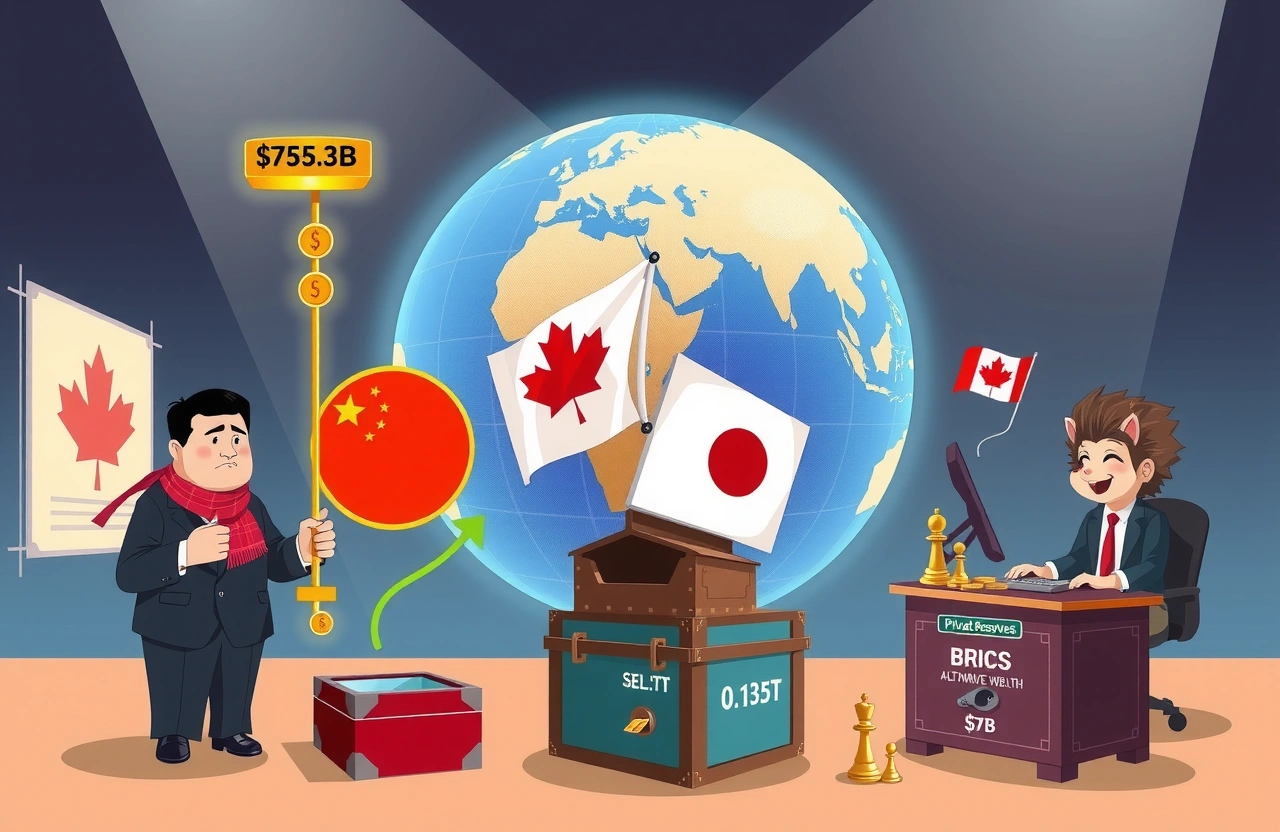
- China continued its U.S. Treasury sell-off streak for a third consecutive month, reducing holdings to $756.3 billion
- Canada’s monumental $61.7 billion acquisition propelled its treasury holdings to a record $430.1 billion
- Japan strengthened its position as America’s largest creditor with fifth monthly increase to $1.135 trillion
- Overall foreign demand for U.S. Treasuries recovered sharply despite market volatility
- Hedge fund hub Cayman Islands reduced exposure by $7 billion amid shifting investment strategies
Global Treasury Markets Defy Political Uncertainty
The U.S. Treasury International Capital (TIC) report for May reveals remarkable resilience in global demand for American debt securities. Despite prevailing concerns about Trump-era tariff policies reverberating through financial markets, foreign investors demonstrated renewed confidence in U.S. Treasuries. Total foreign holdings climbed $324 billion to $9.05 trillion—the second-highest level in history—nearly erasing April’s sharp decline. This resurgence occurs against the backdrop of April’s market turbulence when Trump’s tariff announcements triggered the worst Treasury sell-off since 2001.
“The fundamental demand story for Treasuries remains sturdy despite fiscal deficit concerns,” observed Priya Misra, Portfolio Manager at J.P. Morgan Investment Management. The shift in U.S. Treasury holdings showcases institutional investors’ continued preference for American debt markets given their unparalleled liquidity and institutional depth. Foreign participation remains robust specifically because no comparable alternatives exist in today’s global bond ecosystem.
Capital Flow Dynamics Strengthen
TIC supplemental data illuminates complex capital movements:
- Net foreign inflows surged to $311.1 billion in May
- Private foreign capital dominated with $333.2 billion net inflow
- Foreign central banks recorded net outflows amounting to $221 billion
- Foreign entities acquired $318.5 billion in long-term U.S. securities
Key Players Reshape Treasury Landscape
Japan Cements Dominant Position
Tokyo solidified its status as Washington’s largest creditor by adding $5 billion in May—the fifth consecutive monthly increase—bringing holdings to $1.135 trillion. This contrasts sharply with 2023 patterns when Japan actively sold Treasuries to fund yen interventions. Currency stabilization has reduced these pressures, enabling the Bank of Japan Governor Kazuo Ueda (植田和男) to maintain strategic dollar exposure.
China’s Calculated Retreat Continues
Beijing pared holdings by $9 billion to $756.3 billion, extending its divestment pattern that began in February. This shift in U.S. Treasury holdings marks China’s longest selling streak since 2022, maintaining its position as America’s third-largest creditor. China hasn’t held over $1 trillion in Treasuries since April 2022—a deliberate rebalancing toward gold reserves and multilateral lending institutions.
Canada’s Record Treasury Acquisition
Unprecedented $61.7 Billion Purchase
Ottawa stunned markets with $61.7 billion Treasury purchases—the largest single-month acquisition by any nation in TIC history—propelling its total to $430.1 billion, a 168% year-over-year surge. This aggressive repositioning by Bank of Canada Governor Tiff Macklem exceeded analysts’ projections and coincided with strategic sovereign fund diversification. Canada’s Treasury Department downplayed politics, citing favorable yield spreads and risk-adjusted returns.
Geopolitical Context of Treasury Shifts
Canada’s acquisition occurs amidst trade tensions, including U.S. dairy tariffs and border security disputes. Economists speculate it represents both a portfolio realignment and diplomatic reassurance token. “Massive position changes typically signal strategic reserves redeployment rather than tactical market timing,” noted former IMF chief economist Kenneth Rogoff.
Secondary Markets Signal Possible Divergence
Institutional Hotspot Pullback
Cayman Islands—a hedge fund nexus—reduced exposure by $7 billion to $441.3 billion, suggesting sophisticated investors are diversifying into corporate debt and private credit markets. This shift aligns with rising institutional allocations to alternatives now exceeding 26% of portfolios according to Preqin data.
British Strategy Contrast
UK holdings grew modestly (+$1.7 billion to $809 billion), reinforcing London’s position as America’s second-largest creditor. The Bank of England’s Andrew Bailey maintains Treasury purchases as an essential dollar liquidity management tool despite sterling volatility.
Economic Implications and Market Signals
Dollar Dominance Endures
Treasury yields dipped three basis points following the report’s release, confirming persistent dollar demand. The shift in U.S. Treasury holdings validates dollar debt instrument primacy despite BRICS nations’ alternative payment system development. Treasury markets absorbed over $1.5 trillion in new issuance this year without significant yield spike—testament to structural demand.
Future Monitoring Priorities
Key indicators warrant observation:
- June’s TIC data (releasing August 15, 2025)
- Japanese yen stability’s impact on Tokyo’s Treasury strategy
- China State Administration of Foreign Exchange reserve disclosures
- Canadian central bank policy statement phrasing
Strategic Portfolio Considerations
The shift in U.S. Treasury holdings underscores several investment truths: sovereign debt markets remain indispensable portfolio anchors despite geopolitical friction, currency dynamics increasingly dictate reserve management, and major economies pursue divergent allocation philosophies. As debt issuance proliferates globally, discerning institutional flows provides critical directional signals. Track Treasury auctions, particularly benchmark 10-year note demand, ahead of November elections for volatility insights.
For fixed-income investors, consider supplementing Treasury exposure with short-duration municipals offering tax efficiencies—an approach favored by rising sovereign entities. Currency-hedged international bonds merit allocation as portfolio diversifiers amid shifting geopolitics. Regularly reassess duration risk given inverted yield curve dynamics and monitor Treasury holder concentration trends for systemic vulnerability warnings. Treasury flows remain foremost global capital market weathervanes.