



Executive Summary
- Chinese banks are intensifying credit card promotion strategies, offering high-value bicycles as incentives to attract new customers, reflecting deep-seated pressures in the industry.
- Promotions often require opening multiple cards—up to 10 per person—raising concerns about over-issuance, “sleeping cards,” and regulatory non-compliance.
- Credit card numbers in China have declined for 11 consecutive quarters, with transaction volumes dropping over 11% year-on-year, pushing banks toward unconventional marketing tactics.
- Expert insights highlight the need for差异化发展 (differentiated development) and digital transformation to sustain growth beyond short-term promotions.
- Consumers report mixed experiences, with issues like捆绑营销 (tied marketing) and inferior product quality undermining perceived benefits.
The New Frontier in Bank Customer Acquisition
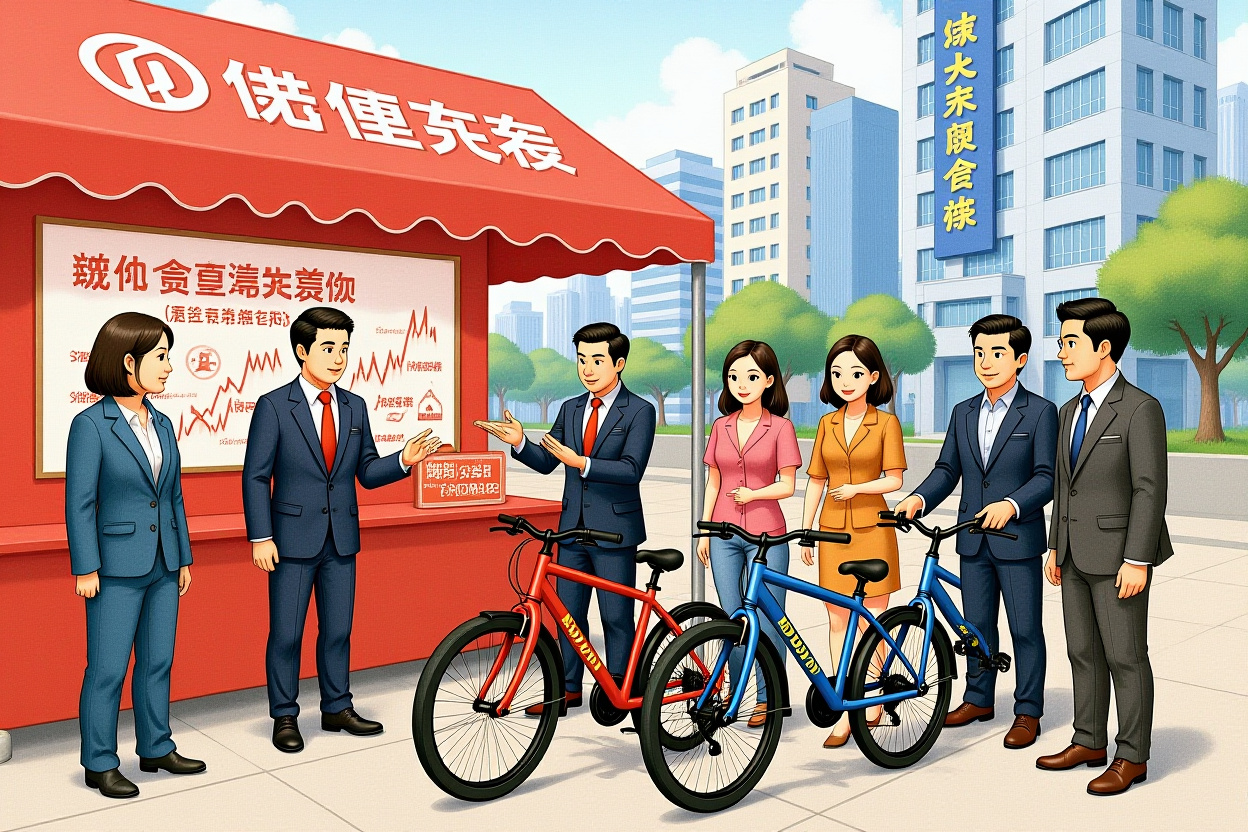
On a bustling September afternoon in Beijing’s Chaoyang District, a scene unfolds that encapsulates the fierce competition in China’s financial sector. Under a large shade tent, rows of shiny bicycles—from折叠自行车 (folding bikes) to山地车 (mountain bikes)—draw crowds, but this isn’t a typical retail event. Instead, bank employees are promoting credit cards, offering these bicycles as rewards for new applications. This visible push is part of broader credit card promotion strategies adopted by banks grappling with saturation and declining usage.
The activity highlights how financial institutions are leveraging tangible incentives to combat waning interest in credit products. With credit card promotion strategies becoming more aggressive, banks are collaborating in unusual ways, such as joint “group buying” campaigns across multiple lenders. These tactics aim to reverse a three-year trend that has seen over 92 million cards disappear from circulation, according to the中国人民银行 (People’s Bank of China).
On-the-Ground Observations from Beijing
At the promotion site, staff from banks like交通银行 (Bank of Communications) and中信银行 (China CITIC Bank) explain the tiers: two new cards for a basic bicycle, three for a mid-range model, and up to ten for premium brands like捷安特 (Giant). “The highest-value bikes require ten credit card applications,” one representative noted, emphasizing that groups can pool applications to meet thresholds. This approach, while effective in driving foot traffic, sparks debates about sustainability and consumer protection.
Consumers like Gu Li (a pseudonym) express skepticism. “It feels impulsive—the bikes are displayed prominently, making it easy to overlook the long-term implications,” he says. Such credit card promotion strategies rely on immediate gratification, but hidden costs, such as mandatory activations or tied services, often emerge post-application. For instance, some banks require customers to enable specific features or make initial purchases at partnered merchants, adding layers of complexity.
Mechanics and Risks of Multi-Card Promotions
The operational details of these campaigns reveal both innovation and vulnerability. Promotions typically allow “拼单” (group buying), where individuals combine applications to qualify for rewards. While this fosters social engagement, it masks the risks of个人过度授信 (excessive personal credit). Bank staff often assure customers that “as long as you don’t default, there’s no impact,” but financial advisors caution that multiple inquiries can affect credit scores and future loan eligibility.
Moreover, the credit card promotion strategies involve significant resource allocation. Banks collectively purchase thousands of bicycles, with estimates suggesting up to 10,000 units were allocated for a single month-long campaign in Beijing. However, critics like Dong Ximiao (董希淼), Chief Researcher at Zhaolian and Deputy Director of the Shanghai Finance and Development Laboratory, warn that such efforts may lead to资源浪费 (resource waste). “Over-issuance contradicts regulatory guidance and increases the number of unused ‘sleeping cards,'” he states.
Consumer Experiences and Feedback
Online forums buzz with mixed reviews. Some participants celebrate scoring free bikes, while others calculate the opportunity cost. “New cardholders typically receive 100–200 yuan in welcome gifts elsewhere,” one user posts. “So, for two cards, you’re effectively paying 200–400 yuan for a non-branded bicycle.” Complaints about quality are common, with reports of bikes valued at 300 yuan on e-commerce platforms being offered as 2,000-yuan incentives.
These credit card promotion strategies also face scrutiny for捆绑营销 (tied marketing). After applying, customers might encounter demands to activate services like investment accounts or insurance products. Such practices, while boosting cross-selling, erode trust. As Dong Ximiao advises, banks should focus on integrating权益 (benefits) meaningfully, such as through lifestyle perks, rather than one-off gifts.
Broader Pressures on China’s Credit Card Industry
The aggressive marketing stems from systemic challenges. Data from the中国人民银行 (People’s Bank of China) shows信用卡和借贷合一卡 (credit and debit combination cards) fell to 715 million in Q2 2025, down 6 million quarterly. This 11-quarter decline reflects regulatory tightening, competition from fintech platforms, and changing consumer habits. For example, internet-based消费金融 (consumer finance) services from firms like蚂蚁集团 (Ant Group) offer alternatives to traditional cards.
Bank earnings reports underscore the strain. Among major lenders,信用卡贷款余额 (credit card loan balances) dropped 2.56% in H1 2025, while transaction volumes plunged 11.05%. This erosion of fee income—a profit cornerstone—forces banks to rethink credit card promotion strategies. Institutions like招商银行 (China Merchants Bank) and平安银行 (Ping An Bank) are experimenting with digital solutions, but physical promotions persist as a stopgap.
Regulatory Environment and Compliance
Recent regulations emphasize账户优化 (account optimization). The国家金融监督管理总局 (National Financial Regulatory Administration) has urged banks to reduce睡眠卡 (sleeping cards) and avoid predatory lending. However, the bicycle campaigns test these boundaries. By encouraging multi-card applications, banks risk non-compliance with rules aimed at curbing over-indebtedness. Dong Ximiao notes that sustainable credit card promotion strategies must align with policies like the取消信用卡透支利率上下限管理 (removal of credit card overdraft rate caps), which allows flexible pricing but demands prudent risk management.
Expert Recommendations for Future Strategies
Industry leaders advocate for a shift in credit card promotion strategies. Dong Ximiao suggests banks动态调整战略 (dynamically adjust strategies) by focusing on差异化发展 (differentiated development). This could include cards tailored to乡村振兴 (rural revitalization) or新市民 (new urban residents), leveraging data analytics to target niche markets. Additionally,线上信用卡业务 (online credit card services) represent a “second curve” for growth, reducing reliance on physical promotions.
Another key area is权益整合 (benefits integration). Instead of one-time gifts, banks could partner with retailers for ongoing discounts, enhancing customer lifetime value. For instance, a coalition of中小银行 (small and medium-sized banks) might pool resources to offer superior rewards, making their credit card promotion strategies more competitive against giants like工商银行 (ICBC).
The Role of Technology and Innovation
Digital transformation is pivotal. By adopting金融科技 (fintech), banks can streamline applications and personalize offers. AI-driven tools can identify high-value customers, ensuring that credit card promotion strategies target those likely to engage long-term. As Dong Ximiao emphasizes, “深化金融科技应用 (deepening fintech application) is essential to providing better internet-based consumer credit services.”
Navigating the Path Forward for Stakeholders
The bicycle campaigns underscore a critical juncture for China’s credit card industry. While they temporarily boost metrics, long-term success hinges on balancing customer acquisition with value creation. Investors should monitor banks that pivot toward digital and differentiated offerings, as these are likely to outperform peers reliant on short-term tactics.
For consumers, vigilance is key. Before participating in such promotions, assess the true cost—including potential impacts on credit health. Banks, meanwhile, must align their credit card promotion strategies with regulatory expectations and sustainable growth. As the market evolves, those who innovate responsibly will lead the next phase of development.