



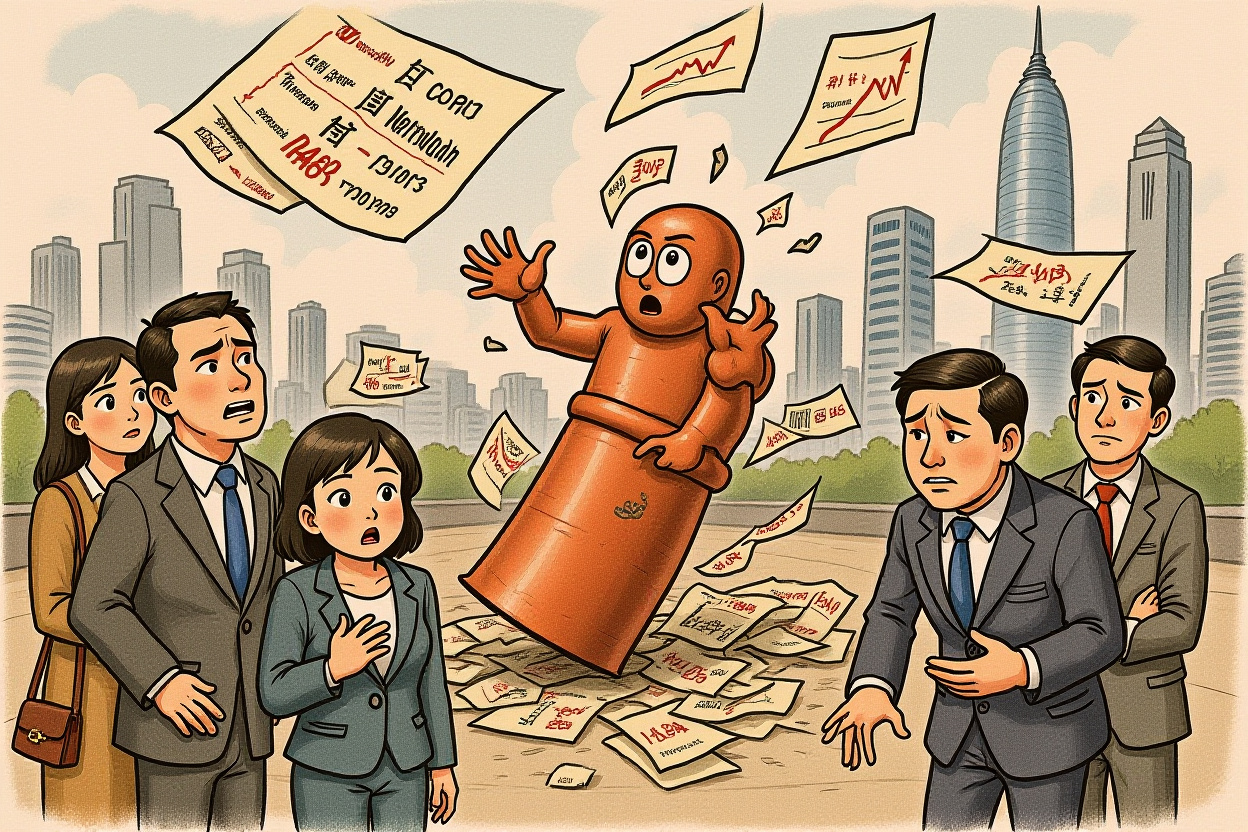
Executive Summary
Key insights into the Zhenwei Group debt crisis and its implications for global investors:
– Zhenwei Group, led by Wang Wen Yin (王文银), faces over 99 billion yuan in unresolved debts despite alleged 10 trillion yuan in copper resources, highlighting severe corporate governance failures.
– The company’s revenue was artificially inflated through circular trade transactions and partnerships with local governments, masking fundamental operational weaknesses.
– Legal actions, including asset freezes and lawsuits from municipalities like Fuan City, signal escalating regulatory scrutiny and potential systemic risks in China’s commodity sector.
– Investors must enhance due diligence on Chinese equities, focusing on verifiable asset claims and transparent financial reporting to mitigate exposure to similar crises.
– The Zhenwei Group debt crisis underscores broader vulnerabilities in China’s industrial and real estate sectors, necessitating cautious portfolio adjustments.
Copper Boom Shadows Deepening Crisis at Zhenwei Group
Global copper prices have surged past 86,000 yuan per ton in 2025, driven by soaring demand from artificial intelligence and electric vehicle industries. This rally propelled major miners like Jiangxi Copper (江西铜业) and Zijin Mining Group (紫金矿业) to record profits, with China Molybdenum (洛阳钼业) witnessing a 72.61% earnings spike. Yet, amidst this sector-wide euphoria, Zhenwei Group (正威集团), once hailed as the World Copper King, confronts a starkly different reality. The Zhenwei Group debt crisis has escalated into a full-blown solvency emergency, with the firm unable to settle obligations as minimal as 5,000 yuan despite boasting resource valuations exceeding 10 trillion yuan. This paradox not only exposes operational hollowity but also raises alarms for international investors navigating China’s equity markets. Understanding the Zhenwei Group debt crisis is crucial for assessing corporate credibility and regulatory enforcement in evolving economic landscapes.
The Rise and Spectacular Unraveling of Zhenwei Group
Zhenwei Group, under founder Wang Wen Yin (王文银), ascended to prominence by claiming control over 30 million tons of copper reserves—approximately 30% of China’s total and 4.3% of global deposits. At its peak, the conglomerate reported 700 billion yuan in annual revenue, outpacing giants like Tencent (腾讯) and Huawei (华为), and secured a position on the Fortune Global 500 list. Wang Wen Yin (王文银) cultivated an image of invincibility, frequently referencing assets including 10 square kilometers of commercial zones and 100,000 square kilometers of exploration rights. However, investigative efforts by analysts and journalists failed to locate these purported mines, drawing comparisons to infamous corporate scandals. The Zhenwei Group debt crisis erupted when legal records revealed 90 enforcement cases and 99.8 billion yuan in unsettled debts, with equity freezes imposed on Wang Wen Yin (王文银).
Verifying the Copper Reserves: Myth Versus Reality
Independent audits and field surveys could not corroborate Zhenwei’s assertions of 30 million tons in copper holdings. When pressed, a board secretary from a Zhenwei-affiliated listed company issued a 3,000-word rebuttal accusing critics of overstepping, yet omitted concrete evidence of mineral assets. This evasion, coupled with the Zhenwei Group debt crisis, eroded investor confidence. Market participants now question whether the reserves ever existed or served as collateral for financing activities. The absence of transparent disclosure mechanisms in China’s private sector exacerbates such uncertainties, urging stakeholders to demand verified audits.
Financial Downfall: From Fortune 500 to Enforcement Lists
Tianyancha (天眼查) data illustrates Zhenwei’s precipitous decline: terminated cases involve sums from 5,000 yuan to billions, reflecting liquidity collapse. Once a symbol of industrial might, Zhenwei now grapples with restricted consumption orders and asset seizures. The Zhenwei Group debt crisis exemplifies how overreliance on unverifiable assets can trigger chain reactions, affecting suppliers, creditors, and equity partners. For instance, defaulted payments to logistics firms have sparked legal disputes, compounding the group’s reputational damage.
Mechanisms of Financial Engineering and Revenue Inflation
Zhenwei Group employed sophisticated strategies to amplify its financial stature, primarily through intra-group trade loops and third-party collaborations. These tactics, while boosting short-term metrics, concealed underlying vulnerabilities and fueled the Zhenwei Group debt crisis. In one prevalent model, Zhenwei orchestrated transactions between subsidiaries, inflating revenue without genuine economic activity. Accounts receivable from these deals were then packaged into financing instruments, attracting additional capital from banks and investors. This approach mirrored schemes uncovered at Shanghai Junhe (上海均和), which collapsed after similar practices, underscoring systemic risks in China’s shadow banking ecosystem.
Circular Trade Networks and Their Consequences
– Internal Transactions: Goods circulated among Zhenwei entities, artificially elevating sales figures and enabling debt issuance against fabricated receivables.
– Third-Party Involvement: Local government financing vehicles (LGFVs) and listed firms like Yijian股份 facilitated deals to meet their own objectives, such as bond issuance or market capitalization targets. Yijian’s subsequent delisting for fraud revealed Zhenwei’s role in 2.416 billion yuan of questionable trades.
– Warehouse Receipt Manipulation: Utilizing warehouse receipts, Zhenwei conducted paper-based transactions without physical movement of commodities, a practice that regulators now scrutinize for fraud potential.
The Zhenwei Group debt crisis intensified as these structures unraveled, leaving供应链 companies stranded with unpaid invoices and diminishing recovery prospects.
Local Government Partnerships: Boon or Burden?
Zhenwei leveraged its World Copper King reputation to secure preferential policies, land grants, and tax incentives from municipal authorities eager to attract industrial investments. Projects in cities like Lanzhou promised job creation and economic growth, but often devolved into real estate speculation. Zhenwei’s property arm acquired residential plots at discounted rates, later reselling them to developers such as China Evergrande Group (中国恒大集团) and Poly Development (保利发展). While profitable for Zhenwei, these ventures yielded limited industrial output, disappointing local stakeholders. The Zhenwei Group debt crisis has prompted municipalities like Fuan City to reclaim land and initiate lawsuits, seeking compensation for unfulfilled commitments.
Operational Theater: Staging Productivity Amidst Decline
As financial pressures mounted, Zhenwei resorted to theatrical measures to maintain appearances. Site visits by officials were met with hastily arranged copper shipments and staged production scenes, involving even administrative staff in mock manufacturing roles. Facilities purportedly dedicated to copper processing, lithium-ion batteries, and semiconductors operated sporadically, if at all. The Zhenwei Group debt crisis deepened as these facades crumbled, evidenced by abandoned projects like the 6-billion-yuan copper plant in Fuan. Local audits confirmed idle capacities and misused subsidies, catalyzing legal reclaims of public resources.
Case Study: Fuan City’s Legal Reckoning
Fuan Municipal Government sued Zhenwei Group in 2025, alleging breach of investment agreements and misuse of allocated land. Court documents cite failure to operationalize promised facilities, resulting in economic losses and wasted fiscal incentives. This case may set a precedent for other regions grappling with unfulfilled Zhenwei commitments, potentially accelerating the Zhenwei Group debt crisis resolution. Outcomes could include asset liquidations or restructuring, offering partial recourse to affected parties.
Broader Implications for Chinese Industrial Policy
The Zhenwei saga highlights pitfalls in China’s pursuit of industrial upgrading through private partnerships. Overemphasis on scale and speed sometimes overlooks due diligence, enabling entities like Zhenwei to exploit policy loopholes. The Zhenwei Group debt crisis urges policymakers to strengthen monitoring mechanisms, ensuring that state support translates into tangible outputs rather than speculative gains.
Market Reactions and Investor Guidance
Chinese equity markets have reacted cautiously to the Zhenwei Group debt crisis, with volatilities observed in commodity and industrial sectors. Shares of Zhenwei-linked companies faced sell-offs, while broader indices reflected concerns over corporate governance standards. International fund managers reassess exposures to Chinese firms with complex ownership structures or unverified asset claims. The Zhenwei Group debt crisis serves as a reminder that headline-grabbing resource estimates require verification through independent audits and site visits.
Risk Mitigation Strategies for Institutional Players
– Enhanced Due Diligence: Scrutinize supply chain integrations and cross-entity transactions to detect circular trade patterns.
– Regulatory Monitoring: Track announcements from bodies like the China Securities Regulatory Commission (CSRC) for enforcement actions or policy shifts.
– Diversification: Reduce concentration in sectors prone to opacity, such as commodities and real estate, by allocating to transparent, export-oriented industries.
Quotes from analysts emphasize prudence: A Shanghai-based strategist noted, The Zhenwei Group debt crisis isn’t isolated—it reflects maturity mismatches and collateral inflation pervasive in China’s corporate landscape.
Comparative Analysis: Lessons from Global Precedents
The Zhenwei Group debt crisis echoes historical debacles like Enron and Wirecard, where inflated assets and fabricated revenues led to collapses. Key takeaways include the importance of whistleblower protections, real-time auditing, and international accounting standards alignment. For China, integrating global best practices could preempt similar crises, bolstering investor trust.
Navigating the Aftermath: Legal and Economic Trajectories
The Zhenwei Group debt crisis is poised to intensify through 2026, with multiplying lawsuits and asset recoveries. Creditors, including state-owned banks and private funds, may pursue debt-for-equity swaps or bankruptcies to salvage value. Wang Wen Yin (王文银) confronts potential personal liability, while subsidiaries face operational halts. Economically, the crisis could dampen regional investments and tighten credit for analogous firms, though it may spur regulatory reforms promoting transparency.
Forward-Looking Scenarios and Preparedness
– Optimistic Outcome: Coordinated restructuring preserves viable operations, with authorities mediating settlements to minimize systemic spillovers.
– Pessimistic Outlook: Protracted litigations trigger fire sales, depressing commodity markets and amplifying losses for international holders of Chinese corporate debt.
Investors should monitor CSRC guidelines and global copper price trends, adjusting portfolios to hedge against counterparty risks. The Zhenwei Group debt crisis underscores that in emerging markets, robust risk frameworks are non-negotiable.
Strategic Recommendations for Corporate Executives
– Strengthen internal controls and adopt IFRS reporting to enhance credibility.
– Engage independent auditors for resource verification, particularly in natural resource sectors.
– Foster stakeholder communication to preempt crises, learning from the Zhenwei Group debt crisis communications failures.
Key Takeaways and Proactive Measures
The Zhenwei Group debt crisis unveils critical lessons for global market participants. First, unsubstantiated asset claims can unravel rapidly, necessitating rigorous verification. Second, China’s regulatory environment is evolving, with increased enforcement against fraudulent practices. Finally, the crisis highlights interdependencies between local governments, corporations, and financial systems, requiring holistic risk assessments. Investors and executives must prioritize transparency, advocate for stronger governance, and diversify geographically to navigate similar disruptions. As the Zhenwei saga unfolds, proactive engagement with regulatory developments and peer collaborations will be pivotal in safeguarding investments and fostering sustainable growth in Chinese equities.