



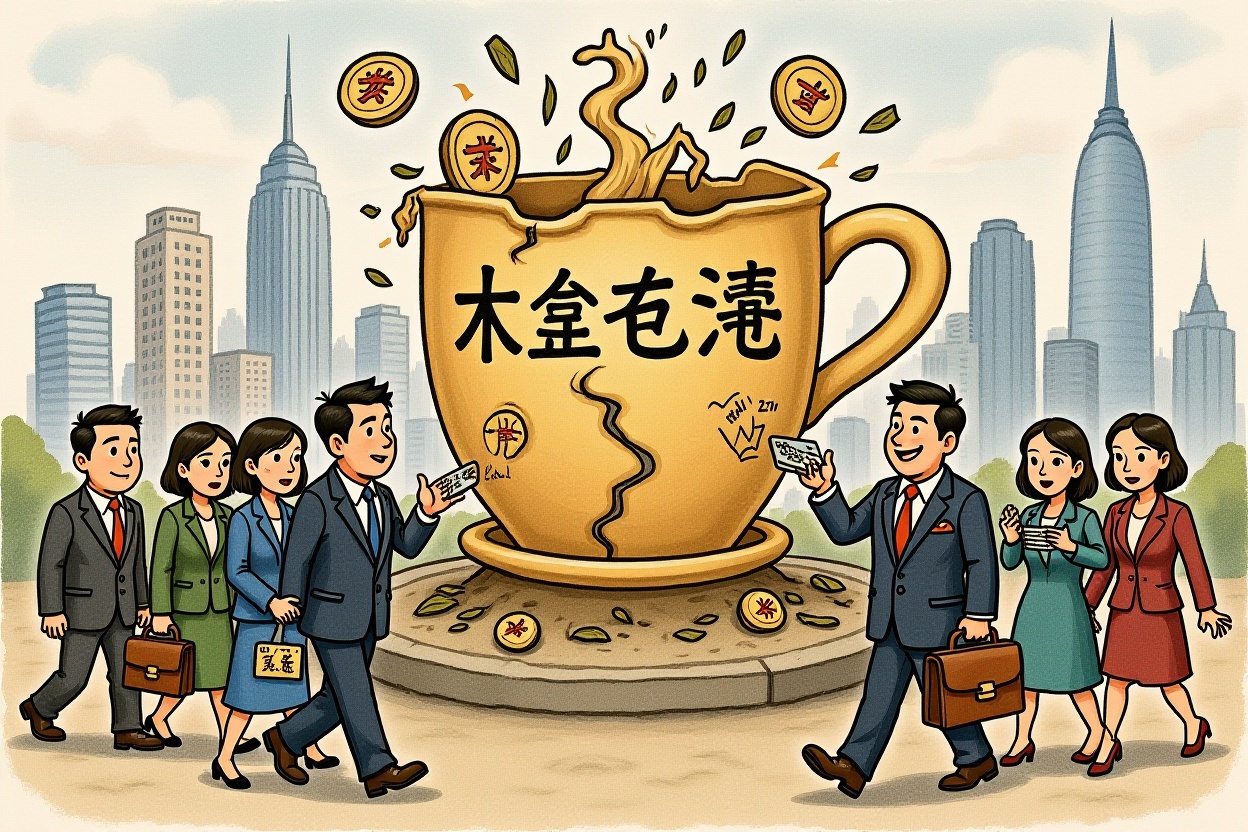
– Xiangpiaopiao (香飘飘), China’s first listed milk tea company, is struggling with significant management instability after a 2.8 billion yuan deal to retain executive Yang Dongyun (杨冬云) collapsed within a year. – Core instant brewing业务 (instant brewing business) revenues are plummeting due to intense competition from ready-to-drink and freshly made tea beverages, with 2025前三季度 (first three quarters) sales下滑 (declining) by over 13%. – New ventures into ready-to-drink products and overseas markets show limited growth, while diversification into health foods and offline stores raises questions about strategic focus. – The company’s high family ownership, at over 81%, hampers governance reforms, making Xiangpiaopiao’s turnaround strategy increasingly uncertain for investors. – Market participants should closely monitor product innovation and management changes for signs of a viable recovery path amid mounting financial pressures.
The Management Gamble That Backfired: A 2.8 Billion Yuan Lesson
Once a household name in China with its iconic ‘cups around the Earth’ slogan, Xiangpiaopiao (香飘飘) now faces an uphill battle to reinvent itself in a rapidly evolving beverage market. The recent failure of a high-stakes 2.8 billion yuan executive retention deal underscores the depth of its challenges, raising serious questions about the viability of Xiangpiaopiao’s turnaround strategy. As traditional instant milk tea sales decline and new competitors dominate, the company’s efforts to pivot have been hampered by internal turmoil and strategic missteps. For institutional investors and market watchers, understanding these dynamics is crucial to assessing the future of this once-dominant player in China’s equity markets.
The Rise and Fall of Yang Dongyun (杨冬云)
In late 2023, Xiangpiaopiao founder and chairman Jiang Jianqi (蒋建琪) made a bold move to revitalize the company by bringing in industry veteran Yang Dongyun (杨冬云). With a background at companies like Baixiang Food (白象食品) where he led a successful product launch, Yang was seen as a key asset for driving growth. To secure his commitment, Jiang structured a leveraged stock transfer: Yang acquired a 5% stake worth 2.76 billion yuan for only 25 million yuan upfront, with the remainder payable over three years. This deal, essentially an 11x leverage play, was contingent on Yang boosting Xiangpiaopiao’s performance and stock price. However, by 2024, the company’s financials showed little improvement, with revenue stagnation and net losses. By late 2024, Yang had pledged his shares back to Jiang and exited, resulting in a net loss of approximately 1.64 million yuan on the transaction—a stark reminder of the risks in talent-driven turnarounds.
Family Control and Governance Challenges
The abrupt departure of Yang Dongyun (杨冬云) highlights broader governance issues at Xiangpiaopiao. The Jiang family maintains over 81% ownership, creating a concentration of power that can stifle external management initiatives. Recent years have seen frequent executive changes, including the resignation of director Jiang Jianbin (蒋建斌) in 2024 and CFO Li Chaonan (李超楠) shortly after. While Jiang’s daughter Jiang Xiaoying (蒋晓莹) has been involved in youth-oriented strategies, she has yet to assume a leadership role capable of driving systemic change. This environment makes it difficult for non-family executives to implement reforms, complicating Xiangpiaopiao’s turnaround efforts and eroding investor confidence in its ability to adapt to market shifts.
The Eroding Core: Instant Milk Tea’s Decline in a New Era
Xiangpiaopiao’s turnaround strategy is fundamentally challenged by the rapid decline of its core instant brewing业务 (instant brewing business). Once a market leader, the company now struggles to compete against the convenience and innovation of ready-to-drink and freshly made tea beverages. Consumer preferences have shifted towards products that offer fresher flavors, faster consumption, and social体验 (experiences), leaving traditional冲泡奶茶 (instant milk tea) increasingly irrelevant. Industry analysts note that外卖大战 (food delivery wars) have further pressured Xiangpiaopiao, with subsidies driving down prices for现制奶茶 (freshly made tea) and eliminating any cost advantage it once held.
Financial Metrics Tell a Sobering Story
The data paints a clear picture of distress. From 2022 to 2024, Xiangpiaopiao’s instant brewing revenue fell from 24.55 billion yuan to 22.71 billion yuan. In the first half of 2025, this segment plummeted by 31.04% to 4.23 billion yuan, directly contributing to overall revenue下滑 (decline) of 13.12% for the first three quarters. Net losses widened to 89 million yuan, a 603.07% drop year-over-year. This erosion has forced the company to rely more on its ready-to-drink业务 (ready-to-drink business), which grew 8.03% in early 2025 but at a slowing pace. However, this growth is insufficient to offset core business losses, highlighting the urgency for a more effective Xiangpiaopiao turnaround plan.
Diversification Efforts: Scattered Shots in the Dark
In pursuit of growth, Xiangpiaopiao has embarked on various new ventures, but many appear disjointed and lack clear strategic alignment. These efforts range from expanding ready-to-drink lines to entering completely unrelated markets, raising doubts about their potential to fuel a sustainable turnaround. While diversification is common in competitive industries, success requires focused execution—something Xiangpiaopiao has struggled to achieve amidst management turmoil.
Ready-to-Drink Expansion and Marketing Costs
The company’s ready-to-drink portfolio, including Meco如鲜果茶 (Meco fresh fruit tea) and兰芳园冻柠茶 (Lan Fong Yuen frozen lemon tea), has seen modest gains, with revenue reaching 5.91 billion yuan in early 2025. However, to promote these products, Xiangpiaopiao has ramped up marketing spend, signing代言人 (endorsers) like时代少年团 (Teens in Times) and侯佩岑 (Hou Peicen). This pushed销售费用率 (sales expense ratio) to 32% in mid-2025, up 3.5 percentage points from the previous year. Such high costs strain profitability, especially when growth is slowing, and may not yield lasting brand loyalty in a crowded market.
Questionable Forays: Offline Stores and Health Products
Xiangpiaopiao’s recent initiatives have ventured into risky territory. The company opened快闪店 (pop-up stores) in成都 (Chengdu) and杭州 (Hangzhou) to test线下实体店 (offline physical stores), but critics view this as a belated attempt to catch the现制茶饮 (fresh tea) trend. More notably, it has expanded into保健品 (health products), launching a ‘古方五红’暖乳茶 (‘ancient recipe five-red’ warm milk tea) targeting menstrual comfort. While innovative, this move distances the company from its core奶茶 (milk tea) expertise and into a highly regulated, competitive sector. Additionally, overseas expansion into东南亚 (Southeast Asia) via a 2.68 billion yuan investment in泰国 (Thailand) offers long-term potential but contributed only 0.59% to revenue in 2024. These scattered efforts suggest a lack of coherent direction, undermining Xiangpiaopiao’s turnaround prospects.
Financial and Market Implications for Investors
The combination of management instability, core business decline, and uncertain diversification has significant ramifications for Xiangpiaopiao’s stock performance and investor sentiment. As a publicly traded company on the上海证券交易所 (Shanghai Stock Exchange), its struggles reflect broader trends in China’s consumer staples sector, where traditional brands must innovate or risk obsolescence. Market data shows that Xiangpiaopiao’s share price has been volatile, with the failed executive deal adding to negative perceptions. Institutional investors are increasingly scrutinizing governance practices and strategic clarity, as these factors are critical for any successful turnaround in Chinese equities.
Earnings Analysis and Forward-Looking Indicators
Recent financial reports reveal that Xiangpiaopiao’s losses are deepening, with net profit margins turning negative. The company’s cash flow has also been pressured by high销售费用 (sales expenses) and investments in new ventures. Key indicators to watch include same-store sales for ready-to-drink products, market share in instant brewing, and progress in overseas markets. According to industry experts, without a sharp focus on product innovation and cost management, Xiangpiaopiao’s turnaround may remain elusive. For example, the即饮业务 (ready-to-drink business) must accelerate growth to above 15% annually to meaningfully contribute, while instant brewing needs stabilization through packaging updates or niche marketing.
Charting a Path Forward for Xiangpiaopiao
For Xiangpiaopiao to regain its footing, a clear and executable strategy is essential. This involves not only addressing immediate financial woes but also rebuilding trust with investors and consumers. The company must learn from its missteps with Yang Dongyun (杨冬云) and other executives to foster a more inclusive management culture. Moreover, refining its product portfolio to leverage existing strengths while cautiously exploring new opportunities could pave the way for a more sustainable Xiangpiaopiao turnaround.
Strategic Imperatives for Recovery
First, Xiangpiaopiao should double down on its ready-to-drink offerings, investing in R&D for flavors that resonate with younger consumers and optimizing distribution through mainstream channels like量贩零食 (bulk snack stores). Second, it needs to streamline its diversification efforts, perhaps phasing out low-potential initiatives like offline stores in favor of core product enhancements. Third, governance reforms are critical: reducing family influence through board diversification or独立董事 (independent director) appointments could improve decision-making. Finally, leveraging its brand heritage in marketing, rather than costly celebrity endorsements, might rebuild emotional connections with consumers.
Investment Takeaways and Market Monitoring
Investors and corporate executives should view Xiangpiaopiao’s case as a cautionary tale in China’s fast-moving consumer goods sector. Key actions include monitoring quarterly earnings for signs of stabilization in instant brewing, assessing management appointments for external expertise, and tracking new product launches for market reception. While the company’s challenges are steep, a disciplined focus on innovation and governance could eventually support a recovery. For now, however, the weight of evidence suggests that Xiangpiaopiao’s turnaround will require more than financial incentives—it demands a fundamental reinvention of its business model and culture. Stay engaged with regulatory filings and industry reports to spot early indicators of change in this pivotal Chinese equity story.