



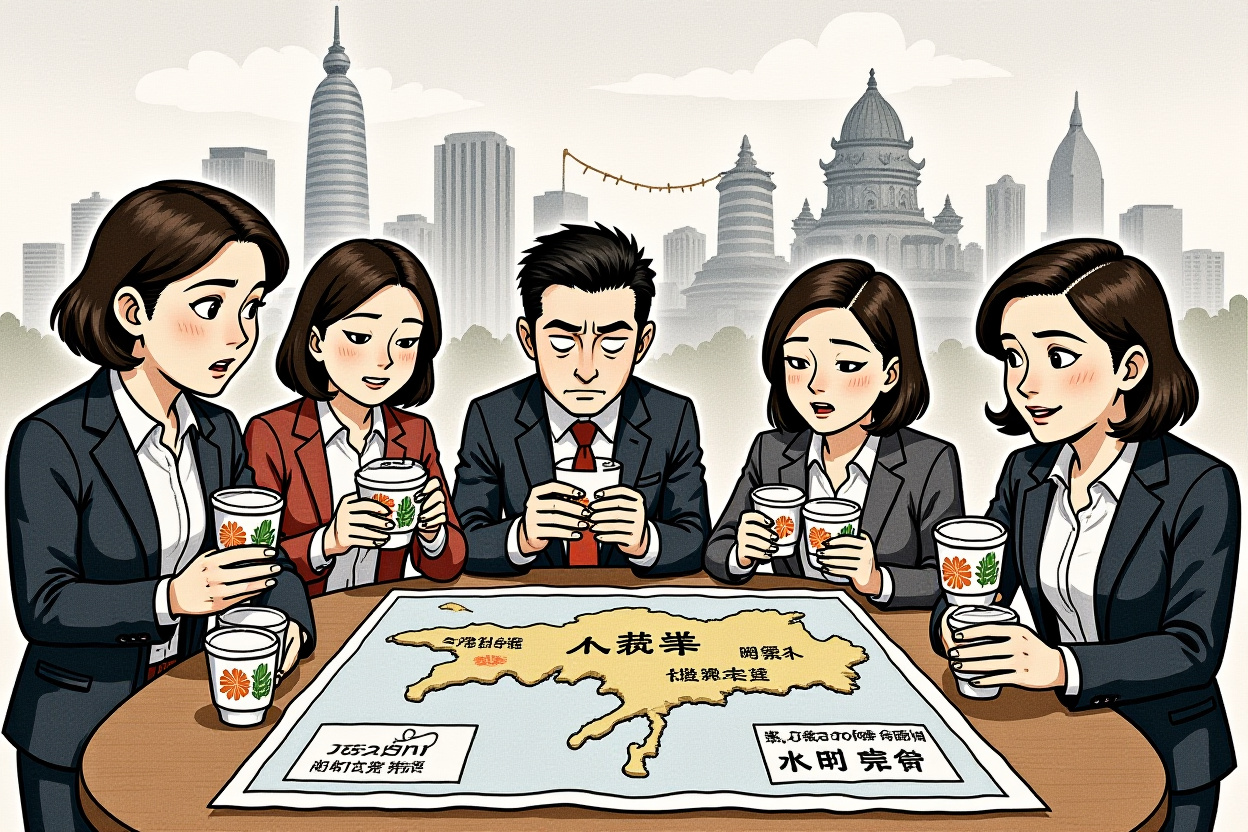
– Xiangpiaopiao (香飘飘) announces a strategic overseas move with a 2.68 billion yuan investment to establish a ready-to-drink beverage production base in Thailand, targeting ASEAN markets.
– The company faces severe domestic performance pressure, with core冲泡 (instant brew) product sales plummeting and annual net losses deepening in 2024.
– Diversification efforts into the ready-to-drink segment and offline tea shops have yielded mixed results, highlighting the challenges of transitioning from a single-product reliance.
– Leadership instability, including the abrupt resignation of former General Manager Yang Dongyun (杨冬云) and a subsequent减持 (reduction in shareholding) plan, raises corporate governance concerns for investors.
– The success of Xiangpiaopiao’s overseas expansion hinges on navigating intense competition in Southeast Asia and establishing brand recognition, a long-term process with significant financial commitments.
As the Chinese consumer market evolves, legacy brands are confronting existential challenges. For Xiangpiaopiao (香飘飘), the iconic maker of杯装冲泡奶茶 (cup-based instant milk tea), the pressure to find new growth engines has never been more acute. With domestic sales in a sustained downturn and profitability evaporating, the company has cast its gaze beyond China’s borders in a high-stakes strategic pivot. This move represents a critical test of whether Xiangpiaopiao’s overseas expansion can serve as a viable lifeline, transforming the firm from a household name in China into a contender in the fiercely competitive ASEAN beverage arena. The outcome will not only determine the company’s future but also offer valuable lessons for other Chinese consumer goods firms facing similar maturation pressures.
The Strategic Leap: Decoding the 2.68 Billion Yuan Thailand Investment
In a bold response to stagnating homefront growth, Xiangpiaopiao (香飘飘) has committed substantial capital to its international ambitions. The company’s公告 (announcement) details a phased investment plan centered on Thailand, marking its most significant foray into overseas manufacturing to date.
Blueprint for an ASEAN Production Hub
The investment structure is meticulously layered. Xiangpiaopiao will first establish a Singaporean subsidiary through its wholly-owned Sichuan Xiangpiaopiao entity, with an initial capital of 1 million Singapore dollars (approximately 5.47 million yuan). This subsidiary will then partner with the Sichuan parent to form a Thai company, with a combined investment of 50万美元 (USD 500,000) and 450万美元 (USD 4.5 million) respectively, resulting in a 10% and 90% ownership split. This Thai entity will be the vehicle for the core project: building a liquid ready-to-drink beverage production base. The total project investment is earmarked at 3800万美元 (approximately 268 million yuan), covering land acquisition, factory construction, and equipment procurement. Pending regulatory approvals, this facility is intended to be more than just a factory; it is envisioned as an export hub servicing Cambodia, Laos, Myanmar, Vietnam, and the broader ASEAN market.
Differentiation Strategy in a Crowded Market
Xiangpiaopiao’s rationale for choosing Thailand and the杯装 (cup-style) format is rooted in a desire for差异化竞争 (differentiated competition). The company argues that its cup packaging, compared to traditional瓶装 (bottled) products, can cultivate a more premium image. It plans to leverage unique tropical flavors, high real fruit juice content, low-sugar and zero-fat formulations, and transparent packaging to stand out. However, this Xiangpiaopiao overseas expansion strategy enters a region already dominated by global beverage giants who have long recognized the stable, year-round demand driven by tropical climates. Building brand recognition and distribution from scratch will require prolonged investment and market cultivation, directly testing the company’s financial endurance and operational execution in unfamiliar territory.
Anatomy of a Domestic Downturn: The Performance Pressure Mounting
The urgency behind Xiangpiaopiao’s overseas gambit is inextricably linked to its deteriorating financial health at home. The company’s core business model, once a roaring success, is now under severe strain from shifting consumer preferences.
The Rise and Fall of the Instant Brew Empire
Founded in 2004 by entrepreneur Jiang Jianqi (蒋建琪), Xiangpiaopiao pioneered and dominated the instant brew milk tea category. Its affordable, consistent-tasting products captured a massive market, with annual sales peaking in 2020 at 45.5909 million标准箱 (standard cases, 30 cups/case), generating 3.067 billion yuan in revenue for its冲泡 (instant brew) segment. The famous marketing slogan “cups sold can circle the地球 (Earth)” became a symbol of its scale. However, the seismic shift towards现制茶饮 (freshly made tea drinks), led by chains like喜茶 (Heytea) and奈雪的茶 (Nayuki Tea), has eroded Xiangpiaopiao’s market. Its products have been largely relegated to lower-tier cities and townships, leading to a steep decline. By 2024, instant brew sales had plummeted to 32.7854 million cases, representing a drop of nearly 380 million cups sold compared to the peak—a vivid illustration of the lost ground.
Financial Metrics Painting a Grim Picture
The operational challenges have translated directly into poor financial results. For the first three quarters of 2024, Xiangpiaopiao reported营业收入 (operating revenue) of 1.684 billion yuan, a year-on-year decrease of 13.12%. More alarmingly, its归母净利润 (net profit attributable to shareholders) was -89.21 million yuan, a staggering 603.07% decline. The扣非净利润 (non-GAAP net profit) fared even worse, sinking 1752.64% to a loss of 107 million yuan. The company has warned that full-year 2024 results will likely be unfavorable. This intense performance pressure has created a burning platform, forcing management to seek growth outside China’s saturated and competitive beverage landscape.
Diversification on Multiple Fronts: A History of Mixed Results
Recognizing the risks of依赖 (over-reliance) on a single, seasonal product line, Xiangpiaopiao has attempted several diversification strategies over the years. The outcomes of these ventures provide crucial context for assessing the potential of its latest overseas expansion.
The Ready-to-Drink Rollercoaster
In 2017, the company launched Meco果汁茶 (Meco Juice Tea) to enter the larger and less seasonal即饮 (ready-to-drink, RTD) market. The innovative cup format and product differentiation led to a promising start, with the RTD segment surpassing 1 billion yuan in revenue within two years. By 2019, Meco Juice Tea alone contributed 870 million yuan. However, this success proved fleeting. From 2020 to 2023, RTD revenue contracted sharply to around 600 million yuan. Analysts attribute this volatility to a combination of external macroeconomic factors and internal operational missteps. In recent years, attempts to recapture market share have involved heavy sales and marketing expenditures, further squeezing profitability amidst the core business decline.
Experimental Forays into Offline Retail
In a more recent and symbolic move, Xiangpiaopiao opened two offline奶茶店 (milk tea shops) in Hangzhou in late 2024. While this sparked speculation about a direct counter-attack on the现制茶饮 (freshly made tea drink) sector, company management clarified that the primary goal is not immediate commercial expansion. Instead, these stores are positioned as brand experience centers—living windows to showcase冲泡 (instant brew) and即饮 (RTD) products, gather direct consumer feedback, and inform R&D. This cautious approach underscores the company’s awareness of the immense capital and operational complexity required to compete in the crowded brick-and-mortar tea shop space, making the capital-heavy Xiangpiaopiao overseas expansion into manufacturing a contrasting, yet equally risky, strategic path.
Corporate Governance and Investor Sentiment: A Layer of Uncertainty
Strategic pivots require stable leadership and investor confidence. Recent events at Xiangpiaopiao have introduced additional variables that market participants are closely monitoring.
Executive Turmoil and Shareholder Actions
The company’s governance story took a dramatic turn with the appointment and rapid departure of Yang Dongyun (杨冬云) as General Manager. Hired in December 2023 from a background at giants like宝洁 (P&G), Yang was seen as a professional manager who could modernize the family-led firm. To align his interests, founder Jiang Jianqi (蒋建琪) transferred over 20 million shares to him at 13.43 yuan per share, a transaction worth 276 million yuan, making Yang a major shareholder with over 5% stake. However, Yang resigned for “personal reasons” just ten months into the role, in October 2024. Shortly after, on December 9, he filed a减持计划 (plan to reduce his shareholding), intending to sell a portion of his stock. This sequence of events has unsettled minority investors, raising questions about the execution stability of the very海外业务发展 (overseas business development) plans Yang was presumably hired to oversee.
Market Outlook: Navigating the ASEAN Beverage Battlefield
The ultimate success of Xiangpiaopiao’s overseas expansion will be decided in the competitive cauldron of Southeast Asia’s beverage market. This region presents both opportunity and formidable hurdles.
The Competitive Landscape and Long-Term Horizon
Southeast Asia is not a greenfield market. It is densely populated with entrenched multinationals like可口可乐 (Coca-Cola),百事 (PepsiCo), and日本 (Japanese) beverage groups, as well as local champions. These players have deep pockets, established distribution networks, and strong brand loyalty. Xiangpiaopiao’s strategy of using Thailand as a manufacturing hub for export assumes it can achieve cost efficiencies and tailor products to regional tastes. However, as the company’s own公告 (announcement) acknowledges, building brand recognition will be a long-term process. The 2.68 billion yuan investment represents significant sunk costs that will weigh on financials for years before any meaningful return materializes, all while domestic performance pressure continues to mount. The company’s existing海外业务 (overseas business), primarily exports of traditional instant brew products, generated only 19.13 million yuan in 2024, a mere 0.59% of total revenue—highlighting the scale of the challenge ahead.
The journey Xiangpiaopiao has embarked upon is emblematic of a broader transition phase for China’s first-generation consumer brands. The decision to pursue aggressive Xiangpiaopiao overseas expansion into Thailand is a calculated risk born from necessity, not mere opportunism. While the potential of the ASEAN market is undeniable, the path is fraught with intense competition, hefty upfront investment, and the lingering shadow of domestic underperformance. For investors, the key metrics to watch will be the pace of capital expenditure in Thailand, any early signs of market traction for its杯装即饮产品 (cup-style RTD products) in the region, and, crucially, the company’s ability to manage its cost structure and stem losses at home. The coming quarters will reveal whether this overseas venture can evolve from a desperate move under performance pressure into a sustainable pillar of growth. Market participants should maintain a vigilant but analytically open stance, recognizing that in the volatile world of consumer staples, strategic reinvention, though perilous, is often the only route to long-term survival.