



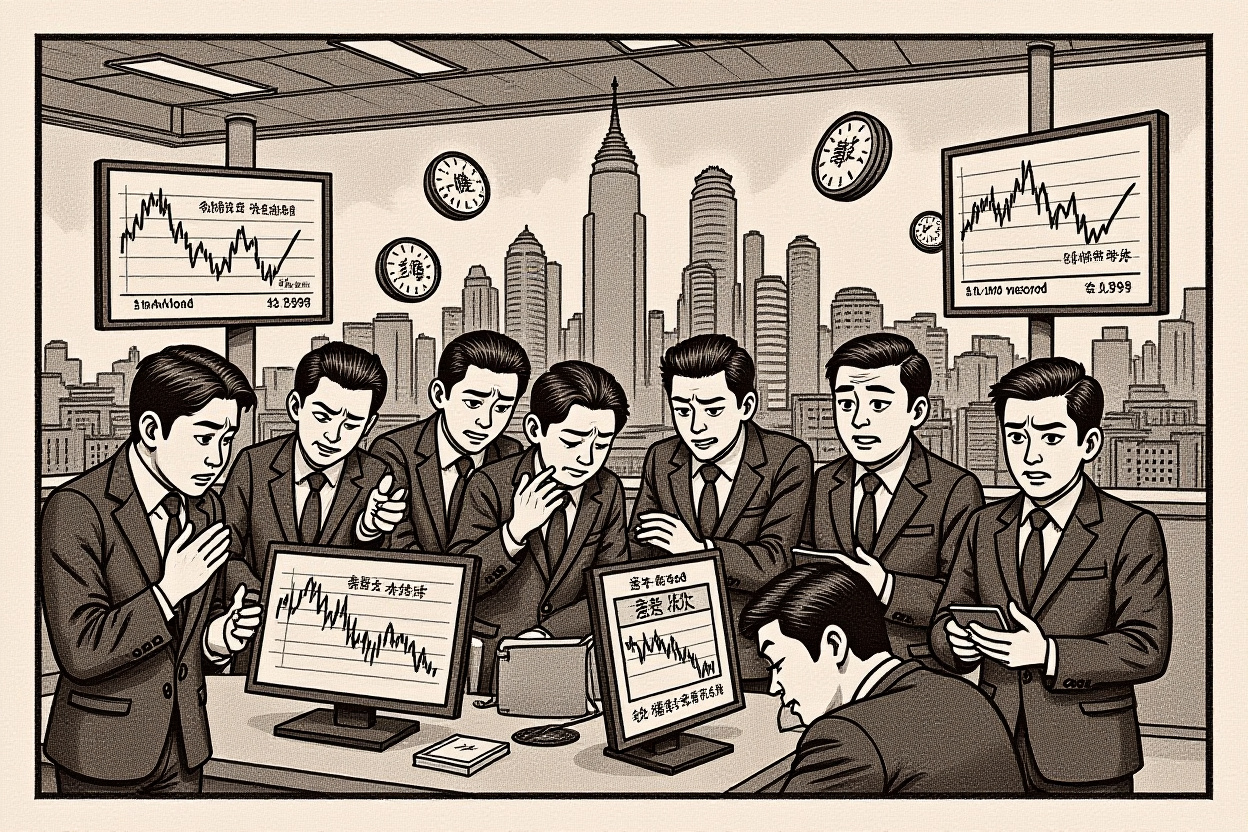
The trading session on April 7th delivered a stark reminder of the interconnected volatility facing global equity markets, with U.S.-listed Chinese stocks finding themselves at the center of the downdraft. The Nasdaq Golden Dragon China Index, a key benchmark tracking these American Depository Receipts (ADRs), slid 0.46%, mirroring and at times exceeding losses in major U.S. indices. This collective weakness among 美股中概股 (U.S.-listed Chinese stocks) was not an isolated event but a confluence of macroeconomic headwinds, sector-specific pressures, and evolving investor sentiment. For sophisticated market participants with exposure to Chinese equities, understanding the anatomy of this selloff is crucial for navigating both offshore and onshore opportunities.
Executive Summary: Key Takeaways from the Selloff
- The broad decline in U.S.-listed Chinese stocks was part of a wider risk-off move in U.S. tech and growth stocks, driven by recalibrated interest rate expectations and sector rotation.
- Specific pressure on Chinese tech giants like Alibaba and JD.com reflects persistent concerns over domestic economic recovery pace and regulatory clarity, despite recent supportive signals from Beijing.
- The performance of the 美股中概股 (U.S.-listed Chinese stocks) cohort serves as a critical sentiment barometer for global capital’s view on China’s growth narrative, with immediate implications for Hong Kong-listed H-shares and, through connective tissue, A-shares.
- Investors should monitor the divergence between ADR performance and their underlying Hong Kong shares for potential arbitrage or hedging opportunities, especially amid lingering delisting risk rhetoric.
- The episode underscores the importance of a nuanced, multi-market strategy when investing in Chinese equities, weighing offshore sentiment against onshore fundamentals and policy catalysts.
The Market Mechanics: A Session of Broad-Based Pressure
The day’s trading opened under a cloud of caution, with all three major U.S. indices – the Dow Jones Industrial Average, S&P 500, and Nasdaq Composite – trending lower from the bell. This set a negative tone for risk assets globally. The Nasdaq, home to most technology and growth-oriented 美股中概股 (U.S.-listed Chinese stocks), was particularly weak, shedding 0.58% intraday. This created an unfavorable ecosystem for the high-growth, often tech-centric Chinese ADRs.
Dissecting the Nasdaq Golden Dragon China Index Drop
The 0.46% decline in the Nasdaq Golden Dragon China Index masked wider moves in individual components. Losses were notably pronounced in specific segments:
- Technology & Innovation: Companies like VNET Group (世纪互联) fell over 3%, while Hesai Group (禾赛科技), a lidar sensor maker, dropped more than 2%. Pony.ai (小马智行), an autonomous driving firm, also declined over 1%.
- Consumer & E-Commerce Giants: Industry bellwethers including Alibaba Group (阿里巴巴集团), JD.com Inc. (京东集团), and Baidu Inc. (百度集团) all traded lower, contributing significantly to the index’s weight.
- Broader Internet & Education: Names like NetEase (网易) and New Oriental Education & Technology Group (新东方) also edged down, indicating the pressure was not confined to a single sub-sector.
This pattern suggests the selloff was a broad reassessment of Chinese growth exposures rather than a targeted strike on one industry.
Unpacking the Catalysts: Why Did U.S.-Listed Chinese Stocks Fall?
The decline in 美股中概股 (U.S.-listed Chinese stocks) cannot be viewed in a vacuum. It resulted from a combination of external U.S. market dynamics and internal China-focused narratives converging during the session.
Factor 1: The U.S. Tech Drag and Interest Rate Sensitivity
A primary driver was the concurrent weakness in megacap U.S. technology stocks. Apple fell over 2%, with Tesla, Microsoft, Nvidia, and Qualcomm also in the red. These stocks are highly sensitive to shifts in long-term interest rate expectations, as their valuations are heavily based on future cash flows. When U.S. Treasury yields rise or expectations for Federal Reserve policy tighten, these stocks often lead market declines. Given that most prominent 美股中概股 (U.S.-listed Chinese stocks) are also growth-oriented tech or consumer internet companies, they are caught in the same valuation recalculation. They trade as part of the global “growth stock” cohort, making them vulnerable to shifts in U.S. monetary policy sentiment that directly impact their peer group.
Factor 2: Lingering China-Specific Economic and Regulatory Crosscurrents
Beyond U.S. rates, China-specific concerns provided fundamental pressure. Despite positive official Purchasing Managers’ Index (PMI) data, investors remain cautiously scrutinizing the strength and sustainability of China’s domestic consumption recovery. Questions about the property market’s stabilization and local government debt continue to hover. Furthermore, while the most intense phase of regulatory overhaul may have passed, the market is still digesting its long-term impact on business models and profit growth for internet platforms. Any perceived slowdown in earnings revisions or uncertainty regarding new supportive policies can trigger swift sentiment shifts among the institutional investors who dominate trading in these ADRs.
Sector Spotlight: The Notable Divergence with U.S. Healthcare
An illuminating contrast to the day’s action was the powerful rally in U.S. healthcare stocks, particularly managed care providers. Humana surged over 7%, and UnitedHealth Group jumped more than 8%. This surge was driven by better-than-expected Medicare Advantage payment rates announced by the U.S. government. This sector-specific boom highlights a critical market theme: rotation. Capital flowed out of rate-sensitive technology and growth sectors (which include Chinese ADRs) and into defensive, policy-positive sectors like healthcare. This rotation amplified the selling pressure on 美股中概股 (U.S.-listed Chinese stocks), as they were squarely in the category of assets being sold to fund moves into other areas. It was less a story of targeted China pessimism and more one of global portfolio repositioning where Chinese ADRs, due to their classification, were on the wrong side of the trade.
The A-Shares Connection: Mapping Offshore Sentiment to Onshore Markets
For global investors, a pivotal question is how movements in 美股中概股 (U.S.-listed Chinese stocks) presage or influence the domestic A-share market. The connection is not direct, but it is significant through several channels.
Channel 1: Sentiment Contagion via Hong Kong’s H-Shares
The most immediate link is through the Hong Kong market. Most large U.S.-listed Chinese companies also have secondary listings in Hong Kong (H-shares). Negative sentiment and selling pressure in the U.S. ADRs often spill over to their Hong Kong-listed counterparts the next trading day. Since Hong Kong’s stock connect programs link it directly to mainland A-share markets (Shanghai and Shenzhen), a sustained selloff in H-shares can dampen sentiment for related sectors in the A-share market. Institutional investors watching the 美股中概股 (U.S.-listed Chinese stocks) performance use it as a real-time gauge of global institutional appetite for China risk.
Channel 2: Sectoral and Thematic Leadership
When leading Chinese tech and innovation companies listed in the U.S. face sustained pressure, it can cast a shadow over similar thematic investments in the A-share market. For instance, weakness in U.S.-listed electric vehicle players or AI-related firms can lead to profit-taking or increased caution in correlated A-share sectors, even if domestic fundamentals remain firm. The performance of these offshore bellwethers sets a narrative that onshore traders and quants monitor closely.
Strategic Implications for Institutional Investors
Movements like the April 7th decline are not merely noise; they offer strategic insights and potential opportunities for the sophisticated investor.
1. Monitoring the ADR-H Share Discount/Premium
Volatility often opens up pricing discrepancies between a company’s U.S. ADR and its Hong Kong-listed ordinary share. Astute investors track this spread. A widening discount for the ADR might signal higher perceived geopolitical or delisting risk in the U.S. market versus the Hong Kong market. This can inform hedging decisions or present arbitrage opportunities for funds with access to both markets.
2. Differentiating Between Noise and Signal
The key is to discern whether a drop in 美股中概股 (U.S.-listed Chinese stocks) is driven by:
- Global Macro Factors (e.g., U.S. rate moves, dollar strength): This may present a buying opportunity if China’s standalone fundamentals are improving.
- China-Specific Fundamental Deterioration (e.g., weak economic data, renewed regulatory action): This warrants a more cautious review of all China exposures.
- Technical & Flow-Driven Selling (e.g., sector rotation, fund redemptions): This may be short-lived and less relevant to long-term value.
Navigating the Path Forward for Chinese Equity Exposure
The observed pullback in U.S.-listed Chinese stocks is a microcosm of the complex environment facing investors in Chinese equities. It underscores their dual identity: they are proxies for China’s economic story but are traded as instruments within the U.S. financial system, subject to its liquidity conditions and risk appetites. For long-term allocators, such periods of stress can help identify mispricings, especially between offshore sentiment and onshore reality. The recent commitment from Chinese regulators to provide more transparent and supportive policies for the capital markets, as echoed in statements from the China Securities Regulatory Commission (CSRC 中国证监会), aims to bolster underlying valuations. However, the trajectory of 美股中概股 (U.S.-listed Chinese stocks) will remain tethered to the tug-of-war between recovering Chinese corporate earnings and the evolving landscape of U.S. interest rates and global risk sentiment.
Investors are advised to maintain a balanced, multi-faceted approach. This involves closely monitoring the U.S.-listed ADR market for sentiment and technical cues, while grounding investment theses in the fundamental data emerging from the mainland and the direct policy signals from Beijing. The opportunity lies not in reacting to every offshore gyration, but in understanding the connective tissue between markets and strategically positioning for when dislocations between price and fundamental value become pronounced. The next move should be to scrutinize the upcoming wave of Q1 earnings reports from both U.S.-listed Chinese companies and their A-share peers, using them as a concrete litmus test to separate market narrative from corporate reality.