



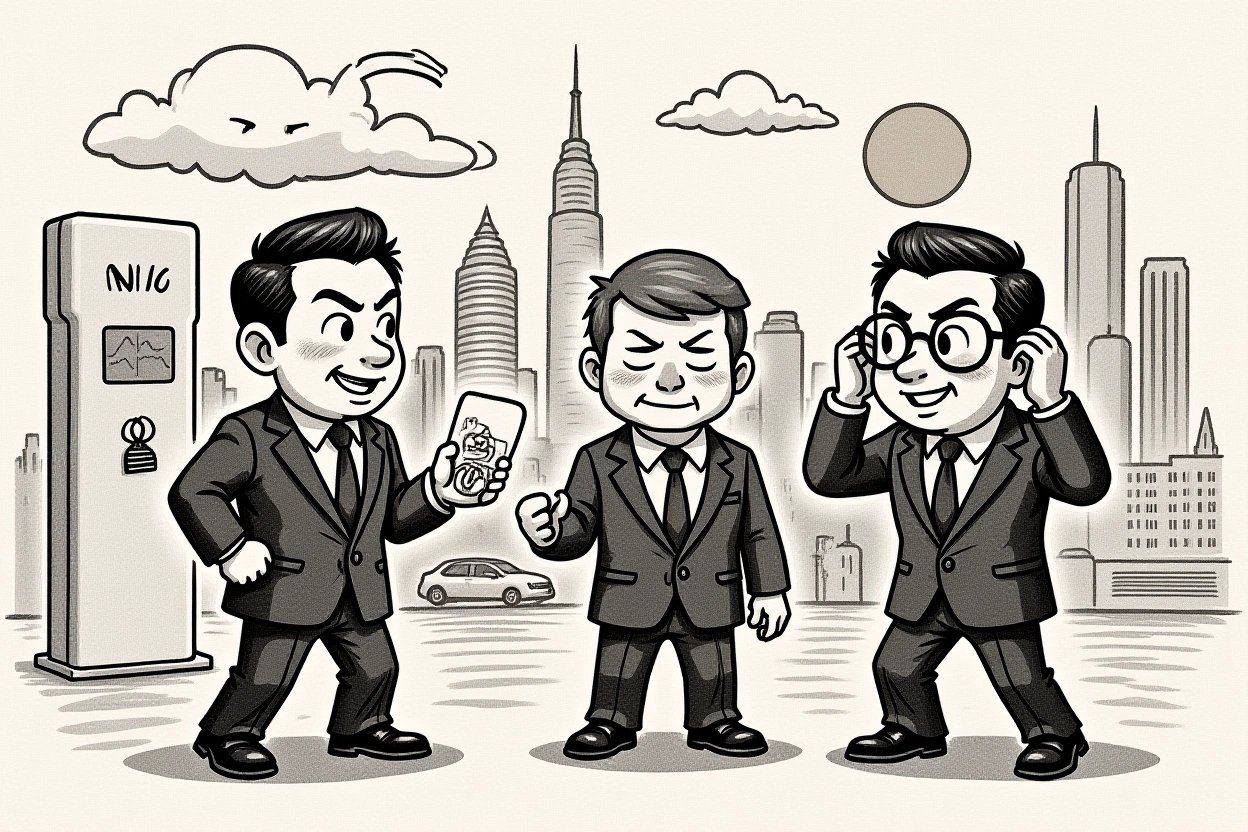
Brothers in Arms to Market Rivals
Three photographs tell the story of China’s electric vehicle revolution. The first, taken in June 2020, shows NIO’s Li Bin (李斌), XPeng’s He Xiaopeng (何小鹏), and Li Auto’s Li Xiang (李想) standing shoulder-to-shoulder with weary smiles. He Xiaopeng’s caption read: ‘Three suffering souls, remembering hard times together.’ At that moment, Li Bin had just emerged from his company’s near-death experience, He Xiaopeng felt perpetually on the brink, and Li Xiang was merely surviving.
By July 2023, at an event celebrating 70 years of China’s auto industry, the same trio appeared with arms wrapped around each other – survivors of the new energy vehicle industry’s first brutal consolidation. Yet within days, they would clash publicly over sales rankings. The third image, captured in March 2025, shows them giving forced thumbs-up at an industry forum. Months later, XPeng would surpass Li Auto in quarterly deliveries for the first time (94,008 vs 92,864 units), with NIO trailing at 42,094. The Wei Xia Li brotherhood had transformed into a tense rivalry among China’s EV champions.
Diverging Paths to Convergence
Original Strategic Differentiation
The Wei Xia Li alliance maintained equilibrium through distinct market positioning:
– NIO pursued premium branding with battery swap infrastructure
– Li Auto dominated family vehicles through extended-range technology
– XPeng built its reputation on tech innovation with ultra-fast charging
This division allowed peaceful coexistence until 2024, when strategic expansions ignited direct competition. XPeng’s game-changing MONA M03 launch in August 2024 achieved 10,000 orders in 52 minutes at its ¥119,800 price point. One month later, NIO’s sub-brand Ledao debuted its L60 model attempting similar disruption, but supply chain constraints hampered its momentum.
The Collision Course
July 2025 marked the first direct product clash within the Wei Xia Li group:
– July 29: Li Auto launched its pure electric i8 SUV (¥321,800-369,800)
– July 31: NIO’s Ledao unveiled the L90 SUV (¥265,800) securing 30,000+ pre-orders
Positioned in overlapping segments, these competing releases transformed latent tension into open warfare. As Li Bin celebrated Ledao’s delivery achievements on Weibo, industry observers noted the once-collaborative spirit had evaporated.
The Water Army Accusations
Social Media Skirmishes
The conflict escalated when Liu Jie (刘杰), Li Auto’s VP of Sales, posted screenshots on July 24, 2025 allegedly showing coordinated attacks against the i8. The posts compared it unfavorably to NIO’s L90. Liu’s rhetorical question – ‘Is this the next direction for the water army to smear the Li i8?’ – triggered a chain reaction.
Shen Fei (沈斐), NIO’s Senior VP and Ledao President, responded bluntly: ‘Suggest calling police directly!’ The exchange intensified when Shen demanded a public apology after investigations allegedly cleared NIO’s involvement. The confrontation peaked with Shen’s comment on Li Auto’s promotional post: ‘Welcome to test drive the Ledao L90 – both are good cars.’
Corporate Escalation
On August 6, Li Auto’s product head Tang Jing (汤靖) shared screenshots of alleged water army recruitment chats, joking about joining to ‘post 1,000 comments daily.’ The next day, Li Auto’s legal department issued a formal statement about ‘organized illegal activities’ targeting their owners.
NIO’s Assistant VP of Brand Communications Ma Lin (马麟) fired back: ‘We detest indiscriminate smearing of any auto brand’s user base… Blaming NIO plays into attackers’ hands.’ The clash culminated in Li Xiang’s August 8 video address acknowledging ‘professional water army agencies’ behind the attacks but vowing not to ‘turn dark’ in response.
The Weekly Sales Ranking Wars
This wasn’t the Wei Xia Li trio’s first public dispute. Since April 2023, Li Auto’s Tuesday sales leaderboards had become industry flashpoints. The practice exploded into controversy when Li Bin publicly criticized the rankings during a July 2024 event: ‘Quarterly reporting is sufficient. Weekly rankings represent low-level internal friction disrupting operations.’
Three days later, He Xiaopeng used his company’s AI technology launch to lambast the practice: ‘While US firms advance AI and chips, our tech companies obsess over weekly sales charts.’ Li Xiang responded with a parable of the ‘Three Wise Monkeys’ – interpreted as mocking his rivals.
The conflict subsided only when China’s Automobile Manufacturers Association (CAAM) intervened in March 2025, issuing guidelines against weekly sales reporting. Li Auto eventually complied, but the episode revealed deep fractures in the Wei Xia Li alliance.
Li Auto’s Pure Electric Growing Pains
The MEGA Crisis
Among Wei Xia Li, Li Auto had enjoyed relative smooth sailing until its pure electric pivot. The March 2024 MEGA MPV launch became what Li Xiang called ‘the auto industry’s largest smear campaign’ when coordinated attacks spread images labeling it a ‘hearse.’ Over 10,000 orders cancelled within 72 hours. Police investigations implicated employees from 3-4 automakers, including XPeng.
The i8 Setback
The MEGA fallout delayed Li Auto’s i8 launch by over a year. When it finally arrived, the vehicle faced immediate controversy after collision test footage with a Dongfeng Mengshi pickup went viral. The resulting 12.84% stock plunge forced an August 5 price cut to ¥339,800. Analysts noted that while recovery was possible, Li Auto’s technological leadership narrative had been damaged.
The Survival Battlefield
Each Wei Xia Li member has faced extinction-level threats:
– Li Auto: Abandoned its ¥50,000 SEV microcar project in 2018
– NIO: Required 2020合肥 municipal bailout during ‘perfect storm’
– XPeng: 2022 G9 launch debacle necessitated corporate overhaul
By mid-2025, new threats emerged. Zhu Xichan (朱西产), automotive professor at Tongji University, predicted: ‘Within three years, NIO, XPeng and Li Auto’s independent survival probability is zero. Mergers are inevitable.’ The entrance of Xiaomi – whose founder Lei Jun (雷军) had invested in both NIO and XPeng – intensified pressure. Lei had previously stated Xiaomi Auto’s survival odds were just 1%.
Despite recent successes – NIO’s Firefly brand delivered 10,000 units in Q2 2025, XPeng’s MONA revived its fortunes, and Li Auto maintained profitability – fundamental challenges remained. As He Xiaopeng noted during XPeng’s August P7 launch: ‘We remain in a bloodbath, not even reaching red ocean status.’ None could claim guaranteed survival.
Uncertain Roads Ahead
The Wei Xia Li journey mirrors China’s EV revolution – from idealistic collaboration to brutal competition. Their intertwined fates reflect broader industry dynamics where technological boundaries blur and market positions shift monthly. As the trio navigates profitability challenges, technological disruption and new entrants like Xiaomi, their once-cooperative relationship has become collateral damage in China’s EV wars.
The original ‘three suffering souls’ now battle on multiple fronts: product segments, technological leadership, and public perception. Their survival may depend on rediscovering elements of their original alliance while competing fiercely. As the Chinese EV market enters its next consolidation phase, watch how these former allies adapt – their strategies will define the next decade of electric mobility. For the latest developments in the Wei Xia Li rivalry, follow our automotive analysis channel.