



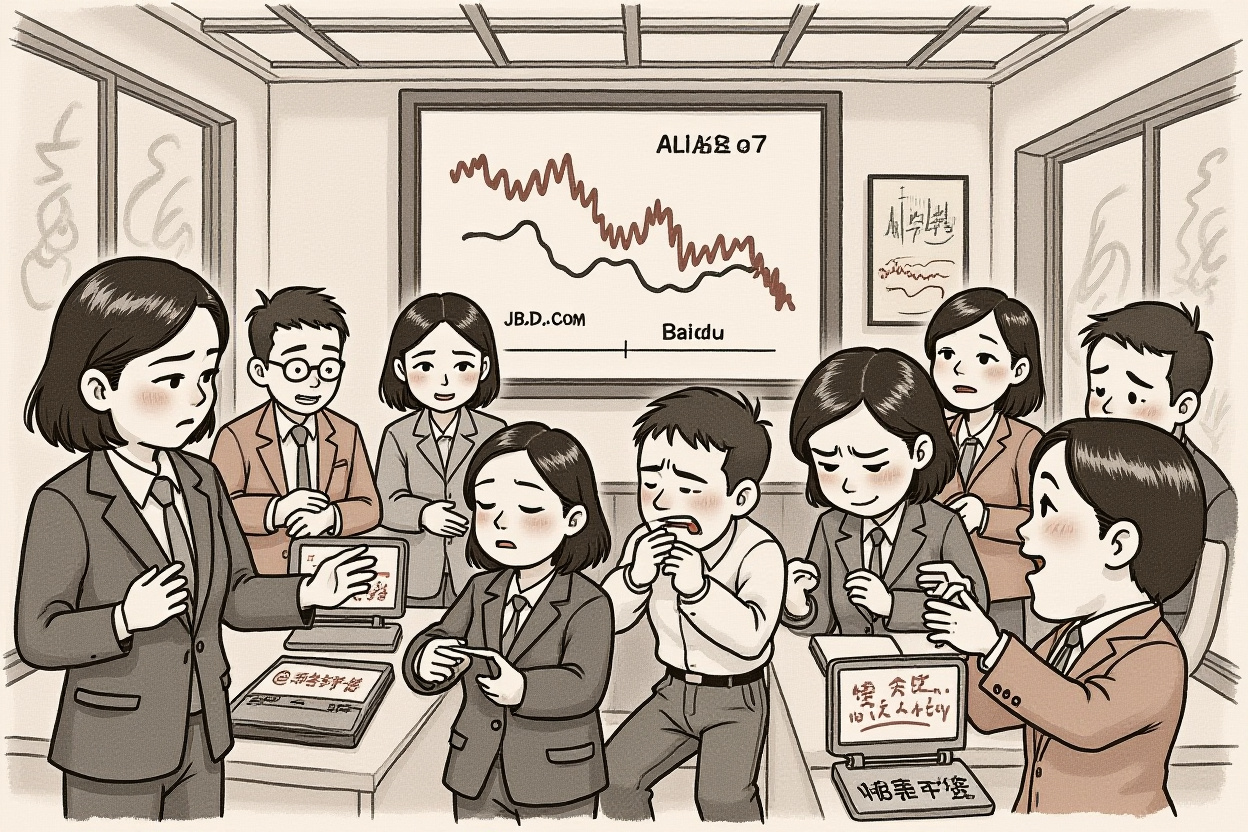
– The Nasdaq Golden Dragon China Index declined 0.46% on April 7th, reflecting a broad downturn in U.S.-listed Chinese stocks amid wider market weakness.
– Major technology and Chinese ADR constituents, including 阿里巴巴集团 (Alibaba Group), 京东集团 (JD.com), and 百度集团 (Baidu), saw significant losses, while U.S. healthcare stocks rallied.
– Underlying drivers include global macroeconomic concerns, interest rate anxieties, and persistent regulatory headwinds facing Chinese firms overseas.
– Historical volatility patterns suggest potential for mean reversion, but investors must weigh near-term risks against long-term growth narratives.
– Actionable insights include reassessing portfolio concentration, monitoring regulatory cues from 中国证监会 (China Securities Regulatory Commission), and identifying entry points during corrections.
Market Tremors Send U.S.-Listed Chinese Stocks into a Tailspin
The trading session on April 7th delivered a stark reminder of the inherent volatility and interconnectedness of global equity markets. As the three major U.S. indices opened lower and extended losses, a distinct undercurrent of selling pressure targeted a specific cohort: U.S.-listed Chinese stocks. This collective decline, encapsulated by the drop in the Nasdaq Golden Dragon China Index, immediately captured the attention of institutional investors worldwide who track Chinese equity exposure through American Depositary Receipts (ADRs). The movement of U.S.-listed Chinese stocks often serves as a critical sentiment gauge and a precursor to trading activity in onshore A-shares, making this downturn a pivotal event for crafting global investment strategy. Beyond the headline numbers, this sell-off reveals a complex tapestry of macroeconomic fears, sector rotation, and the enduring impact of geopolitical and regulatory crosscurrents.
Dissecting the April 7th Trading Session: A Broad Market Unwind
The day’s market action was characterized by a risk-off tone that permeated multiple asset classes. The weakness in U.S.-listed Chinese stocks did not occur in isolation but was part of a broader narrative of caution.
Broad U.S. Indices and Technology Sector Drag
The session saw the 纳斯达克综合指数 (Nasdaq Composite Index) fall 0.58%, the 标普500指数 (S&P 500 Index) decline 0.53%, and the 道琼斯工业平均指数 (Dow Jones Industrial Average) drop 0.63%. This synchronized move lower was led by heavyweight technology names. 苹果公司 (Apple Inc.) fell over 2%, while 特斯拉 (Tesla), 甲骨文公司 (Oracle), 微软 (Microsoft), 英伟达 (NVIDIA), and 高通公司 (Qualcomm) all traded lower. This tech-led weakness created a negative backdrop, reducing risk appetite for growth-oriented segments like U.S.-listed Chinese stocks, which are often grouped with high-growth tech narratives. The sell-off in these bellwether names suggested concerns over valuation, future earnings growth, or broader economic resilience.
Healthcare Resilience Amidst the Gloom
In a notable counter-trend, the healthcare sector, specifically managed care providers, posted strong gains. 哈门那公司 (Humana) surged over 7%, and 联合健康集团 (UnitedHealth Group) jumped more than 8%. This rotation indicated investor capital moving toward defensive, recession-resistant sectors amid the market uncertainty. The divergence highlights how sector-specific dynamics can operate independently of broader index movements and underscores the importance of granular analysis when the cohort of U.S.-listed Chinese stocks experiences pressure.
The Chinese ADR Sell-Off: A Closer Look at the Casualties
The performance of U.S.-listed Chinese stocks on April 7th was uniformly negative, affecting companies across e-commerce, technology, and education. This broad-based decline points to systemic rather than idiosyncratic factors.
Performance of Key Constituents
The Nasdaq Golden Dragon China Index, a key benchmark tracking Chinese companies listed on U.S. exchanges, fell 0.46%. Notable decliners included:
– 世纪互联 (Century Internet): Down over 3%.
– 禾赛科技 (Hesai Technology): Down over 2%.
– 小马智行 (Pony.ai), 蔚来汽车 (NIO), and 迅雷 (Xunlei): Each down over 1%.
– Industry giants like 新东方教育科技集团 (New Oriental Education & Technology Group), 阿里巴巴集团 (Alibaba Group), 网易公司 (NetEase), 京东集团 (JD.com), and 百度集团 (Baidu) all traded lower. The simultaneous weakness across such a diverse range of U.S.-listed Chinese stocks—from autonomous driving to online retail—signals a market-wide reassessment of risk premium attached to China-centric growth stories.
The Barometer Under Pressure: Understanding the Nasdaq Golden Dragon Index
The Nasdaq Golden Dragon China Index (HXC) is more than just a tracker; it is a real-time sentiment indicator for foreign investment appetite towards China’s corporate sector. Its decline, even if modest in percentage terms, often amplifies during periods of global stress or negative China-specific news. The performance of U.S.-listed Chinese stocks as a group can be influenced by liquidity conditions in U.S. markets, changes in the U.S. dollar, and, crucially, the regulatory environment governed by bodies like the 中国证监会 (China Securities Regulatory Commission) and the U.S. 证券交易委员会 (Securities and Exchange Commission).
Unpacking the Catalysts: Why Did U.S.-Listed Chinese Stocks Fall?
Identifying the precise drivers behind a market move is complex, but several interrelated factors likely contributed to the downdraft in U.S.-listed Chinese stocks.
Macroeconomic Headwinds and Interest Rate Jitters
Globally, investors grappled with renewed concerns over persistent inflation and the trajectory of interest rates set by the 美国联邦储备系统 (U.S. Federal Reserve). Higher-for-longer rate expectations can dampen the present value of future earnings, disproportionately affecting growth stocks, including many U.S.-listed Chinese stocks. Additionally, slowing economic indicators from major economies may have sparked fears of reduced global demand, impacting the revenue projections of China’s export-oriented and consumer-focused firms listed abroad.
Regulatory and Geopolitical Overhangs
The regulatory environment for Chinese companies accessing U.S. capital markets remains a persistent concern. Ongoing scrutiny from U.S. regulators regarding audit compliance under the Holding Foreign Companies Accountable Act (HFCAA) continues to cast a shadow. Furthermore, investors monitor policy signals from Beijing regarding data security, anti-monopoly enforcement, and sector-specific regulations. Any perceived tightening or uncertainty can trigger sell-offs in U.S.-listed Chinese stocks, as seen in past years. The stability of U.S.-China relations also plays a background role, influencing investor confidence in the long-term viability of these cross-listings.
Historical Patterns and Cross-Market Implications
Volatility in U.S.-listed Chinese stocks is not a new phenomenon. Analyzing past episodes can provide context for the current downturn and inform potential pathways forward.
Volatility and Recovery: Lessons from the Past
The history of U.S.-listed Chinese stocks is marked by periods of severe stress and robust recovery. For instance, the steep declines during the 2021-2022 regulatory crackdown were followed by significant rebounds as policy clarity improved and valuations became compelling. This pattern suggests that while near-term pain is possible, long-term investors often view these dips as potential entry points, provided the fundamental growth story of the underlying companies remains intact.
The A-Share Connection and Mapping Opportunities
There is a well-documented, albeit imperfect, correlation between the performance of U.S.-listed Chinese stocks and their counterparts trading on mainland exchanges like the 上海证券交易所 (Shanghai Stock Exchange) and 深圳证券交易所 (Shenzhen Stock Exchange). A sell-off in ADRs can sometimes foreshadow or amplify moves in the A-share market the following day, as global sentiment filters back to onshore investors. Conversely, strong policy support or economic data from China can lift both markets. As the Chinese editorial note suggested (‘观美股风云,循映射脉络,觅A股机会’ – Watch U.S. stock trends, follow the mapping context, seek A-share opportunities), astute investors use moves in U.S.-listed Chinese stocks as a signal to scout for mispricings or trends in the domestic market.
Expert Perspectives and Institutional Sentiment
Gauging professional opinion is crucial to understanding the depth and duration of the pressure on U.S.-listed Chinese stocks.
Analyst Commentary on the Sell-Off
Market analysts offered varied interpretations. ‘This appears to be a classic risk-off rotation, compounded by lingering regulatory concerns,’ noted a portfolio manager at a major global asset management firm. ‘U.S.-listed Chinese stocks are acting as a high-beta proxy for global growth fears right now.’ Another analyst from a leading investment bank pointed to technical factors: ‘The group was due for a pullback after a strong run earlier in the quarter; this is healthy consolidation unless fundamental data deteriorates.’ These views underscore that the decline is being viewed through multiple lenses, from macro to technical.
Tracking Institutional Flows and Positioning
Data from fund flow trackers and 13F filings will be scrutinized in the coming weeks to see if institutional investors used the downturn to add to or reduce exposure to U.S.-listed Chinese stocks. Large allocators often have mandates that require a certain weighting to Chinese equities, and ADRs provide a convenient liquidity pool. Sustained outflows could indicate a longer-term de-risking, while stability or inflows might signal conviction in the asset class’s valuation.
Strategic Roadmap for Global Investors
In the face of such volatility, a disciplined and informed approach is paramount for investors with exposure to or interest in U.S.-listed Chinese stocks.
Risk Management and Portfolio Review
Investors should first assess their portfolio’s concentration to this segment. Key actions include:
– Re-evaluating the weight of U.S.-listed Chinese stocks relative to total emerging market or global equity exposure.
– Reviewing the fundamental health of held companies, focusing on earnings revisions, balance sheet strength, and competitive positioning.
– Considering hedging strategies, such as options or ETFs that short the Nasdaq Golden Dragon Index, to mitigate downside risk during turbulent periods.
Identifying Conviction Opportunities
Market dislocations often create opportunities. For investors with a longer time horizon, the decline in U.S.-listed Chinese stocks may present a chance to accumulate shares in high-quality companies at more attractive valuations. Focus should be on firms with:
– Resilient business models less susceptible to regulatory shifts.
– Strong domestic cash flow generation in China’s growing consumer market.
– Clear paths to profitability and transparent governance structures.
Monitoring upcoming earnings calls from companies like Alibaba or JD.com will be critical for gaugating management confidence and forward guidance.
Synthesizing the Market Signal and Looking Ahead
The collective decline of U.S.-listed Chinese stocks on April 7th is a multifaceted event rooted in global macro concerns, sector rotation, and enduring geopolitical nuances. While the immediate price action is negative, it serves as a crucial stress test for investment theses built around Chinese growth. The divergence with rising healthcare stocks underscores a market in flux, seeking safety while punishing perceived risk. For sophisticated market participants, the behavior of U.S.-listed Chinese stocks remains an indispensable barometer. The path forward will be dictated by incoming economic data from the U.S. and China, clarity from regulatory bodies on both sides of the Pacific, and the forthcoming Q1 earnings season. Investors are advised to move beyond the daily noise, deepen their fundamental research on individual companies, and maintain a flexible stance to capitalize on the volatility that continues to define this dynamic segment of the global equity universe.