



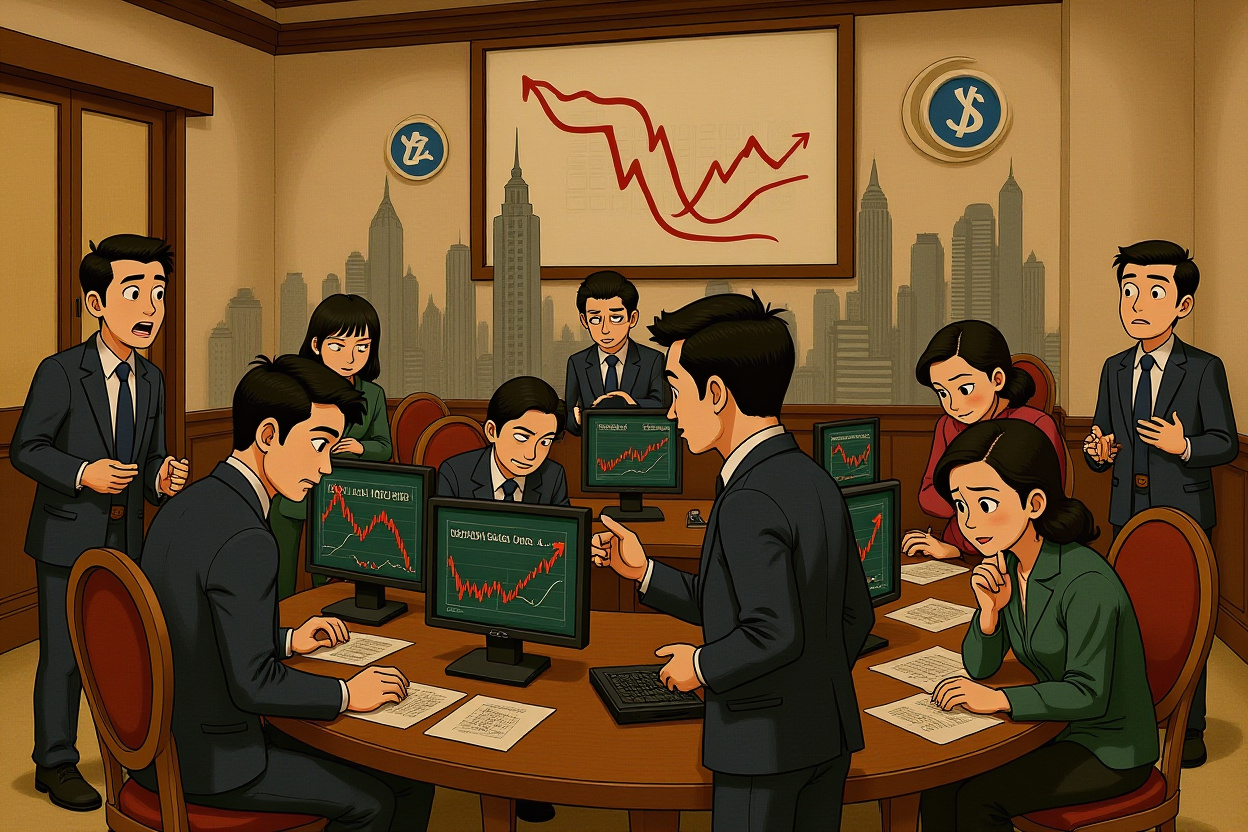
Executive Summary: Key Market Takeaways
The trading session on April 7 delivered a sharp reminder of the interconnected nature of global equity markets, with a pronounced downturn affecting major US indices and, notably, US-listed Chinese stocks. This analysis breaks down the movement, offering actionable insights for professionals.
- The Nasdaq Golden Dragon China Index (纳斯达克中国金龙指数) fell 0.46%, leading a broad decline across prominent American Depositary Receipts (ADRs) like Alibaba Group (阿里巴巴集团) and JD.com (京东集团).
- US technology giants, including Apple and Nvidia, also retreated, contributing to a risk-off sentiment that pressured the broader S&P 500 and Dow Jones indices.
- In a contrasting move, US healthcare insurance stocks like Humana and UnitedHealth Group posted significant gains, highlighting sectoral divergence amid market uncertainty.
- Underlying drivers include lingering concerns over US interest rate policy, China-specific regulatory scrutiny, and macroeconomic indicators from both economies.
- For global investors, this event underscores the importance of monitoring cross-market correlations and adjusting China equity exposure with a nuanced understanding of dual-listed entities.
The April 7 Sell-Off: A Broad Market Retreat Unfolds
A wave of selling pressure swept through US equity markets at the open, setting a negative tone for the session. The three major indices—the Dow Jones Industrial Average, S&P 500, and Nasdaq Composite—all opened lower and extended their losses throughout the day. This collective decline was not an isolated event but a symptom of broader investor apprehension, directly impacting the cohort of US-listed Chinese stocks. The focus phrase, US-listed Chinese stocks decline, became the headline of the day for Asia-focused portfolios, signaling potential headwinds for related asset classes.
US Indices Under Pressure: Data Points and Momentum
By the close, the Nasdaq had fallen 0.58%, the S&P 500 dropped 0.53%, and the Dow Jones declined 0.63%. These moves, while modest in isolation, represented a continuation of the volatility seen in recent weeks as markets grapple with mixed economic signals. The decline was broad-based, with declining issues outnumbering advancers significantly on both the NYSE and Nasdaq exchanges. Volume was above average, suggesting conviction behind the sell-off rather than mere profit-taking. For real-time data, investors often refer to the Nasdaq Market Activity page.
Technology Sector Leads the Downward Charge
Large-cap technology stocks, often market bellwethers, were at the forefront of the weakness. Apple shares fell over 2%, while Tesla, Oracle, Microsoft, Nvidia, and Qualcomm all recorded losses exceeding 1% in some cases. This sectoral drag is critical because technology shares are heavily weighted in major indices and are seen as proxies for growth expectations. Their underperformance can spill over into sentiment for other growth-oriented segments, including the innovative companies found within the US-listed Chinese stocks universe. The synchronized drop in big tech and Chinese ADRs points to a common factor: heightened sensitivity to interest rate and liquidity conditions.
US-Listed Chinese Stocks: A Detailed Examination of the Decline
The performance of Chinese companies listed on US exchanges is a vital barometer for global investor sentiment toward China’s economy and corporate sector. On April 7, this barometer flashed a warning signal. The Nasdaq Golden Dragon China Index (纳斯达克中国金龙指数), a key benchmark tracking these ADRs, declined 0.46%. This move was part of a broader US-listed Chinese stocks decline that saw nearly all major names trade in the red. Understanding this segment’s dynamics is essential for any portfolio with exposure to Chinese equities.
Performance of Key ADRs and the Golden Dragon Index
The sell-off was widespread across industries within the Chinese ADR space. Notable decliners included:
- Century Internet (世纪互联): Down over 3%
- Hesai Technology (禾赛科技): Down over 2%
- Pony.ai (小马智行), Nio (蔚来), and Xunlei (迅雷): Each down over 1%
- New Oriental (新东方), Alibaba Group (阿里巴巴集团), NetEase (网易), JD.com (京东集团), and Baidu (百度集团): All trading lower
This pattern indicates that the weakness was not confined to a single sector like technology or consumer discretionary but was a market-wide reassessment of risk. The US-listed Chinese stocks decline reflected in the Golden Dragon Index has been a recurring theme, influenced by factors ranging from geopolitical tensions to domestic regulatory actions from bodies like the 中国证券监督管理委员会 (China Securities Regulatory Commission, CSRC).
Historical Context and Volatility Trends
Compared to previous sessions, the April 7 drop, while notable, was not an outlier in terms of magnitude. Chinese ADRs have experienced elevated volatility since 2021, driven by regulatory crackdowns on sectors from technology to education. For instance, the Holding Foreign Companies Accountable Act (HFCAA) in the US has added a layer of delisting risk, keeping investor sentiment cautious. Tracking this volatility requires looking at longer-term charts and understanding the structural pressures that make the US-listed Chinese stocks decline a periodic feature of the market landscape. Data from financial platforms often shows that these stocks frequently exhibit higher beta relative to the broader US market.
Diverging Sectors: The Surprising Strength in Healthcare Insurance
Amid the widespread selling, one sector stood out with robust gains: US healthcare insurance. This divergence offers a lesson in defensive positioning and sector rotation during market downturns. While technology and Chinese ADRs fell, stocks like Humana and UnitedHealth Group surged over 7% and 8%, respectively. This movement underscores how different industries respond to unique drivers, even within the same trading session.
Analyzing the Humana and UnitedHealth Group Surges
The sharp rise in these insurance giants was likely fueled by company-specific news and broader sector tailwinds. For Humana, positive updates on Medicare Advantage enrollment or cost projections could have been a catalyst. UnitedHealth Group, as a diversified health services company, often benefits from stable demand for healthcare services irrespective of economic cycles. Their performance highlights a flight to quality and sectors with predictable earnings streams. For investors monitoring the US-listed Chinese stocks decline, this sectoral split serves as a reminder to diversify across uncorrelated assets. Analyzing sector ETFs like the Health Care Select Sector SPDR Fund (XLV) can provide further insights into these trends.
Underlying Causes: Macroeconomic and Regulatory Crosscurrents
To fully comprehend the day’s market action, one must look beneath the surface at the confluence of factors pressuring risk assets. The US-listed Chinese stocks decline did not occur in a vacuum; it was amplified by a complex mix of US monetary policy concerns and China-specific challenges. These crosscurrents create a challenging environment for allocators of capital to Chinese equities.
US Economic Indicators and Interest Rate Concerns
In the United States, persistent inflation data and hawkish commentary from the Federal Reserve have kept the specter of higher-for-longer interest rates alive. Higher rates generally pressure growth stocks by increasing the discount rate on future earnings, which disproportionately affects technology companies and high-growth Chinese ADRs. Minutes from the latest Federal Open Market Committee (FOMC) meeting or speeches by Fed officials can be pivotal in shaping this narrative. Investors are keenly watching indicators like non-farm payrolls and Consumer Price Index (CPI) reports for clues on the Fed’s path, with real-time analysis available on the Federal Reserve website.
China-Specific Regulatory and Economic Headwinds
On the other side of the Pacific, China’s economic recovery has been uneven, with property sector woes and subdued consumer confidence. Regulatory oversight remains a key theme. While the intense crackdowns of 2021-2022 have moderated, agencies like the 国家互联网信息办公室 (Cyberspace Administration of China) and the 中国证券监督管理委员会 (CSRC) continue to shape the operating landscape for companies. Recent statements from officials, such as People’s Bank of China Governor Pan Gongsheng (潘功胜), regarding monetary policy and financial stability, also influence market sentiment. Furthermore, tensions in US-China relations over trade and technology add a geopolitical risk premium to US-listed Chinese stocks. This environment makes any US-listed Chinese stocks decline a multi-faceted event to analyze.
Global Investor Implications: Navigating Risks and Identifying Opportunities
For institutional investors, fund managers, and corporate executives with exposure to Chinese assets, the April 7 movements are a case study in risk management and opportunity spotting. The US-listed Chinese stocks decline presents both a warning and a potential entry point for discerning investors. The key is to separate noise from signal and understand the mapping between US-listed ADRs and their onshore counterparts.
Portfolio Adjustments for Institutional Investors
In response to such volatility, sophisticated investors might consider several strategic adjustments:
- Rebalancing exposures: Reducing overweight positions in high-beta Chinese ADRs and increasing allocations to defensive sectors or cash equivalents.
- Hedging strategies: Using options or inverse ETFs on the Nasdaq Golden Dragon China Index to protect against further downside.
- Fundamental review: Reassessing the investment thesis for individual Chinese companies based on latest earnings, guidance, and regulatory developments.
As noted by veteran investor Ray Dalio, understanding the long-term cycles in China’s market is crucial, and short-term declines can be buying opportunities if fundamentals remain intact.
Mapping US Moves to A-Shares: Is There a Direct Correlation?
The editorial note from the original piece—观美股风云,循映射脉络,觅A股机会! (Observe US stock market trends, follow the mapping clues, seek A-share opportunities!)—highlights a perennial question. Do declines in US-listed Chinese stocks predict weakness in China’s domestic A-share markets? Historically, correlation exists but is not perfect due to different investor bases, liquidity conditions, and regulatory environments. However, sentiment often spills over. For example, a sharp US-listed Chinese stocks decline might lead to cautious opening in the 上海证券交易所 (Shanghai Stock Exchange) or 深圳证券交易所 (Shenzhen Stock Exchange). Monitoring the 沪深300指数 (CSI 300 Index) in conjunction with ADR performance can provide a more holistic view. Resources like the SSE website offer official data for comparison.
Strategic Outlook: Forward Guidance for Market Participants
Looking ahead, the trajectory for US-listed Chinese stocks will be shaped by the evolution of the dual forces discussed: US monetary policy and China’s domestic policy mix. While volatility may persist, it also creates disciplined entry points for long-term capital. The recent US-listed Chinese stocks decline should be framed within a broader investment horizon.
Expert Insights and Prevailing Market Sentiment
Financial analysts are divided on the near-term outlook. Some, like Morgan Stanley’s China equity strategist, point to attractive valuations after the sell-off, especially in internet and consumer sectors. Others caution that regulatory uncertainty remains a persistent overhang. Quotes from industry figures, such as Tencent executive Martin Lau (刘炽平) on corporate resilience, or Alibaba CFO Maggie Wu (武卫) on capital allocation, can provide ground-level confidence. The consensus is that selective stock-picking, rather than broad index investing, will be key to outperformance.
Actionable Steps for Fund Managers and Corporate Executives
In this environment, proactive steps are warranted:
- Enhance due diligence: Deep dive into the regulatory filings and governance structures of Chinese ADR holdings.
- Engage with management: For direct investors, regular dialogue with company executives can uncover risks and opportunities not apparent in public data.
- Monitor key indicators: Keep a close watch on the 中国人民银行 (People’s Bank of China) liquidity operations, US Treasury yield curves, and global risk indices like the VIX.
- Consider geographical diversification: Evaluate increasing exposure to China A-shares via Stock Connect programs or offshore products like the MSCI China A Index.
The US-listed Chinese stocks decline is a moment for recalibration, not retreat.
Synthesizing the Market Move for Informed Decision-Making
The collective decline on April 7 served as a multifaceted market signal. The retreat in US indices, led by technology, combined with a pronounced US-listed Chinese stocks decline, underscores the interconnected risks in today’s global equity landscape. Yet, the simultaneous rally in healthcare insurance stocks demonstrates that opportunities exist even during broad sell-offs. For investors focused on Chinese equities, the event reinforces the need for a nuanced approach that accounts for cross-border regulatory shifts, macroeconomic data, and sectoral rotations.
The key takeaway is that volatility in US-listed Chinese ADRs is a feature, not a bug, of this market segment. By understanding the underlying drivers—from Fed policy to CSRC directives—sophisticated professionals can position portfolios to manage downside while capturing long-term growth. The call to action is clear: move beyond headline reactions. Incorporate structured analysis of both US and Chinese market dynamics into your investment process, and use tools like the Nasdaq Golden Dragon Index as a sentiment gauge, not a sole decision point. Stay agile, stay informed, and let data-driven insights guide your next move in the ever-evolving narrative of Chinese equities on the global stage.