



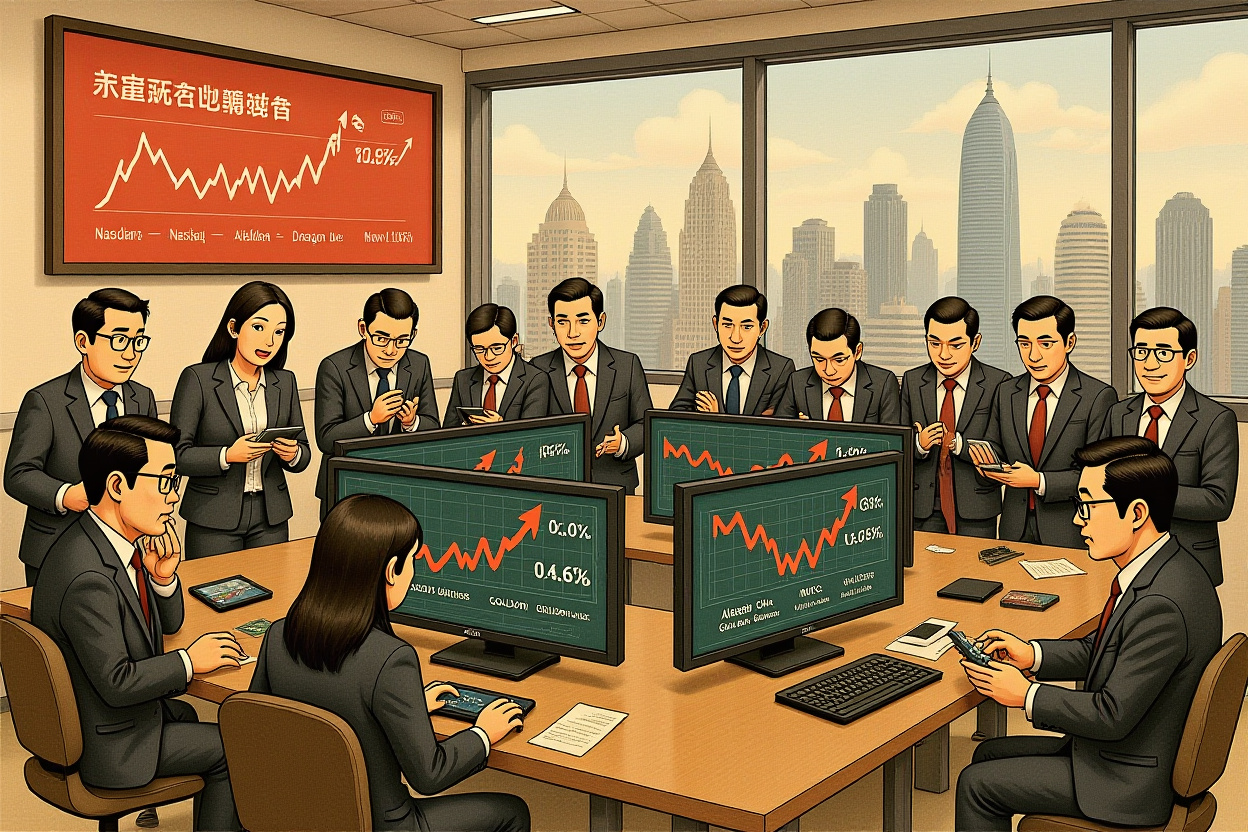
– A broad sell-off hit U.S. markets on April 7, 2026, with major indices and technology stocks leading the decline.
– The Nasdaq China Golden Dragon Index, a key benchmark for U.S.-listed Chinese stocks, fell 0.46%, indicating heightened pressure on Chinese equity markets.
– Healthcare insurance stocks, such as Humana and UnitedHealth Group, surged against the trend, highlighting sectoral divergence.
– This movement underscores the complex interplay between U.S. market sentiment, China-specific regulatory dynamics, and global investment flows.
– Investors should monitor these trends for implications on portfolio allocation and opportunities in domestic A-shares.
The trading session on April 7, 2026, delivered a stark reminder of the volatility inherent in global equity markets, particularly for assets tied to China’s economic narrative. As U.S. indices opened lower and extended their losses, a palpable sense of risk-off sentiment swept through trading desks worldwide. This decline was notably pronounced among U.S.-listed Chinese stocks, a critical segment for international investors seeking exposure to China’s growth story. The collective downturn raises urgent questions about the underlying drivers—be it shifting monetary policy expectations, nascent regulatory developments from Beijing, or broader macroeconomic crosscurrents. For sophisticated market participants, understanding this episode is not merely about tracking daily price action; it is about deciphering the signals for future capital allocation in one of the world’s most consequential equity markets.
The Broad U.S. Market Retreat: Setting the Stage for Global Ripples
A synchronous decline across the three major U.S. indices formed the backdrop for the day’s trading anxiety. The Nasdaq Composite fell 0.58%, the S&P 500 dropped 0.53%, and the Dow Jones Industrial Average retreated 0.63%. This broad-based weakness suggested concerns transcending any single sector, potentially linked to recalibrated expectations around interest rates or looming economic data.
Technology Sector Leads the Downward Momentum
Large-cap technology stocks, often viewed as bellwethers for growth and risk appetite, were significant contributors to the market’s malaise. Apple Inc. saw its shares decline over 2%, while Tesla, Oracle, Microsoft, Nvidia, and Qualcomm all traded lower. This pressure in the tech sector can dampen sentiment for growth-oriented investments globally, including those in high-growth Chinese tech firms listed abroad. The sell-off in these names may reflect profit-taking after recent rallies or nervousness regarding valuation levels in a potentially slowing economic environment.
U.S.-Listed Chinese Stocks: A Detailed Examination of the Sell-Off
The performance of U.S.-listed Chinese stocks often serves as a real-time barometer for international confidence in China’s corporate sector and regulatory landscape. On this day, the barometer pointed squarely toward caution. The Nasdaq China Golden Dragon Index (纳斯达克中国金龙指数), a crucial benchmark tracking American depositary receipts (ADRs) of Chinese companies, declined 0.46%. This move placed it firmly within the broader market downdraft but with nuances specific to the Chinese equity story.
Notable Decliners Across Multiple Sectors
The decline was widespread among prominent names, indicating a sector-agnostic risk reassessment. Key movers included:
– Century Internet (世纪互联): Down over 3%, reflecting pressure on cloud and data center services.
– Hesai Technology (禾赛科技): Fell more than 2%, highlighting sensitivity in the advanced manufacturing and autonomous driving space.
– Pony.ai (小马智行), Nio (蔚来), and Xunlei (迅雷): Each dropped over 1%, affecting the electric vehicle and internet technology sectors.
– Established giants like Alibaba Group (阿里巴巴集团), JD.com (京东集团), Baidu Group (百度集团), NetEase (网易), and New Oriental (新东方) also traded lower. This broad-based weakness among U.S.-listed Chinese stocks suggests that investors were applying a cautious brush to the entire cohort, possibly due to macro concerns or anticipation of policy shifts from Chinese regulators.
Potential Catalysts Behind the Pressure
Healthcare Stocks Defy the Gloom: A Sectoral Safe Haven EmergesAnalyzing the Surge in Insurance SharesRegulatory and Macroeconomic Winds from China: The Core ContextThe performance of U.S.-listed Chinese stocks cannot be divorced from the policy environment in their home country. Recent months have seen a measured but consistent approach from Chinese regulators, focusing on stable, high-quality growth.
Recent Policy Signals and Their Market Impact
The State Council (国务院) and financial authorities like the CSRC have emphasized support for the technology sector within a framework of enhanced compliance and data security. Any perceived tightening or ambiguity in these policies can swiftly impact investor sentiment toward offshore-listed Chinese companies. For instance, discussions around new rules for cross-border data flows or listings could be weighing on stocks like Alibaba and Baidu. Monitoring official announcements from bodies like the National Development and Reform Commission (国家发展和改革委员会) is crucial for anticipating such shifts.
Key Economic Indicators from the World’s Second-Largest Economy
Strategic Implications for International Investors and Fund ManagersPortfolio Rebalancing and Risk Management ConsiderationsForward-Looking Guidance and Scenario AnalysisMapping the Decline to Domestic A-Shares: Seeking Correlated OpportunitiesThe tagline from the original report—观美股风云,循映射脉络,觅A股机会!—aptly highlights a critical exercise: tracing the implications of U.S. market moves for China’s domestic stock exchanges. Historically, there has been a correlation between U.S.-listed Chinese stocks and their A-share counterparts, though this relationship can decouple based on local factors.