



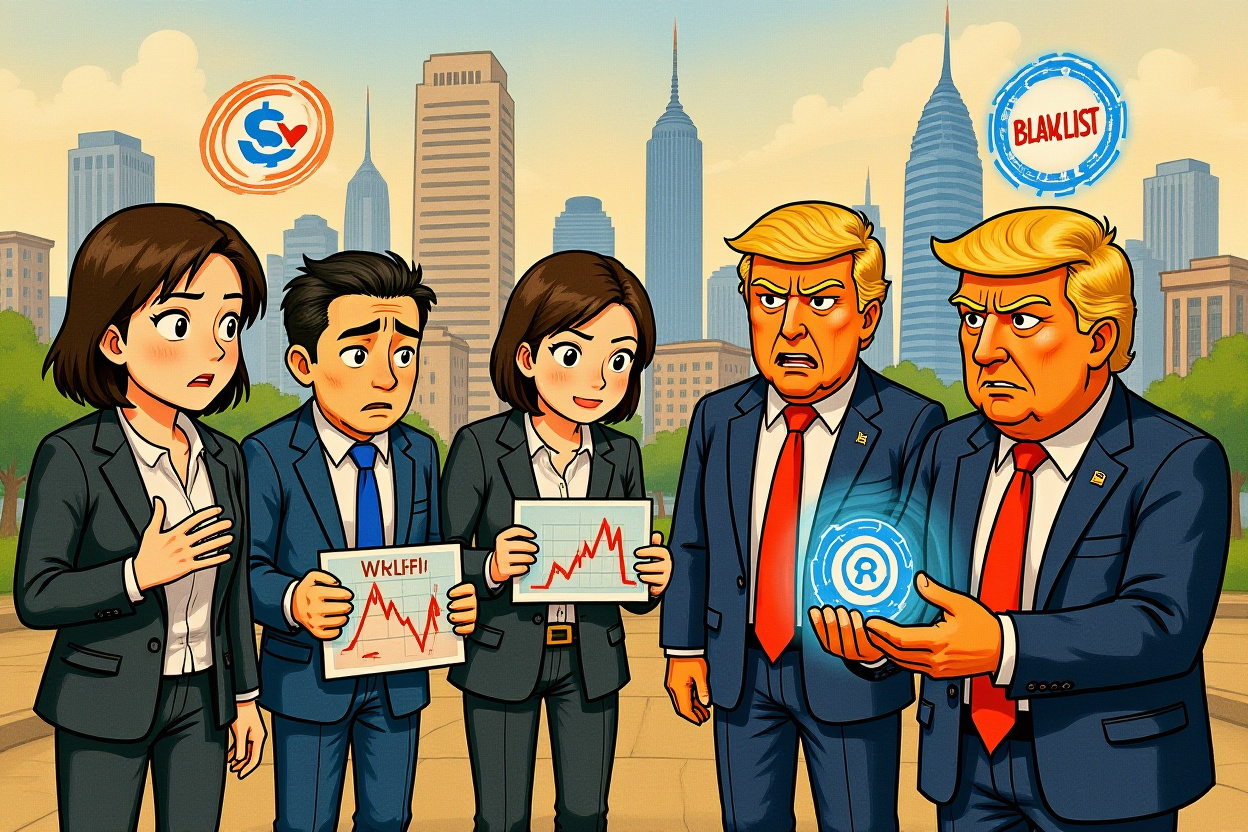
The cryptocurrency world was rocked on September 4th when World Liberty Financial, the crypto initiative backed by the Trump family, blacklisted a wallet belonging to prominent investor Justin Sun (孙宇晨), effectively freezing millions of dollars worth of WLFI tokens. This dramatic move came just days after the token’s public debut, which saw its value plummet nearly 60% from its initial price. The conflict between one of crypto’s most visible figures and America’s most politically powerful family reveals the complex, often opaque relationships shaping digital asset markets today. This article breaks down the events, the players, and what this high-stakes dispute means for the future of cryptocurrency investments and regulatory boundaries.
The WLFI Token Launch and Immediate Turbulence
World Liberty Financial’s WLFI token launched on September 1st amid considerable fanfare, leveraging the Trump name to attract immediate attention. Within hours, the token was trading on major platforms including Coinbase, where early investors hoped for substantial returns. However, the excitement was short-lived. Data from Coinbase showed WLFI’s price crashing from over $0.30 at launch to just $0.18 by September 4th—a cumulative drop of 59.82%. This volatility raised eyebrows across crypto communities, with many questioning the token’s stability and the project’s underlying governance.
Justin Sun’s Massive Investment
Blockchain entrepreneur Justin Sun had positioned himself as one of WLFI’s earliest and largest backers. According to his public statements on X (formerly Twitter), Sun had invested $30 million during the project’s early stages—matching exactly the amount World Liberty Financial claimed was needed to begin operations. Later, Sun revealed his total investment had grown to $75 million, making him the project’s second-largest known investor. His involvement wasn’t purely financial; Sun also served as an official advisor to World Liberty Financial and used his own crypto platform to promote USD1, the project’s flagship stablecoin.
The Blacklisting Decision: What We Know
On September 4th, World Liberty Financial took the extraordinary step of adding one of Sun’s wallet addresses to its blacklist, preventing any transfer of approximately 545 million WLFI tokens. Blockchain analysts from Nansen, including research analyst Nikolai Sundgaard, confirmed that the tokens were effectively frozen. Interestingly, just before the blacklisting, Sun had moved 50 million tokens to another address—a transaction that now appears prescient. The company released a statement addressing community concerns but stopped short of naming Sun or detailing why his tokens were frozen. They emphasized that blacklisting was reserved for addresses associated with ‘malicious or high-risk activities’ that could harm community members.
Sun’s Public Response and Demands
Justin Sun did not remain silent. In a post directed at the ‘World Liberty Financial team’ on X, he protested the freezing of his tokens as ‘unreasonable’ and demanded immediate access to his assets. He mentioned these actions occurred during ‘operations’ but provided no specifics about what those operations entailed, how many tokens were affected, or who authorized the freeze. A spokesperson from Sun’s company, Tron, indicated that communication channels with WLFI remained open and that discussions were ongoing. This public airing of grievances highlighted the tension between Sun and the Trump-affiliated project, despite their previously collaborative relationship.
Trump Family Connections and Crypto Ambitions
The conflict underscores the increasingly complex web of business relationships surrounding the Trump family’s crypto ventures. Earlier this year, Eric Trump (埃里克·特朗普) and other World Liberty Financial representatives shared stages with Justin Sun at major crypto conferences in Dubai and Hong Kong. Donald Trump Jr. (小唐纳德·特朗普) and Sun frequently exchanged public praise on X, complimenting each other’s projects and vision for digital currencies. These interactions weren’t merely ceremonial; they signaled a strategic alignment between Sun’s extensive influence in Asian crypto markets and the Trump family’s branding power in the West.
Financial and Political Stakes
For the Trump family, cryptocurrency represents both a financial opportunity and a potential political tool. World Liberty Financial’s promise of ‘economic freedom’ aligns with broader political messaging, while its tokenized structure offers a way to monetize that message. Sun’s involvement brought not just capital but also credibility in tech circles and access to his massive following. The decision to blacklist his wallet—a move so public and consequential—suggests internal disagreements over strategy, financial control, or regulatory compliance. It also risks alienating other major investors who value liquidity and transparency.
Market Reactions and Investor Implications
The fallout from the blacklisting was immediate. WLFI’s price continued to decline, and trading volumes dipped as nervous investors pulled back. On social media and forums, commentators debated whether this was an isolated incident or a warning sign for crypto projects tied to political figures. The situation revealed several critical lessons for investors:
– Even high-profile backers like Justin Sun aren’t immune to sudden governance actions.
– Projects with centralized control mechanisms (like blacklisting) carry unique risks.
– Political connections can attract attention but also introduce unpredictability.
Data from CoinGecko confirmed WLFI’s struggles, with the token failing to regain its initial value. World Liberty Financial’s earlier promise—that early investors could sell up to 20% of their holdings—now seemed ironic, given that one of their largest investors was prevented from selling any.
Broader Implications for Crypto Governance
This incident raises important questions about governance in decentralized and semi-decentralized projects. World Liberty Financial’s ability to single-handedly freeze a wallet challenges the notion of ‘decentralization’ that many crypto advocates promote. It also highlights the power dynamic between project creators and investors, even when those investors are influential figures like Justin Sun. Regulatory bodies worldwide are watching closely, as events like this could justify tighter oversight of crypto projects, particularly those with political ties.
Regulatory and Legal Pathways
While Sun has not yet threatened legal action, the situation could escalate. Blacklisting a major investor without clear explanation might breach contractual agreements or violate securities laws, depending on how WLFI is classified. Sun’s options include private arbitration, public pressure, or formal complaints to regulators. The outcome could set precedents for how crypto projects manage internal disputes and investor rights—a topic of immense importance as digital assets mature.
Looking Ahead: Resolution or Escalation?
As of now, both parties claim to be in communication, seeking a resolution. For World Liberty Financial, restoring Sun’s access might stabilize the token and reassure other investors. For Sun, recovering his $75 million investment is the immediate priority, though his reputation as a savvy crypto investor is also on the line. The Trump family’s reputation in the crypto space—still nascent—could suffer if this dispute drags on or ends acrimoniously. Investors and observers should watch for:
– Official statements from either side clarifying the reasons for the blacklist.
– Changes in WLFI’s governance rules to prevent similar situations.
– Market movements indicating renewed confidence or further decline.
This clash between two powerful forces in crypto serves as a reminder: even in cutting-edge financial ecosystems, old-fashioned conflicts over money and control still dominate. How this situation resolves could influence not just these players but the entire landscape of politically-linked cryptocurrency projects.
The Trump-Sun feud is more than a personal disagreement; it’s a case study in crypto’s growing pains. Investors should prioritize transparency, understand governance structures, and diversify to mitigate risks. For those watching from the sidelines, this saga underscores the importance of due diligence—especially when famous names are involved. Stay informed by following reliable sources and always verify claims before investing in any asset, digital or otherwise.