



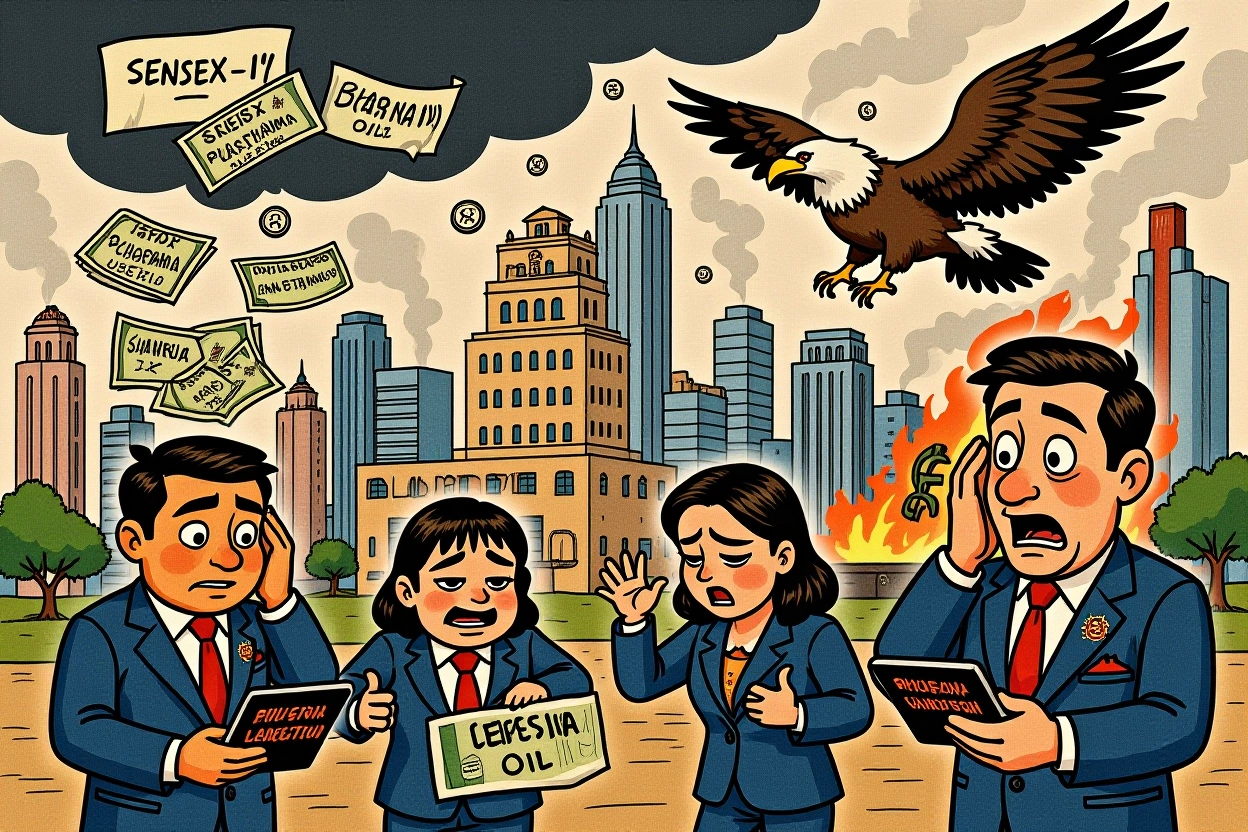
The Tariff Shockwave
President Trump’s unexpected announcement of 25% tariffs on Indian goods effective August 1 has sent shockwaves through Mumbai’s financial district, compounding existing pressures on India’s $3.4 trillion stock market. The Bombay Stock Exchange Sensex tumbled nearly 1% at opening Thursday as pharmaceutical giant Dr. Reddy’s Laboratories plunged 1.36% and state-owned Indian Oil Corporation crashed over 3%. This aggressive trade measure surpasses tariffs imposed on most Asian nations – typically ranging between 15-20% – and arrives as India grapples with slowing economic growth and capital flight.
The trigger point appears buried in agricultural negotiations. Tomo Kinoshita, Invesco’s Global Market Strategist, explains: “India maintains its reputation as a formidable trade negotiator, but this rigidity has now backfired dramatically.” Sources reveal Washington demanded greater access to India’s politically sensitive agricultural sector – a red line for Prime Minister Narendra Modi given farmer protections remain crucial to his support base. Simultaneously, the administration threatened secondary sanctions over India’s continued energy imports from Russia, creating twin pressure points.
Sectors Under Siege
Analysis reveals five critical industries facing immediate jeopardy from the proposed tariff structure:
Pharmaceuticals: Treatment Disruption
– India supplies 40% of US generic drugs and $8 billion annually in pharmaceutical exports
– Leading firms like Sun Pharma derive over 30% revenue from American markets
– IQVIA data confirms Indian manufacturers fill 4 of every 10 US prescriptions
Electronics: Supply Chain Upheaval
– Apple’s strategic shift to Indian iPhone manufacturing now jeopardized
– Bloomberg Intelligence predicts increased consumer costs and inventory delays
– Potential 25% duty eliminates cost advantages gained through production relocation
Textiles: Advantage Erosion
– Gap and Walmart suppliers face irrecoverable cost disadvantages
– Competitive imbalances loom against Vietnam’s tariff-free access
– 15% export decline projected by Clothing Manufacturers Association of India
Gems and Jewelry: Market Paralysis
– $100 billion industry faces thousand-per-employee livelihood impacts
– Gem & Jewellery Export Promotion Council warns of “critical disruption”
– Diamond polishing hubs expecting overnight order cancellations
Energy Sector: Vulnerability to Secondary Sanctions
– Russian oil constitutes 37% of Indian imports via deep-discount agreements
– Reliance Industries and Indian Oil exposed to lost competitive pricing
– Potential $15/barrel cost increase without Russian crude access
The Capital Flight Crisis
This trade tremor compounds existing market fragility. Foreign investors have pulled $2.4 billion from Indian equities this month alone – the fastest capital emigration since 2022 according to Securities and Exchange Board of India data. The capital flight coincides with:
– Underperformance: MSCI India Index trails regional index by 13% year-to-date
– Private equity exit surge: $6B/month divestment pace established for Q3
– Valuation collapse: Nifty 50 price-to-earnings ratio contracting from 21.5x to 17.8x
Nuvama strategist Prateek Parekh observes: “Slowing domestic inflows transfer decisive power to foreign capital movements now trending bearish.” Market weakness continues despite the Modi administration pursuing $63B in privatization initiatives through Oil India and Bharat Petroleum stake sales.
Electronics Exodus Emergencies
Apple’s intricately planned manufacturing transition faces unexpected peril. The Cupertino-based company moved 7% of iPhone production from China to India in 2024 – projected to reach 25% by late-2027 before Trump’s announcement. Foxconn executives privately report they’re “accelerating Vietnam contingency planning” amid Tamil Nadu factory uncertainty.
Samsung faces similar recalibration pressures simultaneously. The Korean electronics giant invested $800M in Greater Noida displays plant targeting North American exports. Company sources acknowledged “strategic reconsiderations” but declined specification pending trade clarification.
Defensive Investor Actions
As negotiations continue ahead of Sunday’s purported deadline, market participants deploy tactical defenses:
1. Implementing currency hedges against projected rupee depreciation beyond ₹84/$
2. Targeted portfolio rebalancing toward domestic healthcare and utilities exposure
3. Short positions accumulating against exporters like Tata Motors
4. Exploring ASEAN manufacturing partnerships
5. Lobbying through FICCI trade associations for agricultural compromise solutions
Pharmaceutical Countermeasures
Top drug exporters implement multi-prong responses:
– Dr. Reddy’s accelerating FDA plant inspections
– Cipla establishing Puerto Rico manufacturing partnerships
– Diverting API shipments via Singapore to circumvent direct-cost disadvantages
– Coordinating export price increases averaging 10.5% announced Thursday
The escalating tensions contradict military coordination strengthening through QUAD security alignment. This disconnect highlights deepening fractures in US-India cooperation frameworks despite geopolitical alignment against Chinese influence.
Economic Tectonic Plates
The tariff clash marks a historic collision between protectionist doctrines: America First versus Modi’s Make in India industrial strategy. Regardless of weekends negotiation theater, structural tensions ensure volatile conditions will persist. Goldman Sachs downgraded FY2025 GDP growth projections from 6.1% to 5.3% citing trade deterioration.
The Reserve Bank of India prepares liquidity injections while nervously monitoring inflation implications of necessary rupee depreciation. Finance ministry officials simultaneously activate ASEAN outreach seeking accelerated regional trade partnerships.
Market participants must track crucial developments:
– Specific tariff exemptions announcement timing
– Agricultural compromise boundary definition
– Russia oil sanctions enforcement mechanisms
– Finance sector ripple effects visible through yields
Your Financial Defense Strategy
Contain portfolio bleeding by rotating exposure away from export-reliant pharmaceuticals toward defensive FMCG sector leaders through ITC holdings. Immediately review stock-bond allocation ratios favoring domestic debt instruments anticipating market volatility. Engage treasury professionals educated on currency hedging mechanisms at institutes like Indian Institute of Management Calcutta. Monitor US Commerce Department determinations daily for imposition exemptions.