



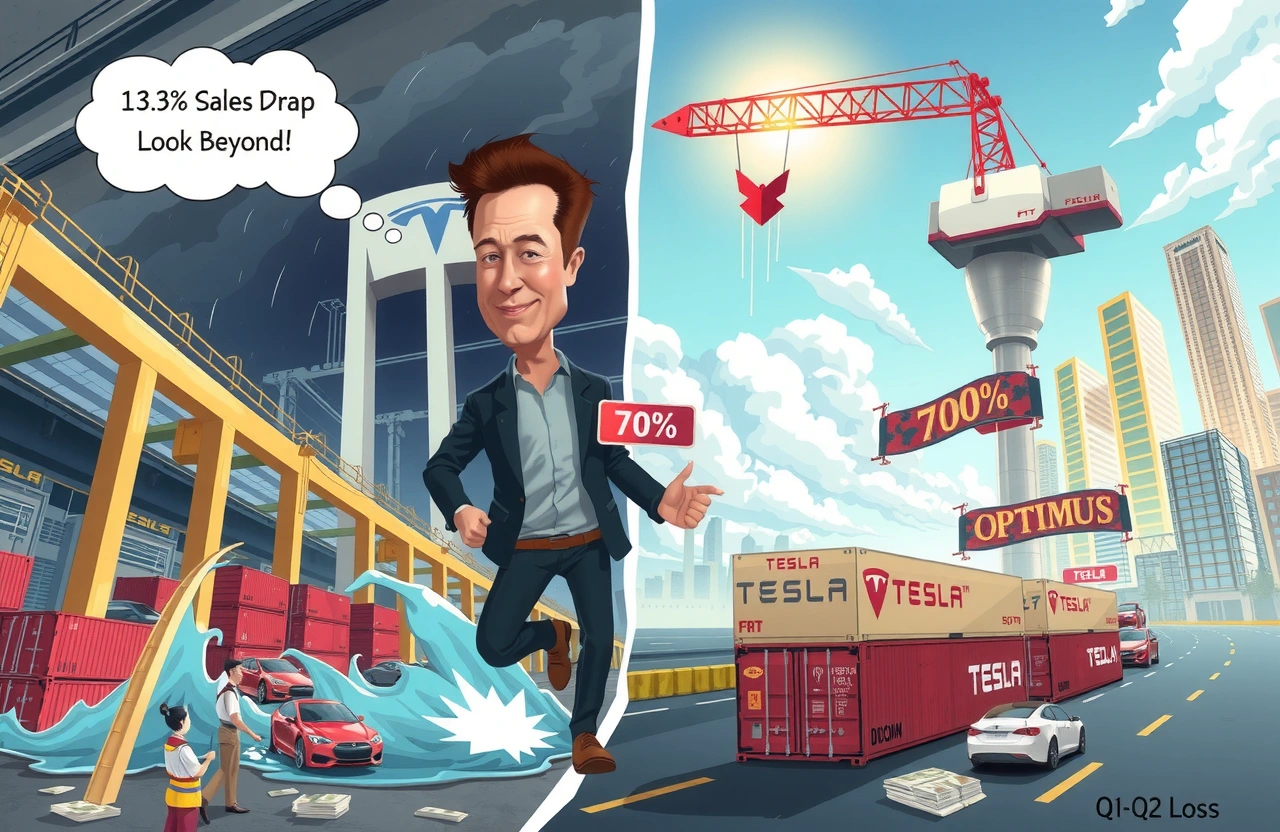
– Tesla’s Q2 2025 sales plunged 13.5% amid industry-wide EV slowdown and policy uncertainty
– Elon Musk declares short-term volatility irrelevant while refocusing on autonomous taxi networks and Optimus robots
– Critical executive departures compound challenges from Musk’s political controversies
– Robotaxi service launches signal Tesla’s high-stakes autonomy pivot
– Competitive pressures mount as legacy automakers adapt to cooling EV demand
Tesla finds itself navigating treacherous terrain as vehicle sales tumbled for consecutive quarters in 2025. A 13.5% year-over-year plunge in Q2 deliveries follows Q1’s 13% drop – marking the worst sustained performance in the company’s history. Against this backdrop of financial strain, Elon Musk (埃隆·马斯克) startles stakeholders by dismissing conventional wisdom. “Observing flowers bloom? Look beyond,” he replied during Tesla’s earnings call. This philosophy underpins his dramatic pivot to autonomy, now steering Tesla’s resources toward driverless taxis and humanoid robots despite slumping immediate revenues.
Financial Storm Intensifies
The Wall Street Journal’s July 2 analysis confirms Tesla’s operational turbulence. With automobile revenues constituting over 75% of Tesla’s income through 2024, the latest quarterly figures underscore systemic vulnerability.
Q2 Sales Analysis
Tesla’s Wednesday report revealed troubling details:
– Global deliveries fell below 380,000 vehicles
– North American inventory climbed to 68 days supply
– Market share retreated to 18% in premium EV segment
Competitive Squeeze
As Tesla stumbled, competitors advanced:
– Ford’s F-150 Lightning achieved record adoption among fleet buyers
– Hyundai’s Ioniq 6 captured Millennial buyers with enhanced battery efficiency
– Chevrolet Equinox EV saw 22% sales growth benefiting from dealer incentives
Musk’s Strategic Detour
Amid financial tremors, Elon Musk (埃隆·马斯克) unveiled a radical pivot to autonomy.
Project Prioritization Shifts
Development resources previously allocated to the $25,000 Model 2 have been fully redirected to Cybercab. This complete transformation in direction illustrates Musk’s relentless pursuit of autonomy.
Robotaxi Rollout and Vision
June’s Austin launch demonstrated Model Y navigating factory-to-residence routes sans driver. Musk envisions:
– Over 100,000 Cybercabs operational by late 2026
– Private vehicle owners monetizing idle cars via Tesla’s ride-hailing platform
– Uber-like revenue models with 70% owner share of fares
External Headwinds Accelerate
Tesla’s woes reflect broader industry contraction.
Market Cooling Indicators
Cox Automotive confirms ominous trends:
– US EV sales collectively declined approximately 7%
– Purchase consideration surveys show softening among middle-income consumers
– Dealership EV inventories rose to 103-day supply nationwide
Policy Support Weakens
Congressional proposals threaten the $7,500 federal tax credit program. Additional complications emerged:
– Zero-emission vehicle mandates delayed in 9 states
– California’s EV-only parking privileges facing legal challenges
Turbulence Within Headquarters
Executive instability compounds Tesla’s external pressures.
Leadership Exodus
Within thirty days, two pivotal executives departed:
– Omead Afshar (European/American manufacturing director)
– Milan Kovac (Optimus robotics lead)
Their exits follow unresolved strategy clashes.
The board’s discontent surfaces as Chairman Robyn Denholm (罗宾·德霍姆) conceded “operational engagement concerns” before reaffirming the board’s backing of Musk’s growth vision.
Brand Controversies Escalate
Musk’s confrontations spark consumer backlash:
– Social media clashes with President Trump spurred #BoycottTesla campaigns
– Republican donor lawsuits challenge Musk’s third-party political PAC
– Consumer Reports notes 11-point brand perception decline
The controversy forced Musk’s May resignation from government technology consulting commitments.
Robotics Revolution Progress
Behind Tesla’s pivot to autonomy, tangible robotics milestones emerge.
Optimus Production Timeline
The humanoid robot project continues with:
– Warehouse receiving prototype completed
– Modular hand mechanisms achieving $10/hr production cost target
– Foxconn reportedly bidding for contract manufacturing
AI Infrastructure Scale
Dojo supercomputer clusters enable breakthroughs:
### Processing Statistics
– 102 exaflops computing capacity verified
– Neural net training durations shortened by 43%
– Real-world scenarios modeling 8x faster than competitors
Critically, such advances accelerate Tesla’s autonomy pivot beyond automobiles.
Roadmap Through Disruption
The automaker’s immediate challenges demand difficult calculus.
Cash Position Analysis
Despite setbacks, Tesla retains strategic flexibility:
– Liquid reserves: $24.3 billion
– Energy storage sales grew 40% last quarter
– Solar deployments reached record capacity
Manufacturing Transition
With traditional vehicle lines scaling back:
– Gigafactory Texas prioritizing Cybercab installations
– Shanghai plant converting 20% capacity toward robotaxi production
– Battery supply chains shifting toward stationary storage
Tesla’s pivot to autonomy now defines its corporate trajectory.
The company’s trajectory highlights rare corporate evolution under pressure. Industry analysts suggest monitoring Tesla’s autonomy ecosystems integration through late 2026. For investors, waiting for signals of robotaxi revenue materialization remains essential before assessing Musk’s strategy validity. Meanwhile, prospective EV buyers should evaluate competing vehicles against Tesla’s refocused priorities.