



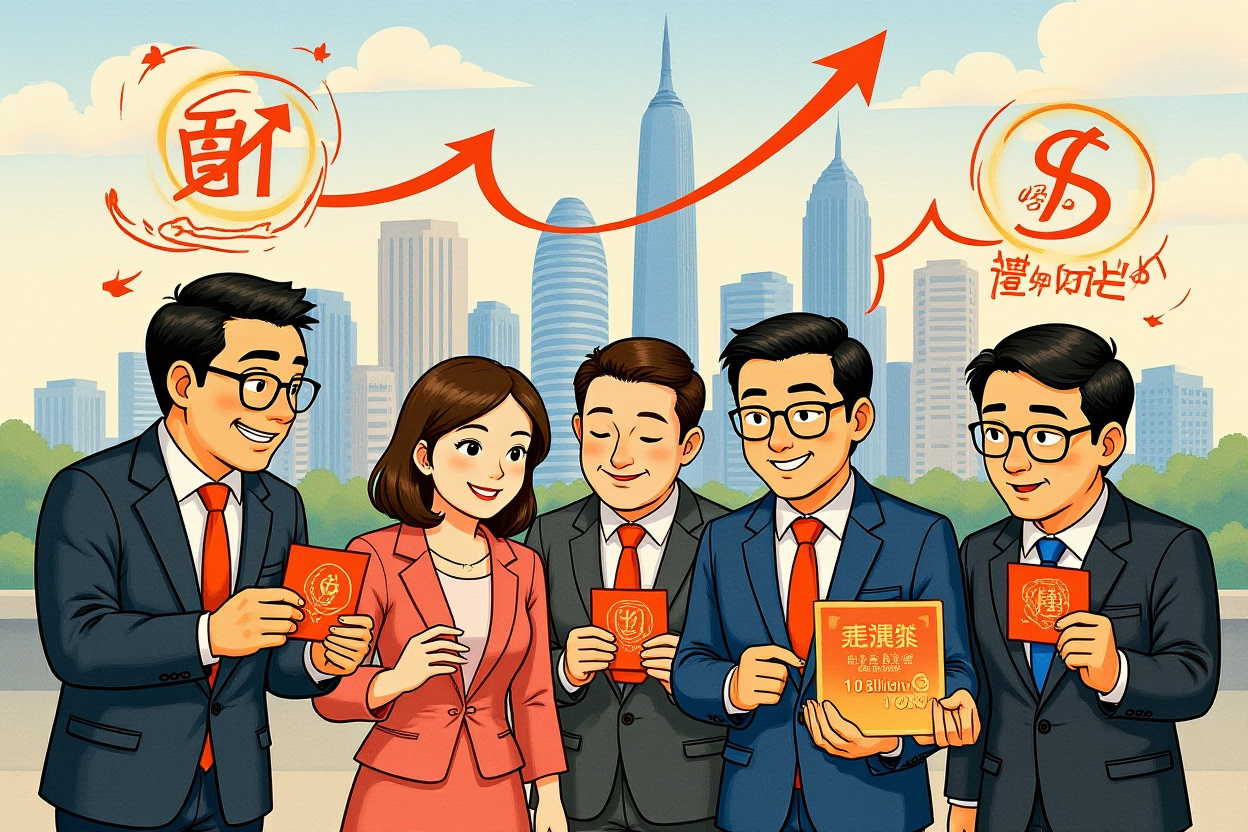
– Tencent (腾讯) is distributing 10 billion yuan in cash red envelopes through its Yuanbao App (元宝App), marking a aggressive return to holiday marketing battles to boost its AI platform’s user base. – The campaign is backed by social AI features like Yuanbao Pai (元宝派), aiming to create a new ‘AI+social’ interaction model and catch up to rivals such as ByteDance’s (字节跳动) Doubao (豆包). – Tencent CEO Ma Huateng (马化腾) has admitted the company ‘slowed down’ in AI infrastructure and is now making strategic adjustments, including organizational reshuffles and high-profile talent hires. – Competitors like Alibaba (阿里巴巴) and ByteDance are also escalating their AI efforts, setting the stage for a pivotal market showdown during the 2026 Chinese New Year period. – Investors should monitor whether Tencent can convert short-term traffic spikes into long-term user engagement, as the battle for AI supremacy intensifies.
Tencent Unleashes a 10 Billion Yuan Red Envelope Onslaught in Yuanbao App
In a dramatic move that has sent shockwaves through China’s tech industry, Tencent (腾讯) has announced a staggering 10 billion yuan cash red envelope giveaway through its Yuanbao App (元宝App), reigniting a marketing war it had largely sat out for years. This aggressive campaign, set to begin on February 1, is not merely a festive gesture but a calculated strategic pivot aimed at propelling Tencent back into the forefront of the artificial intelligence race. The company hopes to replicate the legendary success of its 2015 WeChat (微信) red envelope campaign, which overnight reshaped China’s mobile payment landscape. With the Yuanbao App at the center of this gambit, Tencent is signaling that it can no longer afford to be a spectator in the high-stakes battle for AI dominance, where rivals have already built significant leads.
Revisiting the WeChat Playbook: A Blueprint for AI Disruption
Tencent Chairman and CEO Ma Huateng (马化腾) personally endorsed this move at the company’s 2025 annual employee meeting, explicitly stating the goal was to ‘recreate the glorious moment of the 2015 WeChat red envelopes.’ That historic campaign, which distributed 5 billion yuan over the Lunar New Year, resulted in approximately 200 million new bank card bindings in just two days, effectively enabling WeChat Pay (微信支付) to rival Alipay (支付宝). The Yuanbao App campaign is designed to trigger similar viral social裂变 (social fission), using cash incentives to drive massive user adoption. However, the underlying ambition extends far beyond temporary user acquisition. The Yuanbao App is envisioned as Tencent’s flagship AI-native application, intended to connect core services like WeChat, QQ, Tencent Meeting (腾讯会议), Tencent Video (腾讯视频), and QQ Music (QQ音乐). This integration strategy aims to make Yuanbao more than just a chatbot, transforming it into a central hub for daily digital life.
The Yuanbao App: Tencent’s Vehicle for an AI Counteroffensive
The focus on the Yuanbao App is deliberate. After a relatively late entry into the consumer AI application space in May 2024, Tencent has been aggressively promoting it. According to estimates from AppGrowing, Tencent invested approximately 15 billion yuan in marketing for Yuanbao in 2025 alone. Despite this, user metrics reveal a challenging gap. Data from QuestMobile shows that as of Q3 2025, Doubao (豆包) commanded 172 million monthly active users (MAU), followed by DeepSeek with 145 million MAU. The Yuanbao App trailed in third place with around 32.86 million MAU. This disparity underscores the urgency behind Tencent’s 10 billion yuan red envelope blitz—it is a direct attempt to buy market share and user attention in a field where first-mover advantages are proving critical.
The Social AI Experiment: Inside the Yuanbao Pai Feature
While the red envelopes grab headlines, Tencent’s true strategic innovation lies in the ‘Yuanbao Pai’ (元宝派), a new social AI feature currently in internal testing. Inspired by Tencent Meeting group chats, Yuanbao Pai allows users to create or join a ‘pai’ (派) – a dedicated social space where the AI assistant can participate in conversations, moderate氛围 (atmosphere), execute tasks, share screens, and even enable friends to ‘watch or listen together.’ This represents a fundamental shift: moving AI from a standalone tool to an active participant within social contexts. By leveraging its deep expertise in social networking, Tencent is attempting to define a new paradigm for human-AI interaction, one that could foster stronger user retention than mere utility.
Building an AI-Native Social Field
Tencent insiders describe Yuanbao Pai as a crucial exploration into social scenarios for AI. Unlike simply bolting AI capabilities onto existing apps like WeChat, Yuanbao Pai represents a dedicated, AI-first social field. This approach allows for more radical experimentation without risking the stability and user experience of WeChat, a国民级 (national-level) communications tool with over a billion users. For Tencent, Yuanbao Pai serves as a testing ground. If successful, it could become an unassailable moat in the AI era; if it fails, the lessons learned will inform future developments. The feature’s ability to drive organic, purpose-driven user gatherings around shared interests or tasks is key to solving the post-campaign retention puzzle that often plagues cash-driven user acquisition.
Acknowledging the Lag: Why Tencent Admits It ‘Slowed Down’
In a rare moment of corporate candor, Ma Huateng (马化腾) conceded at the employee meeting that Tencent had been ‘slow’ in its AI initiatives, particularly in building AI infrastructure. This admission highlights a significant strategic vulnerability. While peers like Baidu (百度) with Ernie Bot (文心一言), Alibaba with Tongyi Qianwen (通义千问), and ByteDance with Doubao launched their consumer-facing AI apps in 2023, Tencent’s Yuanbao App did not arrive until mid-2024. This delay allowed competitors to educate users, capture mindshare, and build entrenched usage habits. The traditional Tencent playbook of ‘following and then excelling’ after market battles are clarified, as noted by知名投资人 (renowned investor) Zhu Xiaohu (朱啸虎), is being challenged by the AI era’s new dynamics.
The High-Stakes Infrastructure Race
The AI competition has evolved into a war of attrition centered on computing power, data, and talent. The rule is simple: greater early investment leads to stronger models, which attract more users and data, creating a powerful feedback loop. Competitors have embraced this logic wholeheartedly. Alibaba (阿里巴巴) announced plans to invest at least 380 billion yuan over three years in cloud and AI infrastructure. Reports suggest ByteDance (字节跳动) budgeted 160 billion yuan for AI infrastructure in 2026. Tencent’s late start in centralizing its AI efforts—only moving the Yuanbao App and its Hunyuan large model to the Cloud and Smart Industries Group (CSIG) in late 2024—has put it at a potential disadvantage in this foundational arms race.
Tencent’s Strategic Recalibration: From Follower to Contender
Recognizing the gap, Tencent has initiated a comprehensive strategic pivot. Organizationally, it established large language model and multimodal model departments within its Technology Engineering Group (TEG) in April 2025. In December 2025, it further升级 (upgraded) its R&D架构 (architecture) by creating new departments for AI infrastructure, AI data, and data computing platforms. The most symbolic move, however, was the high-profile recruitment of Yao Shunyu (姚顺雨), a former OpenAI researcher. Yao serves as Tencent’s Chief AI Scientist in the CEO/President’s office, reporting to President Martin Lau (刘炽平), and also leads the AI Infra and large language model departments, reporting to TEG President Lu Shan (卢山).
Leveraging Talent and Ecosystem Synergy
Yao Shunyu’s (姚顺雨) appointment signals Tencent’s intent to shift from局部跟随 (localized following) to attempting to set the pace. He is expected to not only provide strategic direction but also act as a magnet for top-tier AI talent. Tencent is reportedly offering salaries 50% above industry standards for relevant Ph.D. graduates to rapidly expand its AI team. Internally, the Hunyuan model is being developed with a focus on Agent capabilities to serve business lines, while providing deeply customized models for the Yuanbao App to strengthen its ‘AI+social’标签 (tag). This synergy aims to make the Yuanbao App a more intelligent and integrated part of Tencent’s vast ecosystem.
The Competitive Frenzy: Rivals Escalate the AI War
Tencent’s anxiety is well-founded, as its competitors show no signs of slowing down. ByteDance’s Doubao (豆包) is not resting on its laurels. It has integrated recommendations for抖音电商 (Douyin e-commerce) links and directly embedded生态产品 (ecosystem products) like汽水音乐 (Qishui Music), aiming to become a comprehensive lifestyle portal. Furthermore, Doubao’s partnership with China Central Television (CCTV) for the 2026 Spring Festival Gala will give it unparalleled exposure to hundreds of millions of viewers, potentially widening its lead. Similarly, Alibaba’s Qianwen App (千问App) reached over 100 million MAU within two months of its November 2025 launch and has now been deeply integrated with Taobao (淘宝), Alipay (支付宝), and other阿里生态 (Alibaba ecosystem) services, offering hundreds of AI-powered functions.
The Impending Chinese New Year Showdown
The timing of Tencent’s campaign is no accident. The Lunar New Year period has historically been a critical battleground for user acquisition in China. Following Tencent’s announcement, Baidu (百度) quickly countered by promising 5 billion yuan in cash red envelopes through its ‘Wenxin Assistant’ (文心助手). Meanwhile, at ByteDance’s first all-hands meeting of 2026, CEO Liang Rubo (梁汝波) set ‘勇攀高峰’ (bravely scaling new heights) as the annual theme, explicitly defining豆包/Dola助手 (Doubao/Dola Assistant) as the company’s short-term ‘peak.’ This convergence of massive marketing spend and strategic focus sets the stage for the 2026 Spring Festival to become a decisive chapter in China’s AI application war, where the Yuanbao App must prove its mettle.
Market Implications and the Path Forward for Tencent
For institutional investors and market observers, Tencent’s moves raise critical questions about sustainability and long-term value creation. The 10 billion yuan red envelope splash will undoubtedly generate a massive short-term user influx for the Yuanbao App. However, the true test lies in whether Tencent can leverage features like Yuanbao Pai to foster habitual use, moving beyond a mere红包猎人 (red envelope hunter) phenomenon. The company’s ability to seamlessly weave AI into social, entertainment, and productivity scenarios across its ecosystem will determine if it can close the gap with Doubao and build a durable competitive edge.
Balancing Short-Term Tactics with Long-Term Strategy
The current frenzy reflects a broader industry consensus that owning the dominant consumer AI super-app is imperative for the next era. Tencent’s strengths in social connectivity and its vast user base across multiple platforms provide a formidable foundation. However, as an AI practitioner quoted in the article noted,豆包 (Doubao) benefited from the massive traffic of抖音 (Douyin) and gained a first-mover advantage in shaping user habits. Tencent’s challenge is to execute its social AI vision flawlessly while accelerating its underlying model capabilities. The outcome will not only affect Tencent’s stock valuation but could redefine competitive dynamics in Chinese tech for years to come.
Tencent’s AI Crossroads
The 10 billion yuan campaign is a clear statement that Tencent is all-in on the AI race. While the cash giveaway is a dramatic opening move, the company’s future in AI hinges on the innovative appeal of Yuanbao Pai, the speed of its infrastructure catch-up, and its success in attracting top talent. The market should watch for user engagement metrics post-Chinese New Year, the rollout of new AI-social features, and any further strategic partnerships or integrations. In an era where technological leadership is constantly being contested, Tencent has shown it is willing to spend aggressively to secure its place. The coming months will reveal whether this financial firepower can ignite a sustainable AI revolution within its walls.