



Executive Summary
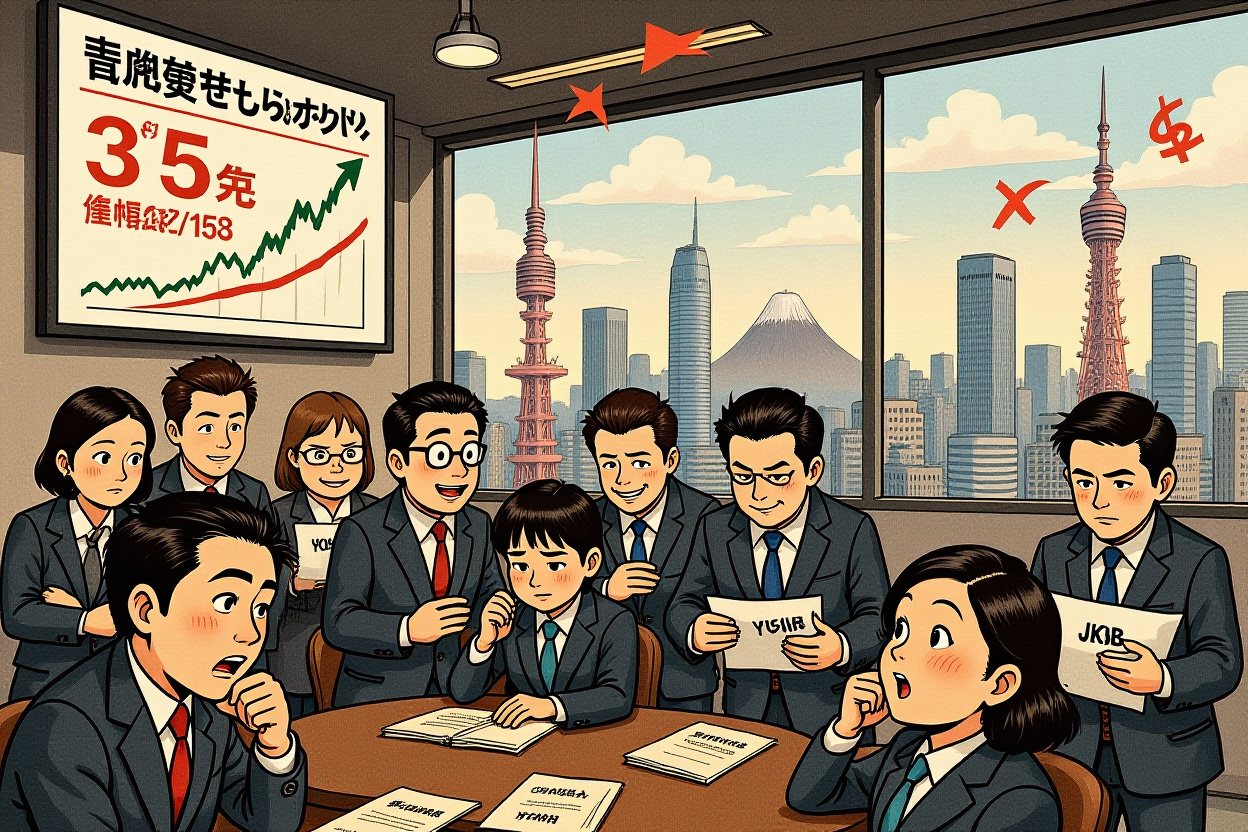
The recent surge in Japanese equities, dubbed the ‘Takaichi Trade’, presents a complex puzzle for investors. Below are the critical takeaways from our in-depth analysis.
- The Nikkei 225’s record highs mask significant turbulence in Japan’s government bond (JGB) and foreign exchange markets, driven by fears over Prime Minister Sanae Takaichi’s (高市早苗) fiscal agenda.
- Market calm in debt and currency spheres may be fleeting, with analysts warning of a potential ‘Takaichi Trap’ where aggressive spending weakens the yen, fuels inflation, and ultimately undermines equity gains.
- The Bank of Japan faces a policy dilemma between supporting growth and containing currency depreciation, with intervention risks looming if the yen approaches 160 against the U.S. dollar.
- Japan’s colossal public debt, at 237% of GDP, remains a structural vulnerability, though market opinions are sharply divided on its immediate risk given high domestic ownership of JGBs.
- Investors should look beyond the equity rally for confirmation of policy prudence, focusing on concrete fiscal details and the central bank’s response to mounting market pressures.
Market Euphoria Meets Underlying Anxiety
The Japanese stock market is celebrating, but the party has a nervous edge. As the Nikkei 225 index soared to consecutive historic highs this week, climbing a cumulative 5% on the back of Sanae Takaichi’s (高市早苗) electoral victory, a strategic play known as the ‘Takaichi Trade’ has captured global attention. This phenomenon describes the bullish bet on equities fueled by expectations of expansionary fiscal policy. However, seasoned market participants are sounding alarms, questioning whether this rally is built on sustainable foundations or if it’s paving the way for a sharp correction. The disconnect between jubilant stocks and jittery bonds and forex markets suggests that the ‘Takaichi Trade’ is as much about perceived opportunity as it is about unaddressed systemic risks.
Beneath the surface of index milestones, government bond yields and the yen have displayed a relative calm that contradicts pre-election volatility. This tranquility is disconcerting to many. A Tokyo-based fixed-income trader, who requested anonymity, encapsulated the sentiment: ‘We should probably view this as a temporary phenomenon. The core issue is how she pays for her promises. This isn’t a honeymoon; it feels more like the calm before the storm.’ The market’s initial reaction to Takaichi’s ¥135 billion fiscal stimulus plan last November was a sell-off in bonds and the yen. Now, with a powerful mandate, the Prime Minister has the political capital to follow through, which is precisely the source of deepening market anxiety.
Record Highs and Rational Exuberance
The equity surge is not without rationale. Investors are pricing in the potential for short-term economic boosts from targeted fiscal spending, particularly in sectors poised to benefit from consumer-focused policies. Takaichi’s campaign pledge to suspend the food消费税 (consumption tax) for two years, estimated to cost ¥5 trillion (approximately $32 billion), is seen as a direct stimulus to household spending. This has driven inflows into consumer discretionary and retail stocks, propelling the broader index. The ‘Takaichi Trade’, in its purest form, is a wager that these measures will successfully combat deflationary pressures and reignite domestic demand without immediate fiscal repercussions.
The Disquiet in Debt and Currency Markets
While equities climb, the bond and currency markets tell a different story. The yield on the 40-year Japanese Government Bond (JGB) briefly spiked above 4% in anticipation of heavy debt issuance, and the yen has hovered near 153 against the U.S. dollar, a level that triggers official concern. This divergence is a classic warning sign. It indicates that a segment of the market, particularly institutional and global players, is hedging its equity bets by pricing in higher long-term borrowing costs and currency depreciation. The relative stability post-election may reflect hope that Takaichi will exercise restraint, but it also sets the stage for violent moves if that hope is dashed. The ‘Takaichi Trade’ thus operates in a dual reality: one of equity optimism and another of debt market skepticism.
Deciphering the ‘Takaichi Trade’ Mechanics
To understand whether the ‘Takaichi Trade’ is an opportunity or a trap, one must dissect its components and the competing narratives driving asset prices. The trade is fundamentally a reflection of market psychology surrounding Japan’s political shift. On one hand, it embodies optimism about growth-oriented policy breaking decades of stagnation. On the other, it fears the untested fiscal ambitions of a leader with a strong populist mandate. This section breaks down the origins and evolving dynamics of this pivotal market theme.
The term ‘Takaichi Trade’ emerged in financial circles as a shorthand for positioning around the Prime Minister’s economic agenda. It is not a single strategy but a constellation of bets across asset classes. For equity bulls, it involves overweighting Japanese stocks, especially those tied to domestic consumption and infrastructure. For bond bears and currency traders, it involves shorting the yen and demanding higher premiums for long-dated JGBs. The central tension of the ‘Takaichi Trade’ lies in these opposing positions, which cannot both be winners in the long run.
Origins in Political Momentum and Market Speculation
The trade’s genesis can be traced to Sanae Takaichi’s (高市早苗) rise within the Liberal Democratic Party and her explicit focus on tackling Japan’s cost-of-living crisis. Her commitment to fiscal activism, a departure from the more cautious approach of some predecessors, immediately altered market calculus. Speculators front-ran the potential for a weaker yen to boost exporter profits, while long-term investors grappled with the implications for Japan’s creditworthiness. The ‘Takaichi Trade’ gained full momentum after her election victory, which secured a strong majority in the Diet, removing a key obstacle to implementing her platform. This political clarity cut both ways: it provided certainty for equity investors but also concrete reason for debt market vigilance.
Investor Sentiment: A House Divided
Market participants are split on the trade’s viability, largely along the lines of their investment horizon and geographic focus.
- Short-Term Traders: Many hedge funds and proprietary trading desks see the ‘Takaichi Trade’ as a tactical opportunity, riding the wave of positive sentiment and liquidity flows, with plans to exit before potential fiscal reckoning.
- Long-Only Institutional Investors: Global pension funds and asset managers are more cautious. They are conducting deeper due diligence on Japan’s fiscal sustainability, concerned that currency-driven gains could be erased by inflation or a debt crisis.
- Domestic Japanese Investors: Households and domestic institutions, major holders of JGBs, have shown relative calm, trusting in the government’s ability to manage debt. This domestic insulation is a key pillar of the ‘Takaichi Trade’ optimism but also a potential blind spot.
Darren Tay, Head of Asia-Pacific Country Risk at BMI, notes, ‘The ‘Takaichi Trade’ in equities is running ahead of reality. Markets may be underestimating the populist pressure she has unleashed. The view that Japan’s debt is mostly domestically held can foster a dangerous sense of insulation from global market discipline.’
The Currency Trap and Central Bank’s Policy Quagmire
A critical vulnerability within the ‘Takaichi Trade’ thesis is the Japanese yen. Aggressive fiscal spending without commensurate monetary tightening risks exacerbating the yen’s decline, creating a feedback loop that could trap policymakers. Darren Tay of BMI explicitly warns of a ‘Takaichi Trap’ for the currency: higher government spending elevates devaluation risks, which in turn increases import costs for energy and food, stoking inflation that could choke consumer spending and corporate margins. This scenario would directly undermine the equity rally the trade is betting on.
Currently, the yen trades around 153 to the dollar, a multi-decade low that keeps officials on edge. Prime Minister Takaichi has relied on her Finance Minister, Satsuki Katayama (片山皋月), to soothe markets, with ministry officials issuing verbal warnings about readiness to intervene. The threshold for action is a closely watched metric. Osamu Takashima, FX Strategist at Citi, states, ‘We believe the government will intervene in the market if the yen retraces to 160.’ This potential intervention creates a complex dilemma for the Bank of Japan (BOJ).
Yen Vulnerability and the Specter of Intervention
The yen’s weakness is structural, driven by Japan’s persistent interest rate differentials with the West. The ‘Takaichi Trade’ amplifies this by adding fiscal uncertainty. If markets believe her spending will be debt-financed, it pressures the yen further. Intervention to support the currency is costly and often ineffective without a fundamental shift in monetary policy. A veteran currency trader in London remarked, ‘If the BOJ stays loose and the Ministry of Finance intervenes, any such move would essentially act as a temporary subsidy for yen shorts.’ This dynamic makes the ‘Takaichi Trade’ in forex a high-stakes game of chicken between speculators and authorities.
The Bank of Japan’s Unenviable Choice
The BOJ is caught between its inflation target, financial stability concerns, and now political expectations. While market consensus anticipates at least two rate hikes by 2026, some traders worry the central bank could face pressure to delay normalization to give Takaichi more fiscal space. Benjamin Shatil, Senior Economist at J.P. Morgan, observes, ‘The BOJ’s path to policy normalization just got more complicated. A premature hike could strengthen the yen and dampen growth, undermining fiscal efforts, but prolonged easing could let inflation run hotter and force more aggressive intervention.’ This policy quagmire is a core risk factor for the sustainability of the ‘Takaichi Trade’. Investors must watch for any shift in the BOJ’s rhetoric or actions as a key signal.
Fiscal Promises: Political Will Versus Market Reality
At the heart of the ‘Takaichi Trade’ debate is the feasibility of Prime Minister Takaichi’s fiscal commitments. In a post-election press conference aimed at calming financial markets, she asserted that her consumption tax cut plan would not involve issuing new bonds. However, economists and strategists remain deeply skeptical. Given the scale of her electoral mandate, the political incentive to deliver on populist promises is immense, but the fiscal arithmetic is daunting.
Benjamin Shatil of J.P. Morgan poses the critical question: ‘Given the size of the mandate she received, how can she realistically walk back such a promise? Unlike other prime ministers, she cannot use parliamentary gridlock as an excuse.’ The market is essentially calling her bluff. If she funds tax cuts through spending reallocation or other revenues, the ‘Takaichi Trade’ in equities could sustain. If she resorts to significant new borrowing, the bond market’s fears would materialize, likely triggering a rapid unwinding of the trade across all asset classes.
Analyzing the Tax Cut Plan and Debt Concerns
The proposed two-year food tax suspension is a microcosm of the larger challenge. Its ¥5 trillion price tag is substantial, and financing it without new debt would require cuts elsewhere or the use of limited fiscal reserves. Japan’s general account budget for FY2024 is approximately ¥112 trillion. Adding this stimulus, even if temporarily, strains an already tight fiscal framework. Analysts at Nomura Research Institute point out that while debt levels themselves may not be an imminent problem, the market’s reaction function has changed. Economist Takahide Kiuchi (木内登英) warned, ‘I have never experienced such a sharp rise in long-term yields as we saw pre-election. The government needs to respond to these warning signals, or Japan could face a crisis.’
Structural Headwinds and the Yen Carry Trade
Beyond immediate fiscal plans, deeper structural issues challenge the ‘Takaichi Trade’ narrative. Shusuke Yamada, Head of Japan FX and Rates Strategy at Bank of America, argues that the election did not alter the fundamental drivers of yen weakness. ‘Firms and investors will continue to seek returns outside an aging, slow-growth Japan. The yen carry trade is unlikely to reverse anytime soon,’ Yamada stated. He emphasized, ‘They need to see tangible proof that Japan is a better long-term investment destination… that takes years.’ This sentiment underscores that the ‘Takaichi Trade’ is a cyclical play on policy, not a structural bet on Japan’s economic renaissance. For the trade to evolve from a short-term opportunity to a long-term investment theme, it must be supported by genuine productivity gains and demographic solutions, which are absent from current policy discussions.
Japan’s Debt Mountain: A Contested Risk for the ‘Takaichi Trade’
No analysis of the ‘Takaichi Trade’ is complete without confronting Japan’s monumental public debt, which the International Monetary Fund (IMF) estimates at 237% of GDP. This towering liability is the ultimate backdrop against which all fiscal maneuvers are judged. Market perceptions of this risk are strikingly polarized, creating another layer of uncertainty for participants in the ‘Takaichi Trade’.
On one side, some analysts downplay the immediate danger, citing Japan’s unique financial ecosystem. Nicholas Smith, Japan Strategist at CLSA, argues that much of the concern reflects foreign investor views. He notes that foreign investors hold only 6.6% of outstanding JGBs but account for 71% of futures trading volume. ‘Foreign investors have no skin in the game. All indications are they don’t really understand this market,’ Smith said, pointing out that Japan’s net debt position is significantly lower than its gross debt and is projected to decline in coming years due to current account surpluses.
The Domestic Holder Thesis and Its Limits
The prevailing comfort with Japan’s debt stems from its high domestic ownership. Japanese banks, insurers, and the Bank of Japan itself hold the vast majority of JGBs, creating a captive investor base that is less likely to stage a sudden sell-off. This provides the government with considerable leeway, a factor baked into the bullish side of the ‘Takaichi Trade’. However, this insulation is not absolute. As yields rise, even domestic institutions face mark-to-market losses and pressure to reallocate portfolios. Furthermore, as noted by BMI’s Darren Tay, reliance on domestic holdings ‘can give the government a dangerous sense of insulation,’ causing it to ignore warning signals from the global bond market, where Japan’s credit default swaps (CDS) are traded.
When Could the Debt Become a Crisis?
The risk scenario for the ‘Takaichi Trade’ is not a sudden default but a gradual loss of market confidence. If Sanae Takaichi’s (高市早苗) government is perceived as abandoning fiscal discipline, it could trigger a sustained rise in long-term interest rates. This would increase debt servicing costs, crowd out other spending, and weaken the yen further—a toxic mix for equities. Takahide Kiuchi of Nomura warns that while debt levels have been high for years, ‘the market’s tolerance has limits. Pre-election yield spikes were a shot across the bow.’ For investors engaged in the ‘Takaichi Trade’, monitoring JGB auction demand and yield curve movements is as crucial as watching the Nikkei. A breakdown in the domestic bid for bonds would be a clear signal that the trade’s foundation is cracking.
Synthesizing the Crosscurrents for Global Investors
The ‘Takaichi Trade’ encapsulates the classic investment dilemma of weighing short-term momentum against long-term fundamentals. Japanese equities offer compelling momentum, driven by policy hopes and corporate governance reforms. Yet, this rally is juxtaposed against profound risks in the bond and currency markets, fueled by untested fiscal expansion and a vulnerable yen. The trade is not inherently a trap, but it demands sophisticated navigation and clear-eyed risk management.
For global institutional investors and fund managers, the path forward involves moving beyond binary thinking. The opportunity lies in selective exposure to companies with strong balance sheets and global revenue streams that can withstand yen volatility. The trap awaits those who chase the rally indiscriminately, ignoring the currency hedge and duration risks in their portfolios. The coming quarters will be decisive: watch for the government’s first supplementary budget, the BOJ’s policy meetings, and any shifts in JGB auction dynamics. These will provide concrete evidence of whether the ‘Takaichi Trade’ can mature into a sustainable investment theme or if it will succumb to the fiscal and monetary pressures now brewing beneath Japan’s market calm.
Call to Action: Investors should immediately stress-test their Japanese equity and debt holdings against scenarios of a weaker yen (towards 160/USD) and a 50-basis-point rise in 10-year JGB yields. Engage with on-the-ground research to distinguish between domestic sentiment and international risk perceptions. Consider structured products or options strategies to gain equity exposure while explicitly hedging currency and interest rate tail risks. The ‘Takaichi Trade’ requires not just conviction, but contingency planning.