



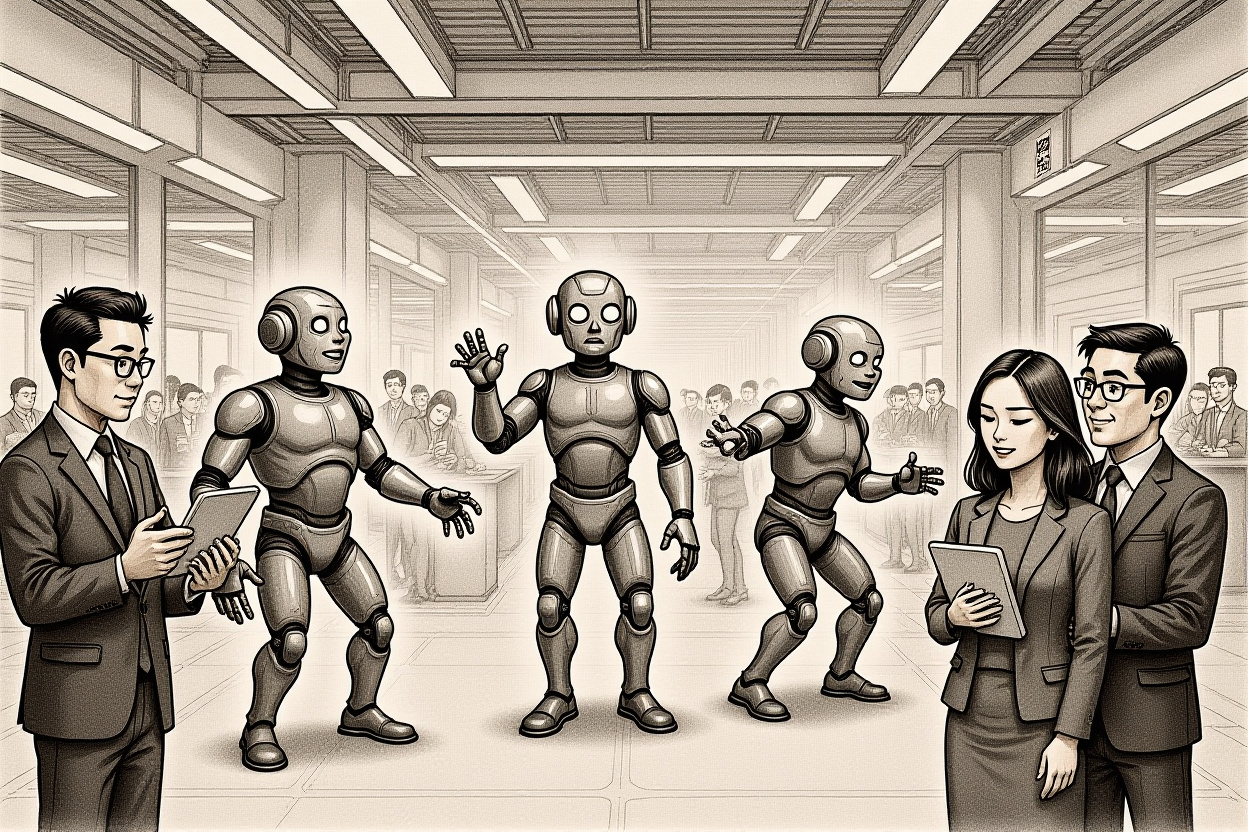
The National Stage as a Commercial Launchpad
For decades, China Central Television’s (CCTV) Spring Festival Gala has been more than just a variety show; it is a cultural institution and a powerful barometer for technological trends. In 2026, this tradition reached a new zenith, transforming the iconic stage into what industry observers are calling the “ultimate testing ground” for China’s burgeoning embodied artificial intelligence (AI) sector. The simultaneous appearance of four leading humanoid robot companies—Unitree Robotics, Magic Atom, Galaxy General, and Songyan Power—signaled a pivotal shift. It marked the moment the industry graduated from laboratory demonstrations and niche exhibitions to a full-scale, national-level audition for mainstream acceptance and commercial viability.
The Gala’s immense viewership, estimated in the hundreds of millions, provides an unrivaled platform for mass education and normalization. For embodied AI—a field encompassing robots that can perceive, reason, and interact with the physical world—this public debut was a calculated strategic move. It aimed not merely to dazzle but to convince a skeptical public and pragmatic industrial buyers that Chinese robotic technology is ready for prime time. As the lights dimmed on the 2026 Gala, the real performance began: the arduous journey from captivating stage act to indispensable commercial tool.
Decoding the Lineup: A Tale of Four Partners
A closer examination of the four participating companies reveals subtle but significant strategic positioning, evident in their officially designated titles. Unitree Robotics was titled the “Gala Robot Partner,” building on its breakout performance in 2025 that propelled it to industry fame. Its collaboration with the renowned Henan Tagou Martial Arts School for the program “武 BOT” showcased dynamic, high-precision movement, reinforcing its brand in advanced locomotion.
Songyan Power appeared as the “Gala Humanoid Robot Partner,” focusing on its anthropomorphic form in a comedy skit. Magic Atom was dubbed the “Gala Intelligent Robot Strategic Partner,” emphasizing AI integration in a musical performance. Galaxy General took the most technically specific title, “Gala Designated Embodied Large Model Robot,” highlighting its foundation in advanced AI models for interaction within a micro-film. These nuanced distinctions are not merely cosmetic; they reflect core technological differentiations and target markets, from industrial agility to consumer-facing interaction, that will define each firm’s path forward. This showcase was their collective thesis defense before the nation.
Beyond the Applause: The Three-Tiered Reality Check
The spectacle of synchronized robotic dancers is impressive, but as a poignant industry adage goes, “Robots cannot dance on stage forever.” The post-Gala landscape presents a sobering trilogy of challenges that these companies must now navigate. Success in a choreographed, controlled environment is merely the entrance exam. The real degree is earned in the messy, unpredictable, and economically unforgiving real world.
The transition from a national showcase to a commercially sustainable business model is the defining hurdle for China’s embodied AI sector. The “ultimate testing ground” of the Gala exposed their capabilities, but the subsequent tests will determine their survival. Each progressive stage represents a leap in complexity, cost sensitivity, and technological integration.
The First Gate: Conquering the Factory Floor
The most immediate and tangible market for humanoid robots lies in industrial automation. Sectors like electronics assembly, automotive manufacturing, and logistics grapple with labor shortages and the need for consistent, high-throughput precision. The value proposition here is clear: perform repetitive, strenuous, or hazardous tasks with unerring reliability.
However, the factory floor is a merciless judge. Unlike the Gala stage, there are no retakes.
- Demands: 24/7 operational uptime, sub-millimeter precision, seamless integration with existing machinery and software systems (MES/ERP), and a compelling return on investment (ROI) measured in months, not years.
- Pitfalls: Robots that perform flawlessly in climate-controlled labs may fail due to vibrations, electromagnetic interference, dust, or variable lighting on a real production line. A single minute of unscheduled downtime can result in significant financial losses.
- The Test: Moving from performing a single, pre-programmed task to handling a variety of parts, adapting to minor anomalies, and working safely alongside human workers. The key metric shifts from “number of dance moves” to “mean time between failures” and “total cost of ownership.”
The Second Gate: Navigating Complex Commercial Spaces
The next tier of difficulty involves deploying robots in dynamic public and commercial environments such as warehouses, retail stores, hospitals, and hotels. Here, the challenges multiply exponentially. The environment is semi-structured or unstructured, filled with unpredictable human activity.
A robot that flawlessly handed a prop to an actor on the Gala stage must now navigate a crowded supermarket aisle, avoid a suddenly running child, understand a customer’s casually phrased question, and locate a specific product on a shelf that may have been rearranged. This requires a massive leap in integrated capability:
- Advanced Perception: Multi-modal sensing (LiDAR, cameras, depth sensors) to create and update a real-time map of a changing environment.
- Robust Navigation: Dynamic path planning and obstacle avoidance amidst moving people and objects.
- Natural Interaction: Speech recognition and generation that works reliably in noisy settings, combined with contextual understanding.
- Multi-Task Dexterity: The ability to switch between tasks like guiding a guest, delivering supplies, or taking inventory.
Success in this arena proves a robot’s utility beyond a single, repetitive factory task, opening a vast market for service-oriented automation.
The Third Gate: The Distant Frontier of the Home
The final and most formidable frontier is the consumer home—the industry’s acknowledged “final frontier” and potential “blue ocean.” This is the most demanding “ultimate testing ground” imaginable. Homes are profoundly unstructured, cluttered, and designed for human, not robotic, mobility.
Challenges include dealing with stairs, carpets, pets underfoot, toys left on the floor, variable lighting, and highly ambiguous commands (e.g., “tidy up the living room”). Furthermore, the requirements for safety, affordability, and simplicity are paramount. A home robot must be:
- Fail-Safe: Incapable of causing injury or significant damage, even with software errors or physical bumps.
- Intuitively Easy: Operable by non-technical users, with minimal setup and maintenance.
- Cost-Competitive: Priced at a point that justifies its utility for a mass-market consumer, likely requiring massive economies of scale not yet achieved.
While this market represents the largest long-term opportunity, it is a decade or more away for general-purpose robots. Current forays are limited to single-function devices like robot vacuums and lawn mowers.
The 2026 Inflection Point: From Hype to Hard Metrics
The collective appearance at the 2026 Spring Festival Gala serves as a powerful demarcation line for China’s embodied AI industry. Analysts agree that the sector is transitioning from a “proof-of-concept” and fund-raising phase, driven by venture capital excitement and technological demos, into a rigorous “commercial validation” phase. The criteria for success are being fundamentally rewritten.
In the years leading to 2026, the leaderboard was often determined by the size of funding rounds, the frequency of press conferences, or the sophistication of prototype videos. Post-2026, the conversation is shifting decisively toward tangible business outcomes. The “ultimate testing ground” of the market now evaluates different key performance indicators (KPIs).
The New Report Card: Orders, Margins, and Scale
The new phase demands evidence of sustainable business models. Investors, both strategic and financial, are increasingly focused on hard metrics that demonstrate real-world traction and a path to profitability.
- Pilot-to-Production Conversion: How many demonstration projects with manufacturing or logistics firms have converted into recurring, paid deployment contracts? A high-profile pilot is no longer enough.
- Customer Retention and Expansion: Are early adopters placing follow-on orders and expanding their use of robots within their operations? This is the strongest signal of product-market fit and ROI.
- Gross Margins and Unit Economics: Can the company manufacture and deploy its robots at a cost significantly below the price it commands? Achieving positive unit economics is a critical milestone.
- Supply Chain Mastery: Securing reliable, cost-effective supplies of critical components like precision actuators, sensors, and chips is a major competitive moat, especially in a geopolitically tense environment.
The pressure is now on the four Gala veterans, and their peers, to prove that the billions in investment flowing into the sector can generate commensurate returns. The stakes are immense. IDC predicts that user spending on embodied AI robots in China will reach a staggering $77 billion by 2030, representing a compound annual growth rate (CAGR) of approximately 94%. This gold rush, however, will only reward those who can mine real value.
Strategic Landscape: Capital, Policy, and Global Context
The drive to commercialize embodied AI in China is not happening in a vacuum. It is powerfully propelled by a confluence of national strategy, capital markets, and global technological rivalry. Understanding this context is essential for investors gauging the sector’s long-term potential and risks.
The Chinese government has explicitly prioritized robotics and AI in its successive five-year plans. Local governments are offering subsidies, establishing innovation zones, and acting as first customers to spur adoption. This top-down support provides a significant tailwind, reducing initial go-to-market barriers for firms like those featured in the Gala. Furthermore, the push for technological self-sufficiency amplifies the strategic importance of developing a leading domestic robotics industry.
The Funding Frenzy and Impending Shakeout
Venture capital and corporate investment have flooded into the space. However, the capital intensity of developing and manufacturing advanced humanoid robots is extreme. Building a prototype is one thing; scaling production, establishing a sales force, and providing ongoing service is another.
- Burn Rate Concerns: Many startups are operating with high cash burn rates, relying on successive funding rounds to stay afloat. The shift in investor focus toward revenue places immense pressure on these companies to generate income quickly.
- Consolidation on the Horizon: Industry experts, including analysts who spoke to Phoenix Net Finance’s Corporate Research Institute, anticipate a wave of consolidation within the next 3-5 years. Not all current players will secure the large, anchor customers needed to survive. Mergers, acquisitions, and outright failures are likely as the market matures.
- The Vertical Integration Imperative: Leading firms are racing to control more of their technology stack, from proprietary actuators and joints to their own embodied AI software platforms. This vertical integration is seen as crucial for controlling costs, ensuring performance, and protecting intellectual property.
Globally, Chinese firms are part of a fierce race against well-funded Western counterparts like Tesla (with its Optimus robot), Boston Dynamics (owned by Hyundai), and Figure AI. The Spring Festival Gala display was, in part, a statement of competitive parity and ambition on the world stage.
Forward Guidance for the Discerning Investor
The dazzling display of robotic prowess at the 2026 CCTV Spring Festival Gala was a watershed moment for China’s embodied AI industry. It successfully introduced a nation to its robotic future and provided a spectacular launchpad for its leading companies. However, for the sophisticated institutional investor, the performance was merely the opening act. The core investment thesis now hinges on the difficult, unglamorous work of commercialization.
The “ultimate testing ground” has moved from the national stage to the factory workshop, the warehouse floor, and eventually, the living room. The companies that shone under the Gala lights must now prove they can operate just as effectively in the shadows of real-world industrial demands. The coming years will separate the contenders from the pretenders, based on a ruthless new report card of purchase orders, operating margins, and customer testimonials.
For investors, this necessitates a shift in due diligence focus. Look beyond the technical specifications and demo reels. Scrutinize the client roster for reputable, repeat buyers. Analyze the scalability of the manufacturing process and the stability of the supply chain. Assess the management team’s experience in navigating complex B2B sales cycles and achieving unit economics. The era of betting on potential is giving way to the era of betting on execution. The final curtain on the Gala has fallen, but the most critical performance—the performance that will define an industry—is just beginning.