



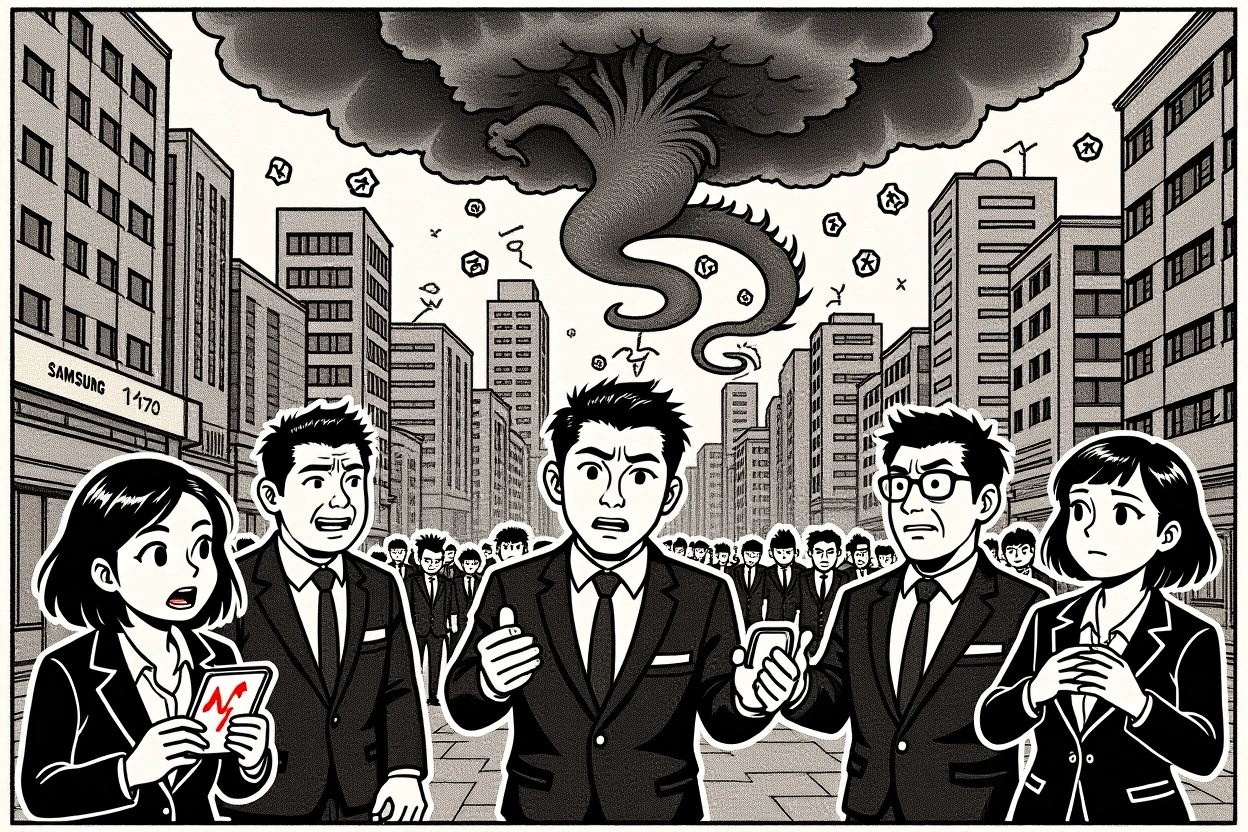
– KOSPI index plunged nearly 4% on August 1 – the sharpest single-day decline since April
– Government tax reforms target capital gains thresholds and transaction levies
– Retail investors launched petition with 17,000+ signatures opposing changes
– Crash complicates President Lee Jae-myung’s (李在明) 5,000-point market target
– Samsung Electronics led declines amid disappointing earnings report
The Sudden Market Freefall
On August 1, 2025, South Korea’s financial markets experienced a violent tremor as the benchmark KOSPI index nosedived nearly 4% – its steepest single-day plunge since early April. This abrupt correction erased approximately $72 billion in market value within hours, transforming Seoul’s trading floors into scenes of palpable anxiety. The sell-off outpaced declines across major Asian exchanges, with Japan’s Nikkei falling 2.1% and Hong Kong’s Hang Seng down 1.8% during the same session. Trading volume surged to 150% of the 30-day average as automated sell programs triggered cascading stop-loss orders.
The Tax Proposals That Sparked Panic
The Ministry of Economy and Finance unveiled a three-pronged tax overhaul that became the immediate catalyst for the KOSPI crash:
– Capital gains tax threshold slashed from ₩5 billion ($3.57 million) to ₩1 billion ($714,000)
– Stock transaction tax increased from 0.15% to 0.20%
– Corporate tax ceiling raised from 24% to 25%
– Dividend tax brackets restructured: 20% on ₩20M-₩300M ($14,300-$214,000), 35% above ₩300M
Finance Minister Choi Sang-mok (최상목) defended the measures as necessary for funding expanded social welfare programs, but institutional investors reacted with immediate sell orders. The Korea Financial Investment Association estimates these changes could affect over 850,000 retail accounts previously exempt from capital gains taxation.
Investor Backlash and Political Fallout
Within hours of the KOSPI crash, a petition titled “Stop the Stock Market Massacre” appeared on the National Assembly’s website. It gathered over 17,000 signatures in its first 24 hours – halfway to the 50,000 threshold requiring parliamentary review. Online brokerage communities erupted with protests, while the Korea Stockholders Alliance announced coordinated “sell Mondays” demonstrations.
Presidential Ambitions Collide With Market Reality
President Lee Jae-myung’s (李在明) administration now faces mounting pressure as the market turmoil threatens his signature economic vision:
– The 5,000-point KOSPI target (requiring 50%+ growth from current levels)
– Redirecting ₩2,100 trillion ($1.5 trillion) from real estate to equities
– Corporate value-up program to eliminate “Korea discounts” in valuations
Market strategist Kim Nam-ho (김남호) of Timefolio Asset Management noted: “This KOSPI crash demonstrates how delicate the balance is between fiscal policy and market confidence. The administration’s reform zeal appears to have underestimated investor psychology.”
Structural Vulnerabilities Exposed
While the tax proposals triggered the plunge, analysts identified underlying fragilities that amplified the KOSPI crash:
Concentration Risks
The market’s heavy reliance on semiconductor stocks left it particularly exposed:
– Samsung Electronics and SK Hynix constitute 28% of KOSPI weighting
– Both companies reported disappointing Q2 earnings amid chip glut concerns
– Foreign investors sold ₩1.7 trillion ($1.2 billion) in tech shares during the crash
Retail Trading Dominance
South Korea’s unique investor profile intensified the sell-off:
– Retail traders account for nearly 70% of daily exchange turnover
– Margin debt reached record ₩26.3 trillion ($18.8 billion) in July
– Over 220,000 options contracts expired during the plunge, forcing liquidations
Global Trade Implications
The KOSPI crash occurred against the backdrop of newly finalized U.S.-Korea trade terms. The bilateral agreement signed days earlier established:
– 15% baseline tariffs on Korean automobiles and industrial goods
– $350 billion Korean investment fund for U.S. energy and infrastructure
– Reciprocal agricultural market access concessions
While avoiding the threatened 25% tariffs, the deal still drew criticism from Korea Automobile Manufacturers Association president Jung Man-ki (정만기), who warned of “profitability challenges” for exporters.
Corporate Earnings Warnings
Concurrent with the KOSPI crash, earnings disappointments revealed sector-specific vulnerabilities:
Technology Sector Stress
Samsung Electronics reported:
– 18% Q2 profit miss versus analyst estimates
– Memory chip inventory levels at 12-week supply (above healthy 8-week benchmark)
– Foundry utilization rates dropped to 75% amid reduced AI chip orders
Consumer Sector Slowdown</h3
Hyundai Motor and LG Electronics both guided for:
– Reduced H2 discretionary spending projections
– Increased bad loan provisions in financing divisions
– Inventory build-up in premium product segments
Broader Economic Context
The KOSPI crash reflects mounting pressure on Asia’s fourth-largest economy:
– Q2 GDP growth slowed to 0.3% quarter-on-quarter
– Corporate tax receipts fell 12% year-on-year
– Household debt-to-GDP ratio reached 104% in June
President Lee’s administration now faces the dilemma of either modifying tax proposals or finding alternative funding for promised ₩25 trillion ($17.8 billion) in consumer subsidies.
Technical Damage Assessment
Chart analysts identified critical breakdown levels during the KOSPI crash:
– The index closed below its 100-day moving average for first time since January
– Relative Strength Index (RSI) plunged to 28 – deepest oversold reading in 18 months
– Volume profile shows significant liquidation between 2,780-2,820 support zone
Fibonacci Asset Management CEO Yoon Jung-in (윤정인) observed: “The velocity of this decline suggests algorithmic trading exacerbated the move. Many quant models automatically trigger sales when volatility spikes beyond predetermined thresholds.”
Forward Outlook and Recovery Scenarios
Market participants are evaluating three potential pathways following the KOSPI crash:
Base Case (60% Probability)
– Partial tax compromise exempting small investors
– Technical rebound to 2,850 resistance level
– 3-6 month consolidation period
Bear Case (25% Probability)
– Full implementation of tax proposals
– Foreign capital flight exceeding $5 billion
– Test of 2,650 support (December 2024 lows)
Bull Case (15% Probability)
– Complete tax plan withdrawal
– Accelerated corporate reform initiatives
– Quick recovery to 3,000 psychological barrier
Strategic Investor Recommendations
For those navigating post-crash markets, consider these approaches:
Portfolio Protection Strategies
– Increase won-hedged positions for foreign investors
– Implement collar strategies (buy puts/sell calls) on concentrated holdings
– Rotate into low-beta sectors like utilities and healthcare
Opportunistic Entry Points
Monitor these technical indicators for re-entry signals:
– Sustained KOSPI closes above 2,850
– VKOSPI volatility index retreating below 25
– Semiconductor inventory days declining below 10 weeks
Market volatility often creates exceptional opportunities for disciplined investors. Monitor parliamentary tax debates closely through the National Assembly’s live broadcasting system, consult certified financial planners about tax-efficient investment structures, and consider dollar-cost averaging into fundamentally sound companies trading below book value. Those who maintain perspective during emotional market events typically capture the greatest long-term advantages.