



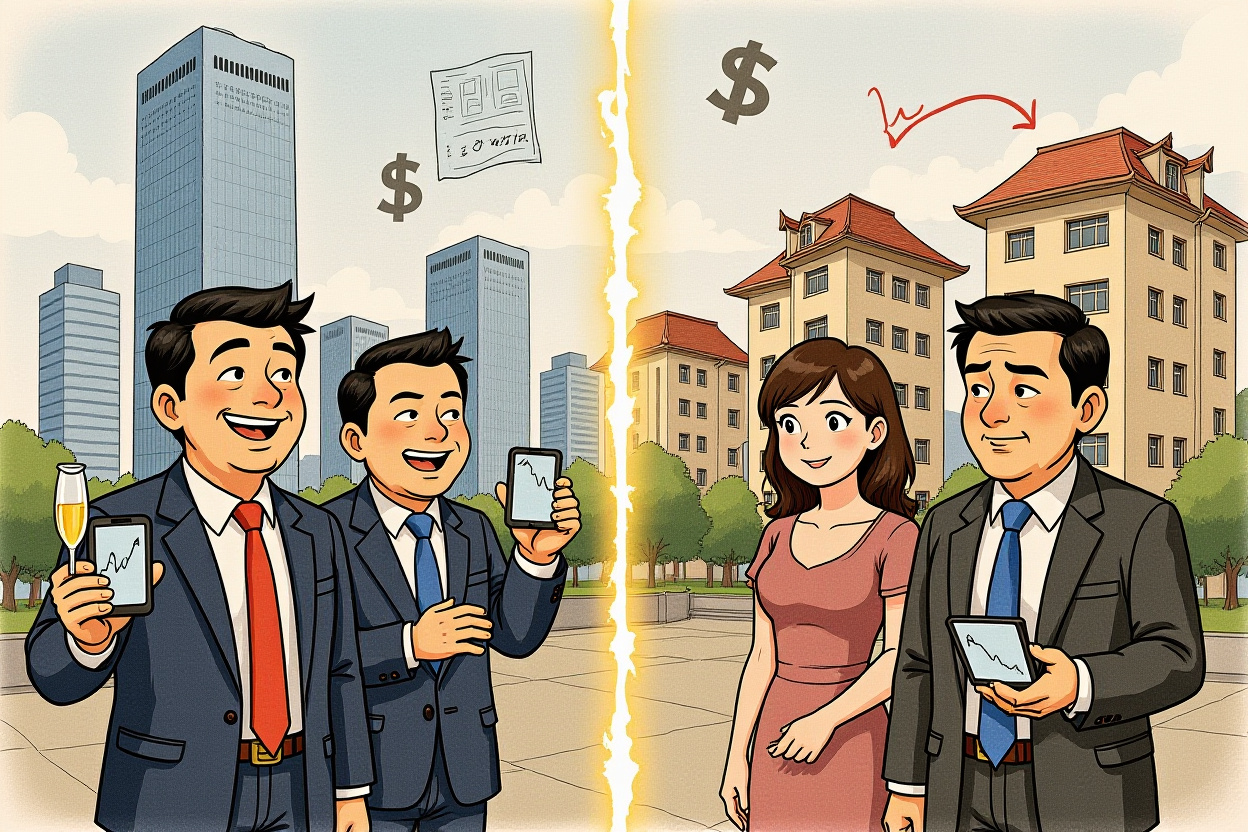
– Luxury residential projects in Shenzhen, such as Shenwan Yunxi (深圳湾澐玺), continue to achieve record-breaking sales, with single-day turnovers exceeding 10 billion RMB, defying the overall market downturn and highlighting concentrated wealth.
– Shenzhen’s average housing prices have persistently declined, breaking below the key psychological threshold of 60,000 RMB per square meter, with transaction volumes remaining subdued amid weak consumer confidence.
– The market’s potential recovery is intricately tied to broader macroeconomic factors, including income growth, employment stability, and the restoration of household confidence, which currently remain under significant pressure.
– Long-term, China’s real estate landscape is poised for severe fragmentation, with premium assets in core cities like Shenzhen retaining value while non-core areas and peripheral locations face stagnation or decline.
– Investors and homebuyers must adopt a nuanced, data-driven approach, focusing on fundamental drivers such as population inflows, supply constraints, and micro-market dynamics to navigate the complexities of Shenzhen’s folded real estate market.
The science fiction metaphor from Hao Jingfang’s (郝景芳) acclaimed novel ‘Beijing Folds’ (北京折叠) has found a stark and unsettling reflection in the contemporary reality of Shenzhen’s property sector. The narrative of a city stratified by time and space, where elites monopolize daylight and resources while the masses are confined to the night, perfectly mirrors the current dichotomy in Shenzhen’s housing market. On one extreme, ultra-luxury mansions command astronomical prices and are swept up in a frenzy by the ultra-wealthy. On the other, ordinary citizens and first-time homebuyers grapple with unattainable down payments, crushing mortgage burdens, and the specter of declining asset values. This phenomenon epitomizes what market analysts now term **Shenzhen’s folded real estate market**, a vivid illustration of how economic disparities are being crystallized in brick and mortar, creating parallel and increasingly separate realities for different socioeconomic classes within the same urban fabric.
The Luxury Boom: Defying Gravity in a Downturn
The recent launch of the Shenwan Yunxi (深圳湾澐玺) project in Shenzhen’s prestigious Shenwan (深圳湾) area served as a powerful reminder of the market’s extreme duality. On November 30, the development offered 348 units with sizes ranging from 209 to 1,150 square meters, carrying an average price of approximately 168,800 RMB per square meter. The total price per unit spanned from 30.64 million RMB to an astounding 377.43 million RMB. Despite these stratospheric figures, the project achieved a remarkable 70% sales rate on its opening day, generating 13 billion RMB in revenue. This single-day performance not only shattered expectations but also set a new national record for single-project single-day sales, surpassing the previous benchmark of 10.6 billion RMB set by Guangzhou’s Poly Yuexi Bay (广州保利玥玺湾) earlier in November.
Wealth Disparity in Action: Understanding the High-Net-Worth Buyer
This episode underscores a critical behavioral divergence rooted in profound wealth inequality. For high-net-worth and ultra-high-net-worth individuals, prime real estate in a global city like Shenzhen represents a critical store of value, a portfolio diversifier, and a hedge against currency volatility. As detailed in UBS’s 2025 Billionaire Report, the number of billionaires in Mainland China grew by 70 to reach 470 individuals, with their total wealth expanding to $1.8 trillion. This cohort, largely self-made, possesses the liquidity and risk appetite to view temporary market corrections as strategic acquisition opportunities. ‘For this tier of investor, property is one component of a sophisticated wealth management strategy,’ explains a Hong Kong-based private banker serving Chinese clients. ‘They have multiple channels to generate returns, so a dip in one asset class is often seen as a chance to accumulate quality assets at a relative discount.’ This mindset starkly contrasts with the defensive posture of the average household. Broader consumption data reveals a decline in per-capita catering spending from 43.2 RMB in 2022 to 33 RMB in the first three quarters of this year, indicative of widespread financial caution. This dichotomy is a defining feature of **Shenzhen’s folded real estate market**, where the luxury and affordable housing segments operate in entirely separate gravitational fields.
Historical Precedent: Luxury Resilience Is Not a New Signal
It is crucial to contextualize the Shenwan Yunxi sale within a broader trend observed throughout Shenzhen’s multi-year market correction. Similar sell-out events have occurred repeatedly since 2021, failing to act as a catalyst for broader market recovery. Notable examples include the rapid sales of Haide Park B (海德园B区) and Shenye Zhongcheng (深业中城) in 2021, the success of招商玺家园 (Zhaoshang Xijiayuan) and Haide Park A (海德园A区) in 2022, and the strong performance of Qianhai Times Phase III (前海时代三期) in 2023. The pattern continued in 2024 with Haide Park Phase II A (海德园二期A区). Upcoming launches, including Shekou Zhongxin Xinyue Bay (蛇口中信·信悦湾), Houhai招商玺 (Houhai Zhaoshang Xi), and the Shenzhen Super Headquarters GCC Liantai Super Headquarters Bay (深超总GCC联泰超总湾), are anticipated to follow a similar script. These isolated successes in the ultra-premium segment do not translate into a rising tide for the entire market; instead, they reinforce the narrative of a deeply **folded real estate market**.
The Broader Market Reality: Persistent Declines and Data-Driven Insights
While luxury segments capture media headlines, the overall market metrics present a consistently sobering picture. Shenzhen’s property sector has been in a pronounced correction phase for over four years, with both transaction volumes and average prices exhibiting sustained downward pressure, offering no clear signs of a definitive bottom.
Transaction Volumes: A Struggle for Sustained Momentum
New home sales in Shenzhen peaked in 2021 at 52,417 units, according to market data. This figure plummeted to 31,621 units in 2023. A short-lived policy-driven uplift in the fourth quarter of 2024, spurred by measures like relaxed purchase restrictions and reduced mortgage rates, managed to pull the annual transaction count to 37,972 units. However, this momentum proved fleeting. By July of the current year, monthly new home sales had fallen back below the 3,000-unit mark, with November recording a mere 2,644 units, as reported by每日楼市早读 (Daily Property Market Morning Read). The secondary market trajectory is equally telling. After a brief surge to 95,273 transactions in 2020, annual volume halved to 40,699 units in 2021. Policy stimuli in late 2024 helped lift the annual figure to 54,487 units, but 2025 has seen a renewed contraction, with November’s secondary market net signings at 4,472 units. This volatility underscores the fragility of underlying demand and the absence of organic, confidence-driven buying activity.
Price Trajectory: The Steady Erosion of Average Values
The price narrative is one of persistent erosion. Shenzhen’s average secondary housing price peaked at approximately 80,000 RMB per square meter in 2021. It entered the 70,000 RMB range in 2022 and fell into the 60,000s in 2023. A significant milestone was reached in July 2024 when the average price dipped below the 60,000 RMB threshold. A minor rebound to around 63,000 RMB occurred in October 2024, but prices settled at 63,300 RMB by December. The downtrend resumed in 2025, with the average price breaking below 60,000 RMB again in July and declining further to approximately 57,000 RMB by November, based on data from每日楼市早读 (Daily Property Market Morning Read). This steady decline through key psychological levels confirms that the market correction is broad-based and that the spectacle of luxury sales does not arrest the fall in mass-market valuations, further entrenching the concept of a **folded real estate market**.
National Economic Context: The Macro Headwinds Shaping Local Dynamics
Shenzhen’s property market does not exist in a vacuum; its fortunes are inextricably linked to the national economic climate and policy environment. Current macroeconomic indicators provide little comfort for a near-term sectoral recovery.
National Real Estate Investment and Sales: A Sector Under Pressure
Data from the National Bureau of Statistics (国家统计局) paints a grim picture for the real estate sector nationwide. From January to October, national real estate development investment fell by 14.7% year-on-year, marking the steepest decline since the adjustment cycle began. The area of new commercial housing sold dropped 6.8%, while the value of sales fell 9.6%. Perhaps more tellingly, the sales value decline is approaching double-digit territory, indicating persistent weakness in demand-side financing. Concurrently, financial data from the People’s Bank of China (中国人民银行) shows that residential mortgage loans experienced negative growth in October, the fourth such occurrence this year, signaling that households are either reluctant or unable to take on new mortgage debt. This credit contraction is a significant barrier to any market recovery.
Fiscal and Land Sale Revenues: The Underlying Strain
Shenzhen’s Fundamental Drivers: The Long-Term Case for ResilienceDespite the formidable short-term challenges, Shenzhen’s underlying economic and demographic fundamentals provide a compelling long-term case for resilience in its core property market. These structural factors are the bedrock upon which any future recovery will be built.
Population Growth and Insatiable Demand Pressure
Shenzhen’s demographic story is one of explosive growth. From its establishment as a city in 1979 to the end of 2024, its permanent resident population has multiplied by an astounding 57.3 times, according to the Shenzhen Municipal Bureau of Statistics (深圳市统计局). This relentless influx of talent, entrepreneurs, and workers creates a continuous and powerful underlying demand for housing. Beyond basic shelter, Shenzhen’s status as a global tech and innovation hub generates significant investment-driven demand, as capital seeks exposure to the city’s economic growth story. The confluence of rigid residential demand and speculative investment interest historically created a powerful upward pressure on prices.
Land Use Policies and Chronic Supply Constraints
A critical and enduring factor shaping **Shenzhen’s folded real estate market** is its unique and constrained land-use policy. Adhering to a principle of ‘industrial立市’ (industrial city-building), Shenzhen has consistently prioritized industrial land over residential development. Industrial用地 has long accounted for roughly 30% of the city’s total land use, a figure near the upper limit of international benchmarks. In contrast, the proportion of land allocated for residential purposes has perennially fallen below the lower limit of international standards. Compounding this supply crunch is the composition of the existing housing stock. Shenzhen is home to 1,044 urban villages (城中村), the highest number of any Chinese city, which provide affordable shelter for an estimated 12 million people, or about 67.5% of the total population. However, these units are largely outside the formal commodity housing market. The latest data indicates Shenzhen has only 2.36 million commodity housing units, creating an extreme scarcity of tradable, high-quality housing in the face of massive demand. This fundamental supply-demand imbalance is a key reason why premium assets in core locations are expected to hold their value over the long term.Future Outlook: Navigating Fragmentation and the New Normal
The era of ubiquitous, speculation-driven property appreciation across China is unequivocally over. The future landscape, particularly for a market as complex as Shenzhen’s, will be characterized by severe and multi-layered fragmentation. This is the inevitable new normal for **Shenzhen’s folded real estate market** and Chinese real estate at large.
The Recovery Node: An Economic, Not a Property, Question
Determining the inflection point for a broad market recovery is perhaps the most challenging task for analysts. The consensus is that the timing does not hinge on further incremental property sector policies, such as additional down payment cuts or minor relaxation of purchase limits. Instead, recovery is dependent on macroeconomic health. A new sustainable equilibrium must be established between housing prices, household incomes, and future expectations. Achieving this requires either a meaningful acceleration in income growth, a further downward adjustment in prices to more affordable levels, or a combination of both, all underpinned by a restoration of confidence in economic stability and career prospects. As noted by prominent financial commentator Fu Peng (付鹏), the prevailing public sentiment is currently defensive, focused on reducing leverage and non-essential consumption rather than on taking on new debt for asset acquisition. Until this sentiment shifts, driven by tangible improvements in employment and wage growth, the **folded real estate market** dynamic will persist, with luxury assets decoupled from the mainstream.
Strategic Implications for Investors and Homebuyers
In this environment, a one-size-fits-all investment strategy is obsolete. For institutional investors, fund managers, and sophisticated individuals, success will require a highly granular, micro-market approach.– Focus on Micro-Locations: Prioritize districts and sub-markets with irrefutable fundamentals: proximity to resilient employment hubs (e.g., Nanshan’s tech corridor), access to premium infrastructure, and severely limited potential for new housing supply.
– Monitor Leading Indicators: Key data points to watch include monthly population inflow statistics, household registration (Hukou) policy changes, land auction premium rates, and inventory digestion cycles for different housing segments.
– Embrace Diversification: Real estate should be viewed as part of a diversified portfolio. Consider exposure through Real Estate Investment Trusts (REITs), which offer liquidity and focus on income-generating commercial properties, or explore other asset classes less correlated with the residential cycle.
– For End-Users: Homebuyers should prioritize purchasing for long-term need and livability over short-term speculation. Thorough stress-testing of mortgage commitments against conservative income projections is essential. The premium for a well-located, quality asset in a core area may be justified as a store of value, whereas purchases in peripheral areas carry higher risk of stagnation.
The **folded real estate market** in Shenzhen is a powerful microcosm of the broader socioeconomic challenges facing China. It vividly illustrates how wealth concentration can create parallel economic realities within a single city. While the luxury segment may continue to see activity driven by asset allocation decisions of the wealthy, the recovery of the broader market hinges on a more fundamental rebuilding of household economic security and confidence. For market participants worldwide, the key takeaway is that the age of simple, directional bets on Chinese property is over. The path forward demands sophistication, selectivity, and patience. To stay ahead, actively monitor official data releases from the National Bureau of Statistics (国家统计局) and the Shenzhen Municipal Bureau of Planning and Natural Resources (深圳市规划和自然资源局), engage with on-the-ground market intelligence, and base decisions on a clear understanding of the deep structural forces that continue to shape **Shenzhen’s folded real estate market**.