



Executive Summary
- The abrupt closure and court-ordered seizure of Shenzhen’s leading BMW dealership, Baoyuanxing (宝源行), has jeopardized prepaid maintenance packages and services for an estimated 300,000 BMW and MINI owners, revealing critical flaws in the traditional 4S店 (4S dealership) model.
- This incident is not isolated but symptomatic of a broader China’s auto dealership crisis, driven by parent company debt collapses, intense market competition, and the disruptive shift towards electric vehicles and direct-to-consumer sales channels.
- Data indicates over 8,000 4S店 have shut down across China since 2020, with 2025 seeing nearly 5,000 closures, predominantly among traditional燃油车 (fuel vehicle) brands, as the industry undergoes rapid consolidation.
- Consumers face significant risks from non-official, high-value prepaid service plans, while dealerships grapple with profitability crises exacerbated by OEM price wars and changing consumer preferences.
- The事件 (event) underscores urgent needs for enhanced regulatory oversight, consumer protection mechanisms, and strategic adaptation by all stakeholders in the evolving Chinese automotive landscape.
A Shuttered Showroom and a Sea of Broken Promises
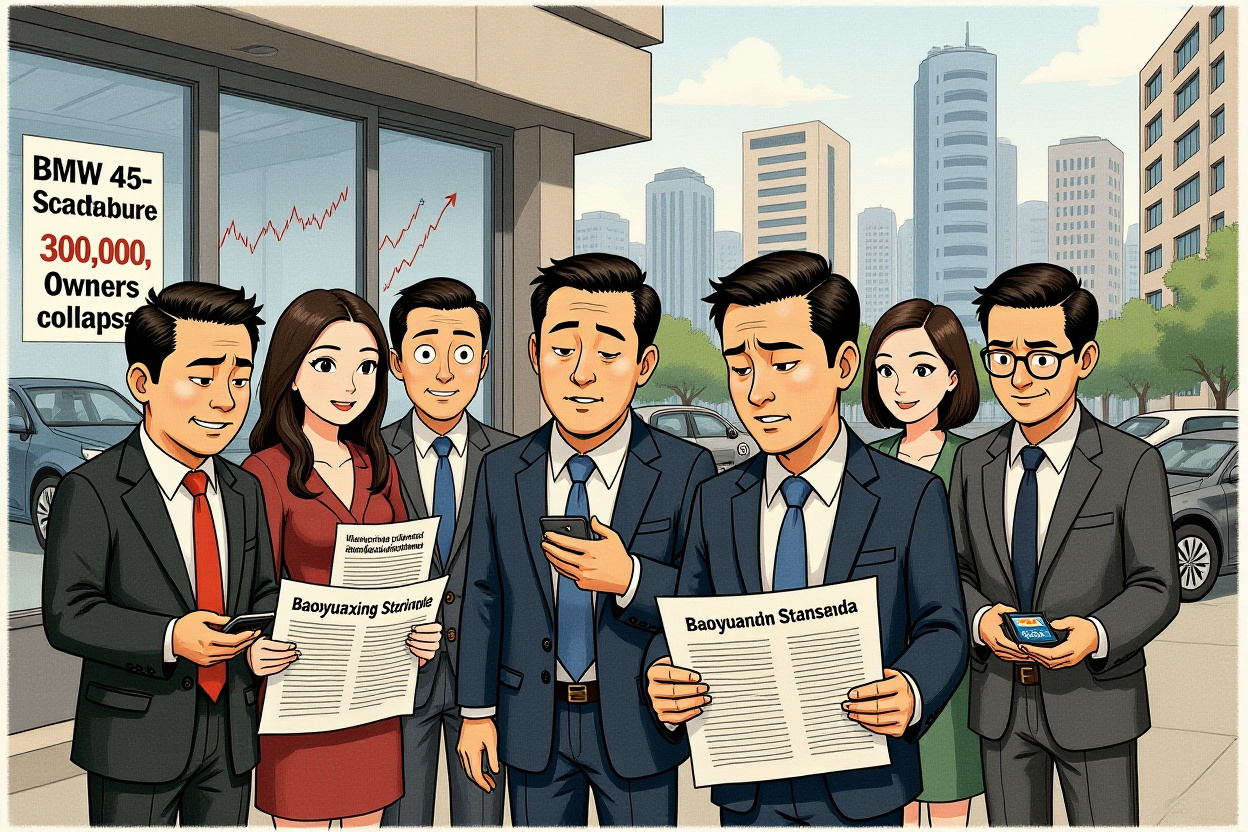
The gleaming showrooms of Shenzhen’s Baoyuanxing BMW 4S店 (Baoyuanxing BMW 4S dealership), once a symbol of premium automotive service, now stand silent and sealed. Court-ordered notices adorn the doors, and dust gathers on luxury vehicles bearing the iconic blue-and-white roundel. For nearly 300,000 customers, this scene represents not just a business failure but a personal financial blow, as thousands of dollars in prepaid maintenance packages and service contracts vanish into thin air. This sudden collapse of a dealership once hailed as Shenzhen’s BMW sales champion serves as a stark and immediate manifestation of China’s auto dealership crisis, a turmoil reshaping the very foundations of car ownership and retail in the world’s largest auto market.
The crisis erupted in early 2026 when owners arriving for scheduled services found the福田区 (Futian District) location locked and deserted. Official communications from BMW China later confirmed that the authorization for Baoyuanxing’s parent company, Guizhou Tongyuan Investment Group Co., Ltd. (贵州通源投资集团有限公司), was being terminated. This left a massive client base in limbo, unsure if their investments would be honored or where to turn for future repairs. The visual of查封 (sealed) vehicles on the showroom floor, under a two-year court order, became a powerful emblem of systemic vulnerability.
From Market Leader to Legal Liability
Established in 2008, Baoyuanxing was no fringe operator. It built a 16-year reputation, frequently topping local sales charts and cultivating a vast base of loyal customers. Its imposing facility and extensive inventory were testaments to its former success. However, beneath this veneer, financial strain had been mounting for over a year. Internal documents and labor arbitration cases reveal that from mid-2025, the dealership faced escalating operational difficulties, including employee wage disputes. The final act, however, involved a deceptive last-minute push to sell expensive保养套餐 (maintenance packages) and延保服务 (extended warranty services) to unsuspecting customers, even as the decision to cease operations was likely already made.
The Human and Financial Toll
Preliminary estimates from affected owner groups suggest outstanding liabilities from these prepaid services could exceed tens of millions of yuan, with individual losses reaching over 100,000 yuan in some cases. The breach of trust is profound. Owners who purchased vehicles based on the dealership’s reputable facade now face uncertain recourse, highlighting a critical gap in consumer safeguards within the franchise model. This element of the China’s auto dealership crisis directly transfers financial risk and emotional distress onto end-consumers, eroding confidence in established retail channels.
Anatomy of a Collapse: Parent Company Debts and Deceptive Practices
The fall of Baoyuanxing is intrinsically linked to the financial implosion of its parent entity, Guizhou Tongyuan Investment Group. This connection illustrates how corporate-level distress can rapidly cascade down to retail operations, leaving customers and employees stranded. The group’s financial woes had been escalating, with public records showing it became the subject of multiple enforcement cases (被执行案件) from January 2026, involving total amounts surpassing 16.13 million yuan. Issues included股权冻结 (equity freezes) and tax arrears, painting a picture of severe liquidity constraints.
The Ripple Effect from Guizhou to Guangdong
This group-level crisis directly severed the lifeline to its subsidiary. As cash flow dried up, Baoyuanxing’s own operations became unsustainable. The dealership itself faced two separate enforcement cases in late 2025 and early 2026, for sums totaling approximately 567,900 yuan. Compounding the problem, many of the service packages sold were not official BMW China programs but rather store-specific promotions. This meant that upon the dealership’s failure, there was no automatic backup from the brand’s national network, forcing owners into complex and uncertain维权 (rights protection) processes. This tactic of selling non-portable, high-margin service plans as a final cash grab before closure has become an alarming pattern in the industry, deepening the China’s auto dealership crisis.
A Pattern of Predatory Behavior
This incident echoes similar scandals exposed by state media. In 2025, other major dealer groups like广汇集团 (Guanghui Group) were reported to have aggressively sold service cards with promises of nationwide usability just prior to shutting doors. Another宝马 (BMW) dealer,运通嘉宝 (Yuntong Jiabao), allegedly refused refunds after its authorization was revoked. These cases reveal a disturbing trend where financially distressed dealerships exploit consumer trust for one final revenue surge, externalizing all downstream risk. This behavior fundamentally damages the principal-agent relationship between brands, their retail partners, and the public.
The Big Picture: An Industry in Profound Transformation
The Baoyuanxing saga is a single data point in a much larger statistical narrative of decline and disruption. China’s auto dealership sector is experiencing its most severe shakeout in decades. Since 2020, industry reports indicate that more than 8,000 traditional 4S店 have ceased operations nationwide. The pace accelerated in 2025, with nearly 5,000 closures, a staggering 93% of which were燃油车 (fuel vehicle) brand outlets. Concurrently, over 80% of dealers reported selling vehicles at a loss, a direct result of brutal price wars initiated by original equipment manufacturers (OEMs). This is the core of the China’s auto dealership crisis: a perfect storm of financial pressure, technological disruption, and evolving market rules.
The Triple-Pressure Cocktail Squeezing Dealers
Analysts point to three converging forces driving this upheaval. First, financial models are breaking. The traditional profit engine reliant on new car sales margins, finance and insurance commissions, and after-service revenue is sputtering. OEMs, facing their own competitive battles, have increasingly shifted the burden of discounts and inventory holding onto dealers, crushing their profitability. Second, OEMs are actively reforming their retail channels. Brands like宝马 (BMW) and奥迪 (Audi) are implementing stricter digital performance metrics and, in some instances, revoking授权 (authorizations) for underperforming or disloyal dealers—Audi reportedly cut ties with some dealers for selling competing brands like华为问界 (Huawei’s AITO). Third, and most transformative, is the新能源 (new energy vehicle) revolution. The rapid consumer shift towards electric vehicles (EVs), coupled with the preferred直销 (direct sales) or agency models of EV makers like特斯拉 (Tesla) and蔚来 (NIO), is rendering the traditional 4S店’s heavy-asset, inventory-holding model less relevant and less profitable.
The Rise of New Retail Paradigms
While traditional networks contract, new energy vehicle brands are expanding their retail presence. In 2025, NEV brands accounted for 56% of all new dealership openings, with自主品牌 (Chinese domestic brands) contributing 88% of the net new growth. This signals a historic power shift. The direct control over customer experience, pricing, and data offered by direct sales is challenging the legacy franchise system. This transition is not merely commercial but strategic, as OEMs seek to own the customer relationship in an increasingly software-and-service-defined automotive era. The ongoing China’s auto dealership crisis is, therefore, a forced evolution accelerated by technological change.
Implications for Consumers and Market Participants
For car owners and potential buyers, the Baoyuanxing case offers painful but vital lessons. The most immediate takeaway is the elevated risk associated with large, upfront payments for non-essential services at any dealership. Prepaid maintenance plans, especially those not underwritten or guaranteed by the vehicle manufacturer itself, represent an unsecured loan to the dealer. In a volatile market, this capital is at high risk. Consumers are advised to scrutinize the terms of service packages, prefer pay-as-you-go models, and research the financial health of the dealership group before committing significant funds.
Navigating a Fragmenting Service Landscape
The crisis also complicates long-term vehicle ownership. With dealerships closing, owners may face challenges in accessing genuine parts, specialized technicians, and maintaining official service records—the latter being crucial for preserving residual value and warranty validity. This uncertainty is pushing some consumers towards brands with more stable, manufacturer-operated service networks or encouraging the growth of independent, high-quality repair specialists. The erosion of the traditional 4S店’s monopoly on service is another dimension of the China’s auto dealership crisis, creating both inconvenience and opportunity in the aftermarket.
Strategic Crossroads for Investors and Executives
For institutional investors and corporate executives monitoring the Chinese auto sector, this turmoil demands a reevaluation of investment theses. Publicly listed dealer groups are facing immense pressure on their balance sheets and valuations. The crisis underscores the importance of analyzing dealer network resilience, adaptability to electrification, and the nature of contractual agreements with OEMs. Investors must discern between groups successfully pivoting towards agency models, used car operations, or NEV brand partnerships and those clinging to obsolete practices. The China’s auto dealership crisis is a clear signal that the sector’s historical metrics and moats are rapidly changing.
Forward Guidance: Adaptation in the Age of Disruption
The closure of Shenzhen’s Baoyuanxing is a poignant milestone, but it is neither the beginning nor the end of this transformative period. It encapsulates the harsh realities of a market in flux: overcapacity in traditional retail, the unforgiving nature of debt, and the disruptive power of new technologies and business models. The China’s auto dealership crisis will likely continue to unfold, with further consolidation among traditional players and the ascendance of new retail formats led by electric vehicle pioneers.
For regulators, there is a pressing need to enhance consumer protection frameworks, particularly around prepaid services and dealership financial disclosures, to prevent similar debacles. For automotive brands, the imperative is to manage this transition responsibly, supporting existing customers caught in dealer failures while thoughtfully redesigning their distribution strategies for the electric future. For the global investment community, understanding the nuances of this shift is critical for accurately assessing risks and opportunities within the Chinese automotive ecosystem. The dust from this collapse will settle, but the landscape it reveals will be permanently altered. Stakeholders who acknowledge the depth of this China’s auto dealership crisis and adapt proactively will be best positioned to navigate the road ahead.