



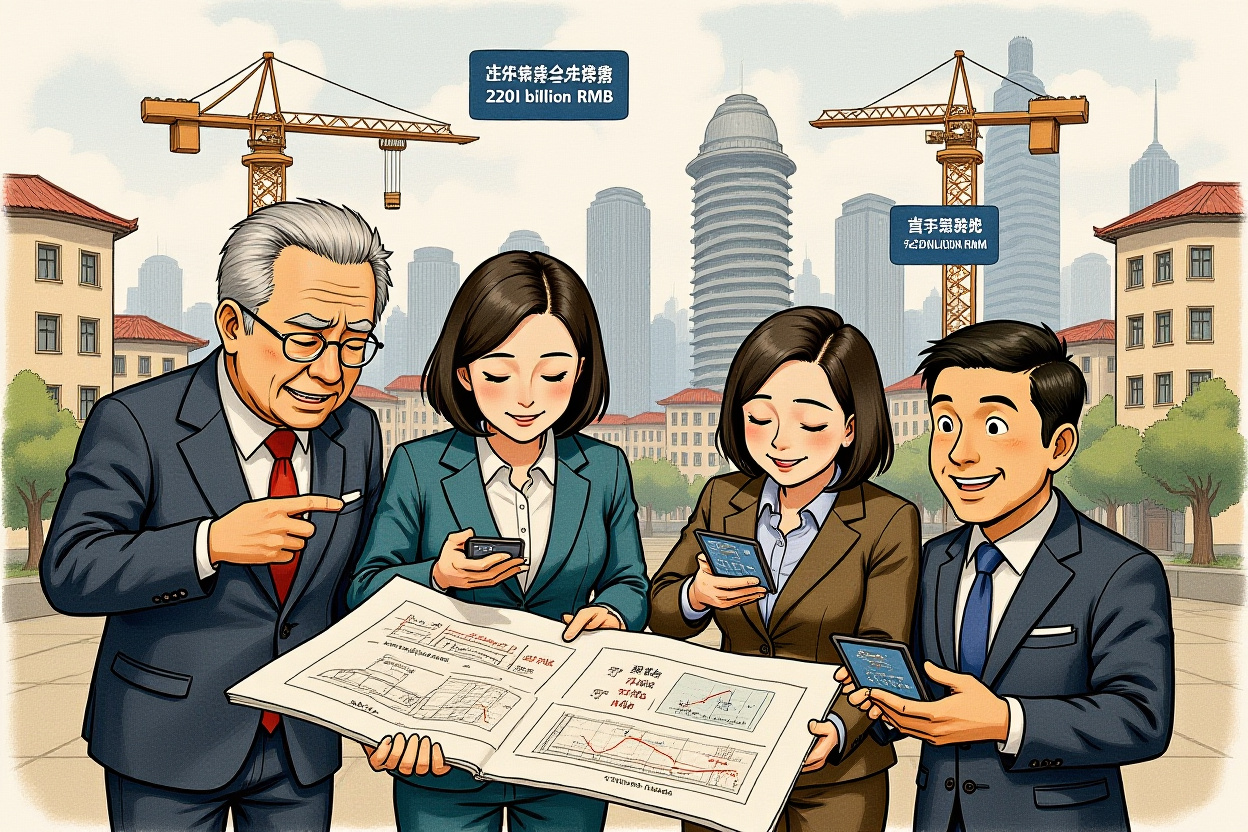
– The first phase of Shenzhen’s Baishizhou urban renewal project, featuring 74-story residential towers, has begun delivery despite a one-month delay and widespread skepticism. – Homebuyers face disappointments over unfulfilled promises, particularly regarding a key school facility that remains undeveloped, raising questions about sales practices. – Developer Lvjing China Real Estate (绿景中国地产) is under significant financial strain, with high debt and low liquidity, casting shadows on the project’s future phases. – Industry experts suggest that state-owned enterprises or local government platforms may need to step in to ensure the completion of this massive 220 billion RMB project. – This case highlights the ongoing challenges in China’s urban renewal and real estate sectors, serving as a cautionary tale for investors and policymakers. In a significant development for China’s property market, the Baishizhou urban renewal project in Shenzhen has commenced the delivery of its first phase, including the country’s tallest residential buildings at 74 stories. This milestone comes after years of anticipation and recent controversies over delays and unmet commitments. The Baishizhou urban renewal project represents not only an architectural feat but also a test case for the viability of large-scale urban redevelopment in a cooling market. As the developer grapples with financial pressures, the delivery process sheds light on the intricate balance between ambitious planning, regulatory compliance, and buyer satisfaction. For international investors eyeing Chinese equities, the unfolding story of Baishizhou offers critical insights into the risks and opportunities within the real estate sector, especially as the Baishizhou urban renewal project navigates its complex journey.
The Baishizhou Urban Renewal Project: A Landmark Delivery Amidst Skepticism
On February 4, Lvjing China Real Estate (绿景中国地产) announced via the Hong Kong Stock Exchange that the main construction work for the first phase of its key urban renewal project in Shenzhen’s Nanshan District, known as Baishizhou (白石洲城市更新项目) or Lvjing Baishizhou Jingting, was completed with government approvals, and the delivery process for residential units had officially started. This Baishizhou urban renewal project, spanning a total gross floor area of 3.58 million square meters with an estimated value of 220 billion RMB, is Shenzhen’s largest urban redevelopment initiative. The first phase, marketed as a high-end residential and commercial complex, includes 1,257 presold homes in towers reaching up to 74 floors, making it one of China’s tallest residential projects. The delivery, however, occurred against a backdrop of doubt, as the original contract stipulated a January 15, 2026, handover, but a one-month grace period until February 14 was contractually allowed, which the developer emphasized was clearly stated in signed agreements.
Project Specifications and Market Positioning
The Baishizhou urban renewal project’s first phase, with an average recorded price of 113,500 RMB per square meter and total prices ranging from 10.12 million to 52.84 million RMB, targets affluent buyers in the Greater Bay Area. Its completion is expected to enhance Lvjing’s portfolio in southern China, but the high stakes are evident. According to reports from the Daily Economic News (每日经济新闻), the project was in a near-complete state by late 2023, with interior finishes underway for remaining units, primarily 110㎡ and 125㎡ layouts, while larger 187㎡ and penthouse units were mostly sold out. This Baishizhou urban renewal project symbolizes the ambitions of urban renewal in megacities, yet its delivery highlights the pressures faced by developers in meeting lofty expectations.
Controversies and Unmet Promises in the Baishizhou Urban Renewal Project
The delivery of the Baishizhou urban renewal project has been marred by disputes over core commitments, particularly regarding educational facilities and construction quality. Homebuyers, who invested based on sales pitches, now express frustration over broken promises, underscoring the risks in China’s real estate market.
Educational Facility Delays and Sales Practice Concerns
Many purchasers were attracted by promises of a prestigious school, specifically the Nanshan Foreign Language School, advertised as a nine-year consistent institution slated for operation by September 2026. Sales materials, including brochures and posters, promoted this as a key selling point. However, current information indicates the school site has not commenced construction, with estimates pointing to a 2027 start and 2029 completion. Owner representative Mr. Wu (吴先生) voiced concerns, stating, “The land hasn’t even been fully demolished, with no signs of groundbreaking, which is unacceptable.” In response, project officials explained that early plans involved developer-led construction, but due to government fiscal adjustments, the Shenzhen Education Bureau (深圳市教育局) now oversees the school, with land transferred in 2025 and a contractor appointed in October 2025. They added that all school-related promotions ceased by mid-2024 and were reviewed by market regulators, denying any违规宣传 (violation of宣传 regulations). This aspect of the Baishizhou urban renewal project raises questions about transparency and the enforcement of sales claims in urban renewal initiatives.
Construction Quality and Standard Disputes
Beyond delays, quality issues have sparked worry among owners. A prominent concern is the underground garage, where some visitors noted the absence of epoxy floor paint, leading to perceptions of subpar finishes for a luxury development. After months of negotiations, the developer released an official garage design rendering, but owners suspect cost-cutting under tight deadlines. The project负责人 (responsible person) countered that garage upgrades were extra investments beyond contractual obligations, with plans reassessed based on owner feedback. This dispute exemplifies the broader challenges in maintaining quality in large-scale projects like the Baishizhou urban renewal project, where financial constraints may compromise standards.
Financial Strains of Developer Lvjing China Real Estate
The Baishizhou urban renewal project’s delivery occurs amidst severe financial difficulties for Lvjing China Real Estate (绿景中国地产), highlighting the precarious state of some Chinese developers. According to the company’s 2025 interim report, current liabilities stood at 60.57 billion RMB, with new borrowings of 7.703 billion RMB in the first half and 2.914 billion RMB due within a year. Alarmingly, bank balances and cash were仅 342.5 million RMB (only 342.5 million RMB), alongside约 1.449 billion RMB (approximately 1.449 billion RMB) in restricted and pledged deposits. This liquidity crunch stems from Lvjing’s heavy bet on the Baishizhou urban renewal project over a decade, essentially staking its entire resources on this venture. The financial data, accessible via the Hong Kong Exchange website, underscores the risks for investors in Chinese real estate equities, as the Baishizhou urban renewal project’s success is tied to the developer’s survival.
Debt Burden and Implications for Project Continuity
With such high leverage, Lvjing faces mounting pressure to secure funding for subsequent phases of the Baishizhou urban renewal project. Market rumors, such as a purported 12 billion RMB investment from CITIC City Development (中信城开), were debunked in a September clarification on its WeChat公众号 (public account), citing misinformation. This reflects the skepticism surrounding financial rescues for the Baishizhou urban renewal project. Analysts suggest that without external intervention, the project’s future phases—with二期 (phase two) demolished and三期, 四期 (phases three, four) pending redesign under Shenzhen’s new regulations—could stall, impacting the overall 220 billion RMB valuation. The Baishizhou urban renewal project thus serves as a barometer for developer resilience in China’s tightening credit environment.
Future Development and Market Implications of the Baishizhou Urban Renewal Project
Looking ahead, the Baishizhou urban renewal project may require partnerships with state-owned enterprises (SOEs) or local government platforms to ensure completion, offering lessons for the broader real estate sector. Industry experts provide insights into potential pathways and investment considerations.
Involvement of State-Owned Enterprises and Expert Analysis
Zhi Peiyuan (支培元), Vice Chairman of the China Investment Association上市公司投资专业委员会 (上市公司 Investment Professional Committee), noted that SOEs are more likely to take over due to their lower capital costs and expertise in navigating complex government relations. Local城投平台 (city investment platforms) could also intervene. Similarly, Lu Kelin (卢克林), International Certified Innovation Manager and CEO of Lukedao Technology (鹿客岛科技), emphasized that large urban renewals in Shenzhen demand “deep pockets and government credit背书 (backing).” He outlined four criteria for接手 (taking over) the Baishizhou urban renewal project: 1. Availability of tens of billions in RMB现金 (cash) for funding. 2. Strong rapport with district and street-level governments for拆迁赔偿 (demolition compensation) talks. 3. Product迭代力 (iteration capability) to redesign massive plans profitably. 4. Financial拆解术 (deconstruction skills) to segment the 220 billion RMB value into manageable portions. These insights suggest that the Baishizhou urban renewal project’s evolution will hinge on collaborative models, potentially involving entities like China International Capital Corporation Limited (中金公司) for restructuring advice.
Broader Market Lessons and Investor Guidance
The Baishizhou urban renewal project exemplifies the challenges in China’s urban renewal and property markets, where grandiose plans often clash with financial and regulatory realities. For institutional investors, this case underscores the need to scrutinize: – Developer financial health and debt profiles in real estate equities. – Regulatory compliance and sales practice risks in urban renewal projects. – Government policy shifts, such as those from the Shenzhen Municipal Government (深圳市政府), affecting project timelines. – Potential for SOE involvement as a stabilizing factor in distressed developments. As the Baishizhou urban renewal project moves forward, monitoring announcements from the People’s Bank of China (中国人民银行) on liquidity measures and local urban planning bureaus will be crucial for assessing market sentiment.
Synthesizing Key Takeaways for the Baishizhou Urban Renewal Project
The delivery of the Baishizhou urban renewal project’s first phase marks a pivotal moment, but it is fraught with lessons on execution risks and market dynamics. Key takeaways include the importance of due diligence on developer promises, the impact of financial volatility on large-scale projects, and the growing role of state-backed entities in China’s real estate sector. The Baishizhou urban renewal project, as a benchmark,提醒 (reminds) investors that urban renewal in China requires not only capital but also robust governance and transparent communication. For those engaged in Chinese equities, particularly in real estate, it is advisable to track regulatory updates from bodies like the China Securities Regulatory Commission (中国证券监督管理委员会) and diversify exposures to mitigate risks from similar projects. Consider consulting market reports from firms like CICC (中金公司) for deeper analysis. As the Baishizhou urban renewal project unfolds, staying informed on its progress can provide actionable insights for portfolio adjustments and strategic investments in the ever-evolving landscape of Chinese urban development.