



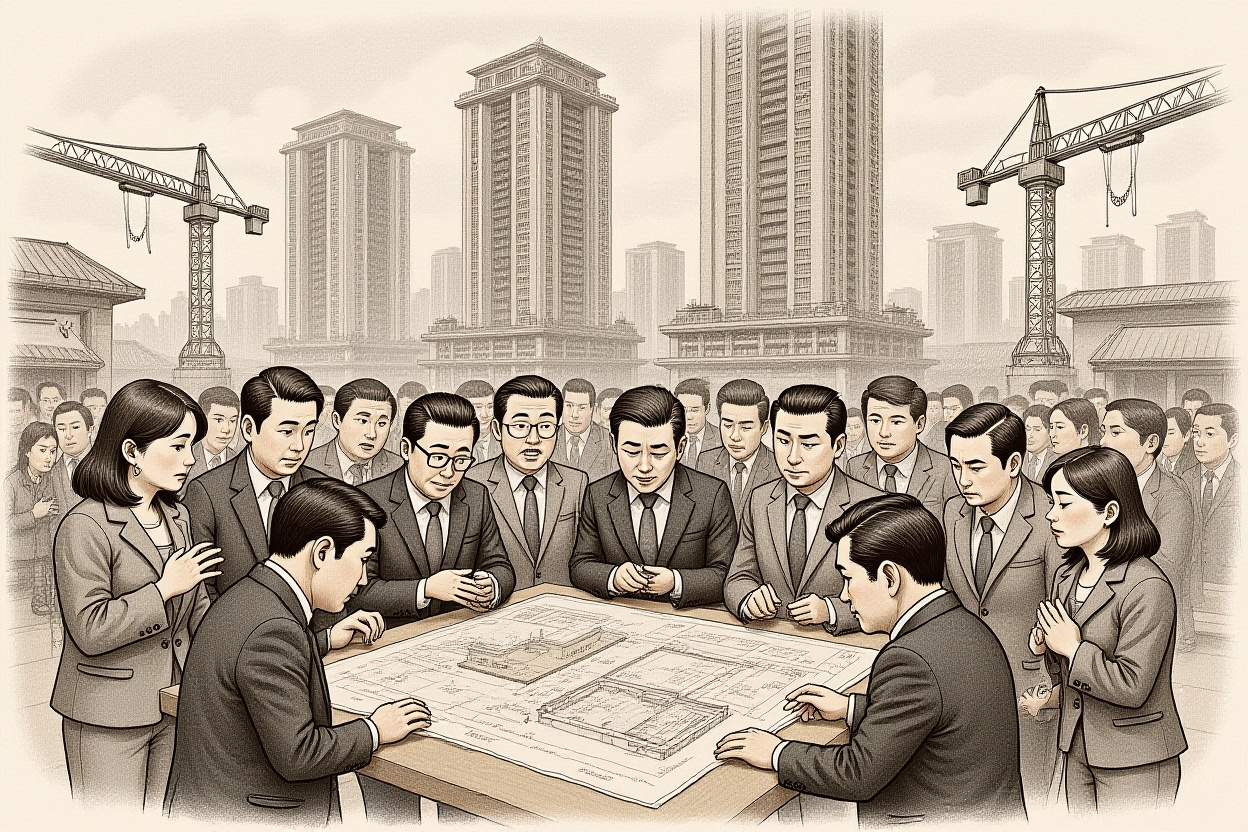
After years of anticipation and mounting scrutiny, the Bai Shizhou urban renewal project (白石洲城市更新项目)—Shenzhen’s largest urban redevelopment endeavor—has initiated the delivery of its first residential units. This milestone, however, is shadowed by significant disputes over delayed timelines, contested promotional claims, and construction quality, offering a critical case study for investors navigating China’s complex real estate landscape.
Executive Summary: Key Takeaways
Before delving into the details, here are the essential points from this development:
– The Bai Shizhou urban renewal project, developed by Greenview China Real Estate (绿景中国地产), has begun delivering phase one units, including towers reaching up to 74 stories, marking a pivotal moment for Shenzhen’s skyline and the developer’s financial health.
– Delivery occurred after a contractual delay, with owners raising alarms over unmet promises, particularly regarding a flagship school that was heavily marketed but remains unbuilt, shifting timelines to 2029.
– Construction quality concerns, notably over underground parking finishes perceived as substandard for a luxury project, have sparked negotiations between homeowners and the developer.
– Greenview’s substantial debt burden, with short-term liquidity pressures, underscores the financial risks in large-scale urban renewals and raises questions about future phases requiring potential state-owned enterprise (SOE) partnerships.
– This project exemplifies the broader challenges in China’s property market: balancing ambitious development with regulatory compliance, buyer expectations, and financial viability in a post-deleveraging era.
A Colossal Urban Renewal Endeavor Comes to Life
The commencement of delivery for the Bai Shizhou urban renewal project is not merely a handover of keys; it represents the materialization of one of China’s most ambitious urban transformation plans. Encompassing a total gross floor area of 3.58 million square meters and an estimated total sales value of approximately RMB 220 billion, this project has been a focal point for the Shenzhen real estate sector since its inception.
Unpacking the Scale and Strategic Importance
Located in Nanshan District (南山区), Shenzhen’s high-tech and financial hub, the Bai Shizhou urban renewal project sits on prime real estate. Phase one, branded as Greenview Bai Shizhou Jinting (绿景白石洲璟庭), involves 1,257 presold residential units with an average recorded price of RMB 113,500 per square meter, placing total unit values between RMB 10.12 million and RMB 52.84 million. The project’s crown jewels are its residential towers, with the highest reaching 74 stories, positioning them among the tallest residential buildings in China. For Greenview China Real Estate, a Shenzhen-based developer, this project has been an all-in bet. The company’s港股上市平台 (Hong Kong-listed platform) has channeled immense resources into the endeavor, with its financial reports reflecting the strain. According to Greenview’s 2025 interim report, the company faced current liabilities of RMB 60.57 billion, with cash and bank balances of only RMB 3.425 billion, highlighting a precarious liquidity position. The successful delivery of phase one is thus crucial for generating cash flow and restoring confidence among stakeholders and the market.
Financial Stakes and Developer’s Gambit
The Bai Shizhou urban renewal project’s progression is intrinsically linked to Greenview’s survival strategy. Having介入 (entered) the redevelopment over a decade ago, the developer has leveraged significant debt to advance the project. The recent delivery milestone aims to alleviate some pressure, but the road ahead remains fraught. The project’s sheer scale means that subsequent phases—reportedly involving site clearance for phase two and planning adjustments for phases three and four—will require substantial additional capital. This reality has fueled market speculation about引入央国企合作开发 (introducing central or state-owned enterprise cooperation for development), a trend becoming increasingly common in China’s property sector as private developers face financing constraints.
Navigating the Delivery: Delays, Disputes, and Developer Defense
The delivery process for the Bai Shizhou urban renewal project has been anything but smooth, underscoring the tensions that can arise in high-stakes urban redevelopment. While the developer announced the completion of main construction and relevant government acceptance procedures, the path to this point has been marked by owner activism and public relations challenges.
The Contested Timeline and Contractual Grace Periods
According to purchase contracts provided by owners, the initial delivery date for phase one住宅 (residential units) was set for January 15, 2026. However, delivery only commenced on February 4, following a Hong Kong Stock Exchange filing by Greenview. The developer pointed to a contractual clause allowing a one-month grace period, asserting that delivery before February 14 would not constitute违约 (breach of contract). A project representative stated this term was clearly stipulated in the online signing contracts, which owners had acknowledged. While technically within bounds, this delay has exacerbated owner anxieties, particularly when coupled with other issues. It reflects a common dynamic in China’s pre-sale system, where buyers often face uncertainty between promised and actual delivery dates, impacting their financial planning and trust in developers.
Voices from the Ground: Owner Grievances and Negotiations
The concerns extend beyond timing. Owners, many of whom invested millions, have organized to voice their frustrations. A representative, Mr. Wu (吴先生), articulated the core issue: a significant number of purchasers were attracted by promises of premium education配套 (facilities). Sales materials explicitly promoted proximity to Nanshan Foreign Language School and advertised a nine-year一贯制学校 (consistent education system school) expected to be operational by September 2026. However,最新信息 (latest information) indicates the school land plot has not yet commenced construction, with revised estimates pointing to a 2027 start and 2029 completion. “The land for the school hasn’t even been fully demolished, with no signs of groundbreaking. This is truly unacceptable,” Mr. Wu (吴先生) emphasized. In response, the project负责人 (responsible person) explained that the school’s construction was initially developer-led but shifted to government oversight due to fiscal planning adjustments. The land was transferred in 2025, and authorities have since appointed a general contractor, with the Education Bureau and Public Works Department now managing the project. The developer claims it halted all school-related promotions by mid-2024 and that all marketing materials were reviewed and filed with the Market Supervision Administration, denying any违规宣传 (illegal promotion).
Scrutinizing Quality and the High-Stakes of High-Rise Living
Beyond promised amenities, the physical build quality of the Bai Shizhou urban renewal project has come under intense scrutiny. For a development marketed as a luxury residential community, perceived compromises in common areas have sparked significant debate, particularly regarding the underground parking facilities.
The Underground Parking Controversy: Expectations vs. Reality
During pre-delivery visits, some owners observed that sections of the地下车库 (underground garage) lacked epoxy floor paint, a feature they associated with high-end properties. Mr. Wu (吴先生) noted that after months of advocacy, the developer issued a stamped version of车库效果图 (garage rendering) outlining planned upgrades. However, owners remain wary of potential偷工减料 (cutting corners) under tight deadlines. The project负责人 (responsible person) countered that garage enhancements were an extra investment beyond contractual obligations, not a mandated delivery standard. He stated that since April-May 2025, the developer had been working with owner representatives to assess and optimize the garage plan based on feedback. This dispute highlights a broader issue in China’s real estate market: the gap between marketing portrayals and as-built conditions, especially in common areas that significantly influence living experience and property values.
Structural and Safety Considerations for 74-Story Towers
The Bai Shizhou urban renewal project’s status as one of China’s tallest residential developments brings inherent engineering and safety considerations to the forefront. While the article does not detail structural complaints, the delivery of such超高层住宅 (super high-rise residences) requires stringent adherence to building codes and post-occupancy maintenance protocols. Investors and prospective buyers in similar projects should factor in long-term costs associated with elevator systems, fire safety, and façade maintenance, which can be substantially higher for towers exceeding 70 stories. The completion and acceptance by relevant government departments provide a baseline assurance, but ongoing owner committees will play a critical role in monitoring upkeep.
Broader Market Implications and the Future of Urban Renewal
The saga of the Bai Shizhou urban renewal project unfolds against a backdrop of shifting dynamics in China’s property sector. Regulatory tightening, liquidity crises among developers, and evolving urban policies all color the interpretation of this event and its implications for similar large-scale projects.
Regulatory Environment and Promotional Accountability
Chinese authorities have increasingly clamped down on misleading sales practices. The controversy over the school承诺 (promises) at the Bai Shizhou urban renewal project will likely attract attention from local regulators, potentially leading to stricter enforcement of advertising standards. The developer’s claim that materials were filed with the Market Supervision Administration suggests an attempt at compliance, but the disconnect with reality points to the challenges in policing promotional content. For international investors, this underscores the importance of conducting independent due diligence on配套 (facilities) claims, rather than relying solely on developer marketing. Verifying land use plans with local natural resources bureaus or education departments can provide more reliable timelines.
Financial Pressures and the Role of State-Owned Enterprises
Greenview’s financial posture, as revealed in its reports, is emblematic of the sector’s strains. With RMB 605.7 billion in current liabilities and minimal cash, the developer’s ability to fund subsequent phases of the Bai Shizhou urban renewal project is in question. Experts cited in the original article provide insightful analysis on potential pathways. Zhi Peiyuan (支培元), Vice President of the China Investment Association Listed Company Investment Professional Committee, suggested that央国企 (central or state-owned enterprises) are more likely candidates to take over or partner, given their lower capital costs and expertise in navigating complex government relations. Lu Kelin (卢克林), International Certified Innovation Manager and CEO of LKDAO Technology, was more blunt, stating that深圳的大型旧改 (Shenzhen’s large-scale old reform projects) only recognize two tickets: “ample funds + government credit endorsement.” He outlined four criteria for a接盘方 (taking-over party): access to tens of billions in cash,默契 (tacit understanding) in拆迁补偿 (demolition and compensation) negotiations with district and street governments, product iteration capability to make revised planning viable, and financial engineering skills to拆解 (unbundle) the RMB 220 billion sales value into manageable tranches. This analysis signals a likely trend toward greater SOE involvement in urban renewal, which could stabilize projects but also alter profit margins and development timelines.
Synthesis and Forward-Looking Guidance for Market Participants
The delivery of the Bai Shizhou urban renewal project’s first phase is a watershed moment with layered implications. It demonstrates that even flagship projects in prime locations are not immune to the operational and reputational risks pervasive in China’s real estate ecosystem.
For institutional investors and fund managers, this case reinforces several critical due diligence practices. Firstly, scrutinize the contractual details of presale agreements, including grace periods and penalty clauses for delays. Secondly, independently verify the status of critical配套 (facilities) like schools, hospitals, and transportation hubs through official government channels rather than sales brochures. Thirdly, assess the financial health of developers beyond headline sales figures, focusing on liquidity ratios, debt maturity profiles, and access to refinancing. The Bai Shizhou urban renewal project highlights how a developer’s survival can hinge on the successful monetization of a single mega-project, concentrating risk.
Looking ahead, the trajectory of the Bai Shizhou urban renewal project will be a bellwether for Shenzhen’s urban development model. The potential introduction of state-owned partners could provide the financial stability needed to complete the vision, but may also lead to design or pace adjustments. For corporate executives and business professionals with exposure to Chinese real estate, monitoring the resolution of owner disputes and the commencement of school construction will offer insights into regulatory effectiveness and social stability considerations.
In conclusion, the Bai Shizhou urban renewal project stands as a testament to the ambitions and complexities of modern Chinese urbanism. Its delivery marks a step forward, but the accompanying controversies serve as a stark reminder: in today’s market, thorough investigation and risk assessment are paramount. Investors are advised to leverage this case study to refine their evaluation frameworks for urban renewal investments across China, paying close attention to developer credibility, government backing, and the tangible progress of promised amenities. As the sector continues to evolve, those who prioritize on-the-ground verification over promotional narratives will be better positioned to navigate the opportunities and pitfalls that lie ahead.