



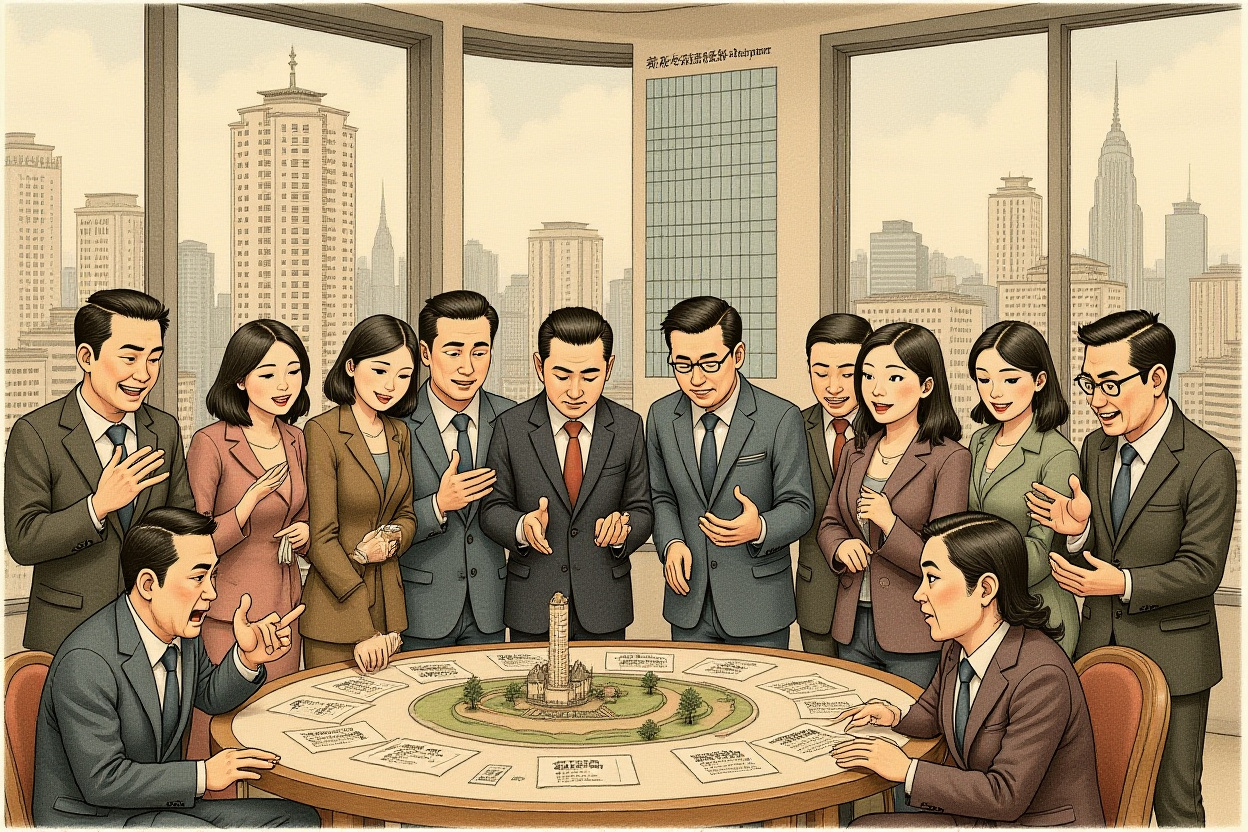
After years of anticipation and mounting scrutiny, the first phase of Shenzhen’s colossal Bai Shi Zhou urban renewal project has officially commenced handover. This milestone for the Greenfield Bai Shi Zhou urban renewal project arrives with a mix of relief and unresolved tensions, highlighting the complex realities of China’s mega-scale property developments.
Executive Summary
Key takeaways from the delivery of Shenzhen’s Bai Shi Zhou project:
- The Greenfield Bai Shi Zhou Jing Ting residential phase has begun delivery after a slight delay, with the developer citing contractual grace periods within the sales agreements.
- Homeowners are contesting unfulfilled pre-sale promises, most critically the guaranteed admission to a premium school, the Nanshan Foreign Language School, which now faces significant construction delays.
- Construction quality concerns, particularly regarding underground parking finishes, have sparked disputes between the developer and buyers over contractual versus promised standards.
- Developer Greenfield China Properties (绿景中国地产) faces substantial financial pressure, with high short-term liabilities casting a shadow over the project’s future phases.
- As a bellwether for urban renewal, the project’s progression and potential need for state-backed partners will be closely watched by investors gauging risks in China’s high-end residential sector.
A Milestone Marred by Controversy
The handover of apartments in the Bai Shi Zhou urban renewal project marks a critical juncture not just for the developer but for Shenzhen’s entire urban regeneration landscape. Positioned in the prime Nanshan District, this phase represents the tangible output of one of China’s most ambitious redevelopment plans. However, the commencement of delivery has been eclipsed by a series of controversies that underscore the perils of large-scale real estate ventures in today’s market.
Delayed Handover and Contractual Nuances
According to the homeowner purchase contracts, the official delivery date for the first-phase residences was set for January 15, 2026. The actual start of handover procedures on February 4, 2025, as announced by Greenfield China Properties on the Hong Kong Stock Exchange, therefore represents a delay. The developer has been quick to clarify that sales contracts explicitly included a one-month grace period, making deliveries before February 14 compliant and not a breach of contract. This clause, they assert, was clearly stated in all signed agreements. For international investors, this highlights the importance of scrutinizing the fine print in Chinese property contracts, where such grace periods are not uncommon but can become focal points for buyer dissatisfaction.
The Broken Promise of Premium Education
The most emotionally charged issue revolves around the promised school配套. During sales campaigns, marketing materials prominently featured commitments to a “quality education at your doorstep” with the Nanshan Foreign Language School (南山外国语学校), a sought-after institution. Promotional leaflets and posters indicated the attached nine-year一贯制 school was expected to be operational by September 2026. “A large number of us homeowners bought specifically for this school,” said an agitated Mr. Wu (吴先生), a homeowner representative. Current information, however, suggests the school land plot has not yet commenced construction, with estimates pointing to a start in 2027 and completion in 2029. The developer states that early plans involved them building the school, but due to adjustments in government fiscal planning, the responsibility was transferred to the Shenzhen Municipal Government. They claim to have halted all school-related marketing since mid-2024 and that all materials were reviewed by the Market Supervision Administration. This situation serves as a stark reminder for buyers: pre-sale promises, especially those concerning government-led infrastructure, carry inherent implementation risks.
Scrutiny on Quality and Developer Accountability
Beyond timing and配套, the physical quality of the delivered product has come under intense scrutiny. Disputes have emerged, particularly concerning common areas and finishing standards, challenging the project’s positioning as a premium, high-value residential community.
The Underground Parking Dispute
A primary point of contention has been the underground garage. Some homeowners visiting the site reported that the parking areas lacked epoxy floor paint, a feature they associated with luxury developments. Following months of lobbying by homeowner groups, the developer issued a stamped version of a garage enhancement plan. The project负责人 responded that garage upgrades were an additional investment beyond the contractual delivery standards. “As early as April-May last year, we had negotiated and determined a garage improvement plan with homeowners based on their requests,” he mentioned. He added that for homeowners dissatisfied with the current construction, the developer is re-evaluating the renovation scheme with professional homeowner representatives. This back-and-forth illustrates a common tension in China’s property market: the gap between marketing-induced expectations and the legally binding delivery specifications outlined in standardized contracts.
Regulatory Positioning and Sales Practices
The developer’s defense hinges on strict adherence to regulated sales practices. They emphasize that all marketing materials were filed and approved, and that they ceased school-specific promotions once the construction mandate shifted to the government. This aligns with broader regulatory crackdowns on false advertising in real estate. For institutional investors, this episode underscores the increasing regulatory risks surrounding sales practices and the potential for reputational damage when project timelines or配套 diverge from initial visions, even if legally permissible.
The Colossal Scale and Financial Weight of Bai Shi Zhou
Initiated as an urban renewal plan in 2014, the Bai Shi Zhou project’s sheer magnitude has always been its defining and most daunting characteristic. With a total gross floor area of 3.58 million square meters and an estimated total sales value of approximately RMB 220 billion, its progression is a key indicator of market health and developer capability.
A Benchmark in High-Rise Living
The first-phase “Jing Ting” residential component预售ed 1,257 units, with the highest tower reaching 74 stories. This establishes it as one of the tallest residential projects currently under construction in China and a new landmark for Shenzhen’s skyline. When it was launched for presale in September 2023, the average record price reached RMB 113,500 per square meter, with total prices ranging from RMB 10.12 million to RMB 52.84 million. The delivery of these units is therefore a significant event for the high-end residential segment, testing demand and acceptance for ultra-high-density living in a core urban area.
Greenfield’s Financial Precariousness
The developer, Greenfield China Properties, has essentially bet its fortunes on this mega-project. Data from the company’s 2025 interim report reveals strained finances: current liabilities stood at RMB 60.57 billion, with new borrowings of RMB 7.703 billion in the first half of the year. Debt due within one year amounts to approximately RMB 2.914 billion, while bank balances and cash were only RMB 342.5 million, alongside about RMB 1.449 billion in restricted and pledged deposits. This liquidity crunch raises valid concerns about the company’s ability to fund and complete subsequent phases of the Bai Shi Zhou urban renewal project without external assistance. The financial community is closely monitoring the developer’s cash flow, as its stability is directly tied to the project’s forward momentum.
Future Trajectory: Partnerships and Market Implications
The delivery of Phase One is just the beginning. The future of the remaining phases, which involve complex resettlement and re-planning, will likely require new capital and partnerships, shaping the model for future urban renewal ventures in Shenzhen and beyond.
The Search for a White Knight
Industry experts are already speculating about potential rescues or partnerships. Mr. Zhi Peiyuan (支培元), Vice President of the China Investment Association Listed Company Investment Professional Committee, suggested that state-owned enterprises (SOEs) or central government-backed firms are more likely candidates to take a stake. Their lower capital costs and expertise in navigating intricate government relations make them ideal partners for such large-scale, socially sensitive projects. Another possibility is involvement from local urban investment platforms (城投平台). The analyst’s view points to a growing trend where financially distressed private developers cede control or form joint ventures with state-backed entities to ensure project completion.
The New Rules of the Game
Mr. Lu Kelin (卢克林), International Certified Innovation Manager and CEO of Looker Island Technology, offered a blunt assessment: Shenzhen’s large-scale旧改 sector only recognizes two tickets: “ample cash + government credit endorsement.” He outlined four criteria for any potential white knight: a war chest capable of deploying tens of billions in RMB;默契 (tacit understanding) in negotiating拆迁 compensation with district and street-level governments; the “product iteration power” to recalibrate the massive master plan profitably under new regulations; and the “financial拆解术” to unbundle the RMB 220 billion valuation into smaller, financeable parcels. This analysis frames the Bai Shi Zhou urban renewal project not just as a real estate development, but as a complex financial and political operation requiring specialized skills beyond conventional property development.
Synthesizing the Bai Shi Zhou Narrative for Global Investors
The commencement of delivery for the Bai Shi Zhou urban renewal project is a multifaceted event with broad implications. It demonstrates the physical realization of a grand urban vision while laying bare the systemic challenges of execution, financing, and stakeholder management in China’s property sector. For sophisticated investors, this case offers critical lessons: the importance of due diligence on developer financials, the need to distinguish between marketing puffery and contractual obligations, and the growing role of state-linked entities in de-risking large projects. The future phases of Bai Shi Zhou will serve as a crucial test case for whether public-private partnerships can successfully steer such behemoths to completion in a cooling market. Market participants should monitor announcements regarding partnership deals or capital injections closely, as they will signal the next chapter for this landmark venture and provide clues for similar urban renewal projects across China’s major cities. The journey of the Bai Shi Zhou urban renewal project is far from over, and its unfolding story will remain a key barometer for the health and evolution of China’s real estate market.