



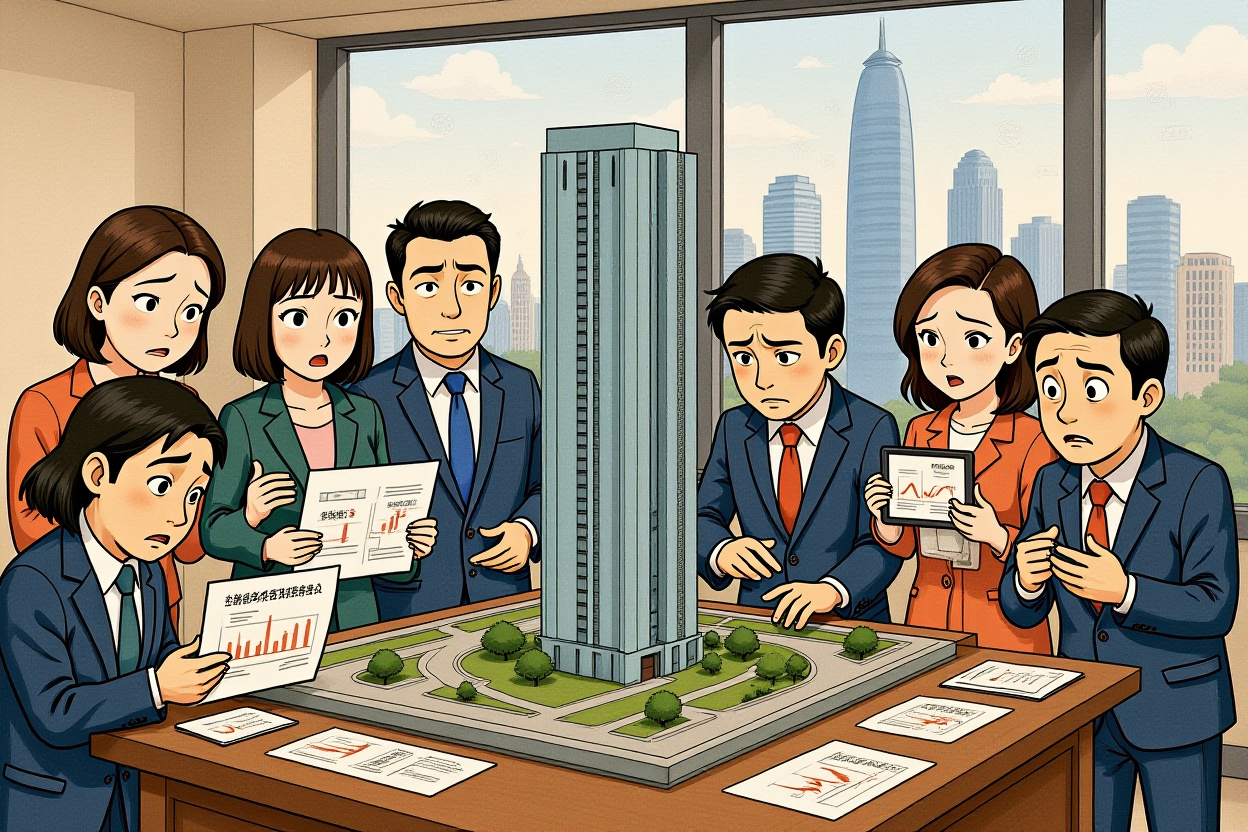
– The first phase of Shenzhen’s largest urban renewal project, Greenview Baishizhou, has commenced delivery despite significant delays and owner concerns over unmet promises.
– Developer Greenview China Real Estate faces substantial financial pressures, with high debt and low cash reserves, raising questions about the project’s long-term viability.
– Key issues include controversies over school infrastructure delays, perceived quality compromises in common areas, and the broader context of China’s slowing property market.
– The project’s outcome could signal trends for urban renewal initiatives across China, with potential for state-backed entities to intervene in troubled developments.
– Investors should monitor regulatory shifts and financial health indicators in China’s real estate sector, as this delivery may influence market sentiment and policy responses.
A Watershed Moment for Urban Renewal
The long-awaited delivery of the 74-story residential towers at Greenview China Real Estate’s (绿景中国地产) Baishizhou urban renewal project in Shenzhen represents a pivotal moment for China’s property sector. This high-rise residential delivery comes after years of anticipation and mounting skepticism, serving as a litmus test for the viability of mega-projects in an era of financial constraints and regulatory tightening. For international investors tracking Chinese equities, the saga of Baishizhou offers critical insights into the risks and opportunities embedded within the country’s ambitious urban transformation efforts.
The focus on this high-rise residential delivery is not merely about bricks and mortar; it encapsulates broader themes of developer credibility, buyer confidence, and the complex interplay between private enterprise and municipal planning in China. As the first phase, named Greenview Baishizhou璟庭, begins its handover process, stakeholders from Hong Kong to New York are assessing the implications for Greenview’s stock (HKEX: 0095) and the health of Shenzhen’s real estate market. The project’s sheer scale—with a total gross floor area of 3.58 million square meters and an estimated sales value of RMB 220 billion—means its fortunes are inextricably linked to the perceptions of institutional investors worldwide.
The Delivery Saga: Promises Versus Reality
On February 4, Greenview China Real Estate announced via the Hong Kong Stock Exchange that the main construction work for the first phase of its Baishizhou project was complete, with government approvals secured and the delivery process initiated. However, this milestone was overshadowed by disputes that have plagued the development since its presale in 2023. The contractual delivery date was January 15, 2026, but developers cited a one-month grace period, pushing the non-default deadline to February 14. This delay, while contractually stipulated, has fueled anxieties among homeowners who invested millions in what was marketed as a premium residential enclave.
Owner Grievances and the School Conundrum
For many buyers, the primary allure was the promised adjacency to top-tier educational facilities. Sales materials prominently featured claims such as ‘quality education at your doorstep with Nanshan Foreign Language School’ and ‘a nine-year consistent school, expected to be operational by September 2026.’ An owner representative, Mr. Wu (吴先生), articulated the collective frustration: ‘A significant portion of us purchased specifically for this school. To now learn that the land hasn’t even been fully cleared, with construction possibly not starting until 2027 and finishing in 2029, is utterly unacceptable.’ This high-rise residential delivery is thus marred by what owners perceive as a bait-and-switch on core amenities.
The developer’s response highlights the shifting sands of urban policy. Project officials stated that while early plans involved developer-led school construction, government fiscal adjustments later transferred responsibility to public authorities. By 2025, the land was handed over, and a contractor was appointed by the district education bureau and public works department. They emphasized that all promotional materials were vetted by the Market Supervision Administration and that school-related marketing ceased mid-2024. Nevertheless, the discrepancy between initial pitches and current reality underscores a recurring challenge in Chinese real estate: the reliance on pre-sales and forward-looking promises that may not materialize as planned.
Quality Concerns and the Garage Controversy
Beyond timelines and schools, the physical execution of this high-rise residential delivery has sparked debates over quality standards. During inspections, some owners noted the absence of epoxy floor paint in underground parking areas—a detail they argue is incongruent with a luxury development where units commanded an average pre-sale price of RMB 113,500 per square meter. In response, developers released stamped renderings of upgraded garage designs, asserting that such enhancements were voluntary additions beyond contractual obligations.
‘The garage upgrade was always an extra investment from our side, not a mandated delivery standard,’ a project负责人 explained. He noted that since April-May 2024, they had been collaborating with owner representatives to refine plans, and are currently reassessing designs based on feedback. This episode reflects a broader tension in China’s property market: as financial pressures mount, developers may prioritize cost-cutting, potentially eroding the perceived value of high-end assets. For investors, these quality disputes signal operational risks that could affect future sales and brand reputation in a competitive sector.
Financial Precariousness and Developer Dilemmas
Greenview’s journey with Baishizhou has been a high-stakes gamble. The company, a local Shenzhen player, committed extensively to this urban renewal endeavor over a decade ago, effectively betting its future on the project’s success. Financial disclosures paint a concerning picture: as of the first half of 2025, Greenview China Real Estate reported current liabilities of RMB 60.57 billion, with new borrowings of RMB 7.703 billion added in that period. Short-term debt due within a year stood at RMB 2.914 billion, against cash and bank balances of just RMB 342.5 million and restricted deposits of approximately RMB 1.449 billion.
The Liquidity Crunch and Market Speculation
These figures underscore the severe liquidity constraints facing Greenview. The high-rise residential delivery of Baishizhou’s first phase, while a positive cash flow event, may not suffice to alleviate the broader debt burden. Market rumors have swirled about potential bailouts or partnerships, notably with state-owned enterprises. In September 2024, CITIC City Development South China publicly debunked claims of a RMB 12 billion investment in the project, emphasizing that such reports were ‘completely inconsistent with facts.’ This denial highlights the sensitivity and speculation surrounding distressed assets in China’s property sector.
Industry experts weigh in on the potential for external intervention. Zhi Peiyuan (支培元), Vice President of the China Investment Association Listed Company Investment Professional Committee, suggested that state-backed enterprises are more likely candidates for takeover due to their lower capital costs and expertise in navigating complex government relations. Local urban investment platforms could also play a role. Lu Kelin (卢克林), International Certified Innovation Manager and founder of Looker Island Technology, outlined four criteria for any rescuer: substantial cash reserves, rapport with district-level governments, product iteration capabilities to recalibrate massive projects, and financial engineering skills to repackage the RMB 220 billion valuation into manageable tranches.
Baishizhou as a Bellwether for Chinese Urban Renewal
The Baishizhou project is not an isolated case but a microcosm of China’s urban renewal ambitions. Initiated in 2014, it spans multiple phases with a total developable area that ranks among the largest in Shenzhen’s history. The first phase, comprising 1,257 residential units in towers reaching up to 74 stories, sets a precedent for high-density living in megacities. With presale prices ranging from RMB 10.12 million to RMB 52.84 million per unit, it targets an affluent demographic, yet its delivery struggles mirror wider systemic issues.
Regulatory Evolution and Policy Headwinds
China’s urban renewal policies have evolved significantly over the past decade, emphasizing sustainable development and social stability. The Baishizhou project navigates regulations from the Shenzhen Municipal Government and broader guidelines from the Ministry of Housing and Urban-Rural Development (住房和城乡建设部). Recent shifts, such as increased scrutiny on pre-sale funds and stricter enforcement of delivery timelines, aim to protect homeowners but add compliance burdens for developers. This high-rise residential delivery occurs amidst a backdrop of policy experimentation, including pilot programs for escrow accounts and enhanced quality inspections.
For international investors, understanding these regulatory dynamics is crucial. The Chinese government’s emphasis on ‘housing is for living, not speculation’ has reshaped market fundamentals, impacting developer profitability and project feasibility. The Baishizhou experience illustrates how policy adjustments—like the transfer of school construction to public hands—can alter project economics overnight, affecting return on investment calculations for equity holders.
Investment Implications and Strategic Outlook
The completion and delivery of Baishizhou’s first phase offer several lessons for sophisticated market participants. Firstly, it highlights the critical importance of due diligence on developer financials and project-specific contingencies. Greenview’s precarious balance sheet serves as a cautionary tale for investors exposed to Chinese real estate equities, particularly those with high leverage and concentrated project risks. Secondly, the disputes over amenities underscore the need to verify promotional claims against contractual obligations and government master plans.
Expert Perspectives on Sector Resilience
Zhi Peiyuan (支培元) notes that the involvement of state-owned enterprises could stabilize troubled projects but may dilute returns for private shareholders. Lu Kelin (卢克林) adds that successful urban renewal in cities like Shenzhen requires not just capital but deep local knowledge and regulatory savvy. For fund managers, this suggests a bifurcated strategy: favoring developers with strong government ties and robust cash flows, while avoiding those overly reliant on single, mega-projects like Baishizhou. The high-rise residential delivery here may temporarily boost Greenview’s stock, but sustained performance hinges on subsequent phases and potential partnerships.
Market data reinforces this cautious stance. According to the National Bureau of Statistics (国家统计局), China’s real estate investment growth has slowed, with new home sales in first-tier cities like Shenzhen showing volatility. The Baishizhou project’s presale performance—where larger units sold out quickly—indicates persistent demand for premium properties, but the overall sector faces headwinds from demographic shifts and economic recalibration. Investors should monitor indicators such as inventory levels, mortgage rate trends, and policy signals from the People’s Bank of China (中国人民银行) for broader market direction.
Navigating the Future of High-Density Development
The delivery of the 74-story towers at Baishizhou marks a technical achievement in engineering and construction, yet its commercial success remains uncertain. For Greenview, the immediate priority is to satisfy first-phase owners and secure cash inflows, while negotiating the complexities of subsequent phases. Project insiders indicate that Phase II demolition is complete, with Phases III and IV undergoing regulatory redesign to align with Shenzhen’s updated planning codes, potentially involving collaborations with central or state-owned enterprises.
This high-rise residential delivery also prompts reflection on the sustainability of ultra-tall residential buildings in urban cores. While they maximize land use in densely populated cities, they impose significant maintenance costs and logistical challenges. For urban planners and investors alike, Baishizhou’s experience may inform future projects, balancing scale with livability and financial prudence. The call to action for global business professionals is clear: engage with detailed project analytics, diversify exposure across developers and regions, and stay abreast of regulatory changes that could precipitate similar delivery dramas across China’s property landscape.
In summary, the Baishizhou project’s delivery is a landmark event with multifaceted implications. It tests developer resilience in a tightening credit environment, reflects evolving urban policies, and offers a case study for investors assessing Chinese real estate equities. As the world watches this high-rise residential delivery unfold, the key takeaway is that in China’s complex property market, thorough risk assessment and adaptive strategies are indispensable for capital preservation and growth.