



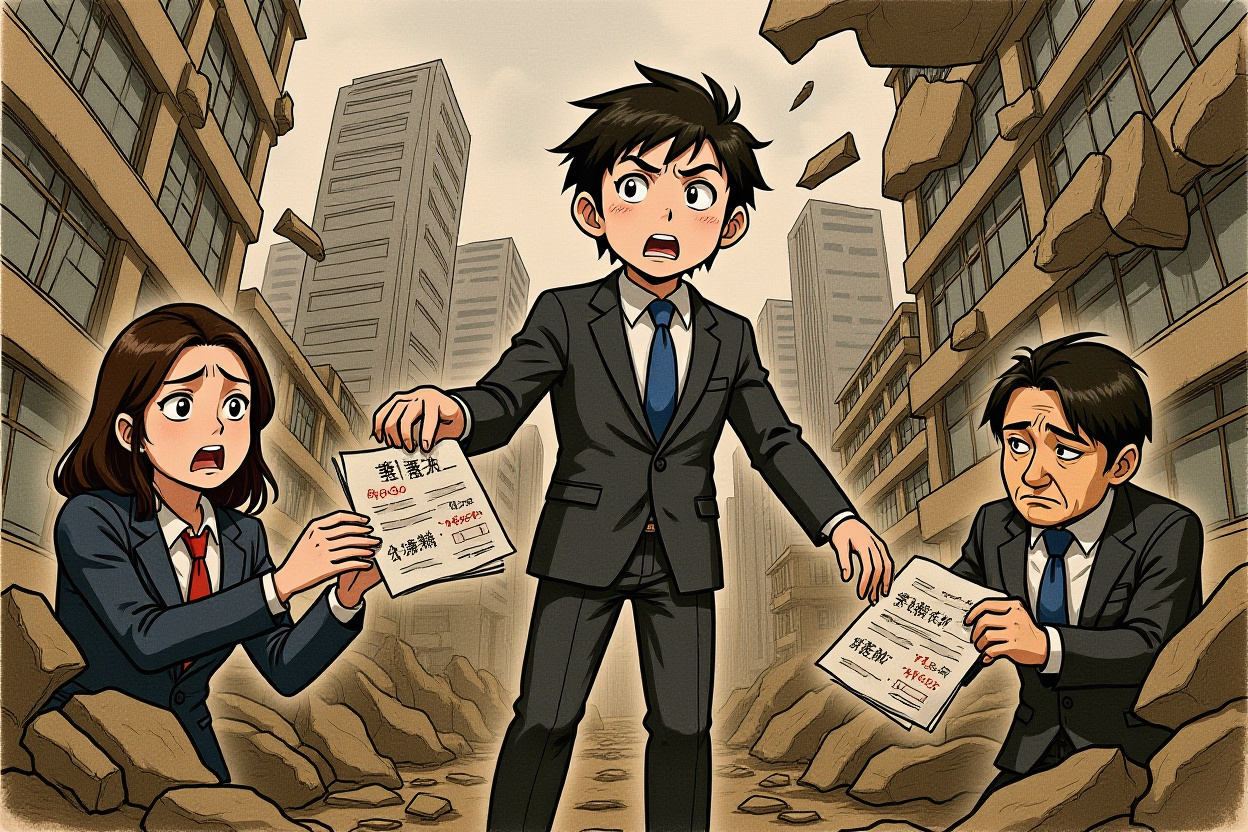
Executive Summary
Key takeaways from the Shanshan Group saga highlight critical risks in Chinese corporate governance and investment strategies.
- Shanshan Group (杉杉集团), once valued at over 60 billion yuan, collapsed into bankruptcy due to a public family feud after founder Zheng Yonggang’s (郑永刚) death.
- Heir Zheng Ju (郑驹) faced rapid asset erosion, with banks withdrawing 5 billion yuan in loans and legal disputes leading to his status as a ‘laolai’ (老赖, debt defaulter).
- A corporate takeover battle saw Saimaike (赛迈科) allegedly ousted from a winning consortium, raising questions about transparency in China’s restructuring processes.
- The Shanshan Group downfall underscores the importance of succession planning and regulatory oversight for investors in Chinese equities.
- Market implications include heightened scrutiny of family-owned businesses and potential regulatory reforms to prevent similar crises.
A Fortune Unraveled in Just Two Years
The stunning Shanshan Group downfall began with the untimely death of its visionary leader, Zheng Yonggang (郑永刚), whose strategic pivot from textiles to lithium batteries had positioned the company for explosive growth. By 2023, Shanshan Group (杉杉集团) reported record profits of 2.3 billion yuan, yet within months, the empire crumbled under the weight of internal strife and financial mismanagement. This rapid descent from a 60 billion yuan asset base to bankruptcy serves as a stark reminder of how quickly corporate fortunes can reverse in China’s volatile equity markets. The Shanshan Group downfall exemplifies the perils of inadequate succession planning and the devastating impact of family conflicts on business stability.
International investors monitoring Chinese equities must note that even well-established companies like Shanshan Group (杉杉集团) are not immune to governance failures. The group’s liabilities surged to nearly 40 billion yuan by 2024, with short-term debts exceeding 11.4 billion yuan, triggering a liquidity crisis. As banks began recalling loans, the Shanshan Group downfall accelerated, highlighting the interconnectedness of corporate governance and financial health in emerging markets. This case study offers invaluable lessons for fund managers and executives seeking to navigate China’s complex regulatory landscape.
The Lithium Bet That Almost Paid Off
Zheng Yonggang (郑永刚) masterminded Shanshan Group’s (杉杉集团) transition from a textile manufacturer to a leader in lithium-ion battery materials, capitalizing on global demand for electric vehicles. Under his leadership, annual profits soared from 100-200 million yuan to over 2.3 billion yuan by 2023, according to company filings. This strategic shift aligned with China’s push for green energy, making Shanshan a darling of investors focused on sustainable tech. However, the Shanshan Group downfall began just as these investments were poised to generate significant returns, underscoring the timing risks in long-term capital allocations.
Key data points illustrate the scale of this transformation:
- Revenue from lithium materials grew by 150% between 2020 and 2023, outpacing industry averages.
- Shanshan Group (杉杉集团) held patents for over 50 battery technologies, enhancing its market valuation.
- Despite these strengths, debt-to-asset ratios exceeded 70% by 2024, signaling underlying financial stress.
Financial Health Before the Collapse
Prior to Zheng Yonggang’s (郑永刚) death, Shanshan Group (杉杉集团) maintained a balance sheet with 60 billion yuan in assets against 12.6 billion yuan in liabilities, as reported in audited financial statements. However, 95% of these liabilities were short-term, maturing within one year, creating a precarious cash flow situation. The Shanshan Group downfall was precipitated by an inability to refinance these obligations amid rising interest rates and credit tightening in China. This scenario mirrors broader trends in Chinese corporate debt, where many firms rely on rolling over short-term loans to sustain operations.
Expert analysis from China International Capital Corporation Limited (中金公司) suggests that companies with high short-term debt exposure are particularly vulnerable to shifts in banking sentiment. In Shanshan’s case, creditor confidence evaporated once family disputes became public, leading to accelerated repayments demands. The Shanshan Group downfall thus serves as a cautionary tale for investors to assess not just profitability, but also debt maturity profiles and governance structures.
The Succession Battle That Shattered Stability
Zheng Ju (郑驹), the eldest son and designated heir, inherited a company on the brink just as internal power struggles erupted into the open. His stepmother, Zhou Ting (周婷), publicly challenged his leadership, demanding equity shares and triggering a boardroom conflict that destabilized Shanshan Group (杉杉集团). This public feud alarmed stakeholders, from employees to institutional investors, and directly contributed to the Shanshan Group downfall by undermining management credibility. The situation worsened when Zhou Ting (周婷) attempted to oust Zheng Ju (郑驹) as chairman, forcing the company into a protracted legal and media battle.
Family-owned businesses in China often face succession issues, but the Shanshan case stands out for its rapid escalation and public nature. According to governance experts at Peking University (北京大学), public disputes in family firms can reduce market capitalization by up to 20% within months, as seen in Shanshan’s valuation drop. The Shanshan Group downfall highlights the urgent need for clear succession protocols and dispute resolution mechanisms in Chinese corporations, especially those with significant international investor presence.
Zheng Ju’s Inheritance and Immediate Challenges
As the new chairman, Zheng Ju (郑驹) confronted mounting debts and skeptical lenders who had previously supported his father. Banks including Industrial and Commercial Bank of China (中国工商银行) began recalling over 5 billion yuan in loans, citing increased risk perceptions after the family conflict went public. Zheng Ju’s (郑驹) inability to secure new financing or negotiate extensions accelerated the Shanshan Group downfall, pushing the company toward insolvency. His personal fortune evaporated when courts enforced the sale of his 1.81 million shares in Shanshan Stock (杉杉股份) to cover a 27 million yuan contract dispute.
The rapid asset erosion faced by Zheng Ju (郑驹) illustrates broader themes in China’s wealth management landscape:
- High-net-worth individuals often concentrate assets in family businesses, increasing exposure to governance risks.
- Legal frameworks for inheritance in China remain complex, particularly for blended families, as seen in Zhou Ting’s (周婷) claims.
- The Shanshan Group downfall underscores how personal liabilities can quickly spiral into corporate crises in interconnected financial systems.
Zhou Ting’s Claim and Public Conflict
Zhou Ting (周婷), widow of Zheng Yonggang (郑永刚), leveraged her position to demand a significant stake in Shanshan Group (杉杉集团), arguing that her children deserved inheritance rights. Her public statements and legal actions diverted management attention from critical operational issues, exacerbating the Shanshan Group downfall. Notably, she appointed her father to represent her interests, further complicating governance and eroding investor confidence. Her pledge to ‘not lie down’ in the face of challenges did little to stabilize the situation, as creditors lost patience with the ongoing turmoil.
This aspect of the Shanshan Group downfall reflects cultural and legal nuances in Chinese business families. Under China’s Inheritance Law, spouses and children have claim to estates, but corporate control disputes can paralyze decision-making. Investors should monitor family dynamics in closely held firms, as these can be early indicators of potential Shanshan Group downfall scenarios in other companies.
Banking Reactions and Financial Collapse
Chinese banks, once supportive of Shanshan Group (杉杉集团), turned cautious as the family feud escalated, with several institutions invoking clauses to demand early loan repayments. This credit squeeze stripped the company of liquidity, forcing asset fire sales and operational cutbacks that deepened the Shanshan Group downfall. Data from the People’s Bank of China (中国人民银行) shows that corporate loan defaults rose by 15% in 2023, with family disputes cited as a contributing factor in several high-profile cases. The Shanshan Group downfall thus aligns with broader regulatory concerns about systemic risks in China’s corporate lending environment.
For institutional investors, the banking response to Shanshan’s troubles offers critical insights into credit risk assessment in China. Lenders prioritized risk mitigation over relationship banking, a shift that could affect other highly leveraged firms. The Shanshan Group downfall suggests that banks are increasingly sensitive to governance issues, not just financial metrics, when evaluating corporate borrowers.
Loan Withdrawals and Debt Pressures
At least five major banks reduced credit lines to Shanshan Group (杉杉集团) in 2023, totaling over 5 billion yuan in recalled loans. This sudden withdrawal of funding left the company unable to meet its short-term obligations, including payroll and supplier payments. The Shanshan Group downfall accelerated as creditors filed lawsuits to recover debts, leading to court-ordered asset freezes and sales. For example, Shanshan lost control of Yongshan Lithium (永杉锂业) after a 20% stake was auctioned off to repay debts.
Key debt metrics before the collapse:
- Short-term debt: 11.4 billion yuan, with 90% due within six months.
- Interest coverage ratio: Fell below 1.0, indicating inability to service debt from earnings.
- Asset-liability ratio: Reached 80% in 2024, well above the 60% threshold considered safe for industrial firms.
Asset Seizures and Loss of Control
As legal pressures mounted, courts enforced seizures of key Shanshan Group (杉杉集团) assets, including equity stakes in subsidiaries and intellectual property related to battery technologies. These actions not only depleted the company’s value but also disrupted operations, leading to customer defections and further revenue declines. The Shanshan Group downfall reached its nadir when Zheng Ju (郑驹) was labeled a ‘laolai’ (老赖) for failing to settle a 27 million yuan debt, tarnishing his reputation and limiting his ability to lead recovery efforts.
This phase of the Shanshan Group downfall highlights the legal vulnerabilities of Chinese entrepreneurs. Enforcement actions can swiftly dismantle business empires, especially when personal guarantees are involved. Investors should consider these risks when evaluating companies with significant founder involvement or complex ownership structures.
Corporate Takeover and Legal Disputes
The bankruptcy restructuring of Shanshan Group (杉杉集团) attracted 17 competing consortia, all vying for control of its lucrative lithium assets at discounted valuations. Ren Yuanlin (任元林), known as the ‘private ship king,’ emerged victorious with a 3.3 billion yuan bid that granted his consortium control over the remaining 60 billion yuan in assets. However, the Shanshan Group downfall took another twist when Saimaike (赛迈科) filed a lawsuit alleging it was wrongfully excluded from the winning bid after contributing to the consortium’s proposal. This ‘swap the狸猫 for the太子’ scenario raises red flags about transparency in China’s corporate restructuring processes.
For global investors, the takeover battle underscores both opportunities and pitfalls in distressed asset investing in China. While bargains exist, governance irregularities can undermine expected returns. The Shanshan Group downfall, through this lens, serves as a case study in the importance of due diligence and legal safeguards in merger and acquisition activities.
The Ren Yuanlin Consortium Victory
Ren Yuanlin (任元林), through his investment vehicle, secured a dominant stake in Shanshan Group (杉杉集团) by partnering with entities like China Orient Asset Management (中国东方资产管理). Their 3.3 billion yuan investment represented a significant discount to book value, highlighting the fire-sale conditions amid the Shanshan Group downfall. This deal allowed the consortium to gain control without assuming all liabilities, a common strategy in Chinese bankruptcies. However, the exclusion of Saimaike (赛迈科) has sparked legal challenges that could delay or alter the restructuring outcome.
Analysis of similar takeovers in China suggests that consortium-based bids often face post-deal disputes:
- In 2022, a Huarong Asset Management (中国华融资产管理) led consortium faced litigation over partner exclusion in a solar company restructuring.
- Successful bidders typically leverage political connections and financing access, as seen with Ren Yuanlin (任元林).
- The Shanshan Group downfall illustrates how competitive restructuring processes can lead to allegations of unfair practices, requiring regulatory intervention.
Saimaike’s Lawsuit and Allegations of Foul Play
Saimaike (赛迈科) claims it developed the initial restructuring plan and participated in two rounds of bidding before being abruptly removed from the consortium. The company has petitioned courts to nullify the current agreement and reopen the process, arguing that its ouster violated procedural fairness. This legal battle adds another layer to the Shanshan Group downfall, potentially setting precedents for how Chinese courts handle consortium disputes in bankruptcies. If Saimaike (赛迈科) prevails, it could recover what it estimates as a 10 billion yuan opportunity loss.
The allegations here resonate with broader concerns about corporate governance in China. A report by the China Securities Regulatory Commission (中国证监会) notes that restructuring processes need stronger oversight to prevent partner disputes. The Shanshan Group downfall, through this lawsuit, may drive reforms that enhance transparency and accountability in future deals.
Market Implications and Investor Insights
The Shanshan Group downfall has sent ripples through Chinese equity markets, particularly affecting sectors like new energy and family-owned enterprises. Stock prices for comparable firms dipped by an average of 5% in the weeks following Shanshan’s bankruptcy announcement, as investors reassessed governance risks. This event underscores the fragility of corporate structures that rely heavily on founder leadership and highlights the Shanshan Group downfall as a wake-up call for portfolio managers. Regulatory bodies, including the China Banking and Insurance Regulatory Commission (中国银行保险监督管理委员会), are now scrutinizing succession plans in listed companies to prevent similar crises.
For sophisticated investors, the Shanshan Group downfall offers actionable insights into risk management. Diversifying across companies with robust board oversight and independent directors can mitigate exposure to single-point failures. Additionally, engaging with management on succession planning should become a standard part of due diligence for Chinese equities.
Impact on Chinese Equity Markets
Following the Shanshan Group downfall, the CSI 300 Index (沪深300指数) experienced heightened volatility, with the industrials sector underperforming by 3% relative to benchmarks. Credit spreads for Chinese corporate bonds widened, reflecting increased risk aversion among fixed-income investors. The Shanshan Group downfall has also prompted credit rating agencies like China Chengxin International Credit Rating (中诚信国际信用评级) to downgrade several family-controlled firms, citing governance concerns. These market reactions highlight the systemic implications of individual corporate failures in China’s interconnected financial system.
Key data points for investors:
- Family-owned businesses account for over 60% of China’s privately listed companies, according to Shanghai Stock Exchange (上海证券交易所) data.
- Stocks with public governance disputes have underperformed the market by 12% on average over five years.
- The Shanshan Group downfall has increased the premium for governance-focused ETFs in China by 2-3%.
Regulatory and Governance Lessons
Chinese regulators are likely to introduce stricter disclosure requirements for succession plans and family conflicts in the wake of the Shanshan Group downfall. The State-owned Assets Supervision and Administration Commission (国务院国有资产监督管理委员会) has already issued guidelines encouraging diversified ownership and professional management in private firms. For international investors, these changes could reduce governance risks but may also increase compliance costs. The Shanshan Group downfall thus serves as a catalyst for broader reforms that could shape China’s capital markets for years to come.
To avoid similar pitfalls, investors should:
- Monitor board composition and independence in family-controlled companies.
- Engage with management on contingency planning for leadership transitions.
- Advocate for transparent restructuring processes in distressed situations.
Navigating the Aftermath of a Corporate Implosion
The Shanshan Group downfall teaches invaluable lessons about the intersection of family dynamics, corporate governance, and financial stability in China’s rapidly evolving markets. From a 60 billion yuan empire to bankruptcy, this saga illustrates how internal conflicts can unravel years of strategic progress in mere months. Investors must prioritize governance due diligence, especially in family-owned businesses, to shield portfolios from similar shocks. The Shanshan Group downfall also highlights opportunities in distressed assets, but only for those with the expertise to navigate legal and regulatory complexities.
As China continues to liberalize its financial markets, incidents like the Shanshan Group downfall will likely prompt stronger safeguards and more transparent processes. For now, institutional players should enhance their scrutiny of succession plans and debt structures when evaluating Chinese equities. By learning from this case, the global investment community can better anticipate and mitigate risks in one of the world’s most dynamic economies. Take the next step: Review your portfolio’s exposure to family-controlled firms and engage with management teams on governance practices to fortify your investments against future downturns.