



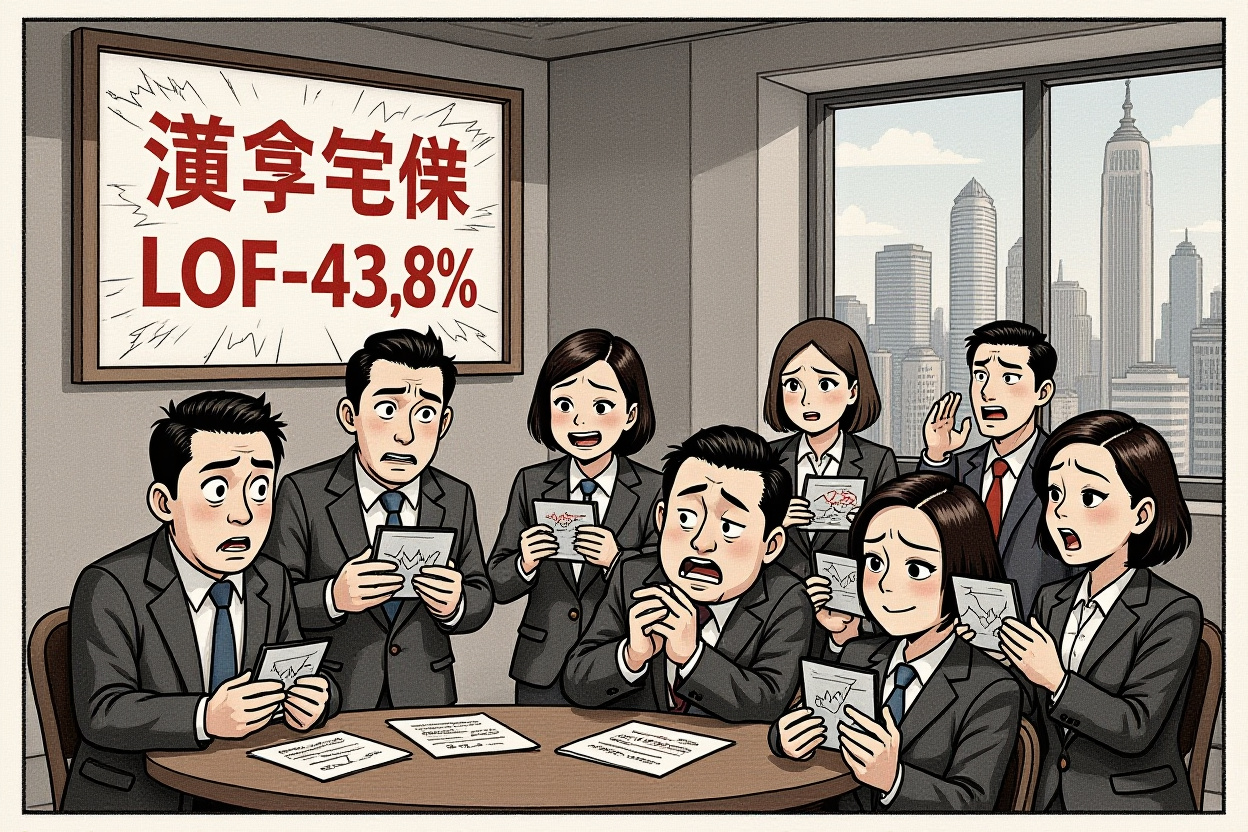
A Sudden Halt and a Stunning Fall
The reopening of trading for the SDIC Silver LOF (SDIC Silver LOF, 国投白银LOF) on Monday was anything but ordinary for China’s fund market. Instead of a continuation of its speculative frenzy, the exchange-traded fund product was met with a swift and severe limit-down plunge, sending shockwaves through the community of retail investors who had piled into the instrument. This dramatic event was the direct result of regulatory intervention by the Shenzhen Stock Exchange (SZSE, 深圳证券交易所), which had suspended the fund the previous Friday citing “abnormal trading behavior” that disrupted market order.
The SDIC Silver LOF’s premium—the amount by which its market price exceeded its underlying Net Asset Value (NAV)—had been a persistent and glaring anomaly, at times soaring to astronomical levels above 100%. Following the trading halt and subsequent resumption, this premium contracted sharply to 43.8%, a significant correction but one that still indicates substantial market dislocation. This episode is not an isolated incident but a critical case study in the regulatory challenges posed by speculative capital flows in China’s rapidly evolving financial markets, where products tied to volatile commodities like silver can become unintended casinos.
Key Takeaways for Global Market Participants
- The SDIC Silver LOF resuming trade and hitting limit-down underscores the Chinese regulators’ low tolerance for disorderly market behavior and their willingness to intervene directly, even in secondary market trading of fund units.
- Extreme premiums in LOF/ETF products represent significant arbitrage opportunities but carry high regulatory and liquidity risks, as the SDIC Silver LOF case vividly demonstrates.
- This regulatory action serves as a stark warning to retail speculators and a reminder of the critical importance of understanding the fundamental NAV mechanism of fund products.
- The event may signal a broader tightening of surveillance on commodity-linked, cross-border, and niche exchange-traded products to safeguard overall financial stability.
Deconstructing the Event: From Frenzy to Freeze
The saga of the SDIC Silver LOF is a textbook example of market mechanics breaking down under the pressure of speculative sentiment. As a Listed Open-Ended Fund (LOF), it is designed to trade on an exchange like a stock, with its market price ideally staying close to its daily calculated NAV. However, driven by retail demand for exposure to silver’s price movements and potentially compounded by limited unit creation mechanisms, the fund’s market price detached violently from its fundamental value.
The Mechanics of a Runaway Premium
The premium on the SDIC Silver LOF did not emerge in a vacuum. It was fueled by several converging factors. Firstly, strong retail interest in silver as an inflation hedge and speculative asset created sustained buying pressure on the tradable LOF units. Secondly, arbitrage mechanisms that typically keep ETF/LOF prices in check—such as the ability for authorized participants to create new units when the price is too high—may have been less efficient or slower-acting for this specific fund. This created a bottleneck where demand vastly outstripped the supply of units, pushing the price to a massive premium over NAV.
This situation meant investors buying the LOF on the secondary market were paying, for example, 1.8 RMB for assets worth only 1 RMB. This disconnect represented a pure speculative bubble on the fund’s structure itself, entirely separate from the performance of silver bullion. The SDIC Silver LOF resuming trade and hitting limit-down was the inevitable, gravity-induced correction once the primary arbitrage valve—the threat of unit creation—was reinforced by regulatory action.
The Regulator’s Heavy Hand: SZSE’s Unambiguous Intervention
The pivotal moment in this drama was the public statement issued by the Shenzhen Stock Exchange on Friday. The bourse did not mince words, stating explicitly that it had identified “abnormal trading behavior” by some investors during the trading of the SDIC Silver LOF and other fund products that “affected the normal trading order.” In response, it imposed self-regulatory disciplinary measures, including the suspension of trading for the relevant investors.
Analyzing the “Abnormal Trading Behavior”
While the SZSE announcement was brief, financial market professionals infer several likely activities that triggered the crackdown. These could have included:
- Coordinated pumping: Groups of investors acting in concert to aggressively bid up the price, creating artificial momentum.
- Spoofing or layering: Placing large orders with the intent to cancel them, to mislead other market participants about supply and demand.
- Circular trading: Wash trades among related accounts to generate false volume and price activity.
Such behaviors distort price discovery and endanger retail investors who may follow the manipulated price signals. The SZSE’s move to suspend trading for specific investors, and then the fund itself, was a targeted surgical strike to dismantle this activity. The subsequent SDIC Silver LOF resuming trade and hitting limit-down was the market’s immediate repricing in the absence of that manipulative pressure. The exchange’s full announcement can be reviewed on its official website (www.szse.cn).
LOFs, ETFs, and the Persistent Premium Puzzle
To understand why this event matters beyond a single fund, one must grasp the critical design difference between LOFs and their more common cousin, the Exchange-Traded Fund (ETF), and why premiums can become entrenched.
Arbitrage Mechanisms: The Theory vs. Reality
In a perfectly efficient market, a high premium should be quickly erased by arbitrageurs. For an ETF, authorized participants (APs) can deliver a basket of the underlying assets to the fund issuer in exchange for new ETF units (creation), which they can then sell on the market, increasing supply and pushing the price down toward NAV. The reverse process (redemption) works for discounts.
For LOFs, the arbitrage mechanism is similar but can be less fluid. The creation/redemption process might be slower (e.g., T+2 settlement), involve higher minimum basket sizes, or have fewer active APs willing to participate. In the case of the SDIC Silver LOF, which invests in overseas silver ETFs, there may be additional complexities like foreign exchange controls and trading hour mismatches that hamper swift arbitrage. This structural friction is what allowed the premium to persist at extreme levels, creating the conditions for speculative excess and, ultimately, regulatory blow-up.
Broader Implications for China’s Financial Market Stability
The forceful intervention by the SZSE in the SDIC Silver LOF resuming trade and hitting limit-down affair sends powerful signals to all market participants. It reflects key pillars of China’s current financial regulatory philosophy under leaders like China Securities Regulatory Commission (CSRC, 中国证券监督管理委员会) Chairman Yi Huiman (易会满).
A Warning to Retail Speculators and “Zombie Funds”
First and foremost, this is a direct message to retail investors. Regulators are demonstrating that they will not stand idly by while popular narratives and herd behavior detach asset prices from fundamental values, especially in products marketed as relatively safe fund vehicles. The losses incurred from the limit-down are a painful, real-world lesson in the risks of chasing hot themes without understanding the underlying product structure.
Secondly, it highlights regulatory scrutiny on niche, cross-border, or commodity-linked investment vehicles. Other LOFs or QDII (Qualified Domestic Institutional Investor) funds tracking volatile assets like oil, niche tech themes, or specific foreign indices could face increased surveillance. The era of these products operating in obscurity with large, persistent premiums or discounts is likely over. The goal is to prevent systemic pockets of risk where retail capital is concentrated in unstable, arbitrage-resistant vehicles.
Navigating the New Landscape: Strategies for Sophisticated Investors
For institutional investors, fund managers, and savvy retail participants, the post-SDIC Silver LOF environment demands adjusted strategies and heightened due diligence.
Due Diligence and Risk Assessment Framework
Moving forward, analyzing any Chinese exchange-traded fund product must include a dedicated premium/discount risk assessment. Key questions to ask include:
- What is the historical range of the premium/discount, and what is the current level?
- How efficient and accessible is the creation/redemption mechanism? How many APs are active?
- Does the fund invest in hard-to-arbitrage underlying assets (e.g., overseas securities, physical commodities)?
- Has the fund or similar products been subject to recent regulatory commentary or disciplinary action?
An elevated premium is no longer just an arbitrage signal; it is a regulatory risk flag. The potential for a sudden trading halt or direct intervention, as seen with the SDIC Silver LOF resuming trade and hitting limit-down, must be priced into any investment or arbitrage decision.
Synthesis and Forward-Looking Guidance
The dramatic limit-down fall of the SDIC Silver LOF upon its trading resumption is far more than a one-day market anomaly. It is a definitive statement from Chinese regulators that maintaining orderly market function and protecting retail investors from clear manipulative behaviors takes precedence over unfettered trading. The swift contraction of the premium from over 100% to 43.8% is a direct measure of the speculative froth being purged from the system by regulatory force.
This event will likely lead to tighter real-time monitoring of premiums across all LOF and ETF products listed on Chinese exchanges. We may see exchanges issue more frequent investor education notices warning of the risks of trading at large premiums. Furthermore, fund issuers themselves may be encouraged or compelled to take more active steps to facilitate arbitrage, such as engaging more APs, to prevent their products from becoming vehicles for speculation.
For global investors, the key takeaway is that China’s capital markets continue to evolve within a framework of “controlled innovation.” While product variety increases, the regulatory perimeter is vigilantly guarded. Successful navigation requires an understanding of not just economic fundamentals and corporate earnings, but also of regulatory priorities and the micro-structure of the instruments themselves. The story of the SDIC Silver LOF serves as a potent reminder: in China’s markets, ignoring regulatory intent and market mechanics can be just as perilous as misjudging the underlying asset.
To stay ahead of these developments, market participants should closely monitor announcements from the SZSE and Shanghai Stock Exchange (SSE, 上海证券交易所) regarding trading discipline and subscribe to research that analyzes premium/discount dynamics across the Chinese ETF universe. In an environment where regulatory action can be a primary market mover, such vigilance is not optional—it is essential for capital preservation and identifying the next genuine opportunity amidst the noise.