



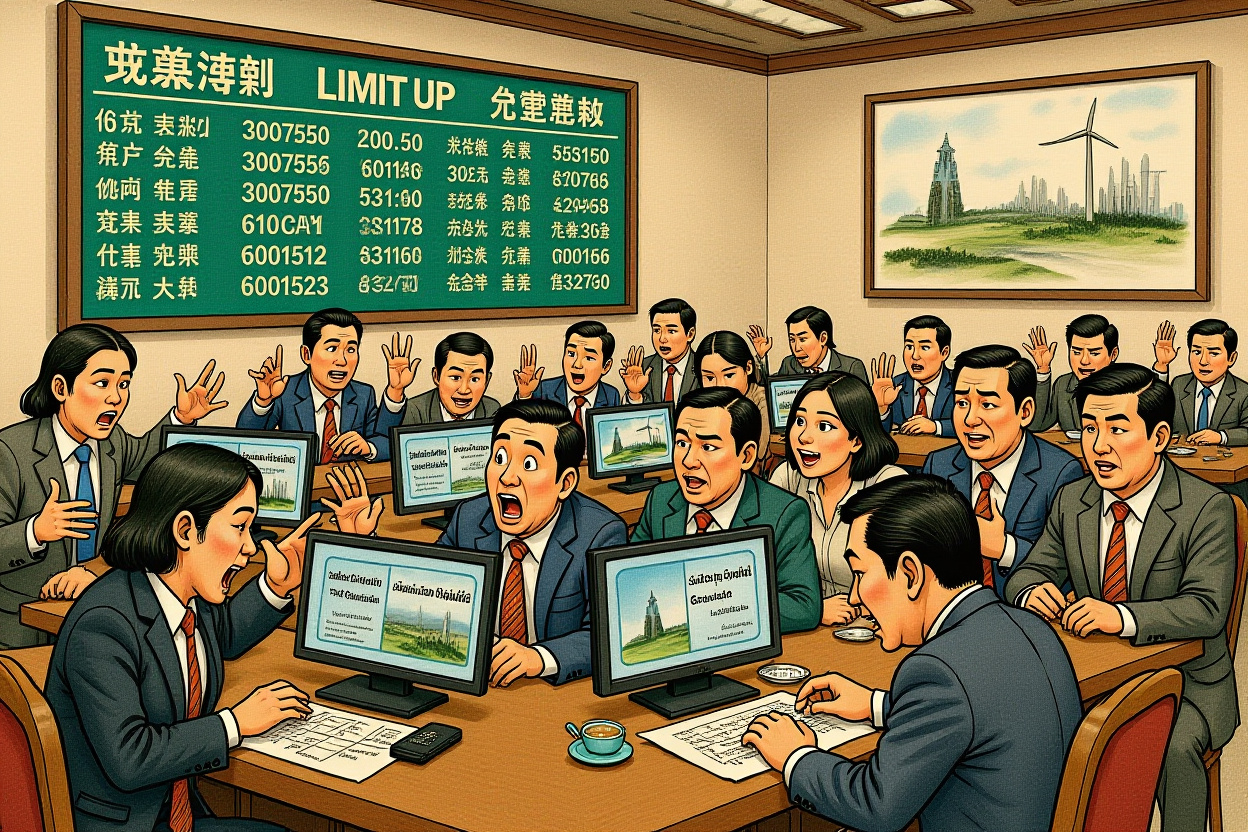
– A sudden announcement from Saudi Arabia triggered unprecedented volatility in Chinese equity markets, leading to multiple one-minute limit up events.
– The entire renewable energy and technology sectors experienced rapid price surges, highlighting market sensitivity to geopolitical and economic news.
– Regulatory bodies like the 中国证券监督管理委员会 (China Securities Regulatory Commission) are monitoring the situation for potential market manipulation or systemic risks.
– Investors are advised to reassess portfolio exposures in light of increased cross-border market correlations and volatility.
– This event underscores the growing influence of Middle Eastern capital and news flow on Asian financial markets.
In the high-stakes world of Chinese equities, where milliseconds can mean millions, the market witnessed a seismic event this week. A one-minute limit up—a rare phenomenon where a stock’s price hits its daily upper limit almost instantly after opening—swept through an entire sector, fueled by breaking news from Saudi Arabia. This frenzy not only captured headlines but also exposed the intricate vulnerabilities and opportunities within China’s rapidly integrating capital markets. For institutional investors and fund managers globally, understanding the mechanics behind this one-minute limit up event is crucial for navigating future shocks and optimizing strategic allocations in Asian assets.
The Event Unfolds: A Market in Turmoil
The trading session began like any other, but within moments, screens flashed red and green as several stocks on the 上海证券交易所 (Shanghai Stock Exchange) and 深圳证券交易所 (Shenzhen Stock Exchange) skyrocketed. The one-minute limit up was not isolated; it cascaded across companies in the clean energy and tech hardware spaces, creating a domino effect that left traders scrambling.
Decoding the One-Minute Limit Up Phenomenon
A one-minute limit up occurs when buy orders overwhelm sell orders immediately after market open, pushing a stock’s price to its maximum allowed daily increase—typically 10% in China’s A-share markets—within 60 seconds. This is often driven by pent-up demand following significant overnight news. In this case, the trigger was a surprise announcement from Saudi Arabia regarding a massive investment in global renewable energy projects, with Chinese firms poised as key beneficiaries. Market data showed volume spikes exceeding 300% above average, indicating frenetic algorithmic and retail trading activity. The one-minute limit up events were concentrated in stocks like 隆基绿能 (LONGi Green Energy Technology) and 宁德时代 (CATL), which saw their prices soar before slight pullbacks.
Initial Market Reactions and Volatility Spikes</h3
The immediate aftermath saw the 沪深300指数 (CSI 300 Index) jump 2.5% in early trading, with volatility indices spiking to levels not seen since the 2020 pandemic sell-off. Analysts from 中金公司 (China International Capital Corporation Limited) noted that the speed of the move underscored market fragility to external catalysts. Key observations include:
– Liquidity dried up momentarily as market makers adjusted to the news flow.
– Cross-asset correlations strengthened, with yuan-denominated bonds and commodities also experiencing ripples.
– Social media platforms like 雪球 (Xueqiu) buzzed with retail investor speculation, amplifying the momentum.
Saudi Arabia’s Bombshell: What We Know
The catalyst for the market frenzy was a late-night press release from the Saudi Arabian Ministry of Energy, detailing a $500 billion commitment to solar and wind energy infrastructure over the next decade. This announcement, part of the Kingdom’s Vision 2030 diversification plan, explicitly mentioned partnerships with Chinese manufacturing and technology giants, sending shockwaves through relevant equity sectors.
Details of the Saudi Announcement</h3
The Saudi plan involves direct investments and offtake agreements with companies specializing in photovoltaic panels, energy storage, and smart grid technology. Chinese firms, which dominate global supply chains in these areas, are expected to secure over 40% of the contracts, according to preliminary estimates. This news broke during Asian trading hours, catching many investors off-guard and leading to the rapid repricing seen in the one-minute limit up scenarios. The announcement is accessible via the Saudi government’s official portal [Link to Saudi Ministry of Energy announcement].
Historical Context and Market Sensitivity</h3
Historically, news from the Middle East has had muted direct impacts on Chinese equities, but this event marks a shift. As China deepens its Belt and Road Initiative collaborations with Gulf states, market linkages have strengthened. Previous instances, such as Saudi Aramco’s IPO, indirectly boosted Chinese energy stocks, but nothing compares to the velocity of this reaction. The one-minute limit up phenomenon highlights how integrated global capital flows have become, with news from Riyadh now capable of moving markets in Shanghai within minutes.
Sectoral Impact: Which Tracks Went Crazy?
Historically, news from the Middle East has had muted direct impacts on Chinese equities, but this event marks a shift. As China deepens its Belt and Road Initiative collaborations with Gulf states, market linkages have strengthened. Previous instances, such as Saudi Aramco’s IPO, indirectly boosted Chinese energy stocks, but nothing compares to the velocity of this reaction. The one-minute limit up phenomenon highlights how integrated global capital flows have become, with news from Riyadh now capable of moving markets in Shanghai within minutes.
Sectoral Impact: Which Tracks Went Crazy?
The term “track” in the original headline refers to specific industry sectors or themes in the stock market. In this case, the renewable energy and advanced manufacturing sectors were at the epicenter of the frenzy, experiencing what traders describe as “going crazy” with rapid price appreciations.
Identifying the Affected Industries</h3
The most impacted industries included:
– Solar panel manufacturers: Companies like 晶科能源 (Jinko Solar) and 天合光能 (Trina Solar) saw gains exceeding 15% at peak.
– Battery and energy storage: Firms such as 亿纬锂能 (EVE Energy Co., Ltd.) benefited from anticipated demand surges.
– Industrial automation and robotics: With Saudi investments targeting smart infrastructure, stocks like 汇川技术 (Inovance Technology) rallied sharply.
This sector-wide surge was validated by trading volume data from the 中国结算 (China Securities Depository and Clearing Corporation), showing a 250% increase in sectoral turnover.
Case Studies of Key Stocks</h3
Examining specific stocks reveals the mechanics of the one-minute limit up. For instance, 阳光电源 (Sungrow Power Supply Co., Ltd.) opened at its limit up price of 58.2 yuan, a 10% increase from the previous close, within the first minute. This was driven by a backlog of buy orders placed pre-market after the Saudi news disseminated. Similarly, 先导智能 (Lead Intelligent Equipment Co., Ltd.) experienced a one-minute limit up due to its exposure to battery production lines favored by the Saudi initiative. These cases illustrate how targeted news can trigger cascading buy-side pressure, especially in sectors with high retail participation.
Regulatory and Institutional Response
Examining specific stocks reveals the mechanics of the one-minute limit up. For instance, 阳光电源 (Sungrow Power Supply Co., Ltd.) opened at its limit up price of 58.2 yuan, a 10% increase from the previous close, within the first minute. This was driven by a backlog of buy orders placed pre-market after the Saudi news disseminated. Similarly, 先导智能 (Lead Intelligent Equipment Co., Ltd.) experienced a one-minute limit up due to its exposure to battery production lines favored by the Saudi initiative. These cases illustrate how targeted news can trigger cascading buy-side pressure, especially in sectors with high retail participation.
Regulatory and Institutional Response
In the wake of the volatility, Chinese regulatory authorities and financial institutions moved swiftly to assess the situation and ensure market stability, mindful of the risks posed by such rapid price movements.
中国证券监督管理委员会 (China Securities Regulatory Commission) Actions</h3
The CSRC issued a statement emphasizing its monitoring of abnormal trading activities and reminding market participants of rules against price manipulation. While no immediate intervention was announced, the commission hinted at potential adjustments to circuit breaker mechanisms if volatility persists. The full statement can be found on the CSRC website [Link to CSRC announcement]. Additionally, the 上海证券交易所 (Shanghai Stock Exchange) temporarily suspended automated trading for three stocks that exhibited extreme one-minute limit up behavior, citing the need to prevent disorderly markets.
Market Safeguards and Circuit Breakers</h3
China’s market infrastructure includes circuit breakers that halt trading if indices move beyond certain thresholds, but these are designed for broader market stress, not individual stock spikes. The one-minute limit up events tested these safeguards, revealing gaps in micro-level volatility controls. Experts like PBOC Governor Pan Gongsheng (潘功胜) have previously advocated for enhanced surveillance of cross-border news impacts. Recommendations from industry groups include:
– Implementing dynamic limit up/down bands based on stock liquidity.
– Enhancing pre-market auction periods to absorb overnight news shocks.
– Encouraging institutional investors to provide liquidity during such events.
Investor Implications and Strategic Moves
China’s market infrastructure includes circuit breakers that halt trading if indices move beyond certain thresholds, but these are designed for broader market stress, not individual stock spikes. The one-minute limit up events tested these safeguards, revealing gaps in micro-level volatility controls. Experts like PBOC Governor Pan Gongsheng (潘功胜) have previously advocated for enhanced surveillance of cross-border news impacts. Recommendations from industry groups include:
– Implementing dynamic limit up/down bands based on stock liquidity.
– Enhancing pre-market auction periods to absorb overnight news shocks.
– Encouraging institutional investors to provide liquidity during such events.
Investor Implications and Strategic Moves
For global investors, this episode offers critical lessons on risk management and opportunity capture in Chinese equities, particularly when external news drives extreme volatility like the one-minute limit up.
Opportunities for Sophisticated Investors</h3
The rapid price movements created arbitrage opportunities, especially for quantitative funds with high-frequency trading capabilities. By analyzing order flow data, some firms capitalized on momentary mispricings between correlated stocks. Moreover, the sustained sectoral momentum suggests longer-term investment themes: analysts from 高盛 (Goldman Sachs) recommend overweight positions in Chinese green tech stocks, citing structural tailwinds from Middle Eastern capital inflows. Key actions include:
– Diversifying into sectors with indirect exposure, such as raw materials for renewable infrastructure.
– Using options strategies to hedge against further one-minute limit up events.
– Monitoring Saudi sovereign wealth fund activities for early signals.
Risk Management in Volatile Conditions</h3
Volatility of this magnitude necessitates robust risk frameworks. Institutional investors should reassess their Value-at-Risk (VaR) models to incorporate geopolitical news sensitivity, especially from regions like the Middle East. The one-minute limit up scenario underscores the importance of stress testing portfolios against sudden liquidity gaps. Practical steps involve:
– Setting stricter stop-loss orders for positions in news-sensitive sectors.
– Increasing cash reserves to exploit pullbacks after initial surges.
– Engaging with local brokers for real-time news aggregation and analysis.
Global Perspectives and Cross-Border Effects
Volatility of this magnitude necessitates robust risk frameworks. Institutional investors should reassess their Value-at-Risk (VaR) models to incorporate geopolitical news sensitivity, especially from regions like the Middle East. The one-minute limit up scenario underscores the importance of stress testing portfolios against sudden liquidity gaps. Practical steps involve:
– Setting stricter stop-loss orders for positions in news-sensitive sectors.
– Increasing cash reserves to exploit pullbacks after initial surges.
– Engaging with local brokers for real-time news aggregation and analysis.
Global Perspectives and Cross-Border Effects
The reverberations of this event extended beyond China, affecting international markets and investor sentiment, highlighting the interconnectedness of modern finance.
International Investor Sentiment</h3
Global fund managers reported mixed reactions: some viewed the Saudi news as a validation of Chinese technological prowess, leading to increased allocations, while others expressed concern over market frothiness. Surveys from 摩根士丹利 (Morgan Stanley) indicate that 65% of international investors plan to increase their exposure to Chinese renewables in the next quarter, driven by this event. However, caution prevails regarding potential regulatory crackdowns or profit-taking after the one-minute limit up spikes.
Comparisons with Other Market Events</h3
This one-minute limit up frenzy draws parallels to the 2021 meme stock craze in the U.S., where retail momentum drove extreme volatility. However, the Chinese version is more news-driven and sector-specific. Unlike the U.S. events, which were largely detached from fundamentals, the Saudi announcement has tangible economic implications, suggesting that the price moves may have a fundamental basis. Lessons from past episodes include the need for enhanced market education and the role of social media in amplifying news impacts.
This one-minute limit up frenzy draws parallels to the 2021 meme stock craze in the U.S., where retail momentum drove extreme volatility. However, the Chinese version is more news-driven and sector-specific. Unlike the U.S. events, which were largely detached from fundamentals, the Saudi announcement has tangible economic implications, suggesting that the price moves may have a fundamental basis. Lessons from past episodes include the need for enhanced market education and the role of social media in amplifying news impacts.
The one-minute limit up frenzy triggered by Saudi Arabia’s announcement is a stark reminder of the velocity and vulnerability of today’s financial markets. For investors, it underscores the necessity of agile strategies that can capitalize on rapid information diffusion while mitigating downside risks. Key takeaways include the growing clout of Middle Eastern capital in shaping Asian equity trends, the importance of sector-specific news analysis, and the need for regulatory evolution to keep pace with market innovations. As Chinese markets continue to globalize, such events may become more frequent, demanding heightened vigilance and adaptive portfolio management. Moving forward, investors should prioritize real-time news monitoring, deepen their understanding of cross-border economic partnerships, and consider diversifying into structurally resilient sectors. The call to action is clear: in an era where news from Riyadh can spark a one-minute limit up in Shanghai, proactive engagement and continuous learning are not just advantages—they are imperatives for success in Chinese equities.