



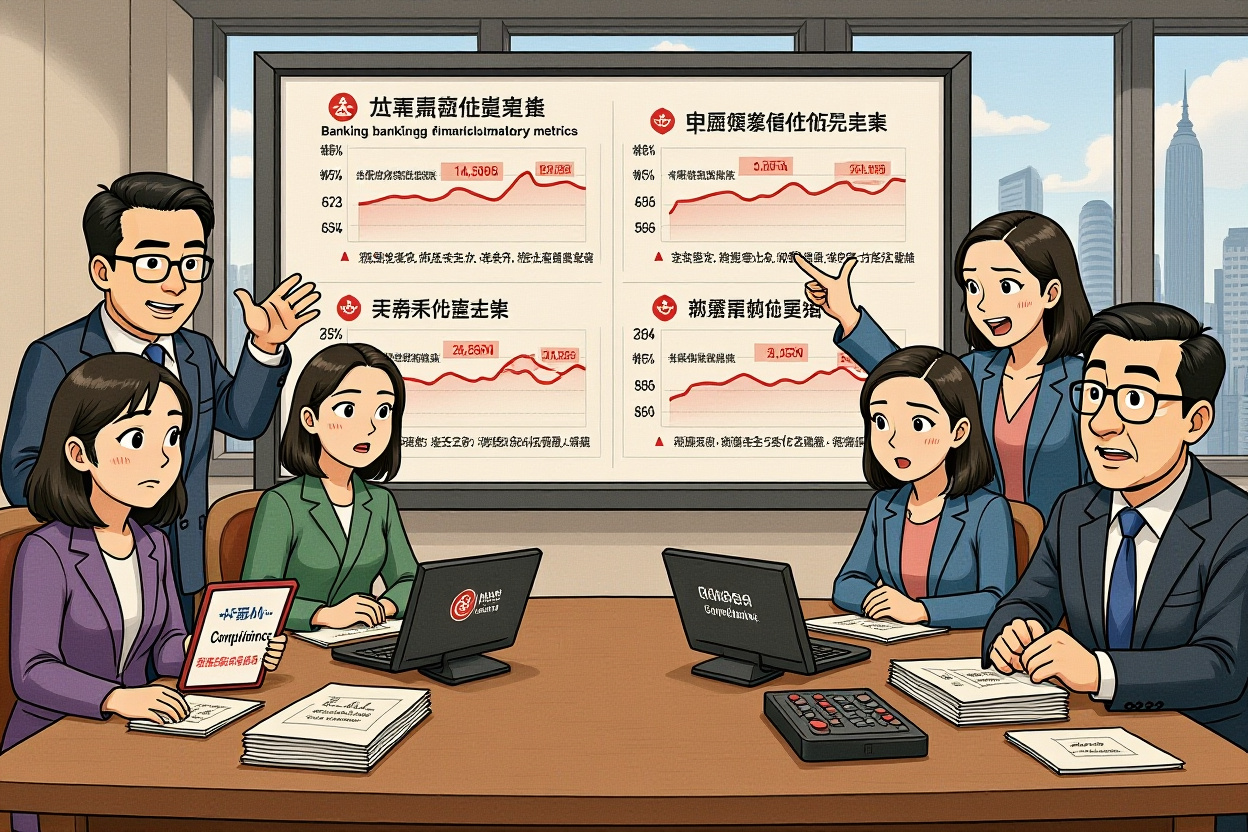
In November 2025, a subtle but profound shift occurred in China’s financial regulatory enforcement. While the overall number and value of fines against banks declined, the pattern revealed a new, more surgical strategy. The national financial regulators, including the National Financial Regulatory Administration (NFRA) and the People’s Bank of China (PBOC), have pivoted from casting a wide net to executing precision strikes, focusing their considerable authority on institutions with systemic and repeated compliance failures. This targeted enforcement strategy, as the data now confirms, has brought two major lenders squarely into the crosshairs: Huaxia Bank (华夏银行) and Bank of Beijing (北京银行). Their designation as the month’s top penalty recipients underscores a critical evolution in China’s approach to maintaining financial stability and consumer protection. For global investors and market participants, understanding this shift is key to assessing operational risk within China’s vast banking sector.
Executive Summary: Key Takeaways
- Despite a 56.76% month-on-month drop in total fine amounts, China’s bank regulators intensified a targeted enforcement strategy in November 2025, focusing on institutions with deep-seated compliance issues.
- Huaxia Bank, a national joint-stock commercial bank, was fined 14.3596 million yuan across 9 penalties, with a single PBOC penalty of 13.655 million yuan highlighting severe lapses in anti-money laundering (AML) and core operational controls.
- Bank of Beijing, a major city commercial lender, faced an even larger total impact, receiving 20 penalties totaling 28.1814 million yuan, with its violations extending into real estate and wealth management business lines.
- The regulatory focus has decisively moved beyond traditional credit violations to foundational areas like payment settlement, account management, and AML—the so-called “lifeline” functions of a modern bank.
- The persistent and broadening nature of violations at these banks raises serious questions about internal control efficacy and the long-term impact of hefty fines on business performance and investor confidence.
The Big Picture: A Shift to Targeted Enforcement
The headline numbers for November 2025 suggested a regulatory thaw. According to data from Qiye Yujingtong (企业预警通), the total number of bank penalties fell by 7.48% to 433, while the total monetary value of fines plummeted by 56.76% to 160 million yuan. However, this aggregate calm masked a significant strategic storm. Regulators have abandoned a blanket approach in favor of precision strikes, concentrating resources on institutions demonstrating the most severe and persistent risks.
The Anatomy of a Precision Strike
The evidence for this targeted enforcement strategy lies in the distribution of penalties. Although fewer in total, the penalties became more impactful. Thirty-four individual fines exceeded 1 million yuan each, collectively accounting for a staggering 63% of the month’s total fine value. This indicates regulators are pursuing high-value, consequential actions rather than dispersing efforts across minor infractions. The enforcement bodies themselves showed distinct profiles: the NFRA issued the majority of penalties (290), but the PBOC’s actions, though fewer (107), carried far greater financial heft, with an average fine of 679,300 yuan per case, demonstrating its role as the enforcer of last resort for critical systemic breaches.
Evolving Violation Trends: From Credit to Core Compliance
The nature of the violations is also transforming. While penalties for credit business irregularities remained the most numerous (220), their share of the total fine value dropped to 28%. This suggests banks have made superficial improvements in visible credit processes, though隐性违规 (implicit violations) like inadequate due diligence in loan reviews persist. More tellingly, penalties in areas like data governance and employee conduct management fell sharply, potentially indicating some success from prior regulatory pressure. Conversely, violations in外汇业务 (foreign exchange business) and票据业务 (bill business) saw notable increases, pointing to new areas of regulatory scrutiny. The consistent application of the “双罚制” (dual-punishment system), where both the institution and responsible individuals are penalized, remains a cornerstone of this targeted enforcement strategy, with warnings being the most common individual sanction.
Case Study 1: Huaxia Bank and the Breach of Financial Lifelines
The case of Huaxia Bank epitomizes the regulators’ new focus. In November, the bank emerged as a primary target of this targeted enforcement strategy, receiving 9 penalties worth a combined 14.3596 million yuan. This resulted in an average fine of 1.5955 million yuan per notice—a severity metric that far outpaced peers. For comparison, while another joint-stock bank, China Guangfa Bank, received more penalties (19), its total fine amount was less than a third of Huaxia Bank’s.
Dissecting the 13.655 Million Yuan PBOC Hammer Blow
The most significant action came on November 26, when the PBOC levied a colossal 13.655 million yuan fine against Huaxia Bank for ten categories of violations. This penalty sheet reads like a catalog of fundamental banking failures, moving far beyond loan underwriting:
- Core Operations Failure: Violations of account management,清算管理 (clearing management), and收单业务 (merchant acquiring business) regulations.
- Currency Control Negligence: Breaches of反假货币 (anti-counterfeiting) and人民币流通 (RMB circulation) rules.
- Systemic Anti-Money Laundering Collapse: This was the centerpiece of the penalty. The bank failed at virtually every stage:客户身份识别 (customer identification),保存客户身份资料和交易记录 (record retention),报送大额交易报告或者可疑交易报告 (reporting of large and suspicious transactions), and even conducting transactions with身份不明的客户 (unidentified clients).
- Credit Information Mismanagement: Violations of信用信息采集、提供、查询 (credit information collection, provision, and inquiry) rules.
This was not an isolated incident. Just in September 2025, Huaxia Bank was fined 87.25 million yuan for issues in loans, bills, and interbank business. This pattern of “屡罚屡犯” (repeated penalties for repeated offenses) across expanding risk areas—from credit to the foundational pillars of AML and payments—prompts grave concerns about the bank’s internal control culture and the real efficacy of its corrective actions. The financial toll is already visible: for the first three quarters of 2025, Huaxia Bank reported an 8.79% year-on-year decline in revenue and a 2.86% drop in net profit attributable to shareholders—among the worst performances in the listed bank cohort.
Case Study 2: Bank of Beijing’s High-Volume Compliance Breakdown
Bank of Beijing presents a different but equally concerning profile under the targeted enforcement strategy. In November, it achieved an unenviable “double high” status, receiving the most penalties (20) and the highest total fine amount (28.1814 million yuan) for the month. While its average fine of 1.4091 million yuan was slightly lower than Huaxia Bank’s, the sheer volume of infractions paints a picture of widespread compliance breakdowns.
A Mirror of Systemic Failures with Added Risks
A major penalty on November 28, amounting to approximately 25.2685 million yuan plus confiscation of illegal gains, also implicated 11 individuals who were fined a collective 865,000 yuan. Bank of Beijing’s violation list closely mirrored Huaxia Bank’s, confirming these as industry-wide pain points: failures in account management, payment settlement, and AML. However, Bank of Beijing’s penalty notice exposed additional, sector-specific vulnerabilities that are highly relevant to current macroeconomic concerns:
- Real Estate and Local Government Financing: The bank was cited for violations in房地产类业务 (real estate-related business) and地方政府融资管理 (local government financing management).
- Wealth Management and Off-Balance-Sheet Exposures: Penalties also touched on理财业务 (wealth management business) and表外业务 (off-balance-sheet business), areas that have long been a focus of China’s broader financial de-risking campaign.
This suggests that for regional banks like Bank of Beijing, the targeted enforcement strategy is not only probing universal compliance standards but also testing their risk management in complex, locally significant business lines that are directly tied to national economic policy goals.
Beyond the Headlines: The Broader Regulatory Trajectory and Market Implications
The high-profile penalties against Huaxia Bank and Bank of Beijing are not outliers but signposts on a well-defined regulatory path. Data from KPMG’s recent report reinforces this trend, showing that in Q2 and Q3 of 2025, financial regulators issued 735 penalties to banks and insurers totaling 7.96 billion yuan—a year-on-year increase of 10.36% in quantity and a sharp 49.34% rise in value. This indicates that the overall regulatory intensity, measured by financial impact, is accelerating, even as it becomes more focused.
The New Competitive Arena: Compliance as a Core Competency
This evolving landscape fundamentally redefines success in Chinese banking. The era of competing solely on asset scale, growth speed, and net interest margin is being eclipsed. The new imperative is achieving a sustainable balance between业务创新 (business innovation) and合规管理 (compliance management). The targeted enforcement strategy makes it clear that regulators will not tolerate innovation that outpaces a firm’s ability to manage the associated risks, particularly in critical areas like AML, data security, and consumer protection.
Implications for Institutional and International Investors
For investors, this shift necessitates a deeper due diligence framework. Evaluating a Chinese bank now requires moving beyond traditional financial metrics to assess “operational resilience.” Key questions include: Does the bank have a history of major penalties? Are violations recurring and spreading across business units? What is the caliber and autonomy of its chief compliance officer and internal audit function? The persistence of problems at banks like Huaxia Bank, led by Chairman Guan Wenjie (关文杰), suggests that fines alone may be insufficient to drive cultural change; investors must scrutinize governance and the tangible outcomes of remediation plans.
Synthesizing the Signals: Navigating the New Normal
The November 2025 enforcement data delivers a unambiguous message: China’s financial regulators are executing a sophisticated, risk-based targeted enforcement strategy. The significant fines imposed on Huaxia Bank and Bank of Beijing serve as powerful object lessons. Regulatory scrutiny has decisively moved downstream from the point of credit issuance to the very plumbing of the financial system—payment settlement, account integrity, and anti-money laundering defenses. These are no longer back-office concerns but front-line determinants of regulatory standing and institutional viability.
The dual-punishment system ensures accountability reaches individual managers, while the concentration of high-value penalties demonstrates a willingness to impose material financial costs. For the wider banking sector, the path forward is clear. Proactive investment in compliance technology, rigorous independent testing of control environments, and fostering a culture where risk management is valued as highly as revenue generation are no longer optional. The next phase of competition in Chinese finance will be won not by who grows the fastest, but by who can build the most robust and agile operational framework. For global stakeholders, incorporating this nuanced understanding of China’s precision-targeted regulatory approach is essential for accurate risk pricing and long-term investment decisions in the world’s second-largest banking sector.
Call to Action: Investors and analysts should closely monitor the upcoming annual reports and governance disclosures from penalized banks like Huaxia Bank and Bank of Beijing. Scrutinize their sections on “internal control evaluation” and “rectification measures” for concrete details, not boilerplate language. Furthermore, stay abreast of official announcements from the National Financial Regulatory Administration and the People’s Bank of China to anticipate the next focal points of this relentless targeted enforcement strategy.