



Summary Bullet Points:
– Porsche dealerships in Zhengzhou and Guiyang have abruptly closed, with vehicles cleared out, signaling severe operational and financial distress.
– Porsche’s sales in China plummeted 26% year-over-year in Q3 2025, with market share halving from its peak, as the brand loses its status as the largest single market.
– Domestic Chinese electric vehicle brands like Aito, Xiaomi, Li Auto, BYD’s Denza and Yangwang are capturing the premium segment, with models consistently topping sales charts in price brackets above ¥400,000.
– Porsche is implementing a strategic retail contraction, planning to reduce its Chinese sales network to around 80 outlets by 2026, beginning with the closure of its Beijing Shijingshan center.
– The crisis underscores a fundamental shift in consumer preference towards technologically advanced, value-driven Chinese EVs, forcing global luxury brands to reassess their China strategies.
The Luxury Car Sky Collapses: Porsche’s Dealer Exodus in China
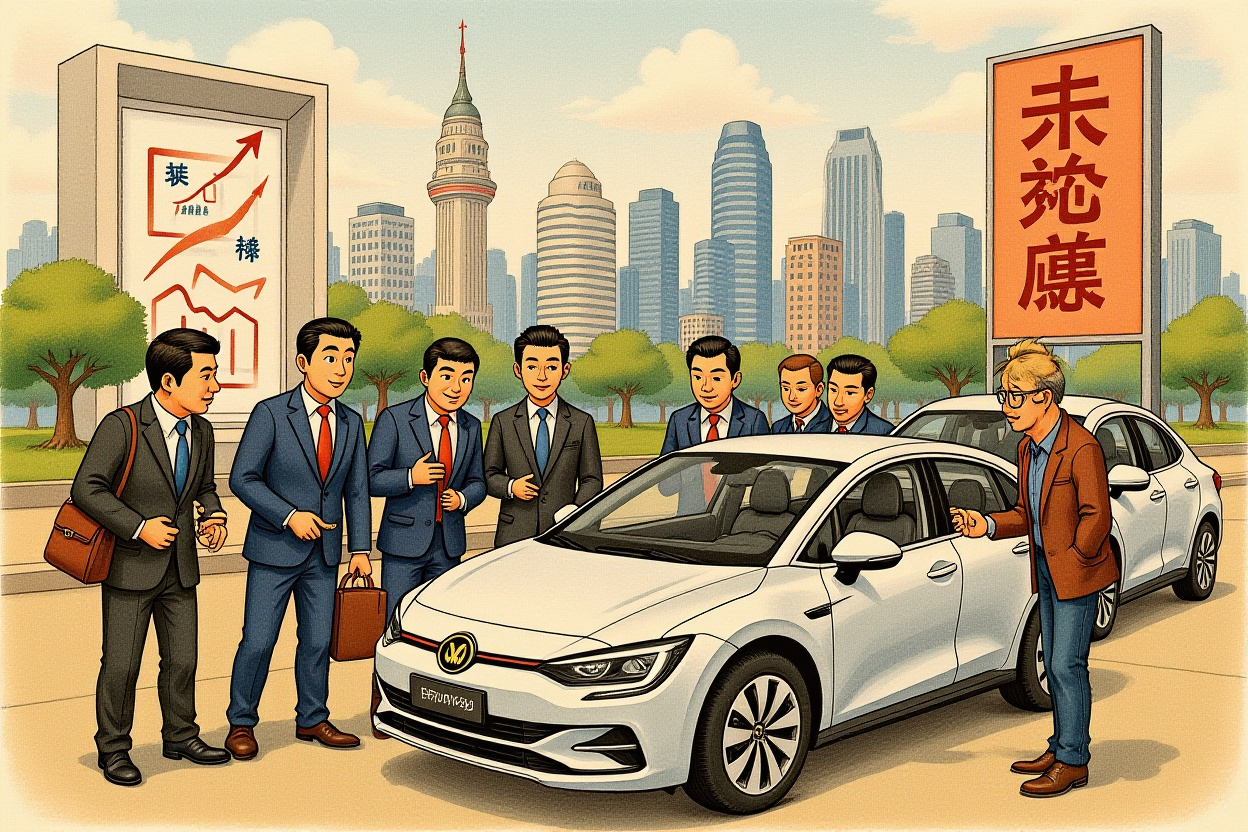
The once unassailable fortress of imported luxury automotive brands in China is showing deep cracks. In a startling development, Porsche, the iconic German marque, is witnessing a rapid unraveling of its retail network in the world’s largest car market. Reports of the sudden shuttering of the Zhengzhou Zhongyuan Porsche Center and the Guiyang Mengguan Porsche Center, with showrooms left eerily empty, have sent shockwaves through the industry. These incidents are not isolated misfires but symptomatic of a profound Porsche crisis in China. For a brand that historically commanded months-long waiting lists and substantial premiums, this dealer exodus marks a dramatic fall from grace and highlights the intense pressure facing traditional luxury automakers.
Case Studies: Zhengzhou and Guiyang – From Showroom to Ghost Town
The abrupt closure of two major Porsche centers exemplifies the operational breakdown. In Zhengzhou, capital of Henan province, the Zhongyuan Porsche Center was reportedly cleared of vehicles overnight, leaving customers and employees in the lurch. Similarly, the Guiyang Mengguan center in Guizhou province now stands vacant. These actions suggest potential financial insolvency or a strategic retreat by franchisees, raising alarms about corporate oversight and brand stability. Such sudden dealer failures damage consumer trust and can leave buyers with unresolved warranty and service issues, further tarnishing the brand’s premium image. This Porsche crisis in China is now manifesting at the grassroots retail level, indicating systemic problems beyond mere sales fluctuations.
Financial Contagion and Market Response
The dealer closures coincide with alarming financial metrics. According to industry analyses, some Porsche dealerships in China are struggling with unsustainable operating costs tied to grandiose showrooms, coupled with plummeting profitability. As new car sales decline, the lucrative after-sales and service revenue stream also dries up, creating a vicious cycle. The market response has been a swift reevaluation of Porsche’s equity and its parent company Volkswagen Group’s exposure. Investors are closely monitoring whether this Porsche crisis in China will trigger similar issues for other premium brands within the Volkswagen stable, such as Audi and Bentley, or signal a broader sectoral decline for European luxury marques.
A Dynasty’s Rise and Stumble: Porsche’s Historical Ties and Chinese Ascent
To understand the current predicament, one must look at Porsche’s unique heritage and its two-decade love affair with the Chinese consumer. The brand’s origins are inextricably linked to the Volkswagen Group through a complex family saga. The company was founded by engineering visionary Ferdinand Porsche (费迪南德·保时捷), who also played a pivotal role in creating the Volkswagen Beetle. Decades of corporate maneuvering between the Porsche and Piëch families culminated in Volkswagen fully acquiring Porsche AG in 2012. Despite this, Porsche remained a profit powerhouse, often contributing a quarter of the Volkswagen Group’s earnings while accounting for only a thirtieth of its volume. This profitability was critically fueled by its success in China.
China: From Golden Goose to Trouble Spot
For eight consecutive years starting in 2015, China was Porsche’s largest single market, a testament to the brand’s cachet among the country’s burgeoning affluent class. In 2021, Porsche delivered 95,671 vehicles in China, representing nearly a third of its global sales. Chinese consumers embraced models like the Cayenne SUV and Panamera sedan, often paying significant markups. However, the inflection point arrived around 2022. While global sales remained stable, deliveries in China began to contract, falling 2.5% that year and a precipitous 15% in 2023. By 2024, North America had dethroned China as Porsche’s top market. The speed of this reversal underscores how quickly competitive dynamics can shift in the hyper-accelerated Chinese automotive landscape, setting the stage for the current Porsche crisis in China.
The Chinese EV Vanguard: Redefining Luxury and Capturing Market Share
The central force behind Porsche’s woes is the explosive rise of homegrown, intelligent electric vehicle brands. Chinese consumers, especially younger, tech-savvy buyers, are no longer equating luxury solely with a European badge and a combustion engine. They are increasingly drawn to domestic brands that offer superior connectivity, autonomous driving features, and compelling value propositions. This paradigm shift is at the heart of the Porsche crisis in China. Brands under the Huawei-backed Aito (问界) lineup, such as the M9, have dominated the ¥500,000+ SUV segment for 20 consecutive months. Xiaomi’s debut SU7 sedan has garnered massive orders, while Li Auto (理想), BYD’s Denza (腾势) and Yangwang (仰望) brands are all securing significant shares of the premium market.
Technology as the New Luxury Currency
The definition of luxury is being rewritten. Where Porsche and peers like BMW, Mercedes-Benz, and Audi (BBA) traditionally competed on horsepower, leather quality, and brand heritage, Chinese EVs compete on seamless software integration, over-the-air updates, and advanced driver-assistance systems. Features like Huawei’s HarmonyOS cockpit or Xiaomi’s HyperOS create an ecosystem that deeply integrates with a user’s digital life. For many Chinese consumers, a smart, connected cabin and superior range are now more tangible luxury indicators than a meticulously stitched dashboard. This technological edge allows Chinese brands to command premium prices while still undercutting traditional luxury models, applying immense pricing pressure and contributing directly to the Porsche crisis in China.
Data Points of Disruption
The sales figures are unequivocal. In November 2024, the Harmony Intelligent Mobility (鸿蒙智行) alliance, encompassing Aito and other brands, achieved a record monthly delivery of over 80,000 units, with an average transaction price of approximately ¥390,000. The Denza D9 MPV consistently outsells luxury rivals in its category, and the Yangwang U8 off-roader has successfully entered the ultra-premium segment above ¥1 million. These successes demonstrate that Chinese brands are not just competing on price but are winning on product merit across multiple high-value segments that were once the exclusive domain of imported brands. This competitive onslaught is a core driver of the Porsche crisis in China and represents a sustainable challenge, not a fleeting trend.
Diagnosing the Decline: Porsche’s Strategic and Operational Challenges
Porsche’s response to the market shift has been a mix of strategic recalibration and retrenchment, but it faces deeply entrenched challenges. The company has announced a renewed focus on its internal combustion engine lineup while simultaneously attempting to accelerate its electric vehicle offerings, such as the Taycan and Macan EV. However, this dual-path strategy appears fraught with difficulty in a market rapidly transitioning to smart EVs. The decision to shrink its Chinese dealership network from over 140 sites to a target of 80 by 2026 is a clear admission of overexpansion and a bid to cut costs. Yet, this very retrenchment may further alienate consumers by reducing convenience and service access.
The Triple Bind: Costs, Perception, and Talent
Industry analysts point to three intertwined problems exacerbating the Porsche crisis in China. First, the operational model of lavish, city-center dealerships imposes crushing fixed costs that are untenable with declining sales volume. Second, there is a growing perception gap; Porsche’s brand narrative of sports car performance and engineering purity is not fully resonating with a new generation of Chinese buyers who prioritize smart technology and ecosystem integration. Third, a severe talent drain is crippling operations. High-performing sales and management personnel are migrating to the more dynamic and better-compensated domestic EV brands. The much-publicized case of the ‘Three Golden Flowers’ sales team from Zhengzhou, renowned for record-breaking daily sales, who collectively left Porsche for a Chinese EV startup, is a symbolic example of this brain drain.
Broader Implications and the Future of Luxury Mobility in China
The Porsche crisis in China is not an isolated event but a leading indicator for the entire imported luxury car sector. Brands like Mercedes-Benz, BMW, and Audi are also experiencing slowed growth and intensified competition from domestic players. The era where global automakers could rely on the Chinese market for disproportionate profits and growth is fundamentally over. The market has matured, and Chinese consumers have become more sophisticated and discerning, with robust local alternatives. This forces a strategic reckoning for every international brand: adapt swiftly with localized, tech-forward products and business models, or risk continued erosion.
Lessons for Global Automakers and Investors
The key takeaway for global automakers is that technological leadership and deep consumer insight are now non-negotiable. Simply badge-engineering global EVs for China is insufficient. Success requires co-developing vehicles with Chinese tech partners, embracing local software stacks, and potentially adopting new retail approaches like direct-to-consumer sales or agency models. For investors, the Porsche crisis in China underscores the need to scrutinize the China exposure of all traditional automotive stocks while recognizing the explosive growth potential of listed Chinese EV makers and their suppliers. The investment thesis for the auto sector is being rewritten in real-time.
The Road Ahead: Can Porsche Win Back China?
Porsche’s path to recovery is steep. It requires more than just marketing campaigns or temporary price cuts. A genuine turnaround hinges on launching compelling electric products that can compete on intelligence and software, perhaps developed in closer collaboration with Chinese tech firms. It also necessitates a radical overhaul of its retail and ownership experience to match the convenience and transparency offered by domestic brands. The company must also address its talent retention issue to rebuild a capable local team. The ‘win back China’ strategy, recently articulated by management, will be its most critical test in decades.
The unfolding Porsche crisis in China serves as a powerful case study in market disruption. It demonstrates that no brand, regardless of its heritage or past success, is immune to the forces of technological innovation and shifting consumer values. The Chinese automotive market is in the vanguard of the global industry’s transition, and the rules of competition are being set there. For consumers, this shift means more choice, better technology, and greater value. For the industry, it heralds a new era of fierce, innovation-driven competition where agility and local relevance are paramount. Stakeholders must move beyond nostalgia and swiftly adapt to this new reality, for the market will reward only those who truly understand and meet the evolving definition of luxury and performance.