



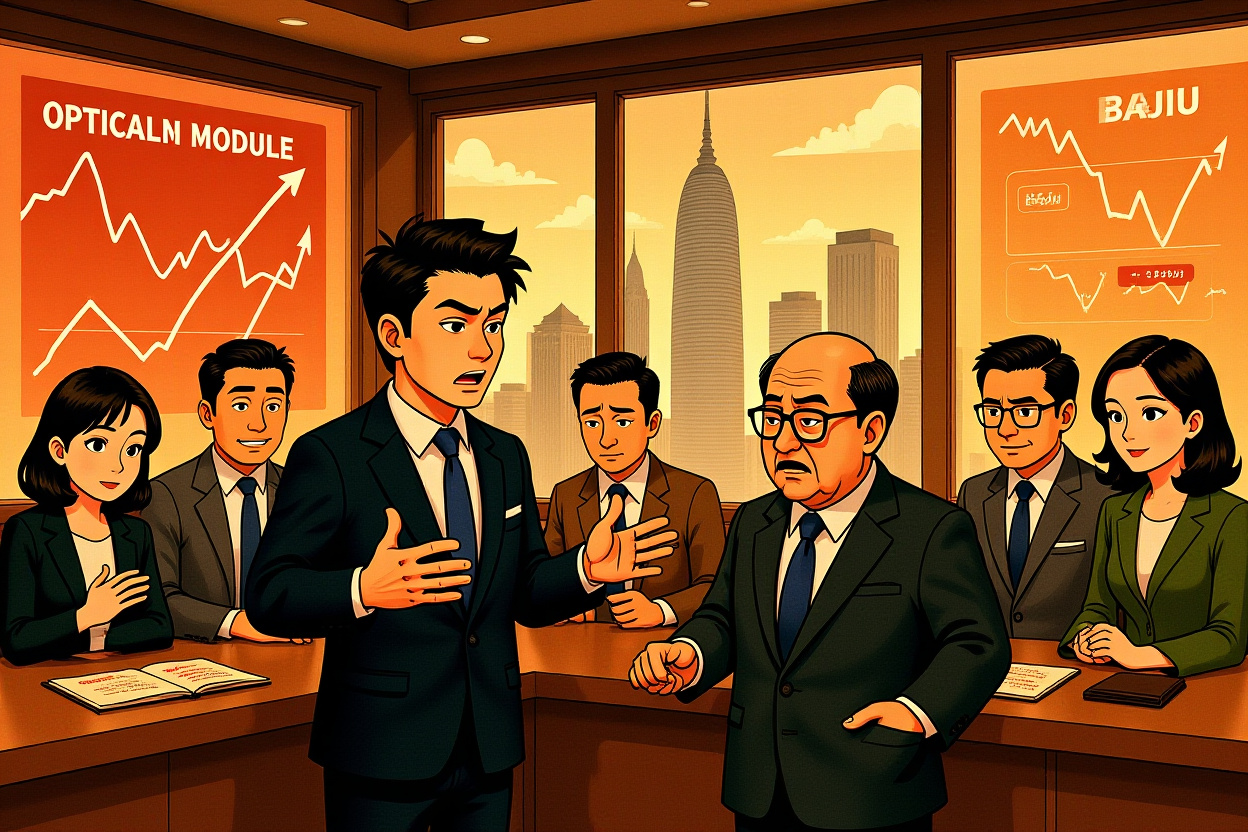
The Chinese stock market is witnessing a dramatic divergence between high-flying technology sectors and struggling traditional industries. Optical module manufacturers have become market darlings, posting astronomical returns that have left seasoned investors scratching their heads. Meanwhile, once-reliable baijiu stocks are languishing, creating a stark contrast that has sparked fierce debates among professionals. This tension erupted publicly when a skeptical fund manager was bluntly told to ‘go buy your baijiu’ by a confident young analyst defending the optical module thesis. The clash represents more than just differing opinions—it signals a fundamental shift in China’s economic priorities and investment landscape.
The Spectacular Rise of Optical Module Stocks
The performance numbers for optical module companies are nothing short of extraordinary. These manufacturers, which produce critical components for data centers and telecommunications infrastructure, have delivered returns that dwarf traditional market benchmarks.
Staggering Returns Since April
Since April 8th, the optical module sector has experienced unprecedented growth:- Eoptolink Technology (新易盛): Up 597%- InnoLight Technology (中际旭创): Up 465%- TFC Optical Communication (天孚通信): Up 322%These gains are part of a longer-term trend that has seen these companies multiply their market value many times over. Eoptolink has seen its stock price increase 27-fold over three years, while InnoLight and TFC have risen 18 and 11 times respectively during the same period.
The AI and Data Center Boom
The phenomenal performance of optical module stocks is fundamentally driven by the artificial intelligence revolution. As AI models grow increasingly complex and data-intensive, they require massive computing infrastructure that depends on high-speed optical connections. Data centers worldwide are scrambling to upgrade their networks to handle AI workloads, creating unprecedented demand for optical components. This sector has become a direct play on the AI megatrend that is transforming global technology.
The Baijiu Breakdown: Traditional Sectors Struggle
While optical module stocks soar, China’s famous baijiu producers are experiencing a dramatic downturn. The traditional liquor sector, once considered a defensive safe haven for investors, has become one of the market’s worst performers.
Three Years of Decline
Over the same three-year period that saw optical module stocks multiply, baijiu giants have suffered significant losses:- Kweichow Moutai (贵州茅台): Down approximately 22%- Wuliangye (五粮液): Down approximately 22%- Luzhou Laojiao (泸州老窖): Down approximately 22%The sector’s struggles reflect broader challenges facing traditional consumer industries in China, including changing consumption patterns, economic uncertainty, and a shift in investor preference toward technology and innovation-driven companies.
The Cultural Shift in Investing
The divergence between optical modules and baijiu represents more than just sector rotation—it signals a fundamental shift in how investors view China’s economic future. Where traditional consumer staples were once seen as reliable compounders, investors are now increasingly betting on companies positioned to benefit from technological transformation and global trends like AI adoption.
The Analyst Clash: ‘Go Buy Your Baijiu, Old-Timer’
The tension between these competing investment theses exploded into public view through a remarkable exchange between a seasoned fund manager and a young analyst.
Ling Peng’s Skeptical Questions
On September 5th, prominent fund manager Ling Peng (凌鹏) expressed astonishment at market predictions suggesting InnoLight Technology could achieve over 25 billion yuan in profit by 2027. He questioned how a components manufacturing company could possibly achieve such extraordinary profitability, noting that current net margins of approximately 30% far exceed those of established electronics manufacturers like Luxshare (立讯精密), which operates at around 5% net margins.Ling challenged the underlying assumptions behind these projections, asking what company would dramatically expand capacity while expecting significant future price declines. He compared this logic to a fund manager aggressively building positions while anticipating substantial market declines.
The Analyst’s Blunt Response
A communications sector analyst from a securities research firm fired back aggressively on social media, telling Ling to ‘go buy your baijiu, old-timer.’ The analyst, who reportedly only transitioned to covering the sector in 2022, suggested the fund manager was ‘breaking down’ in the face of the powerful optical module thesis. This generational and philosophical clash highlights how rapidly changing markets can create tension between established investment frameworks and emerging opportunities that defy traditional valuation metrics.
Market Mechanics Behind the Optical Module Boom
The bullish case for optical module stocks rests on two key premises that supporters believe justify both current valuations and future projections.
Capacity Expansion Thesis
Proponents argue that manufacturers have already deployed significant capacity that will come online through 2027, creating a visible pipeline of future supply. This capacity expansion is happening amid unprecedented demand from cloud providers and data centers building out AI infrastructure. The physical constraints of manufacturing these sophisticated components create barriers to entry that protect incumbent players during periods of explosive demand growth.
Pricing Power Assumptions
The second pillar of the bullish argument concerns pricing power. Companies have indicated they don’t expect to significantly reduce prices despite capacity expansion, suggesting they can maintain current margin structures. If manufacturers can indeed preserve approximately 30% net margins on dramatically increased revenue, the mathematical path to 25 billion yuan in profit becomes more plausible. However, skeptics question whether any technology component manufacturer can maintain such exceptional profitability as production scales and competition inevitably increases.
Broader Market Context and Expert Perspectives
The optical module versus baijiu debate is occurring within a complex market environment featuring unusual patterns and divergent expert opinions.
Volatility and Remarkable Recoveries
Chinese markets have experienced significant volatility, with the创业板指 (ChiNext Index) recently dropping over 4% before surging 6.55% the following day to completely recover losses. This marked the first time in nearly a decade that the index had rallied so strongly immediately after such a sharp decline. Historical precedents from 2010, 2015, and 2016 suggest these sharp reversals can signal important market inflection points.
Hong Hao’s Market Assessment
Prominent strategist Hong Hao (洪灏) has suggested that current market conditions don’t indicate speculative excess. In recent interviews, he noted that margin debt as a percentage of total market capitalization remains well below 2015 levels. Using Warren Buffett’s favorite market valuation metric—total market capitalization to GDP—Hong points out that the Chinese market trades at approximately 100% of GDP, well below the 200%+ level seen in U.S. markets and close to long-term averages.Hong predicts the Shanghai Composite could rise significantly above 4,000 points by year-end, driven primarily by institutional rather than retail participation. He notes limited evidence of the speculative account opening or fund transfers from bank to brokerage accounts that typically characterize retail-driven bubbles.
Unconventional Market Relationships
Hong also highlights unusual patterns in other asset classes, particularly the simultaneous rise in gold prices and long-term interest rates—a relationship that traditionally moves in opposite directions. He suggests that if Chinese assets perform well, the人民币 (Renminbi) would likely strengthen accordingly. Regarding U.S. markets, Hong believes expectations for Federal Reserve rate cuts may be overly optimistic.
Hong Kong Market Outlook and Opportunities
The investment case extends beyond mainland markets to Hong Kong, where experts see significant potential.
Zhang Yidong’s Bullish Hong Kong Thesis
Zhang Yidong (张忆东), global chief strategist at Industrial Securities, has published reports suggesting Hong Kong markets are poised for a ‘super long bull market’ that could potentially last 20-30 years. He believes the Hang Seng Index could reach 28,000 points around November, with the Hang Seng Tech Index potentially reaching 6,000-6,200 points.Zhang argues that current selling pressure on internet stocks could reverse dramatically into a short squeeze, particularly as liquidity conditions improve with expected Federal Reserve rate cuts. He anticipates non-U.S. long-term funds and global hedge funds will increasingly allocate to Hong Kong markets, especially if the人民币 strengthens to approximately 7 against the U.S. dollar.
Sector-Specific Opportunities
Beyond internet stocks, Zhang identifies innovative pharmaceuticals, new consumption trends, and artificial intelligence as strategic assets. He believes innovative pharmaceuticals offer particularly strong potential because they combine characteristics of both consumer and technology sectors. Chinese pharmaceutical companies are transitioning from imitation and follow-on drugs to truly innovative, leadership positions in global markets.
Investment Implications and Future Outlook
The dramatic divergence between optical module stocks and traditional sectors like baijiu presents both opportunities and challenges for investors navigating Chinese markets.
Sector Rotation Considerations
The extreme performance differentials suggest investors should carefully consider their sector exposures and allocation strategies. While momentum has favored technology and innovation-driven companies, traditional sectors may eventually present valuation opportunities if economic conditions stabilize or consumer sentiment improves. The key challenge is determining whether current trends represent a permanent structural shift or a cyclical extreme that will eventually mean-revert.
Risk Management Approaches
For investors considering optical module stocks, careful risk management is essential given their extraordinary run-up and valuation levels. The sector’s dependence on continued AI infrastructure investment creates concentration risk, while the assumption of maintained pricing power represents a significant uncertainty. Diversification across technology sub-sectors and attention to position sizing become critically important when investing in such high-momentum areas.
Long-Term Structural Trends
Beyond short-term market movements, the optical module versus baijiu debate reflects broader structural trends in the Chinese economy. The government’s emphasis on ‘new quality productive forces’ and technological self-reliance suggests policy support for innovation-driven companies over traditional industries. The transition from property-driven growth to technology and consumption-led development may continue to create investment opportunities in sectors aligned with these national priorities.The remarkable confrontation between a skeptical fund manager and a confident young analyst represents more than just a personal disagreement—it encapsulates a fundamental shift in market leadership from traditional defensive sectors to technology companies driving and benefiting from transformational trends like artificial intelligence. While optical module stocks have delivered extraordinary returns, investors should carefully consider both the opportunities and risks presented by such concentrated momentum-driven performance. As Chinese markets continue evolving amid complex economic transitions, maintaining flexibility while staying focused on long-term structural trends may provide the most sustainable approach to navigating these dramatic sector divergences. For those seeking to understand these market dynamics more deeply, tracking both fundamental industry developments and broader macroeconomic trends will be essential to successful investing in this rapidly changing environment.