



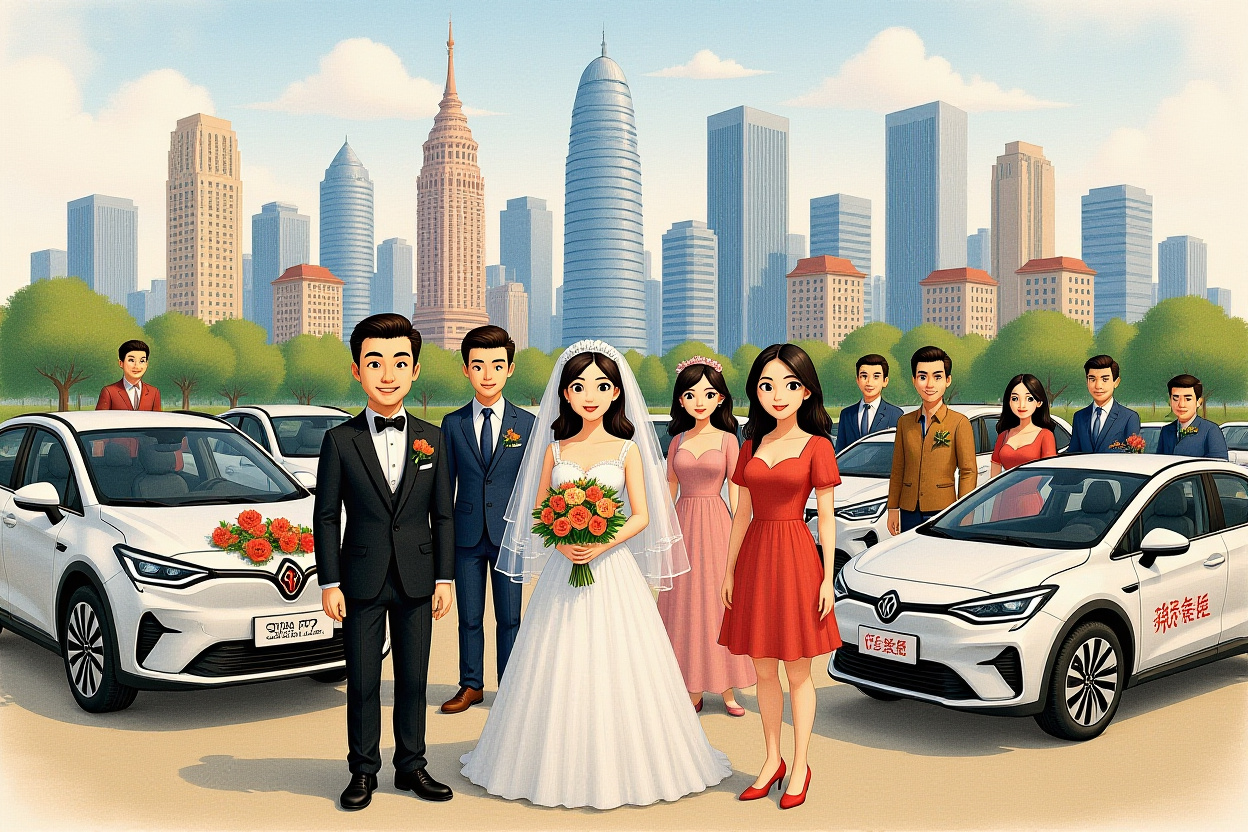
As China’s Generation Z takes center stage in matrimonial celebrations, a quiet revolution is unfolding in the wedding car industry. The once-unshakeable dominance of German luxury brands is being challenged by homegrown new energy vehicles, with orders for NEV wedding fleets skyrocketing during peak seasons. This shift isn’t just about transportation—it’s a fundamental redefinition of status symbols and personal expression in one of life’s most important ceremonies. The new energy vehicle wedding cars phenomenon represents both a cultural and commercial transformation that’s reshaping consumer behavior and market dynamics across China’s automotive landscape.
Executive Summary: Key Market Insights
– New energy vehicle wedding car orders surged over 500% during the recent National Day holiday period, with some regional clubs reporting more orders in one week than the previous nine months combined– Domestic brands including Xiaomi SU7, Nio ET5, and Xpeng P7 are capturing market share through community-based rental models that offer cost savings of 30-50% compared to traditional luxury rentals– Consumer preferences are shifting from brand prestige to personalization, with 72% of couples under 30 now considering vehicle appearance and technological features more important than traditional status symbols– The trend is driving innovation in rental business models, with owner-led collectives outperforming traditional rental companies in flexibility and pricing– Market analysis projects new energy vehicle wedding cars could capture over 60% of China’s wedding car rental market within five years, creating significant opportunities for domestic automakers
The New Energy Wedding Revolution
What began as isolated cases of couples choosing personal vehicles over rental luxury cars has evolved into a full-blown market transformation. During the recent National Day and Mid-Autumn Festival holiday period, social media platforms exploded with requests for new energy vehicle wedding cars, with some regional owner clubs reporting they had to stop accepting orders weeks in advance due to overwhelming demand.
Quantifying the Surge
The scale of this shift became apparent when a Jiangxi-based Xiaomi owners club with over 2,000 members reported receiving more than 120 wedding car orders for the holiday period alone—surpassing their total orders for the entire first three quarters of the year. Similarly, rental companies in Zhejiang noted that Li Auto wedding car orders increased five to sixfold compared to the same period last year. This explosive growth demonstrates how quickly new energy vehicle wedding cars are moving from niche preference to mainstream choice.The phenomenon isn’t limited to major metropolitan areas. Across tier-2 and tier-3 cities, couples are increasingly opting for domestic electric vehicles from brands like Nio, Xpeng, and Li Auto over traditional Mercedes-Benz, BMW, and Audi offerings. The appeal cuts across economic segments, with both budget-conscious couples and affluent professionals embracing the trend for its combination of style, technology, and personal significance.
Economic Drivers Behind the Shift
The rapid adoption of new energy vehicle wedding cars stems from a convergence of economic factors that make them increasingly attractive to cost-conscious couples and entrepreneurial vehicle owners. With wedding costs in China averaging between 200,000 and 500,000 RMB, couples are seeking areas where they can reduce expenses without compromising on quality or experience.
Cost-Benefit Analysis
– Traditional luxury car rentals: 500-800 RMB per vehicle per day– New energy vehicle wedding cars: 400-700 RMB per vehicle per day– Community-based rentals: Often include additional services like photography or decoration at minimal extra costThe pricing structure makes new energy vehicle wedding cars particularly appealing. While traditional rental companies must account for vehicle acquisition costs, insurance, and full-time staff, owner-led collectives operate with significantly lower overhead. This allows them to offer competitive rates while still providing owners with supplemental income. For couples, the savings can be substantial—a typical eight-vehicle NEV wedding fleet costs approximately 3,200-5,600 RMB compared to 4,000-6,400 RMB for a comparable BBA fleet.
Changing Consumer Preferences
China’s post-95 and post-00 generations are bringing fundamentally different values to wedding planning than their parents’ generation. Where previous generations viewed weddings as opportunities to display social status through conspicuous consumption, younger couples prioritize authenticity, personal expression, and shared experiences. The rise of new energy vehicle wedding cars perfectly aligns with this value shift.
Redefining Status Symbols
For Generation Z couples, the concept of ‘face’ or social prestige is evolving. While their parents might have insisted on a Mercedes-Benz S-Class to impress relatives and guests, younger couples are more concerned with vehicles that reflect their personal style and values. As one Nio ET5 owner explained when choosing his own vehicle over a traditional luxury rental: ‘The older generation thinks BBA gives them face, but we feel these cars are too common on the streets already.’This sentiment is echoed across social media platforms where couples share their wedding planning experiences. The ability to customize vehicles with unique colors, technological features, and personal touches makes new energy vehicle wedding cars more meaningful than generic luxury rentals. Many couples report that using their own vehicles creates more authentic memories and photographs than standardized rental options.
Market Response and Business Models
The surge in demand for new energy vehicle wedding cars has sparked innovation in how these services are organized and delivered. Traditional rental companies are scrambling to adapt while new community-based models are emerging to capitalize on the trend.
Community-Driven Rentals
Social media platforms like Xiaohongshu have become hubs for organizing new energy vehicle wedding car fleets. Accounts with names like ‘City Name + Xiaomi SU7 Wedding Fleet’ actively recruit vehicle owners and connect with couples planning weddings. These community-based operations typically follow one of two models:– Owner collectives: Groups of owners who coordinate through social media and messaging apps to form impromptu wedding fleets– Club-managed services: Formalized through owner clubs that appoint dedicated coordinators to handle bookings and fleet managementThe Jiangxi Xiaomi owners club has transformed wedding car services into what members describe as a ‘light entrepreneurship project.’ With dedicated personnel handling inquiries and coordination, they’ve created a streamlined system that matches supply with demand efficiently. Their success demonstrates how new energy vehicle wedding cars are creating economic opportunities beyond traditional automotive business models.
Traditional Industry Adaptation
Established wedding car rental companies are taking notice of the new energy vehicle wedding cars trend. One rental company manager reported that while Li Auto orders were negligible during last year’s National Day holiday, this year saw a five to sixfold increase. In response, some companies are creating new positions like ‘New Energy Fleet Manager’ specifically to handle the growing demand for domestic electric vehicle weddings.However, not all traditional operators are enthusiastic about the shift. One traditional wedding car club owner expressed concerns about profitability: ‘The return on investment for these vehicles isn’t high. If we price them too expensively, nobody chooses them. If we price them too cheaply, we lose money. Additionally, new energy vehicles are easily undercut by owner groups and part-time drivers, so we professional rental companies have no price advantage.’This tension highlights the fundamental difference in operating models between traditional rental companies with fixed costs and the more flexible community-based approaches that characterize the new energy vehicle wedding cars ecosystem.
Broader Automotive Market Implications
The wedding car trend reflects larger transformations occurring across China’s automotive industry. Domestic new energy vehicle manufacturers are gaining market share at the expense of both traditional luxury brands and early electric vehicle pioneers.
Market Share Dynamics
According to China Association of Automobile Manufacturers data, 2024 saw national passenger vehicle production and sales reach 27.477 million and 27.563 million units respectively, representing year-on-year growth of 5.2% and 5.8%. Within this total, new energy vehicle annual sales surpassed 10 million units for the first time, accounting for 40.9% of all new car sales and establishing NEVs as a crucial pillar of China’s automotive market.The competitive landscape is intensifying. Tesla, once the dominant electric vehicle brand in China, has seen its sales decline significantly. January 2025 sales (including exports) reached 63,200 units, down 11.5% year-on-year and approximately 33% month-on-month. By February, sales had further dropped to 30,700 units, a dramatic 49.16% year-on-year decrease and 51.47% month-on-month decline.Meanwhile, domestic brands are surging. The September 2025 delivery rankings for new automakers showed Leapmotor topping the list with over 66,000 vehicles delivered, followed closely by Xpeng, Aito, and Xiaomi—all achieving monthly deliveries exceeding 40,000 units. However, not all domestic brands are thriving equally, with Li Auto experiencing a 37% year-on-year decline and Zeekr and GAC Aion showing negative growth of 14% and 19% respectively.
Wedding Market as Leading Indicator
The popularity of new energy vehicle wedding cars provides valuable insights into broader consumer acceptance of domestic electric vehicles. As couples choose these vehicles for one of the most photographed and socially significant days of their lives, they’re effectively providing powerful endorsements to their social networks. This organic marketing has far-reaching implications for brand perception and future purchase decisions across the consumer spectrum.Industry analysts view the wedding car trend as a leading indicator of wider market shifts. When consumers choose specific vehicles for emotionally significant occasions, it signals deep brand connection that often translates to long-term loyalty and advocacy. The visibility of new energy vehicle wedding cars in wedding photography and social media sharing creates a virtuous cycle of exposure and consideration that benefits domestic manufacturers.
Future Outlook and Strategic Considerations
The transformation of China’s wedding car market is still in its early stages, but the direction is clear. New energy vehicle wedding cars are transitioning from novelty to normality, with significant implications for automotive manufacturers, rental companies, and wedding industry stakeholders.
Projected Market Development
According to the China Research and Intelligence ‘2025-2030 China Wedding Car Rental Industry Investment Prospects Forecast Report,’ the industry structure is undergoing generational reconstruction. While traditional luxury vehicles still account for approximately 40% of the market in 2025, theme customization and new energy vehicle wedding cars are growing rapidly and have already captured over 30% market share. The report projects that, driven by both policy support and evolving consumer preferences, new energy vehicle wedding cars could achieve market penetration exceeding 60% in the coming years.Several factors will drive this growth:– Continued technological innovation: Enhanced features like autonomous driving capabilities, advanced entertainment systems, and customizable lighting will increase the appeal of new energy vehicle wedding cars– Expanding model options: As domestic manufacturers introduce more vehicle types across price segments, couples will have greater choice in finding vehicles that match their style and budget– Environmental consciousness: Growing awareness of sustainability issues makes electric vehicles increasingly attractive for eco-conscious couples– Cultural normalization: As more couples choose new energy vehicle wedding cars, the practice becomes self-reinforcing through social proof and reduced resistance from older family members
Strategic Recommendations
For automotive manufacturers, the wedding car trend represents an opportunity to build brand loyalty and drive sales through emotional connections. Companies that actively support owner clubs and facilitate community building around their vehicles will likely see disproportionate benefits from this trend. Creating wedding-specific packages or features could further capitalize on the movement.For investors and industry analysts, monitoring the adoption of new energy vehicle wedding cars provides valuable insights into consumer acceptance of domestic brands and the evolving definition of luxury in the Chinese market. The trend signals broader shifts in consumer values that could influence product development, marketing strategies, and investment priorities across multiple sectors.The rise of new energy vehicle wedding cars represents more than just a change in transportation preferences—it’s a manifestation of evolving Chinese consumer values, technological advancement, and economic pragmatism. As younger generations continue to redefine traditions according to their own priorities, the market for wedding services will increasingly reflect these new preferences. Automotive manufacturers, rental companies, and wedding industry professionals who understand and adapt to this transformation will be best positioned to thrive in the evolving landscape. For global investors watching China’s consumer markets, the wedding car phenomenon offers compelling evidence of the country’s shifting consumption patterns and the growing dominance of domestic brands in sectors once dominated by foreign luxury goods.