



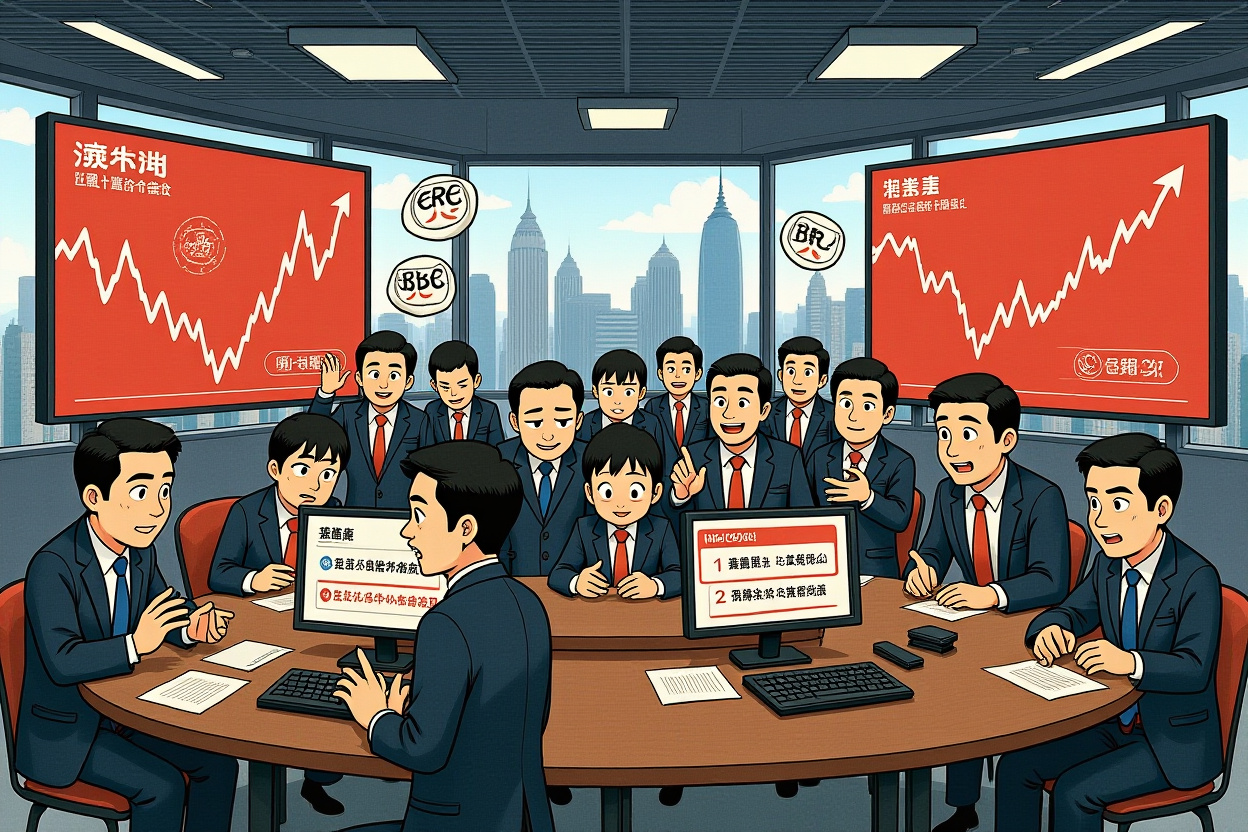
Executive Summary: Key Market Takeaways
Financial markets in Asia opened to a wave of risk aversion as news of escalating Middle Eastern tensions prompted a broad-based retreat. Chinese equities, particularly sensitive to global risk sentiment, were not immune. This report provides a detailed dissection of the market’s reaction, its drivers, and implications for forward-looking investment strategy.
- A coordinated morning sell-off hit major Chinese indices, including the 上证综合指数 (Shanghai Composite Index) and 恒生指数 (Hang Seng Index), reflecting acute investor sensitivity to external geopolitical shocks.
- The primary catalyst was a significant announcement by U.S. military forces in the Middle East, coupled with strong rhetoric from the Iranian leadership, raising fears of an expanded regional conflict that could disrupt global energy supplies and trade flows.
- Sectoral performance was bifurcated, with energy and defense-related stocks seeing relative resilience, while consumer discretionary, technology, and travel-related shares bore the brunt of the selling pressure.
- Regulatory bodies, including the 中国证券监督管理委员会 (China Securities Regulatory Commission, CSRC), are monitoring market stability, but direct intervention appears limited, favoring a market-driven price discovery process for now.
- For institutional investors, this event underscores the critical need for robust geopolitical risk frameworks within China-focused portfolios and highlights potential tactical opportunities in oversold sectors with strong fundamentals.
Market Reaction: A Detailed Look at the Morning Rout
The opening bell across Greater China’s bourses was met with a palpable wave of selling. The speed and breadth of the decline indicated a market caught off-guard by the overnight geopolitical developments, leading to a classic ‘risk-off’ repositioning.
Index Performance and Trading Dynamics
The 上证综合指数 (Shanghai Composite Index) gapped down at the open, swiftly breaching key psychological support levels. Similarly, the technology-heavy 创业板指数 (ChiNext Index) experienced pronounced losses, reflecting a flight from growth-oriented assets. In Hong Kong, the 恒生指数 (Hang Seng Index) and the 恒生中国企业指数 (Hang Seng China Enterprises Index) mirrored the weakness, with turnover spiking significantly in the first hour of trading—a clear sign of institutional deleveraging and hedge fund activity. The morning sell-off was not merely a Chinese phenomenon; it echoed across Asia, but the depth in Chinese markets was notably acute, underscoring their integration into global capital flows and sentiment.
Capital Flow Patterns
Northbound capital flow data via the 沪深港通 (Stock Connect) schemes showed a sharp net outflow from foreign investors in the A-share market. This movement is a critical barometer of international institutional sentiment towards Chinese assets. Concurrently, there was a marked increase in the price of gold and a strengthening of traditional safe-haven currencies against the 人民币 (Renminbi), corroborating the broad-based risk aversion. The velocity of this morning sell-off highlighted how algorithmic and quantitative trading strategies can amplify geopolitical news flows, creating short-term dislocations.
Geopolitical Triggers: Parsing the U.S. Announcement and Iranian Response
The immediate catalyst for the financial market volatility stemmed from a rapidly evolving situation in the Middle East. The interconnected nature of global energy, shipping, and security means events in the region have immediate repercussions for risk assets worldwide.
The U.S. Military’s Strategic Move
In a significant development, the United States Central Command (CENTCOM) announced a substantial reinforcement of its naval and aerial assets in the Persian Gulf region. This move, framed as a measure to ensure freedom of navigation and deter aggression, was interpreted by markets as a preparation for potential escalation. Analysts pointed to the specific language used in the announcement, which referenced ‘credible threats’ to commercial shipping lanes—a direct artery for global energy exports. For China, the world’s largest crude oil importer, any threat to the Strait of Hormuz is a direct threat to economic stability, instantly repricing energy security risks and inflation expectations.
Iranian Leadership’s Firm Stance
In response, the Iranian President delivered a televised address characterized by a firm, uncompromising tone. He emphasized Iran’s readiness to defend its national interests and sovereignty, specifically warning against any ‘miscalculations’ by external powers. The market’s concern is that this verbal posturing could lead to a miscalculation or proxy conflict that inadvertently draws in major powers or disrupts critical infrastructure. The resulting uncertainty is the exact environment where the morning sell-off finds fertile ground, as investors retreat to the sidelines to await clarity.
Sectoral Impact: Winners and Losers in a Risk-Off Climate
The broad-based morning sell-off masked a nuanced sectoral performance. Understanding this divergence is key for investors looking to navigate volatility or identify relative value.
- Energy & Commodities: As feared, international crude benchmarks, Brent and WTI, surged. This benefited A-share giants like 中国石油天然气股份有限公司 (PetroChina) and 中国海洋石油有限公司 (CNOOC). Conversely, airlines such as 中国国际航空股份有限公司 (Air China) and refiners faced margin pressure from higher input costs.
- Defense & Aerospace: Stocks in the defense-industrial complex, including 中航工业机电系统股份有限公司 (AVIC Electromechanical Systems) and 中国航天科工集团公司 (China Aerospace Science and Industry Corporation, CASIC) subsidiaries, saw relative strength or limited losses, priced on expectations of sustained geopolitical tensions and domestic procurement.
- Technology & Consumer Discretionary: This segment was the epicenter of the selling. High-valuation tech names listed on the 科创板 (STAR Market) and consumer giants like 腾讯控股 (Tencent) and 阿里巴巴集团 (Alibaba Group) were heavily sold. The logic is straightforward: in a potential global growth slowdown triggered by an oil price shock, future earnings growth is discounted more heavily.
- Travel & Leisure: The nascent recovery in tourism and leisure stocks suffered a setback. Companies like 携程集团 (Trip.com Group) and casino operators in Macau sold off on fears that renewed global tensions would dampen international travel sentiment.
The Regulatory Posture and Domestic Market Stability
In past episodes of extreme volatility, Chinese regulators have not been passive observers. The current approach appears calibrated, focusing on liquidity assurance rather than direct price support.
Monitoring and Communication
The 中国证券监督管理委员会 (China Securities Regulatory Commission, CSRC) issued a routine statement acknowledging ‘normal market fluctuations’ and reaffirming its commitment to a ‘stable, transparent, and predictable market environment.’ This was interpreted as a signal that no extraordinary measures were imminent. Similarly, the 中国人民银行 (People’s Bank of China, PBOC) conducted its open market operations at a steady rate, injecting a modest amount of liquidity to ensure interbank rates remained stable—addressing systemic risk without directly targeting equity prices. This restrained response suggests a comfort with the market’s ability to absorb this specific geopolitical shock, viewing the morning sell-off as a rational, if sharp, repricing rather than a disorderly collapse.
Long-Term Institutional Support
Beyond immediate actions, the role of long-term domestic institutional investors is crucial. The 国家社会保障基金 (National Council for Social Security Fund, NSSF) and large domestic insurance companies are often seen as market stabilizers. Their buy-on-dip behavior during such sell-offs can provide a floor for blue-chip stocks. While their daily actions are not public, their mandate to seek long-term value often leads to increased activity during periods of panic, subtly counteracting the indiscriminate selling that characterizes a morning sell-off driven by external headlines.
Strategic Implications for Global Investors
For the international fund managers and corporate executives who comprise this publication’s core readership, this event is a case study in managing China exposure within a global portfolio. The sharp morning sell-off serves as a potent reminder of specific risk factors.
Re-calibrating Risk Models
The integration of geopolitical risk premia into valuation models for Chinese equities must be dynamic. This episode shows that even regional conflicts far from China’s borders can trigger significant capital outflows. Investors should assess company-specific exposure to global energy prices, supply chain chokepoints, and international consumer sentiment. A pure bottom-up analysis is insufficient; a top-down geopolitical overlay is now a non-negotiable component of research. The speed of the morning sell-off also validates the importance of stress-testing portfolios against sudden, correlated drawdowns across asset classes.
Identifying Tactical Opportunities
Volatility is the friend of the prepared investor. This market dislocation may create attractive entry points in sectors and companies with resilient fundamentals that were sold indiscriminately. For instance, high-quality tech firms with dominant domestic market share, strong balance sheets, and minimal direct energy cost exposure could be oversold. Similarly, the sell-off in renewable energy plays, which are long-term beneficiaries of energy security concerns, may present a contradiction worth exploring. The key is rigorous fundamental analysis to separate babies from the bathwater thrown out during the panic of a morning sell-off.
Navigating Uncertainty: A Forward-Looking Perspective
The trajectory of Chinese equity markets in the coming sessions will hinge on the evolution of the geopolitical landscape and the demonstrated resilience of the domestic economy. While the initial morning sell-off was severe, its permanence is not assured.
Market attention will now split between headlines from the Middle East and key domestic data points, such as PMI releases and credit growth figures, to gauge the underlying health of the Chinese economy. A de-escalation of tensions would likely prompt a swift, relief-driven rebound, particularly in the hardest-hit growth sectors. Conversely, further escalation would prolong the risk-off environment, potentially shifting the market’s focus to stagflation risks. The restrained response from regulators like the CSRC provides the market room to find its own equilibrium, suggesting confidence in the medium-term outlook.
For sophisticated investors, the imperative is clear: maintain a disciplined, research-driven approach. Use volatility as a tool to upgrade portfolio quality by acquiring strong companies at better valuations. Ensure hedging strategies, whether through options, futures, or strategic asset allocation, are active and proportionate to the evolving risk. The morning sell-off is a moment of stress, but within it lies the data and price movements necessary for making informed, strategic decisions about Chinese equity allocation. Monitor capital flows, sector rotations, and official commentary closely—the next moves will separate reactive trading from strategic investment.