



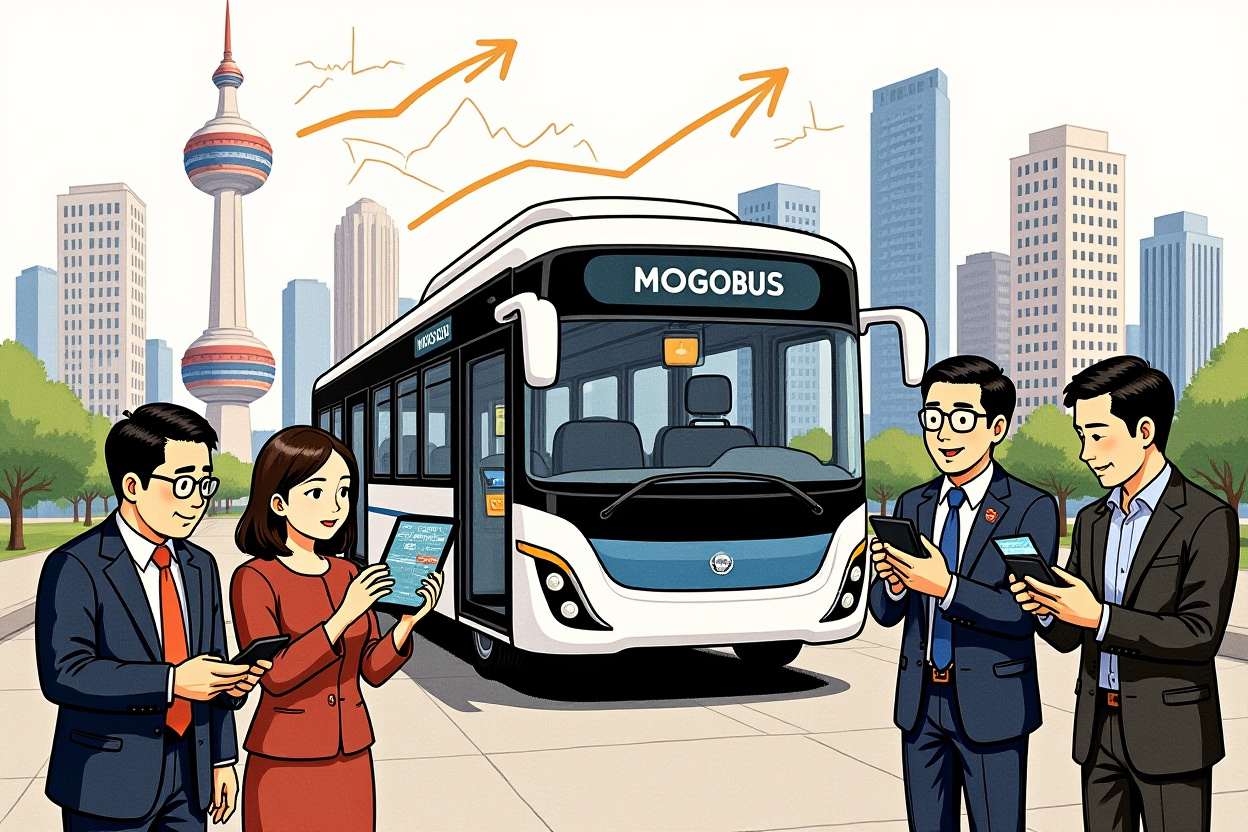
– 2025-2026 is identified as the critical node for large-scale commercialization of autonomous buses, with technology and market readiness converging.
– Mogo Auto (蘑菇车联) is receiving unsolicited procurement interests from Southeast Asia, Japan, South Korea, and the Middle East, signaling strong global demand.
– The company’s autonomous bus, MOGOBUS, is innovating beyond transportation to serve as a tourist attraction, enhancing experience economies in scenic areas.
– A landmark export deal with Singapore marks the first inclusion of autonomous buses in a foreign public transport system, showcasing viable出海 (going global) models.
– With operations in over 20 Chinese cities and 500,000 kilometers logged, Mogo Auto provides a scalable blueprint for investors eyeing smart mobility growth.
As Chinese equity markets continue to evolve, the autonomous vehicle sector stands out as a beacon of innovation and strategic investment potential. The pronouncement by Teng Deyi (滕德毅), the MOGOBUS business head at Mogo Auto (蘑菇车联), that 2026 represents a critical node for autonomous bus application has sent ripples through financial circles. This timeline is not merely a projection but a convergence of technological maturation, regulatory tailwinds, and escalating market demand. For institutional investors and fund managers monitoring the automotive and tech sectors within China, understanding this inflection point is paramount to capitalizing on the next wave of growth. The 2026 critical node for autonomous bus application underscores a broader shift towards smart city infrastructure and sustainable mobility, positioning companies like Mogo Auto at the forefront of a transformative industry. As global interest in Chinese autonomous solutions surges, the implications for portfolio allocation and risk assessment are profound, making this a pivotal moment for informed decision-making.
The 2026 Critical Node for Autonomous Bus Application: Why Timing Is Everything
The assertion that 2025-2026 constitutes the critical node for autonomous bus application is rooted in multiple converging factors. From a technological standpoint, advancements in AI, sensor fusion, and 5G connectivity have accelerated the reliability of self-driving systems, reducing latency and enhancing safety protocols. Concurrently, regulatory frameworks in China and key international markets are maturing, with bodies like the Ministry of Industry and Information Technology (工业和信息化部) rolling out supportive policies for autonomous vehicle testing and deployment. This alignment creates a fertile ground for commercialization at scale.
Technological Maturity and Market Readiness
Autonomous bus technology has progressed from pilot phases to robust operational readiness, as evidenced by Mogo Auto’s cumulative 500,000 kilometers of safe driving across diverse urban environments. The company’s MOGOBUS fleet utilizes lidar, radar, and camera arrays integrated with proprietary algorithms, enabling Level 4 automation in controlled settings. Data from these operations indicate a 99.9% uptime and zero major accidents, bolstering investor confidence in the sector’s viability. Moreover, the declining cost of key components, such as semiconductors and batteries, is making autonomous buses more economically feasible for mass adoption. As Teng Deyi (滕德毅) emphasized in his speech, this cost-curve optimization is pivotal for hitting the 2026 critical node for autonomous bus application, where total cost of ownership could rival traditional buses.
Regulatory Milestones and Global Benchmarks
Mogo Auto’s Strategic Expansion: From Domestic Leader to Global PioneerMogo Auto (蘑菇车联) has strategically positioned itself to capitalize on the 2026 critical node for autonomous bus application through both domestic dominance and international outreach. Founded in 2017, the company has rapidly scaled its operations, now serving over 20 cities in China, including tourist hubs like Zhangjiajie and urban centers like Tianjin. This extensive footprint provides a robust data pipeline for refining algorithms and building operational expertise, which is crucial for export credibility.
Domestic Footprint and Operational Excellence
In China, Mogo Auto’s MOGOBUS units have transported more than 200,000 passengers, highlighting public acceptance and functional reliability. Key metrics include an average route efficiency improvement of 15% compared to human-driven buses and a reduction in energy consumption by 20%, aligning with China’s carbon neutrality goals. The company’s partnerships with municipal transport authorities often involve revenue-sharing models, which diversify income streams and mitigate upfront capital risks. For example, in a collaboration with the Changbai Mountain tourism zone, MOGOBUS operates as a shuttle service, generating ticket sales while collecting valuable terrain data. This domestic success not only validates the technology but also builds a replicable model for international markets.
The Singapore Breakthrough: A Blueprint for Global Export
The October 2023 exclusive contract with Singapore represents a watershed moment, marking the first time an autonomous bus has been incorporated into a foreign public transportation system. This deal involved整车出口 (whole vehicle export), with MOGOBUS units shipped directly for deployment on designated routes. Financially, the project is estimated to be worth $5 million initially, with options for fleet expansion based on performance reviews. For Mogo Auto, this validates its出海 (going global) strategy and opens doors to other high-regulation markets like Japan and South Korea, where procurement interests have been expressed. Investors should note that such exports enhance revenue diversification and reduce dependency on the domestic cycle, a key factor in equity valuation resilience.
Innovating Beyond Transportation: Autonomous Buses as Tourism Catalysts
A key insight from Teng Deyi (滕德毅) is the reimagining of autonomous buses not just as transit tools but as integral components of the tourism economy. By transforming MOGOBUS into a tourist attraction or interactive experience, Mogo Auto (蘑菇车联) taps into the growing experience economy, which is particularly relevant for China’s文旅 (cultural tourism) sector. This innovation expands the total addressable market and creates sticky revenue models that transcend mere mileage-based fees.
Redefining the Tourist Experience with MOGOBUS
In scenic areas, MOGOBUS has been deployed for租借 (rental) or包车 (charter) services, offering private tours with enhanced amenities. For instance, in a pilot with a mountainous resort, buses were equipped with panoramic windows and audio guides, increasing visitor dwell time by 30%. Future concepts include interior modifications like circular bars, larger screens for multimedia entertainment, and augmented reality displays that narrate local history. These features position autonomous buses as premium offerings, commanding higher price points and improving unit economics. For tourism operators, this translates to increased per-capita spending, making MOGOBUS a value-added investment rather than a cost center.
Case Study: Integration with China’s Tourism Infrastructure
Financial Implications and Market Valuation DriversThe progression toward the 2026 critical node for autonomous bus application has significant ramifications for equity valuations and investment strategies in Chinese automotive and tech stocks. Mogo Auto (蘑菇车联), while privately held, serves as a bellwether for publicly traded suppliers and partners, such as sensor manufacturers or software providers listed on the科创板 (Sci-Tech Innovation Board). Key performance indicators include deployment scale, international contract wins, and margin expansion from service diversification.
Valuation Metrics and Growth Projections
Analysts project that the global autonomous bus market could reach $10 billion by 2026, with China accounting for over 40% of that share. For Mogo Auto, metrics like the Singapore deal and unsolicited overseas interests suggest a compound annual growth rate (CAGR) of 50% in revenue over the next three years. Investors should monitor operational leverage: as fleet size grows, the cost per kilometer decreases, potentially boosting EBITDA margins from current estimates of 15% to over 25% by 2026. Additionally, asset-light models, such as vehicle-as-a-service offerings, can improve return on invested capital (ROIC), making the company an attractive target for eventual IPO or strategic acquisitions.
Risk Assessment in a Dynamic Sector
Despite optimism, risks persist, including regulatory shifts, cybersecurity threats, and supply chain disruptions. For instance, changes in data localization laws could impact international deployments, while semiconductor shortages might delay production. However, Mogo Auto’s diversification into tourism and public transit mitigates some of these risks by spreading revenue sources. Investors are advised to conduct due diligence on technological moats and patent portfolios, as intellectual property will be a key differentiator as competition intensifies. The 2026 critical node for autonomous bus application thus represents both a opportunity and a test of operational resilience.
The Road to 2026: Strategic Partnerships and Scaling Models
To hit the 2026 critical node for autonomous bus application, Mogo Auto (蘑菇车联) is pursuing innovative合作方式 (cooperation models) that accelerate adoption without overextending capital. These include vehicle asset investments with institutional partners and joint运营 (joint operations) with municipal entities, sharing both risks and rewards. Such frameworks are essential for scaling beyond pilot phases into mainstream public transportation networks.
Collaborative Frameworks with Municipalities
In China, Mogo Auto has pioneered public-private partnerships (PPPs) where cities provide infrastructure support, such as dedicated lanes and charging stations, while the company manages fleet operations. A case in point is the agreement with Baiyin City, which includes performance-based subsidies tied to ridership targets. This model reduces upfront costs for municipalities and ensures alignment with public service goals. For international expansion, similar frameworks are being negotiated in the Middle East, where sovereign wealth funds show interest in funding smart city projects. These partnerships not only drive revenue but also embed Mogo Auto into long-term urban planning cycles, securing recurring income streams.
Future-Proofing Through Technology and Training
Beyond hardware, Mogo Auto invests in software updates and driverless system training for local operators, ensuring sustainable operations. The company has established a training academy in partnership with Chinese universities, certifying over 1,000 technicians in autonomous vehicle maintenance. This human capital development reduces deployment friction and builds local capacity, a critical factor for scaling in emerging markets. As Teng Deyi (滕德毅) highlighted, such initiatives are integral to meeting the 2026 timeline, as they address the talent gap that often hinders technology adoption. For investors, this underscores the company’s holistic approach to growth, mitigating execution risks.
The insights from Mogo Auto’s leadership underscore that the 2026 critical node for autonomous bus application is more than a temporal marker—it is a confluence of innovation, market forces, and strategic execution. For sophisticated investors and corporate executives, this period offers a unique window to engage with a sector poised for exponential growth. Key takeaways include the importance of technological readiness, the value of diversification into tourism, and the strategic advantage of early international footprints like the Singapore project. As Chinese autonomous vehicle companies navigate this inflection point, those with robust partnerships and scalable models will likely emerge as market leaders. Moving forward, stakeholders should monitor regulatory announcements, pilot program results, and financial disclosures from key players to inform allocation decisions. Consider exploring related equities in smart infrastructure and experience economy sectors to build a diversified portfolio aligned with the autonomous mobility revolution.