



Debt Doubles as “Convenient” Credit Reveals Its True Cost
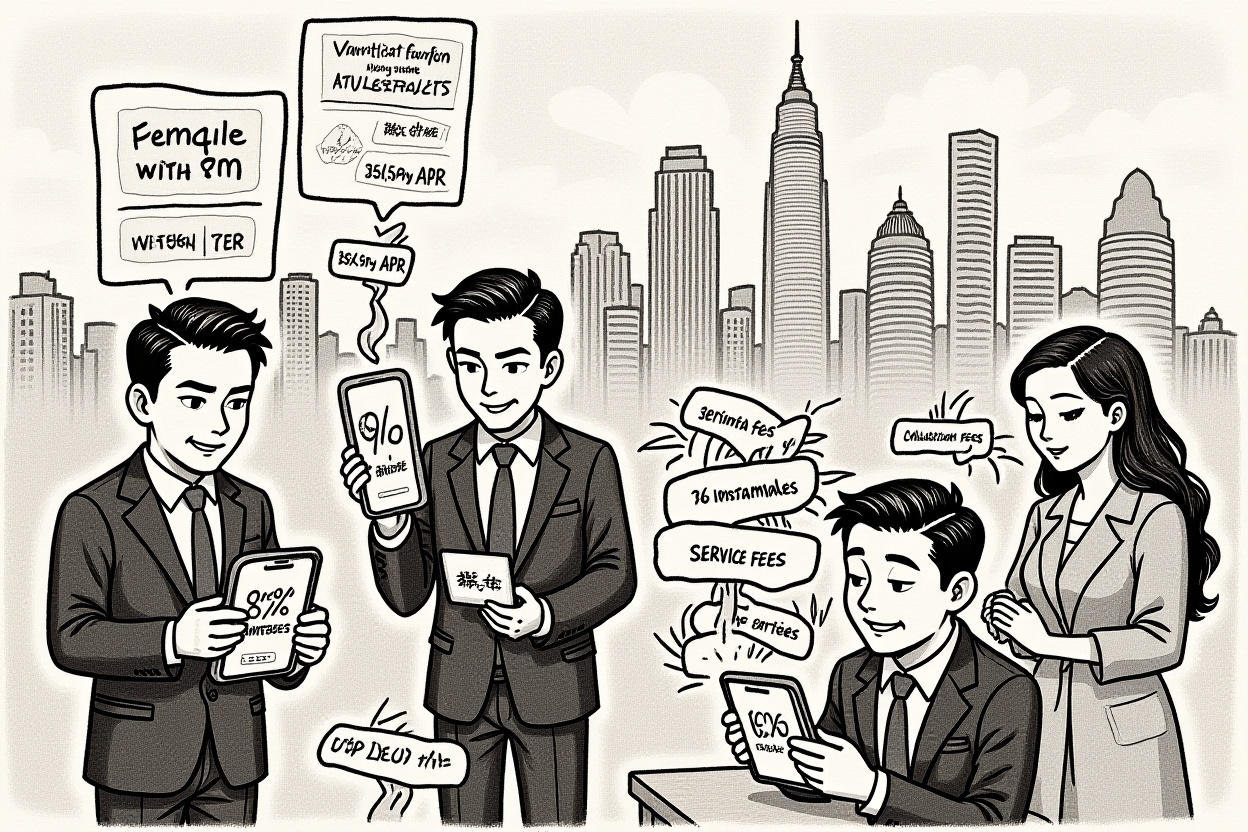
As the Lunar New Year approached, marketing from consumer credit platforms painted a picture of effortless generosity. Fenqile (分期乐), a major online lending platform, advertised credit limit increases of up to 50,000 yuan, promising users the ability to “activate with one click” and bring money home for the holidays. For Chen, a borrower whose story recently ignited public outrage on Weibo, the reality of such loans has been a six-year nightmare of suffocating debt.
Chen, who took out loans while a university student, found herself needing to repay 26,859 yuan on an original principal of just 13,674 yuan—a near-doubling of her debt. With annualized rates on her five separate loans ranging between 32.08% and 35.90%, and one 400-yuan purchase stretched over a staggering 36 installments, her financial burden became unbearable. After ceasing payments in August 2022, she faced over 1,000 days of aggressive collection tactics that targeted her social circle, leading to severe psychological distress. Her case is a stark lens into the opaque and costly world of China’s “mini-loans” (迷你贷)—small-amount, long-term installment products that promise low monthly payments but ensnare borrowers in compounding debt.
Summary of Key Findings
- Opaque Fee Structures: Platforms like Fenqile often advertise low headline interest rates but add opaque membership, guarantee, and service fees, pushing effective annualized costs toward the 36% informal ceiling.
- Regulatory Lag: Despite new rules from Chinese regulators capping comprehensive financing costs, implementation gaps allow high-cost loans to persist, trapping vulnerable borrowers.
- Persistent Targeting of Students: Historical roots in the controversial “campus loan” (校园贷) business continue to shadow platforms, with evidence of on-campus promotion and lending to students.
- Aggressive Data & Collection Practices: Borrowers report severe privacy invasions and aggressive, harassing collection methods, including contacting relatives and employers.
The “Mini-Loan” Business Model: Low Thresholds, Long Terms, High Costs
The core appeal of the mini-loan model is its accessibility. Platforms present a facade of extreme user-friendliness: Fenqile’s mini-program promises “up to 200,000 yuan to borrow, annual interest rates as low as 8%.” For a young consumer facing a cash crunch, the ability to split a 400-yuan purchase over three years for a seemingly manageable 18.23 yuan per month is a powerful lure. This is the foundational hook of the mini-loan strategy—minimize the perceived immediate pain to maximize long-term borrower enrollment.
However, this model relies on extending loan durations to extreme lengths and layering on various fees. The mathematical reality is brutal. Extending a small principal over 24, 36, or even more installments at a high effective Annual Percentage Rate (APR) causes total interest to balloon. A loan of 10,000 yuan at 35% APR over 36 months results in total interest payments exceeding 6,000 yuan. For borrowers taking multiple such loans, like Chen, the debt snowball effect is devastating. The business profitability hinges on this very snowballing, where the long tail of payments from a large user base generates substantial revenue, often from the most financially fragile segments.
Unpacking the True Cost: A Case Study in Opaque Pricing
Reports from The Chinese Consumer magazine illustrate the gap between advertised and actual costs. In one case, a borrower from Hangzhou took a loan of 10,300 yuan from Fenqile with a contracted annual rate of 6% over 12 months. The expected repayment was 10,643 yuan. Bank records, however, showed monthly payments of 1,034.78 yuan, leading to a total repayment of 12,425.4 yuan—an extra 1,782 yuan. The discrepancy points to hidden fees not clearly disclosed at the point of sale.
Similarly, another borrower from Sichuan complained that after taking two loans of 49,880 yuan each via Fenqile’s “Lehua Borrow” (乐花借钱) product, the platform deducted 1,102.14 yuan in “guarantee fees” without clear prior notification. These fees were buried within lengthy, complex electronic agreements. The common thread in over 160,000 complaints against Fenqile on the Hei Mao Complaint Platform (黑猫投诉平台) is the lack of transparent, upfront disclosure of the all-inclusive comprehensive financing cost, which regularly pushes towards 36%.
The Regulatory Tightrope: Rules vs. Reality in Chinese Consumer Finance
Chinese financial regulators are acutely aware of the risks posed by high-cost consumer lending. In a significant move, the People’s Bank of China (中国人民银行) and the National Financial Regulatory Administration (国家金融监督管理总局) jointly issued the “Guidance on the Management of Comprehensive Financing Costs for Microfinance Companies” on December 19, 2025. The rules explicitly forbid new loans with a comprehensive annualized cost exceeding 24% and mandate that, in principle, all new loans by the end of 2027 must have costs within four times the one-year Loan Prime Rate (LPR). From 2026 onward, local financial regulators are instructed to immediately correct violations, stop new lending, and incorporate dynamic credit reporting management for loans above 24%.
This creates a direct clash with the prevailing mini-loan business model. The 24% cap is a stark deviation from the informal 36% ceiling that many platforms, including Fenqile, have historically targeted. The regulatory intent is clear: to protect financial consumers and prevent debt traps. However, the existence of a 2-3 year transition period and the challenge of consistent enforcement across China’s vast market create a gap where high-cost loans can still be issued. Borrowers like Chen, whose loans originated years ago, remain trapped under the old, more permissive standards, highlighting the lag between policy announcement and on-the-ground relief for existing debtors.
From Campus to Corporation: The Unshakable Shadow of “Campus Loans”
To understand Fenqile and its parent company Lixin Group (乐信集团), one must revisit its origins. The platform was founded in 2013 by Xiao Wenjie (肖文杰), who now chairs the Nasdaq-listed Lixin Group. Its early, rapid growth was fuelled by serving university students, becoming a prominent player in the controversial “campus loan” (校园贷) sector. This business came under intense regulatory scrutiny and was effectively banned in 2016 due to widespread reports of predatory lending, data misuse, and aggressive collection targeting students.
Lixin subsequently rebranded, expanded its partnerships with licensed institutions like Shanghai Bank (上海银行), and went public in 2017, presenting itself as a mature fintech company. However, evidence suggests the platform’s links to the student demographic remain. Searches for “Fenqile campus loan” on complaint platforms yield hundreds of results. Users report that they were students when they borrowed, and there are accounts of Fenqile promoters setting up booths on campuses to market loans directly—a practice that contravenes the spirit, if not the letter, of post-2016 regulations.
The Data and Collection Pipeline: From Intrusion to Harassment
The borrower’s journey on such platforms often begins with a sweeping data grab. As investigated by Economic Reference News (经济参考报), using the Fenqile software requires agreeing to share a vast array of personal data: ID cards, bank details, income information, facial biometrics, location, and contact lists. This data is then shared with a network of third parties, including payment partners, credit enhancement agencies, and collection firms.
This pipeline becomes a weapon upon default. The over 20,000 complaints referencing violent collection practices describe a pattern of “blasting the address book” (爆通讯录), where collectors contact not just the borrower, but also their family, friends, colleagues, and even community leaders to apply pressure. For borrowers like Chen, this transforms a financial problem into a profound social and mental health crisis, compounding the difficulty of regaining financial stability.
Navigating the Market: Implications for Stakeholders
The unfolding scenario around mini-loans presents critical considerations for all market participants. For consumers, especially young adults, the imperative is heightened financial literacy and extreme caution. The allure of “low monthly payments” must be weighed against the total cost of borrowing, calculated using the APR. Reading the fine print on all fees and understanding data privacy terms is non-negotiable before clicking “agree.”
For investors in fintech and consumer finance, this represents a significant regulatory and reputational risk. Companies whose profitability is heavily reliant on high-margin, long-duration mini-loans face a forced business model transformation. The 2025 guidance signals an irreversible regulatory tightening, and firms that fail to adapt their pricing, transparency, and collection practices ahead of the 2027 deadline may face severe operational constraints and loss of licensure.
For regulators, the challenge is one of enforcement and timing. Closing the gap between national policy and local execution is crucial. Furthermore, providing clear pathways for existing borrowers trapped in pre-regulation high-cost loans to refinance or settle could be a necessary step to truly clean up the market and alleviate the social burden of such debt.
The Path Forward: Transparency, Compliance, and Financial Health
The case of Chen and the 160,000 complaints against Fenqile are not isolated incidents but symptoms of a systemic issue in a segment of China’s digital lending market. The mini-loan model, built on opacity and long-term debtor entrapment, is fundamentally at odds with the stated goals of Chinese financial regulators to promote responsible innovation and protect consumers. The coming years will be a litmus test for the fintech industry’s ability to evolve beyond its most controversial practices.
The trajectory is clear: regulatory costs are rising, and sustainable growth will depend on transparent pricing, ethical data use, and humane customer treatment. Platforms that proactively align with the 24% cap and beyond will likely earn long-term trust and regulatory goodwill. For the global investment community watching Chinese equities, particularly in the fintech space, a company’s approach to this transition—its compliance strategy, customer complaint resolution, and adaptation of its core revenue model—will be a key indicator of governance quality and long-term viability. The era of profiting from the fine print in borrowers’ despair is closing.