



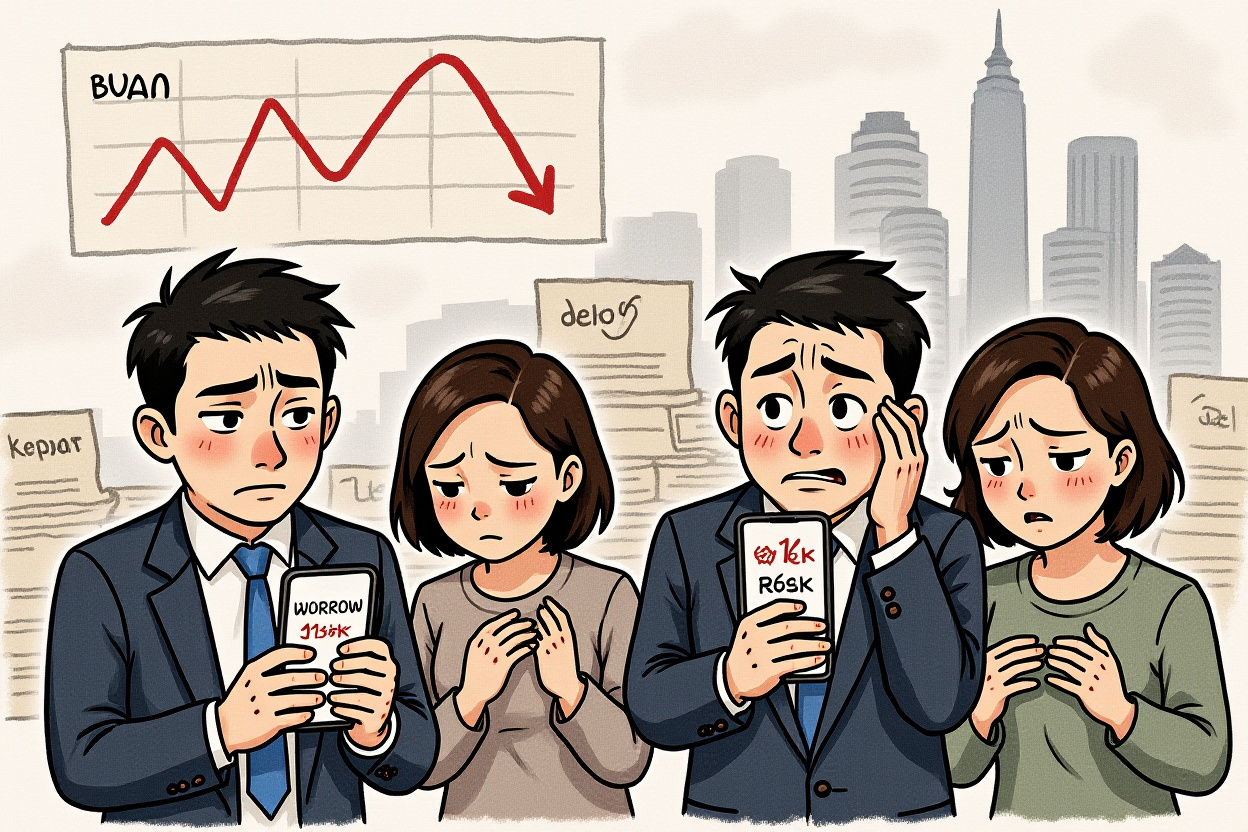
As China celebrated the Lunar New Year, a familiar pressure mounted for many young adults: the need for cash to fund red envelopes, family travel, and festive spending. In a timely nudge, the popular lending platform Fenqile (分期乐) published a promotional post on its official account, promising users a credit limit boost, with ‘maximum limits soaring to 50,000 yuan’. For those feeling a financial pinch, the offer was tempting—a quick digital tap to ‘activate’ funds for the holiday. Yet, for a growing number of borrowers, the season was marred not by celebration, but by the crushing burden of exorbitant interest and aggressive debt collection tactics tied to these very loans.
On February 23rd, Fenqile trended on Weibo, China’s equivalent of Twitter, under the shocking hashtag #400YuanSplitInto36Installments and #Borrow13kRepay26k. The viral discussion centered on a borrower, Ms. Chen, who six years ago took out five separate loans totaling 13,674 yuan (approximately $1,880). Her attempt to finally settle the debt this February revealed a staggering repayment figure: 26,859 yuan (approximately $3,700)—nearly double the principal, representing an effective annualized rate pushing 36%. The psychological toll has been severe, with collection agents informing her friends and family, leading to depression and a desperate desire for normalcy.
This case illuminates the dark underbelly of China’s burgeoning fintech-lending sector. Beneath the glossy veneer of ‘financial technology,’ the business model of so-called mini-loans—offering small, seemingly manageable installments—is facing intense scrutiny. These platforms attract users with low barriers to entry while pushing comprehensive annualized costs to the legal limit, profess to serve young consumers while facing allegations of lending to students and employing coercive collection practices. The critical question for regulators and investors alike is whether this model can withstand the coming wave of stricter supervision.
Executive Summary: The ‘Mini-Loan’ Dilemma
Key takeaways from this investigation into China’s consumer lending landscape:
– A regulatory crackdown is intensifying, with new rules from the People’s Bank of China (中国人民银行) and the National Financial Regulatory Administration (国家金融监督管理总局) explicitly banning new loans with a comprehensive annualized cost above 24% and aiming to cap costs at four times the Loan Prime Rate (LPR) by end-2027.
– Platforms like Fenqile, operated by NASDAQ-listed LexinFintech (乐信集团), utilize a ‘mini-loan‘ model that masks true costs through extended tenures (e.g., 36 months for a 400-yuan purchase) and opaque fees, leading to snowballing debt where total repayment can far exceed the principal.
– Consumer protection is a major issue, with over 160,000 complaints on the Black Cat投诉 platform against Fenqile alone, citing hidden charges like membership, guarantee, and credit assessment fees that inflate effective rates to the 36% ceiling.
– Despite public pivots away from ‘campus lending,’ evidence suggests these platforms continue to target students, and their data collection and aggressive collection practices raise serious privacy and ethical concerns.
– The sustainability of the high-margin business model for online microlenders is now in direct conflict with regulatory mandates for fair consumer finance, presenting significant operational and compliance risks.
The Tightening Grip of Regulation on Consumer Finance
The Chinese regulatory environment for consumer credit, particularly online microlending, is undergoing a profound and rapid transformation. The era of lax oversight is closing, replaced by a framework explicitly designed to protect borrowers from usurious rates.
New Rules Set Clear Cost Caps
In a decisive move, on December 19, 2025, the People’s Bank of China (中国人民银行) and the National Financial Regulatory Administration (国家金融监督管理总局) jointly issued the ‘Guidance on the Management of Comprehensive Financing Costs for Small Loan Companies.’ This directive is a game-changer. It unequivocally prohibits the issuance of new loans with a comprehensive annualized financing cost exceeding 24%. Furthermore, it mandates that, in principle, by the end of 2027 at the latest, the cost of all newly issued loans must be reduced to within four times the 1-year Loan Prime Rate (LPR).
The guidance also outlines an enforcement timeline. Starting in 2026, local financial supervision authorities are instructed to take immediate corrective action against small loan companies issuing loans above the 24% threshold. Penalties include ordering a halt to new lending and incorporating such violations into dynamic credit reporting management. This creates a powerful compliance incentive beyond mere fines.
The Legal and Judicial Backdrop
This administrative guidance builds upon a firm judicial foundation. China’s Supreme People’s Court has long held that the judicial protection ceiling for private lending interest rates is 4x the LPR (currently around 13-14%). While this doesn’t directly invalidate contracts above this rate, it severely limits lenders’ ability to seek judicial enforcement for the excess. The new rules extend this principle directly into the pre-issuance supervision of licensed institutions. The 24% interim cap and the future LPR-linked target represent a clear regulatory pathway to align the entire licensed small loan industry with judicial standards for fairness.
Deconstructing the ‘Mini-Loan’ Business Model: How Debt Snowballs
The term mini-loan is a potent marketing tool, suggesting trivial, bite-sized debt. The reality is a financial product engineered for maximum profitability through extended duration and opaque fee structures, often trapping borrowers in a cycle of repayment far exceeding initial expectations.
The Illusion of Affordability
Fenqile’s user interface is a masterclass in attractive presentation. Upon opening its mini-program, users are greeted with compelling promises: ‘Borrow up to 200,000 yuan,’ ‘Annual interest rate as low as 8%,’ and ‘From just 2.2 yuan per day for a 10,000-yuan loan.’ These figures are psychologically calibrated to appeal to someone in urgent need of funds, presenting a facade of transparency and low cost.
The case of Ms. Chen is a textbook example of the model’s mechanics. During her university years, she took five loans from Fenqile, including one for just 400 yuan spread over 36 months. Promoters emphasized the ‘low monthly payment of just 18.23 yuan,’ obscuring the terrifyingly long tenure and the effective Annual Percentage Rate (APR) ranging from 32.08% to 35.90%. By stretching minimal payments over years, the platform ensures a long-term revenue stream while the borrower’s debt, like a snowball rolling downhill, accumulates staggering interest.
The Opaque World of ‘Comprehensive’ Fees
Where the mini-loan model truly generates its returns is in the labyrinth of additional charges. The advertised ‘interest rate’ is frequently just the tip of the iceberg. On the Black Cat投诉 platform, over 160,000 complaints against Fenqile consistently cite unexpected fees for membership, guarantees, and credit assessments.
These fees are often buried in lengthy, complex electronic agreements. As reported by ‘China Consumer’ (《中国消费者》), cases demonstrate the discrepancy:
– A borrower from Hangzhou, Mr. Meng, took a loan for 10,300 yuan at a contracted annual rate of 6%. While the contractual repayment should have been 10,643 yuan, his bank statements showed total repayments of 12,425.4 yuan—an extra 1,782 yuan in hidden costs.
– Another borrower from Sichuan, Mr. Sha, complained that after taking two loans of 49,880 yuan each via Fenqile’s ‘Lehua Borrowing’ (乐花借钱) product, the platform deducted 1,102.14 yuan in ‘guarantee fees’ without clear prior disclosure.
A common thread in these complaints is the lack of prominent, informed consent. Platforms often fail to clearly disclose the nature, service content, or pricing basis for these additional fees upfront, violating core principles of consumer financial protection and effectively pushing the total cost of borrowing to the regulatory red line of 36%.
Target Market: The Unfinished Business of ‘Campus Loan’ Scandals
Fenqile’s operator, JI’an Fenqile Network Small Loan Co., Ltd. (吉安市分期乐网络小额贷款有限公司), is ultimately controlled by LexinFintech Holdings Ltd., founded by CEO Xiao Wenjie (肖文杰). The company’s origin story is deeply intertwined with the controversial ‘campus loan’ (校园贷) phenomenon that swept Chinese universities last decade.
Roots in Student Lending
LexinFintech, originally launched as Fenqile in 2013, aggressively grew by offering easy credit to college students for electronics and lifestyle purchases. This strategy fueled rapid user acquisition and transaction volume growth. However, following a regulatory crackdown on abusive campus lending practices in 2016-2017, the company rebranded, pivoted to a broader ‘credit consumer’ narrative, and accelerated its push for a NASDAQ listing in 2017 to recast itself as a legitimate fintech firm.
Despite this public relations shift, evidence suggests the platform’s reach still extends deeply into the student population. A search for ‘Fenqile + campus loan’ on the Black Cat投诉 platform yields 922 results. Complaints describe borrowing while still enrolled, on-campus promotion booths set up by Fenqile agents, and direct marketing to students. This ongoing activity raises serious questions about compliance with regulations prohibiting targeted lending to undergraduates without independent means of repayment.
Aggressive Collection and Data Privacy Concerns
The borrower experience often turns punitive upon default. Over 20,000 complaints reference violent collection practices, including harassment, verbal abuse, and the notorious tactic of ‘blasting the communication list’ (爆通讯录), where collection agents contact the borrower’s family, friends, colleagues, and even community leaders to apply social pressure.
This is enabled by the extensive personal data collected at the point of application. An investigation by ‘Economic Reference News’ (《经济参考报》) found that using the Fenqile app requires consent to collect and use dozens of personal data points: ID card photos, bank card details, occupation, income, facial recognition biometrics, location, and address. The platform’s privacy policy states this sensitive information may be ‘shared’ with a wide range of third parties, including payment partners, clearing banks, credit enhancement agencies, and industry associations. This creates a comprehensive surveillance and leverage framework that leaves consumers vulnerable from the moment they click ‘agree.’
The Path Forward: Compliance, Consumer Duty, and Market Implications
The high-profile case of Ms. Chen and the tens of thousands of similar complaints represent more than just public relations challenges for LexinFintech and its peers. They signify a fundamental clash between a high-margin lending business and an evolving regulatory philosophy centered on financial consumer rights.
Operational and Investor Risks
For publicly listed entities like LexinFintech, the regulatory trajectory poses direct risks to profitability and business model sustainability. A forced reduction in comprehensive financing costs from near 36% to 24%, and eventually to a level linked to the LPR, will compress net interest margins—a key metric for lenders. The requirement to clearly disclose and justify all fees may eliminate lucrative revenue streams that relied on opacity.
Investors must now scrutinize whether these companies’ growth was built on regulatory arbitrage that is rapidly closing. The transition to a compliant model, reliant on better risk assessment, operational efficiency, and truly value-added services, will test management’s strategic capabilities. Failure to adapt could lead to severe regulatory penalties, class-action lawsuits from aggrieved borrowers, and a permanent loss of social license to operate.
A Call for Enhanced Consumer Vigilance and Financial Literacy
While regulators wield the stick, the onus is also on consumers, especially young adults, to exercise extreme caution. The allure of the mini-loan is its convenience and the deferral of pain. Borrowers must learn to look beyond the monthly payment and calculate the total cost of borrowing (TCB) or the annualized percentage rate (APR), which includes all fees. They should meticulously review loan agreements, question any unclear charges, and be wary of untenably long repayment periods for trivial amounts.
Financial literacy initiatives are crucial. Understanding that a 400-yuan purchase repaid over 36 months at a high rate is profoundly uneconomic is a basic but essential defense against predatory lending. Consumers should treat their personal financial data with the utmost seriousness, understanding that granting access to a lending app can have consequences far beyond a single transaction.
Navigating the New Landscape of Chinese Consumer Credit
The unfolding saga of Fenqile and the broader ‘mini-loan‘ sector is a critical microcosm of China’s attempt to harness the power of fintech for financial inclusion while preventing its misuse. The regulatory intent is now unambiguous: to curb usury, enforce transparency, and protect vulnerable borrowers. The 2025 guidance with its 24% cap and 2027 LPR target provides a clear compliance roadmap and timeline.
The coming years will separate the true financial technology innovators from the lenders who merely used a digital facade to engage in high-cost credit. Companies that proactively align their pricing, disclosure, and collection practices with the new consumer-centric standards may find sustainable, if less spectacular, growth. Those that resist or attempt to circumvent the rules through new fee structures face existential risk from regulators, the courts, and an increasingly informed and vocal user base.
For international investors and observers of China’s financial markets, this regulatory tightening is a sign of maturation. It moves the consumer finance sector away from a ‘wild west’ phase and toward a more stable, rules-based environment. While this may dampen short-term profitability for some players, it ultimately reduces systemic risk and fosters a healthier, more sustainable market for consumer credit—one where borrowing 13,000 yuan does not lead to a 26,000 yuan nightmare.