



Executive Summary
- Chinese fintech platform Fenqile (分期乐) faces scrutiny for offering mini-loans with effective annualized rates nearing 36%, far exceeding regulatory caps, leading to debt spirals for young borrowers.
- Despite regulatory guidelines from the People’s Bank of China (中国人民银行) and the National Financial Regulatory Administration (国家金融监督管理总局) capping comprehensive financing costs at 24%, platforms use opaque fees to maintain high profitability.
- The mini-loan model, often targeting students and low-income consumers, raises ethical concerns about predatory lending, data privacy violations, and aggressive debt collection practices.
- Investors in Chinese fintech stocks like Lexin (乐信集团) must assess regulatory risks and sustainability as authorities tighten oversight on consumer lending practices.
- This trend underscores broader market vulnerabilities in China’s consumer credit sector, impacting equity valuations and demanding enhanced due diligence from institutional players.
The Alarming Rise of Mini-Loans in China’s Consumer Credit Market
As Chinese households navigate festive seasons and economic pressures, a seemingly convenient solution has emerged: mini-loans offering quick cash with low monthly payments. However, beneath the glossy veneer of financial technology lies a troubling reality where borrowers like Ms. Chen find themselves trapped, repaying nearly double their principal due to exorbitant interest rates. This phenomenon, centered on products like those from Fenqile (分期乐), highlights a critical flaw in China’s booming fintech sector. The mini-loan industry, while promising accessibility, often exploits regulatory gaps to impose hidden costs, pushing young consumers into debilitating debt cycles. For global investors monitoring Chinese equities, understanding these dynamics is essential to gauge risks in consumer finance stocks and anticipate regulatory shifts that could reshape market landscapes.
Decoding the Mini-Loan Trap: Hidden Fees and Debt Accumulation
The allure of mini-loans lies in their perceived affordability, but as cases mount, the true cost becomes glaringly apparent. Platforms like Fenqile (分期乐) advertise low annual rates, yet through elongated repayment terms and ancillary charges, effective costs soar, ensnaring borrowers in financial quagmires.
Case Study: From 13,674 Yuan to 26,859 Yuan in Debt
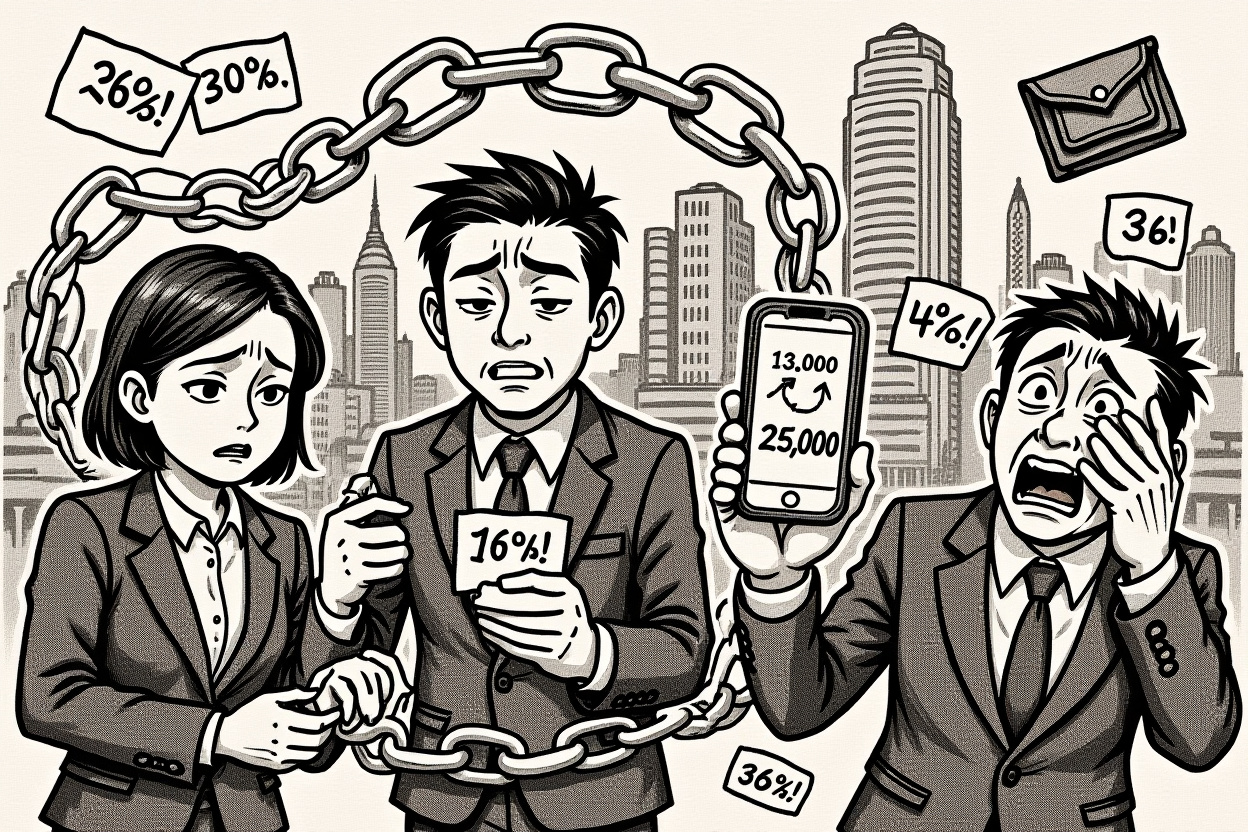
Ms. Chen’s experience epitomizes the mini-loan dilemma. During her university years, she borrowed 13,674 yuan through Fenqile (分期乐) for everyday expenses, including a 400-yuan purchase split over 36 installments. With annual interest rates ranging from 32.08% to 35.90%, her total repayment ballooned to 26,859 yuan—almost twice the principal. After defaulting in 2022, she faced over 1,000 days of delinquency and relentless debt collection that invaded her personal life, causing severe psychological distress. This example underscores how mini-loans, marketed as manageable, can escalate into unmanageable burdens through compounded interest and opaque fee structures.
Regulatory Red Lines Versus Platform Tactics
In December 2025, the People’s Bank of China (中国人民银行) and the National Financial Regulatory Administration (国家金融监督管理总局) issued the Guidelines for the Management of Comprehensive Financing Costs of Small Loan Companies, capping new loans at 24% annualized and aiming to align rates with four times the one-year Loan Prime Rate (LPR) by 2027. Despite this, platforms circumvent these limits by embedding costs like membership fees, guarantee charges, and credit assessment fees. For instance, Fenqile’s (分期乐) website promises rates as low as 8%, but user complaints on platforms like Black Cat投诉 reveal effective costs nearing 36%. This regulatory arbitrage highlights the challenges in enforcing compliance across China’s fragmented fintech ecosystem, where mini-loans continue to thrive on borderline practices.
Targeting the Vulnerable: The Lingering Shadow of Campus Lending
Fenqile (分期乐) and its parent company Lexin (乐信集团) have historical ties to campus lending, a sector infamous for exploiting students. Although regulatory crackdowns in 2016 forced a rebranding, evidence suggests that mini-loans still permeate educational institutions, raising ethical and legal questions.
Historical Roots and Ongoing Controversies
Founded in 2013 by Xiao Wenjie (肖文杰), Lexin (乐信集团) grew rapidly by offering credit to university students, capitalizing on youthful demand for consumer goods. After going public on NASDAQ in 2017, it shifted focus to broader fintech services, yet Fenqile (分期乐) remains linked to student borrowing. On Black Cat投诉, over 922 complaints cite campus loan promotions, including on-campus booths and targeted marketing. These mini-loans, often disguised as educational tools, perpetuate debt among financially inexperienced demographics, contradicting Lexin’s (乐信集团) claims of serving creditworthy consumers. This persistence indicates systemic issues in China’s consumer credit outreach, where mini-loans exploit regulatory blind spots to maintain profitability.
Privacy Intrusions and Aggressive Collection Practices
Beyond high interest, mini-loan platforms compromise user privacy through extensive data harvesting. Fenqile’s (分期乐) privacy policy allows sharing personal information—such as ID cards, bank details, and facial recognition data—with third parties including payment partners and credit enhancers. Coupled with violent debt collection tactics, such as harassing borrowers’ social circles, this creates a coercive environment. Reports from The Economic Reference News (经济参考报) detail how users consent to these terms unknowingly, leading to psychological trauma and social ostracization. For investors, these practices signal reputational risks that could trigger regulatory backlash, affecting the valuation of fintech firms reliant on mini-loan revenue streams.
Regulatory Scrutiny and Market Implications for Chinese Equities
As authorities intensify oversight, the mini-loan sector faces pivotal changes that will ripple through China’s financial markets. Understanding these shifts is crucial for institutional investors assessing exposure to consumer finance stocks and related equity instruments.
Current Enforcement and Future Compliance Deadlines
The 2025 guidelines mandate that by 2026, local financial authorities must correct loans exceeding 24%, suspend new issuance, and integrate them into dynamic credit reporting. However, enforcement varies across regions, with platforms like Fenqile (分期乐) operating under Jiangxi-based吉安市分期乐网络小额贷款有限公司 (Jian分期乐 Network Small Loan Company). This jurisdictional complexity slows implementation, allowing mini-loans to persist. Investors should monitor announcements from the China Banking and Insurance Regulatory Commission (CBIRC) for updates on compliance, as stricter enforcement could pressure margins for companies like Lexin (乐信集团), impacting their NASDAQ-listed shares and broader fintech indices.
Investment Risks and Opportunities in Responsible Lending
The mini-loan controversy underscores systemic risks in China’s fintech boom. With over 160,000 complaints against Fenqile (分期乐) on Black Cat投诉, consumer backlash is mounting, potentially leading to lawsuits or regulatory fines. For equity investors, this necessitates due diligence on companies’ lending practices and adherence to ESG principles. Conversely, firms pivoting to transparent, low-cost models may gain market share as regulators promote responsible finance. Tracking metrics like loan delinquency rates and fee structures can provide insights into sustainability, helping investors navigate volatility in sectors tied to mini-loans. Resources like the Shanghai Stock Exchange (上海证券交易所) disclosures offer valuable data for such assessments.
Navigating the Future of Consumer Credit in China
The mini-loan epidemic reveals deep-seated issues in China’s financial technology landscape, where innovation often outpaces regulation. For young borrowers, the path forward demands greater financial literacy and cautious engagement with digital lenders. From an investment perspective, the tightening regulatory environment signals a shift toward consolidation and compliance, which could reshape competitive dynamics in the consumer credit sector. As authorities like the People’s Bank of China (中国人民银行) push for lower financing costs, companies reliant on high-interest mini-loans may face existential challenges, while those embracing transparency could emerge as leaders. Global investors should prioritize firms with robust risk management and ethical practices, as these attributes will likely define resilience in China’s evolving equity markets. Stay informed through official channels and market analyses to make strategic decisions in this rapidly changing landscape.