



Executive Summary
In early March 2026, a globally coordinated new product launch by McDonald’s (麦当劳) spiraled into a public relations crisis, underscoring deeper vulnerabilities for the fast-food giant. This incident, centered on CEO Chris Kempczinski’s (克里斯·坎普钦斯基) perceived insincere product tasting, has amplified scrutiny on the company’s brand trust and strategic direction. For investors monitoring consumer sectors and Chinese equities, the event highlights critical factors influencing multinational corporations in volatile markets.
- The viral video of CEO Chris Kempczinski taking a minuscule, symbolic bite of a new burger triggered widespread mockery, damaging brand authenticity and consumer trust.
- McDonald’s faces a dual challenge: defending its ‘value leadership’ in inflationary Western markets while battling fierce local competition in its key growth engine, China.
- Global financial pressures persist, with 2024 marking the first same-store sales decline since 2020, despite a 2025 rebound driven by value menus.
- In China, McDonald’s aggressive store expansion to 10,000 outlets by 2028 confronts intense rivalry from domestic brands like Wallace (华莱士) and Tastien (塔斯汀), which compete on hyper-localized offerings and value.
- The trust crisis extends beyond PR to food safety, following a 2024 E. coli incident in the U.S., complicating efforts to stabilize brand equity and investor confidence.
From Global Launch to PR Disaster: The Symbolic Bite Heard Round the World
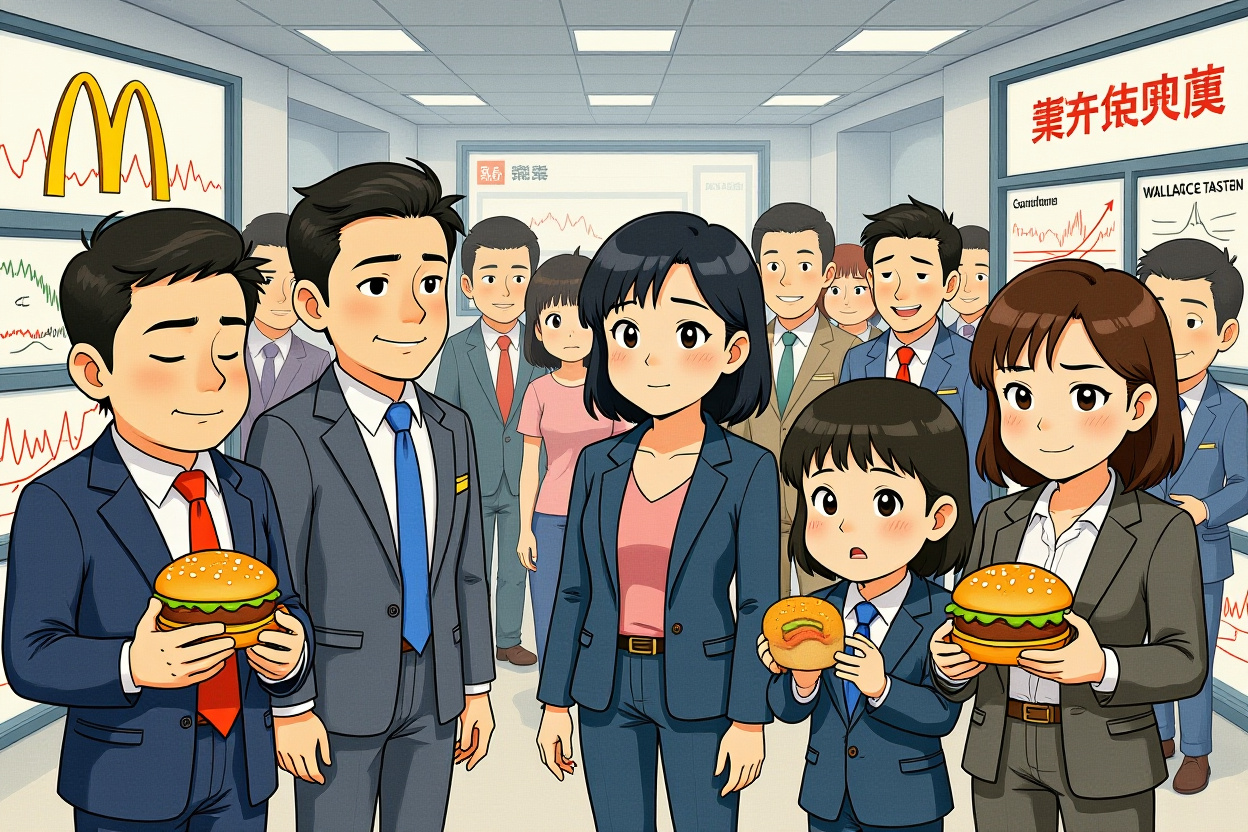
A meticulously planned campaign for McDonald’s new ‘Grand Arch’ burger backfired spectacularly, transforming a routine marketing video into a case study in corporate tone-deafness. CEO Chris Kempczinski (克里斯·坎普钦斯基), in a sub-one-minute clip, praised the product but hesitated visibly before taking a comically small nibble from the edge. Social media erupted, with users dubbing it a ‘bite of superficial damage’ and accusing the CEO of performative, disconnected leadership. This moment crystallized a growing perception that McDonald’s management is out of touch with its core product and customer base.
Deconstructing the Viral Video Fallout
The video’s damage was multifaceted. Kempczinski consistently referred to the burger as a ‘product,’ not food—a lexical choice interpreted as cold corporatism over genuine culinary enthusiasm. This echoed a prior 2024 incident where he appeared to chew a chicken sandwich only twice before cutting to a wiped mouth. The contrast was stark when Burger King (汉堡王) North America President Tom Curtis (汤姆·柯蒂斯) seized the opportunity, posting a video of himself messily devouring a Whopper, a masterclass in opportunistic, authentic-seeming marketing. The episode underscores how executive communication missteps can rapidly escalate into a full-blown trust crisis, eroding brand loyalty that took decades to build.
The CEO Profile: Elite Background Clashes with Public Expectation
Chris Kempczinski’s (克里斯·坎普钦斯基) distinguished resume, featuring Duke University and Harvard Business School pedigrees, along with senior roles at Procter & Gamble and PepsiCo, ironically exacerbated the public relations crisis. Appointed in 2019 after his predecessor was ousted, Kempczinski is a marathon runner with a lean physique. Despite claims of eating McDonald’s several times a week, his ‘marathoner’s body’ appeared incongruous with the brand’s high-calorie fare, fueling narratives of elite disdain. This image disconnect amplified the symbolic bite’s impact, making it a proxy for broader skepticism about corporate sincerity.
Leadership and the Perception Gap
In the hyper-scrutinized era of social media, every executive action is magnified. Kempczinski’s demeanor in the video—awkward and seemingly unfamiliar with his own product—contrasted sharply with the hands-on, passionate leadership often expected in the food industry. For institutional investors, this raises questions about management’s ability to authentically connect with consumer trends and navigate brand-sensitive issues. The incident suggests that McDonald’s may be grappling with an internal culture that prioritizes operational metrics over emotional brand equity, a precarious position when consumer trust is fragile.
Beyond the Bite: McDonald’s Multifaceted Global Trust Crisis
The CEO’s faux pas is a symptom, not the disease. McDonald’s operational and financial headwinds reveal a company at a strategic crossroads. In 2024, global comparable sales declined for the first time since the pandemic, with net profit dropping 3%, pressured by inflationary costs for ingredients and labor. This forced price hikes that alienated value-conscious consumers, eroding the chain’s long-standing ‘value leadership’ position. The company acknowledged this shrinkage in its perceived value advantage, prompting a strategic pivot.
Financial Recalibration and Safety Scandals
In response, McDonald’s launched a ‘value strategy’ in 2025, heavily promoting bundles like the $5 meal deal. This helped drive a 4% increase in both total revenue and net income for the year, as per financial reports. However, the recovery is tenuous. Concurrently, a severe E. coli outbreak linked to McDonald’s in the U.S. in October 2024, resulting in hospitalizations and a fatality, severely damaged consumer trust. As Kempczinski noted in a shareholder letter, some days make McDonald’s the lead story for all the wrong reasons. This combination of financial pressure and safety concerns forms the bedrock of the current trust crisis, making the brand vulnerable to any additional missteps.
The China Conundrum: Growth Engine Amidst a Competitive ‘Thunderdome’
While navigating global challenges, China represents both McDonald’s greatest opportunity and its most formidable battlefield. The market is critical for global growth, with over 7,700 outlets in mainland China by end-2025 and plans to add roughly 1,000 more in 2026, targeting 10,000 stores by 2028. China is designated as McDonald’s ‘number one incremental growth market globally.’ Yet, this aggressive expansion unfolds in an increasingly brutal competitive landscape.
Local Rivals and Operational Headwinds
McDonald’s and KFC (肯德基) once dominated Western fast food in China. Today, they face fierce competition from domestic players. Wallace (华莱士) has scaled to nearly 20,000 stores through ultra-low pricing, while Tastien (塔斯汀) has gained traction with its ‘hand-stretched dough’ localization and compelling value meals. These brands aggressively court budget-conscious consumers with ‘poor ghost套餐’ (穷鬼套餐), challenging McDonald’s on its own value proposition. As McDonald’s penetrates third- to fifth-tier cities, its standardized supply chain and management systems are tested. Market consumption is rationalizing, making single-store efficiency paramount. Unlike KFC, which explores sub-brands like ‘Ken Yue Coffee’ (肯悦咖啡) to boost store productivity, McDonald’s must solve the puzzle of balancing breakneck expansion with quality control and profitability. This intense competition directly impacts the trust equation; Chinese consumers have more choices than ever and will swiftly abandon brands that fail to deliver consistent value and quality.
Investment Implications: Navigating the Trust Crisis in Consumer Equities
For sophisticated investors, especially those focused on Chinese consumer markets, the McDonald’s saga offers critical lessons. A brand’s equity is its most valuable intangible asset, and incidents that trigger a trust crisis can have material financial consequences. In China, where consumer sentiment is pivotal for retail and restaurant stocks, understanding how multinationals adapt to local competition and regulatory environments is key. The trust crisis at McDonald’s serves as a cautionary tale for other consumer-facing firms listed in Hong Kong or with significant China exposure.
Assessing Brand Resilience and Market Valuation
The immediate stock market reaction to such PR events can be volatile, but the long-term impact depends on fundamental corrective actions. Investors should monitor: management’s response to restore authenticity; same-store sales growth in key regions like China; margin trends amid value wars; and supply chain investments to ensure safety. The ability to navigate this trust crisis will be a litmus test for McDonald’s leadership and a data point for evaluating similar companies in the sector. Brands that successfully localize while maintaining global standards may better withstand such shocks.
Synthesizing the Path Forward for McDonald’s and Market Watchers
The ‘one-bite PR disaster’ is a vivid symbol of deeper struggles. McDonald’s must simultaneously address a global trust deficit, fueled by perception issues and past safety lapses, and execute a flawless growth strategy in the complex Chinese market. For the company, moving beyond this trust crisis requires genuine engagement with consumers, transparent communication, and perhaps most importantly, demonstrable commitment to product quality and value. The planned Chinese expansion is a bold bet that will demand localized innovation and operational excellence to fend off savvy domestic competitors.
For global investors and analysts, this episode underscores the heightened importance of ESG factors—particularly social license and brand trust—in investment decisions, especially for consumer stocks with Asian exposure. Monitoring how McDonald’s manages its recovery can provide insights into broader market trends. The call to action is clear: scrutinize consumer brands not just on financial metrics, but on their cultural competency, leadership authenticity, and resilience in the face of public scrutiny. In today’s interconnected market, a CEO’s bite size can indeed ripple through global trust and valuations, making vigilant analysis more crucial than ever.