



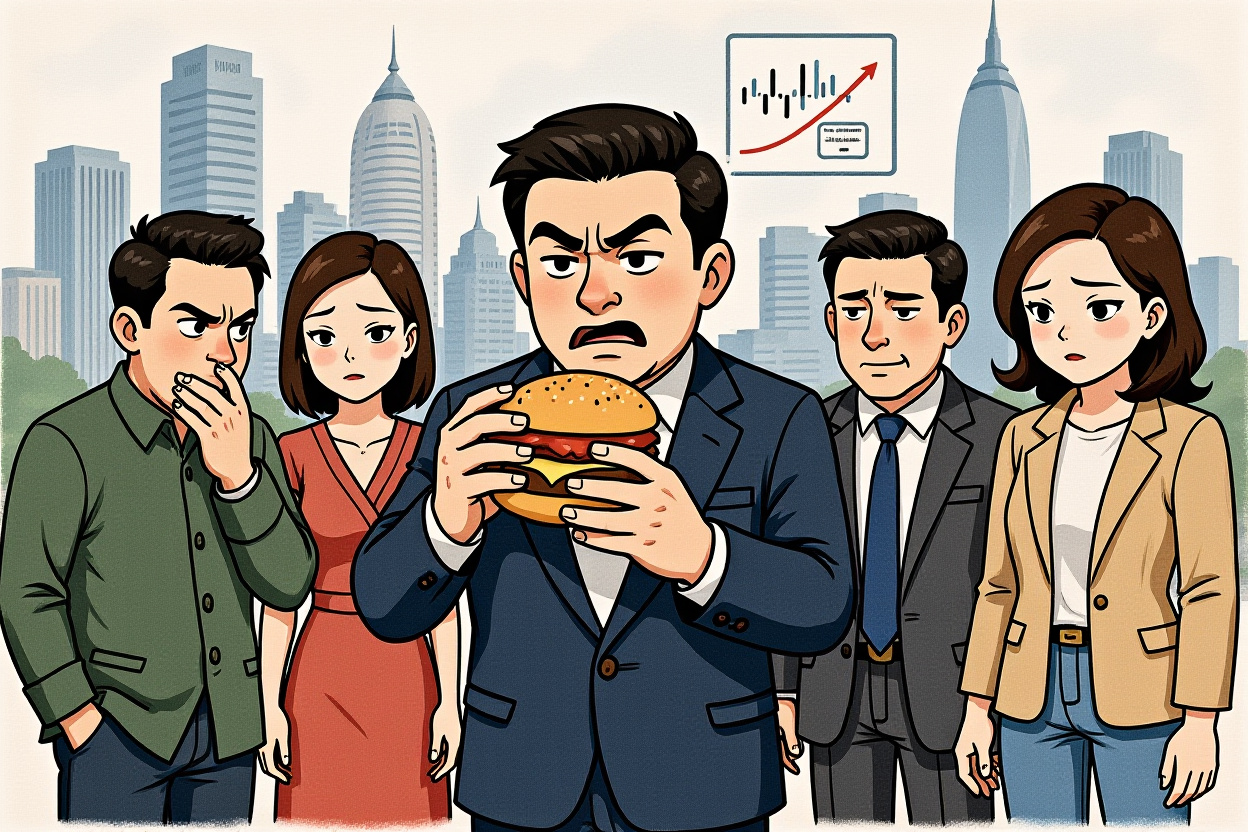
– A viral video of McDonald’s CEO Chris Kempczinski (克里斯·坎普钦斯基) taking a symbolic bite of a new burger sparked global mockery and raised questions about authentic leadership in the age of social media scrutiny. – The incident underscores a deeper McDonald’s trust crisis, fueled by inflation-driven price hikes, food safety concerns, and eroding value perception among cost-conscious consumers globally. – In China, McDonald’s faces intense competition from local rivals like Wallace (华莱士) and Tastien (塔斯汀), even as it pursues aggressive expansion to 10,000 stores by 2028. – Strategic shifts towards value menus and operational efficiency are critical for McDonald’s to navigate market headwinds and restore consumer confidence in both established and emerging markets. – Investors and industry watchers must monitor how McDonald’s balances rapid growth with brand authenticity, as CEO missteps can amplify underlying vulnerabilities in a hyper-competitive landscape.
The PR Disaster That Went Viral: More Than Just a Symbolic Bite
In early March 2026, a meticulously planned global product launch for McDonald’s (麦当劳) unexpectedly spiraled into a full-blown public relations crisis, captivating social media platforms worldwide. The focal point was a less-than-one-minute video featuring McDonald’s global CEO Chris Kempczinski (克里斯·坎普钦斯基) introducing a new burger, dubbed the ‘Grand Arch.’ What was intended as a routine promotional piece quickly became a case study in corporate communication gone awry, directly contributing to the emerging McDonald’s trust crisis. Kempczinski’s performance during the crucial taste-test segment—where he appeared hesitant and took only a small, symbolic bite from the edge of the burger—was perceived as disingenuous and out of touch. This ‘bite that caused a surface wound,’ as netizens mocked, transformed a marketing moment into a global talking point about authenticity and leadership.
Deconstructing the Viral Video and Public Backlash
The video’s details fueled the fire. Chris Kempczinski (克里斯·坎普钦斯基) referred to the burger consistently as a ‘product’ rather than ‘food’ or a ‘burger,’ a choice of language viewed as overly corporate and devoid of passion. Observant users also recalled a similar incident from August 2024, where Kempczinski was seen chewing a chicken sandwich only twice before the video cut to him wiping his mouth and offering praise, leading to speculation he had discreetly disposed of the food. The 2026 episode confirmed a pattern for critics: a leader seemingly disconnected from the core product of his own empire. The backlash was swift and merciless on platforms like Twitter and Weibo, with comments ranging from ‘He looks like he’s never seen a burger before’ to accusations of ‘elitist arrogance.’ This episode starkly revealed how a single misstep in the digital age can amplify a broader McDonald’s trust crisis, where consumer skepticism about corporate motives is already high.
Competitors Seize the Moment: A Lesson in Contrast Marketing
The crisis did not go unnoticed by rivals. Tom Curtis, President of Burger King North America, swiftly posted a video of himself taking large, enthusiastic bites of a Whopper, with condiments visibly smearing on his face. This unvarnished, genuine-seeming endorsement served as a powerful contrast to Kempczinski’s staged moment, highlighting the competitive peril when a brand’s authenticity is questioned. Burger King’s opportunistic marketing capitalized on the McDonald’s trust crisis, reminding consumers and the industry that in the battle for fast-food loyalty, perceived honesty and relatability are potent weapons. The incident underscores that in today’s market, every executive action is scrutinized, and competitors are poised to exploit any perceived weakness.
Profile of the CEO: Elite Background Versus Public Perception
The backlash against Chris Kempczinski (克里斯·坎普钦斯基) was compounded by his personal profile. A graduate of Duke University and Harvard Business School, with a career spanning Procter & Gamble and PepsiCo before joining McDonald’s in 2015, Kempczinski represents a classic corporate executive archetype. He took the helm in November 2019 after his predecessor, Steve Easterbrook, was ousted over a relationship with an employee. However, his trim, marathon-runner’s physique, which he has claimed is maintained despite eating McDonald’s ‘three or four times a week,’ created a visual disconnect for many consumers. This physical dissonance, paired with the video’s awkwardness, reinforced a narrative of a leader who may not genuinely embrace the brand’s everyday, indulgent appeal, further eroding trust.
The Challenge of Leadership Authenticity in Consumer Brands
For a brand like McDonald’s, which relies on mass appeal and emotional connection, the CEO is a vital brand ambassador. The incident highlights a critical challenge: how can a globally mobile, elite executive authentically represent a product rooted in convenience and affordability for millions? Kempczinski’s stumble shows that claimed product usage must be demonstrably believable. When the leader’s engagement appears performative, it can trigger a deeper skepticism about the company’s overall commitment to quality and customer-centricity. This facet of the McDonald’s trust crisis is about bridging the gap between the boardroom and the dining room, ensuring that leadership communications resonate as heartfelt rather than scripted.
Global Headwinds: Financial Pressures and Eroding Trust Foundations
Beyond the viral video, the McDonald’s trust crisis is fueled by substantial operational and market challenges. In 2024, McDonald’s reported its first global comparable sales decline since 2020, with net profit dipping 3%. Soaring inflation pushed up costs for ingredients and labor, forcing menu price increases that alienated value-seeking customers. Management publicly acknowledged that the chain’s ‘value leadership’ position was weakening. In response, 2025 saw a strategic pivot to a ‘value strategy,’ emphasizing bundles like the $5 Meal Deal to win back budget-conscious consumers. This move helped drive a 4% growth in total revenue and net income for the year, as reported in their financial statements.
The Shadow of Food Safety Incidents
Financial pressures are only one part of the story. Consumer trust is fragile and can be shattered by safety lapses. In October 2024, a severe E. coli outbreak in the United States linked to McDonald’s products led to multiple hospitalizations and one fatality. Such events strike at the very heart of a food brand’s covenant with its customers. In a letter to shareholders, Chris Kempczinski (克里斯·坎普钦斯基) himself noted, ‘There are some days when it feels like McDonald’s is at the center of every major news story.’ Rebuilding confidence after safety scares is a long-term endeavor, and any additional misstep—like a CEO’s unconvincing taste test—can reopen those wounds, making the McDonald’s trust crisis a multi-layered issue spanning affordability, safety, and brand integrity.
The China Conundrum: Breakneck Growth Meets Fierce Local Competition
While grappling with these global issues, China represents McDonald’s most significant growth frontier and its most brutal competitive arena. This dual reality is central to understanding the company’s future and the global implications of the McDonald’s trust crisis. McDonald’s China, operated through a master franchise joint venture, ended 2025 with over 7,700 restaurants in mainland China and aims to open approximately 1,000 new stores in 2026, targeting 10,000 locations by 2028. The market is unequivocally the company’s ‘number one incremental growth market globally.’ However, growth here is fraught with unique challenges that test the brand’s resilience and adaptability.
The Rise of Local Rivals and the ‘Value-for-Money’ Battle
The competitive landscape in China has transformed. Where McDonald’s and KFC (肯德基) once dominated Western fast-food, local chains have risen with aggressive strategies. Wallace (华莱士) has scaled to nearly 20,000 stores nationwide, while Tastien (塔斯汀) has gained traction with a localized ‘hand-stretched dough’ burger concept. These players often compete fiercely on price, offering ‘budget meal’ deals that pressure McDonald’s value proposition. For McDonald’s, competing in this ‘poor ghost套餐’ (穷鬼套餐) segment requires relentless focus on cost efficiency without compromising on the perceived quality that justifies its brand premium. This intense local competition means any slippage in consumer trust or brand appeal can be quickly exploited by rivals.
Operational Challenges in a Diversifying Market
As McDonald’s penetrates deeper into China’s third- to fifth-tier cities, it encounters operational complexities. Maintaining consistent quality, service, and supply chain efficiency across a vast and geographically dispersed network is a monumental task. Furthermore, with Chinese consumption becoming more rational, single-store efficiency is a key performance metric. Competitors like KFC are exploring models to boost efficiency, such as co-locating sub-brands like ‘K Coffee’ (肯悦咖啡) to share resources. McDonald’s must similarly innovate to balance rapid expansion with profitability, ensuring that growth does not dilute the customer experience or operational standards—a delicate act that, if mismanaged, could exacerbate the McDonald’s trust crisis in a critical market.
Strategic Implications and the Path Forward for the Golden Arches
The convergence of the CEO’s PR misstep, global financial pressures, and fierce market competition paints a complex picture for McDonald’s. This is not merely about a poorly received video; it is a symptom of larger strategic tensions. The McDonald’s trust crisis serves as a wake-up call for the entire organization, highlighting the need for authentic engagement, transparent communication, and relentless execution on core promises of value and safety. For institutional investors and market analysts, these events underscore the importance of evaluating leadership’s connection to brand ethos as a tangible component of corporate governance and risk assessment.
Lessons in Authenticity and Digital Age Leadership
The incident offers clear lessons for McDonald’s and other consumer-facing corporations: – Leadership communications must be crafted with an understanding of digital-native audiences who value genuineness over polish. – Executive brand ambassadors should undergo media training that emphasizes relatable, unfiltered engagement, especially for product demonstrations. – Crisis response must be swift and human-centered, acknowledging missteps rather than dismissing them as overblown. – Building a buffer of brand equity through consistent value delivery and community engagement can help mitigate the impact of isolated PR failures. As noted in analysis by sources like the Daily Economic News (每日经济新闻), McDonald’s 2025 recovery was built on a back-to-basics value strategy; extending that authenticity to all consumer touchpoints is the next logical step.
Investment Outlook and Monitoring Key Indicators
For the sophisticated investors and fund managers focusing on Chinese equities and global consumer brands, monitoring McDonald’s requires a multi-factor approach: – Track comparable sales growth, especially in high-growth markets like China, against local competitors’ performance. – Scrutinize margin trends to assess the sustainability of value-menu strategies amid cost inflation. – Monitor brand health metrics, including social sentiment analysis and trust indices, as early warning signals for potential crises. – Evaluate the company’s capital allocation between aggressive store expansion (particularly in China) and investments in digital infrastructure, supply chain resilience, and employee training to uphold quality. The McDonald’s trust crisis is a reminder that in the consumer sector, intangible assets like brand reputation are as critical as tangible store counts. The ongoing challenge for McDonald’s is to ensure that its quest for growth, symbolized by the relentless march to 10,000 stores in China, does not outpace its ability to maintain the operational excellence and brand trust that made it an empire. The CEO’s ‘symbolic bite’ may fade from headlines, but the underlying issues it revealed will demand strategic focus for years to come. Investors should look for concrete actions—not just words—that demonstrate a recommitment to core consumers in every market.