



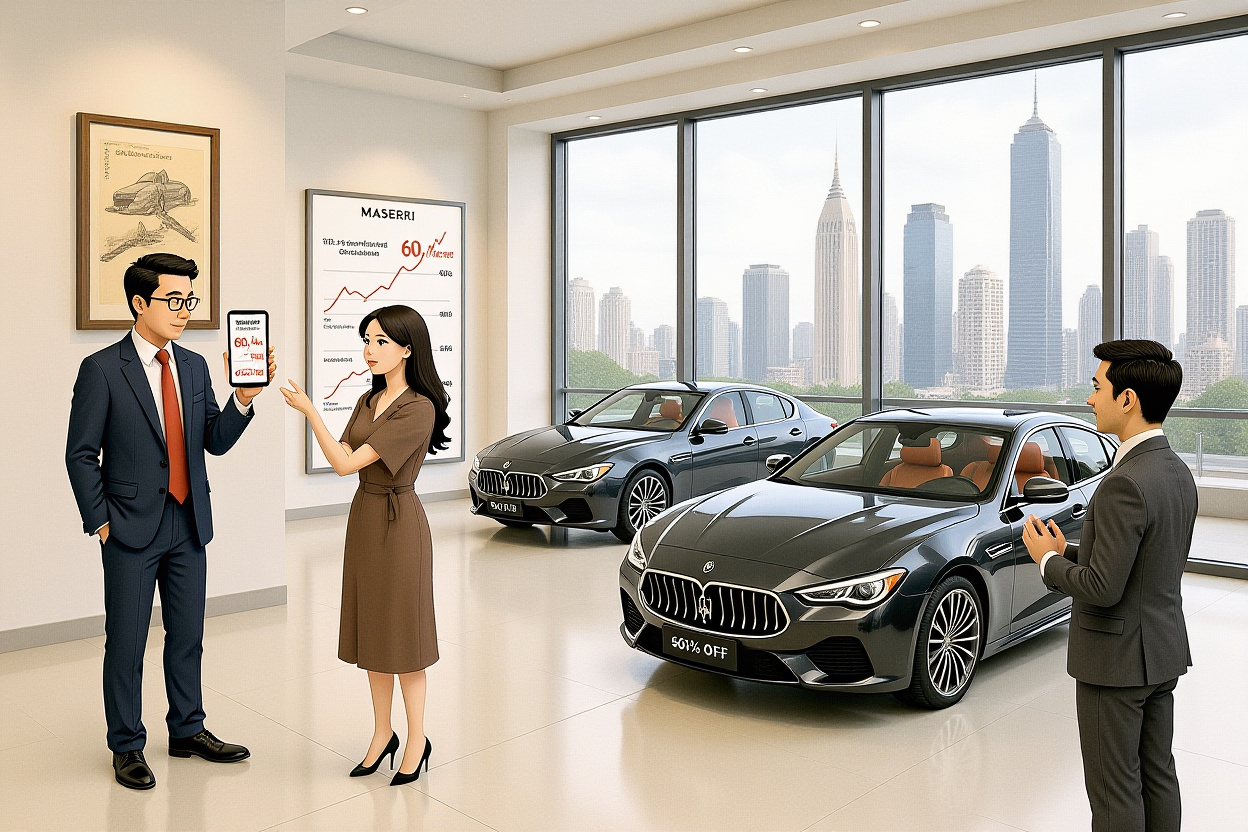
– Maserati’s last Beijing 4S store is clearing inventory of the fuel-powered Grecale at discounts up to 60%, with only two units remaining in stock.
– New vehicle orders now face waiting periods of 10 to 12 months, signaling significant supply chain realignment and strategic inventory reduction by the brand.
– The service network in Beijing has contracted sharply, down from five sales outlets to just two authorized after-sales centers, highlighting Maserati’s shrinking presence in China.
– Official sales data shows Maserati’s China deliveries plummeted 71% year-on-year in 2024, with global shipments also declining, reflecting broader challenges in the luxury segment.
– Industry analysts point to fierce competition from domestic electric vehicle makers, shifting consumer preferences, and weakened demand for imported luxury cars as key factors behind the downturn.
A Glimpse into the Last Beijing Showroom
The atmosphere inside the Beijing Poly Maserati 4S store is one of poignant transition. Once a hub for the Italian marque’s luxury vehicles, the showroom now holds just two cars. This tangible scarcity underscores a critical phase for Maserati in the world’s largest auto market. For international investors and industry watchers, the scene is a microcosm of the profound shifts redefining China’s premium automotive sector.
Inventory Crunch and Aggressive Discounting
‘We only have two fuel版格雷嘉 (Grecale) units left in the showroom. Everything else has been sold. If you want to order, the wait is nearly a year,’ explained salesperson Wang Ming (王明) during a recent visit. The models on offer, produced in late 2022, are being sold as inventory clearance. With a starting promotional price of 388,800 yuan, the Grecale is effectively discounted by approximately 40% off its official 650,800 yuan base price. In Hebei province, discounts reach up to 45%, with prices as low as 358,800 yuan.
This fire-sale strategy is a direct response to mounting inventory pressure. The deep price cuts are a tactical move to generate cash flow and make room for future model lineups, which are expected to carry significantly higher price tags. This aggressive discounting is a clear indicator of Maserati’s shrinking presence in China as it attempts to reset its market position.
A Contracting Service and Sales Network
The operational footprint has withered considerably. Beijing once hosted five Maserati sales locations. Today, only the Beijing Poly store actively sells new vehicles. The Beijing Jundong Maserati 4S store (金港店) has ceased sales entirely, now only offering after-sales service for existing owners alongside its primary Ferrari business. A call to Maserati’s China customer service center confirmed that only two authorized service dealers remain in the capital.
The sales team itself has downsized, from over a dozen personnel to just three advisors at the Poly location. This contraction in physical and human infrastructure is a stark visual of the brand’s retrenchment. It raises immediate questions about long-term serviceability and residual values for current owners, factors crucial for luxury brand perception.
Decoding the Sales Strategy and Market Signals
The current discounting frenzy is not merely a seasonal promotion but a strategic pivot. Maserati is fundamentally clearing out older, combustion-engine stock to pave the way for newer, often electrified, models. This transition is fraught with complexity in a market moving at breakneck speed.
The Calculus of Clearance and Long Wait Times
Wang Ming noted that the store sold over twenty cars during the initial promotional weekend earlier in the year and moved nearly ten units in recent weeks as the clearance season concludes. This final surge in sales of discounted models precedes a period where consumers will face long lead times and higher prices for new orders. The stated wait time of 10-12 months suggests supply chain reconfiguration, possibly tied to production adjustments in Italy or logistical prioritization for other markets.
The company has explicitly avoided the heavily discounted pure-electric Grecale models sold in Shanghai, citing a lack of specialized Italian-made repair equipment. This decision highlights the infrastructural and technical challenges luxury brands face in supporting new energy vehicles (NEVs) in China, further complicating Maserati’s shrinking presence in China.
Data Points: A Market in Steep Decline
The narrative on the showroom floor is borne out by hard numbers. According to financial reports from its parent company, Stellantis N.V. (斯特兰蒂斯集团), Maserati’s sales in China have been on a steep downward trajectory:
– 2022: 4,680 units
– 2023: 4,367 units
– 2024: 1,209 units (a 71% year-on-year decrease)
Stellantis attributed the 2024 slump primarily to falling Grecale sales, reduced demand for Western luxury imports in China, and active inventory reduction measures. Data from the China Passenger Car Association (乘联分会) shows Maserati sold 1,081 units in the first ten months of 2025, a 2% dip from the same period last year. While this represents a moderation from the steep 2024 decline, the volume remains a fraction of its former performance.
The Broader Context: Luxury Imports Under Siege
Maserati’s struggles are not occurring in a vacuum. They reflect a tectonic shift in the Chinese automotive landscape, where domestic brands are ascendant and consumer loyalty is increasingly tied to technology and value rather than legacy prestige.
The Rise of Domestic Competition and the EV Shift
Cui Dongshu (崔东树), Secretary General of the China Passenger Car Association, recently noted that imports of super-luxury cars have significantly weakened since 2023, with 2025 sales continuing to slide. He identified the rise of domestic vehicles as a primary cause. Chinese brands like Nio (蔚来), Li Auto (理想汽车), and BYD (比亚迪) are now competing directly in the high-end segment with feature-rich electric SUVs and sedans, often at more competitive price points.
This domestic onslaught, coupled with a broader consumer pivot towards smart, connected, and electric vehicles, has left traditional internal combustion engine (ICE) luxury marques struggling to maintain relevance. The market is signaling that heritage alone is no longer a sufficient selling proposition in China.
Regulatory and Economic Headwinds
Broader economic factors and regulatory priorities have also created headwinds. Government policies strongly favor new energy vehicles through subsidies, tax breaks, and licensing advantages in major cities. Meanwhile, a cautious economic recovery has tempered discretionary spending on high-ticket luxury items. The combination has accelerated Maserati’s shrinking presence in China, a trend observable across several European luxury brands that have been slow to electrify their lineups.
Strategic Implications and the Road Ahead
For Maserati and its peers, the Beijing showroom case study offers critical lessons. The path forward requires more than inventory clearance; it demands a fundamental reassessment of product strategy, brand positioning, and local engagement.
Potential Pivots for Maserati in China
Future success likely hinges on a committed electric vehicle strategy tailored for Chinese consumers. The brand’s upcoming Folgore all-electric models must offer compelling technology, performance, and design to justify a premium in a crowded field. Strengthening local partnerships for sales, service, and possibly even localized production or assembly could improve responsiveness and cost structure.
Enhancing the customer experience and digital engagement will be paramount. In a market where tech-savvy buyers expect seamless digital integration, legacy dealership models need urgent modernization. The contraction of the physical network might paradoxically create an opportunity to invest in high-touch, boutique-style retail experiences in key metropolitan areas.
Forward-Looking Guidance for Investors and Observers
The situation presents a cautionary tale but also a watchlist for adaptive players. Investors should monitor:
– Maserati’s launch timeline and reception for its all-electric models in China.
– Any announcements regarding strategic partnerships or adjustments to its local distribution model.
– Quarterly sales data from Stellantis for early signs of stabilization or further decline.
– Competitive moves by other luxury brands, such as Porsche or BMW, in electrifying their China offerings.
Synthesizing the Market Reality
The visit to Maserati’s last Beijing 4S store paints a vivid picture of a brand at a crossroads. Deep discounts on fuel cars and year-long waits for new orders are symptomatic of a larger strategic recalibration. Maserati’s shrinking presence in China is a direct consequence of failing to keep pace with the market’s rapid evolution towards electrification and智能化 (intelligent connectivity).
The dramatic sales decline underscores the vulnerability of legacy luxury brands that rely heavily on combustion engine heritage in a market now driven by software, battery range, and smart features. While the aggressive inventory clearance may provide short-term liquidity, the long-term viability of Maserati’s shrinking presence in China depends on its ability to reinvent itself for the electric age and reconnect with the aspirations of Chinese luxury consumers.
For corporate executives, fund managers, and institutional investors with exposure to the automotive sector, this case underscores the imperative to scrutinize not just financials, but also brand agility, local market strategy, and technological roadmap when assessing investments in China’s auto industry. The next move for Maserati and its peers will be telling: adapt with conviction or continue to cede ground in the world’s most critical automotive arena.