



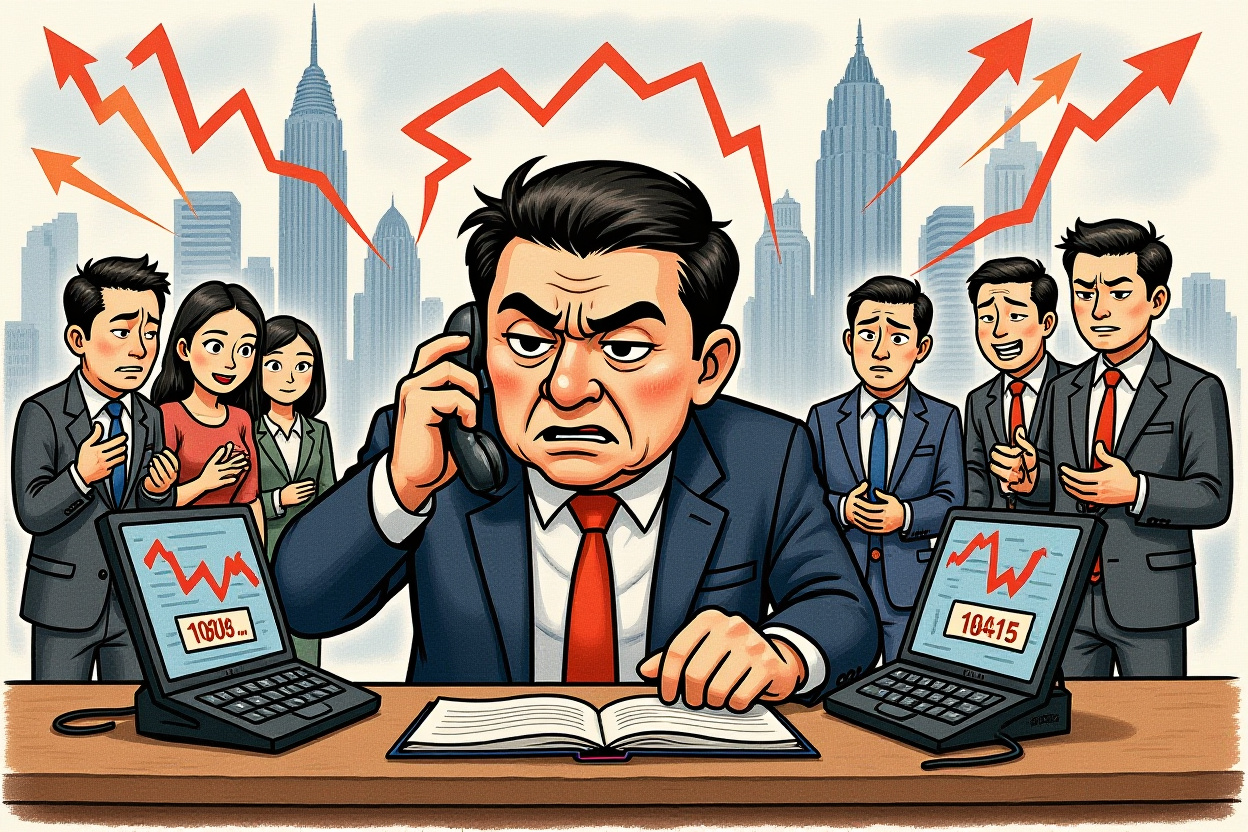
– The incident where Liang Wenfeng (梁文锋) had his phone overwhelmed by investor calls underscores acute stress points in China’s asset management sector during market turbulence.
– This event highlights heightened investor anxiety, potential redemption pressures, and communication breakdowns that can exacerbate fund liquidity risks.
– Analysis reveals broader implications for regulatory oversight by bodies like 中国证监会 (China Securities Regulatory Commission) and the stability of Chinese equity markets.
– Key lessons include the necessity for robust investor relations strategies and proactive risk management among fund managers.
– Forward-looking insights suggest that similar scenarios may recur, demanding greater transparency and resilience in China’s financial ecosystem.
In the frenetic arena of Chinese hedge funds, few episodes encapsulate the volatility of investor sentiment as dramatically as when a manager’s communication lines buckle under a deluge of panicked calls. This was precisely the scenario for Liang Wenfeng (梁文锋), the veteran investor steering 淡水泉投资 (Springs Capital), whose phone was recently blown up by investors amid a market downturn. The incident where Liang Wenfeng’s phone was overwhelmed by investor calls serves as a potent symbol of the fragile trust between capital allocators and fund managers in China’s dynamic equity markets. As global investors scrutinize such signals, understanding the underlying causes and ramifications becomes critical for navigating opportunities and risks in one of the world’s largest financial landscapes.
The Incident: Liang Wenfeng’s Phone Overwhelmed by Investor Calls
The phenomenon of Liang Wenfeng’s phone being overwhelmed by investor calls emerged from reports by 凤凰网 (Phoenix News), capturing immediate attention across financial circles. This event occurred against a backdrop of sharp declines in Chinese equities, particularly affecting technology and consumer sectors, which spurred a wave of investor inquiries into fund performance and redemption options. Liang Wenfeng, known for his value-oriented strategies, found himself at the epicenter of this communication crisis, highlighting how even seasoned managers can face intense scrutiny during periods of market stress.
Timeline and Triggers
Sources indicate that the surge in calls to Liang Wenfeng unfolded over a critical 48-hour window following a significant market correction. Key triggers included:
– A 5% drop in the 沪深300指数 (CSI 300 Index) over two trading sessions, eroding gains for many funds.
– Rumors of regulatory tightening from 中国证监会 (China Securities Regulatory Commission) on hedge fund leverage, amplifying uncertainty.
– Specific underperformance in several high-profile holdings within Springs Capital’s portfolio, prompting investor concern.
This timeline underscores how rapidly investor sentiment can shift, leading to scenarios where Liang Wenfeng’s phone was overwhelmed by investor calls, disrupting normal operations and necessitating crisis management responses.
Immediate Market and Media Reaction</h3
The news of Liang Wenfeng's communication breakdown reverberated through markets, with observable effects:
– Increased volatility in stocks associated with Springs Capital's investments, as traders speculated on potential forced selling.
– A spike in search volumes for terms like 'hedge fund redemptions China' on financial data platforms, reflecting broader anxiety.
– Commentary from analysts suggesting that such incidents could precipitate wider redemption waves if not contained, impacting market liquidity.
Media outlets, including 上海证券报 (Shanghai Securities News), amplified the story, framing it as a test of resilience for China's burgeoning hedge fund industry. This coverage reinforced the narrative that Liang Wenfeng's phone being overwhelmed by investor calls was not an isolated event but a symptom of deeper structural pressures.
Liang Wenfeng and Springs Capital: A Profile in Chinese Asset Management
To contextualize the incident, it’s essential to examine Liang Wenfeng’s role and the firm he leads. Liang Wenfeng (梁文锋) co-founded 淡水泉投资 (Springs Capital) in 2007, building it into one of China’s largest hedge funds with assets under management exceeding $10 billion at its peak. His investment philosophy emphasizes bottom-up stock picking with a long-term horizon, often focusing on undervalued companies in sectors like manufacturing and technology. However, recent years have seen challenges, including performance dips during market rotations, which may have contributed to the investor pressure manifesting in calls overwhelming his phone.
Investment Strategy and Performance Metrics</h3
Springs Capital's strategy relies on intensive research and a concentrated portfolio, which can lead to outsized returns but also heightened volatility. Key performance data includes:
– An average annualized return of 15% over the past decade, though with notable drawdowns during market corrections, such as a 20% decline in 2022.
– Heavy exposure to 科创板 (Sci-Tech Innovation Board) stocks, which have been susceptible to regulatory shifts and global tech sector swings.
– Investor redemption rates that historically averaged 5-10% annually but spiked during periods of underperformance, echoing the recent communication crisis.
This profile explains why, when market conditions soured, Liang Wenfeng's phone was overwhelmed by investor calls, as clients sought clarity on strategy adjustments and exit options.
Historical Context in China’s Hedge Fund Evolution</h3
China's hedge fund industry has grown rapidly since the 2010s, fueled by market liberalization and rising wealth. However, it remains characterized by:
– A relatively young investor base with lower risk tolerance compared to mature markets, leading to swift reactions to negative news.
– Regulatory frameworks still evolving, with bodies like 中国基金业协会 (Asset Management Association of China) implementing stricter disclosure rules to enhance transparency.
– Past incidents, such as the 2015 market crash, where fund managers faced similar communication crunches, setting precedents for the current situation.
In this light, Liang Wenfeng's experience is part of a broader pattern where rapid growth meets periodic stress tests, often resulting in scenarios where phones are overwhelmed by investor calls.
Investor Psychology and Behavior in Volatile Markets
China's hedge fund industry has grown rapidly since the 2010s, fueled by market liberalization and rising wealth. However, it remains characterized by:
– A relatively young investor base with lower risk tolerance compared to mature markets, leading to swift reactions to negative news.
– Regulatory frameworks still evolving, with bodies like 中国基金业协会 (Asset Management Association of China) implementing stricter disclosure rules to enhance transparency.
– Past incidents, such as the 2015 market crash, where fund managers faced similar communication crunches, setting precedents for the current situation.
In this light, Liang Wenfeng's experience is part of a broader pattern where rapid growth meets periodic stress tests, often resulting in scenarios where phones are overwhelmed by investor calls.
Investor Psychology and Behavior in Volatile Markets
The incident where Liang Wenfeng’s phone was overwhelmed by investor calls offers a window into the psychological drivers of investor behavior during turbulence. In Chinese markets, where retail investors constitute a significant portion of hedge fund clients, emotions like fear and herd mentality can amplify reactions. Studies show that during downturns, the volume of investor inquiries to fund managers can increase by 300-500%, straining communication channels and leading to decision-making based on incomplete information.
Case Studies and Comparative Analysis</h3
Similar episodes have occurred globally, providing lessons for China:
– In the U.S., during the 2008 financial crisis, hedge fund managers like those at Bridgewater Associates faced massive investor call volumes, leading to improved automated response systems.
– In Hong Kong, the 2019 protests saw fund managers at firms like 东方证券 (Orient Securities) dealing with panicked calls, prompting upgrades in client relationship management tools.
– Data from 中国证券投资基金业协会 (China Securities Investment Fund Association) indicates that redemption rates among domestic hedge funds spike by an average of 8% during quarterly reporting periods, correlating with increased communication demands.
These examples underscore that the phenomenon of phones being overwhelmed, as with Liang Wenfeng, is a universal challenge in asset management, but one exacerbated by China's unique market dynamics.
Quantifying the Surge: Data on Investor Communications</h3
To grasp the scale, consider:
– A survey of Chinese fund managers revealed that 65% experienced a doubling of investor calls during market downturns in the past year.
– Telecommunications data from providers like 中国移动 (China Mobile) show spikes in call volumes to financial districts in Shanghai and Shenzhen coinciding with market volatility.
– Analysis from 清华大学五道口金融学院 (PBC School of Finance, Tsinghua University) suggests that each 1% drop in major indices can lead to a 15% increase in investor inquiries to top fund managers.
This data contextualizes why Liang Wenfeng's phone was overwhelmed by investor calls, highlighting systemic pressures rather than individual failings.
Regulatory Environment and Investor Protection Mechanisms
To grasp the scale, consider:
– A survey of Chinese fund managers revealed that 65% experienced a doubling of investor calls during market downturns in the past year.
– Telecommunications data from providers like 中国移动 (China Mobile) show spikes in call volumes to financial districts in Shanghai and Shenzhen coinciding with market volatility.
– Analysis from 清华大学五道口金融学院 (PBC School of Finance, Tsinghua University) suggests that each 1% drop in major indices can lead to a 15% increase in investor inquiries to top fund managers.
This data contextualizes why Liang Wenfeng's phone was overwhelmed by investor calls, highlighting systemic pressures rather than individual failings.
Regulatory Environment and Investor Protection Mechanisms
The incident has drawn attention to China’s regulatory framework, designed to safeguard investors while promoting market stability. 中国证监会 (China Securities Regulatory Commission) and other bodies have introduced measures to address communication breakdowns, but gaps remain. For instance, regulations require fund managers to provide timely updates on performance, yet they do not mandate specific response protocols for crisis situations, which can leave managers like Liang Wenfeng vulnerable when phones are overwhelmed by investor calls.
Current Guidelines and Compliance Requirements</h3
Key regulatory elements include:
– 私募投资基金监督管理暂行办法 (Interim Measures for the Supervision and Administration of Privately Offered Investment Funds), which outlines disclosure obligations but lacks细则 (detailed rules) on emergency communications.
– Initiatives like 投资者适当性管理 (Investor Suitability Management) aim to ensure clients understand risks, yet implementation varies, contributing to panic during downturns.
– Recent proposals from 中国人民银行 (People's Bank of China) to enhance financial infrastructure, such as improving digital communication platforms, could mitigate future incidents.
These frameworks are evolving, but the case of Liang Wenfeng's phone being overwhelmed by investor calls suggests a need for more robust standards to prevent similar crises.
Impact on Fund Management Practices and Reforms</h3
In response, industry players are adopting changes:
– Springs Capital has reportedly invested in upgraded call center systems and AI-driven chatbots to handle routine inquiries, reducing the load on key personnel.
– Other firms, like 高毅资产 (Gaoyi Asset), have implemented 24/7 hotlines and dedicated investor relations teams, learning from the incident where Liang Wenfeng's phone was overwhelmed.
– Regulatory consultations are underway to introduce mandatory stress testing for fund liquidity and communication plans, which could formalize best practices.
These developments indicate a shift towards greater resilience, though the memory of Liang Wenfeng's overwhelmed phone serves as a cautionary tale for the sector.
Global Perspectives and Cross-Border Implications
In response, industry players are adopting changes:
– Springs Capital has reportedly invested in upgraded call center systems and AI-driven chatbots to handle routine inquiries, reducing the load on key personnel.
– Other firms, like 高毅资产 (Gaoyi Asset), have implemented 24/7 hotlines and dedicated investor relations teams, learning from the incident where Liang Wenfeng's phone was overwhelmed.
– Regulatory consultations are underway to introduce mandatory stress testing for fund liquidity and communication plans, which could formalize best practices.
These developments indicate a shift towards greater resilience, though the memory of Liang Wenfeng's overwhelmed phone serves as a cautionary tale for the sector.
Global Perspectives and Cross-Border Implications
For international investors and fund managers, the incident where Liang Wenfeng’s phone was overwhelmed by investor calls offers valuable insights into Chinese market integration with global finance. As China’s equity markets become more accessible through channels like 沪深港通 (Stock Connect programs), understanding local investor behavior and regulatory responses is crucial for risk management. Comparative analysis with markets like the U.S. and Europe reveals both similarities and distinct challenges, such as higher retail participation and faster information dissemination in China.
Lessons from International Hedge Fund Crises</h3
Global precedents inform potential solutions:
– After the 2020 pandemic-induced volatility, U.S. hedge funds enhanced their digital communication tools, using platforms like Zoom for investor briefings to reduce phone dependency.
– In the EU, regulations like MiFID II require detailed transaction reporting, which has improved transparency and reduced panic calls during market swings.
– Data from 国际货币基金组织 (International Monetary Fund) shows that markets with stronger investor education programs, such as Singapore, experience lower call surges during downturns.
Applying these lessons could help Chinese managers avoid scenarios where phones are overwhelmed, as seen with Liang Wenfeng, by fostering more stable investor relations.
Investment Strategy Adjustments for Global Portfolios</h3
For institutional investors worldwide, key takeaways include:
– Monitoring communication breakdowns as early warning signs of liquidity issues in Chinese funds, potentially affecting asset allocations.
– Diversifying exposures across multiple managers and strategies to mitigate risks associated with single-point failures like Liang Wenfeng's overwhelmed phone.
– Engaging with regulatory developments, such as China's push for 开放资本市场 (capital market opening), to anticipate changes that could influence fund operations.
By incorporating these insights, global players can better navigate the complexities highlighted by the incident where Liang Wenfeng's phone was overwhelmed by investor calls.
Forward Outlook: Navigating Investor Relations in China’s Evolving Markets
For institutional investors worldwide, key takeaways include:
– Monitoring communication breakdowns as early warning signs of liquidity issues in Chinese funds, potentially affecting asset allocations.
– Diversifying exposures across multiple managers and strategies to mitigate risks associated with single-point failures like Liang Wenfeng's overwhelmed phone.
– Engaging with regulatory developments, such as China's push for 开放资本市场 (capital market opening), to anticipate changes that could influence fund operations.
By incorporating these insights, global players can better navigate the complexities highlighted by the incident where Liang Wenfeng's phone was overwhelmed by investor calls.
Forward Outlook: Navigating Investor Relations in China’s Evolving Markets
Looking ahead, the episode where Liang Wenfeng’s phone was overwhelmed by investor calls is likely to catalyze broader changes in China’s financial ecosystem. Market participants, from fund managers to regulators, must adapt to increasing volatility driven by factors like geopolitical tensions and technological disruption. Proactive measures, such as enhancing communication infrastructures and fostering investor education, will be essential to prevent recurrence and maintain confidence in Chinese equities.
Strategies for Fund Managers and Asset Allocators</h3
To build resilience, industry leaders recommend:
– Implementing scalable communication systems, including automated response units and social media updates, to diffuse pressure during crises.
– Conducting regular stress tests on liquidity and redemption scenarios, ensuring preparedness for events where phones might be overwhelmed, as with Liang Wenfeng.
– Strengthening transparency through frequent, detailed reporting, which can preempt investor anxiety and reduce call volumes.
These strategies aim to transform challenges into opportunities for growth, learning from the incident where Liang Wenfeng's phone was overwhelmed by investor calls.
Predictions for Chinese Equity Market Dynamics</h3
Expert analysis suggests several trends:
– Increased regulatory scrutiny on fund manager communications, potentially leading to new guidelines from 中国证监会 (China Securities Regulatory Commission).
– A shift towards more institutional investment in hedge funds, which may reduce the frequency of panic calls compared to retail-driven surges.
– Technological adoption, such as blockchain for real-time reporting, could mitigate communication breakdowns, making incidents like Liang Wenfeng's overwhelmed phone less common.
By anticipating these shifts, stakeholders can position themselves advantageously in a market where investor relations are paramount.
Expert analysis suggests several trends:
– Increased regulatory scrutiny on fund manager communications, potentially leading to new guidelines from 中国证监会 (China Securities Regulatory Commission).
– A shift towards more institutional investment in hedge funds, which may reduce the frequency of panic calls compared to retail-driven surges.
– Technological adoption, such as blockchain for real-time reporting, could mitigate communication breakdowns, making incidents like Liang Wenfeng's overwhelmed phone less common.
By anticipating these shifts, stakeholders can position themselves advantageously in a market where investor relations are paramount.
The incident where Liang Wenfeng's phone was overwhelmed by investor calls serves as a multifaceted lesson for China's financial markets. It underscores the intense pressure on fund managers during volatility, the critical role of effective communication, and the ongoing need for regulatory and operational enhancements. For global investors, this episode highlights the importance of due diligence on manager resilience and market sentiment indicators. As Chinese equities continue to integrate with world markets, proactive engagement with these dynamics will be key to unlocking value while managing risks. Moving forward, let this be a call to action: prioritize robust investor relations frameworks and continuous adaptation to safeguard against future crises where communication lines falter.