



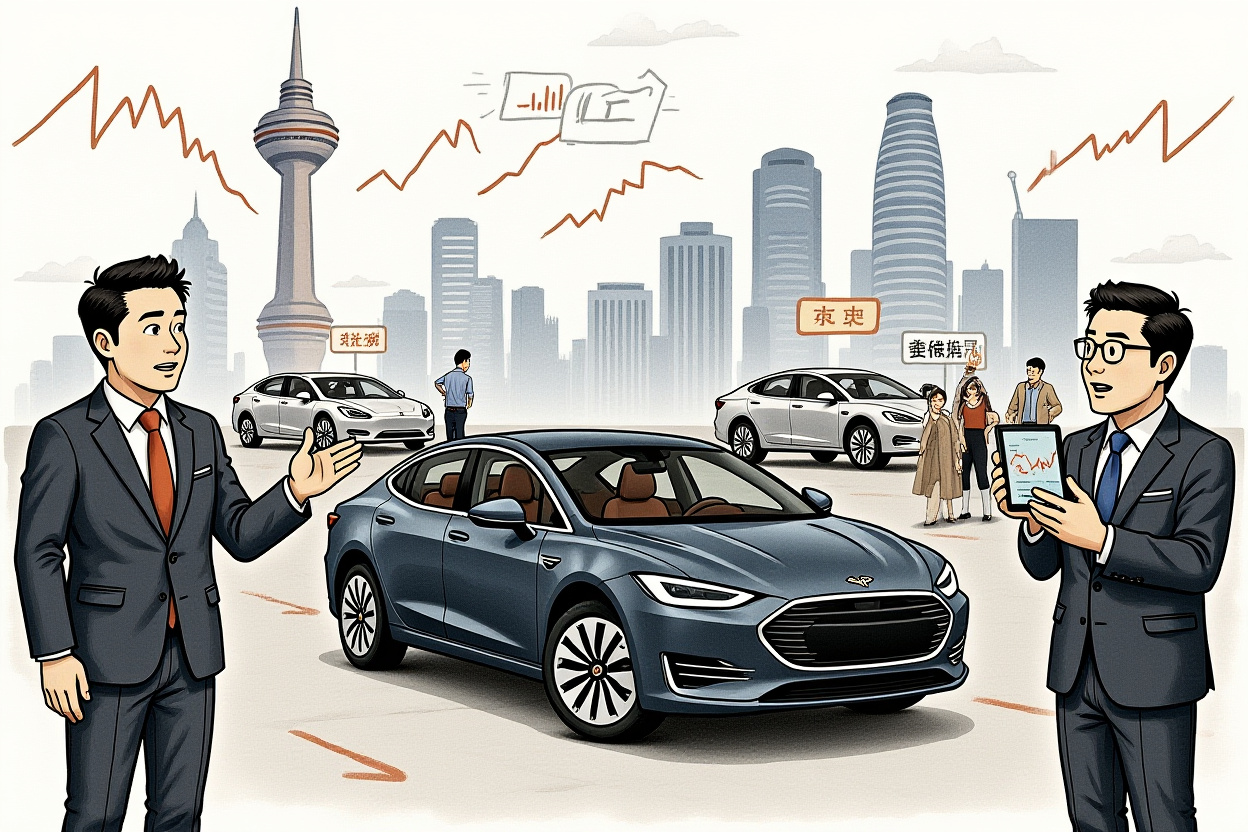
Executive Summary: Key Takeaways from the Xiaomi-Tesla Rivalry
– Xiaomi’s (小米) SU7 has become the first electric sedan in its segment to outsell Tesla’s (特斯拉) Model 3 in China, based on Yiche.com (易车网) sales rankings, validating Lei Jun’s (雷军) assertion that Tesla is indeed strong, but not invincible.
– Both companies are escalating financing battles: Tesla launched 7-year low-interest plans for Model 3/Y, while Xiaomi responded with 3-year zero-interest offers for its YU7 model, intensifying competition for consumer wallets.
– Lei Jun conducted a live dismantling of the YU7 to address quality concerns, highlighting a strategic transparency move to build trust and counter skepticism in a crowded market.
– Xiaomi Automotive delivered over 410,000 vehicles in 2025, with a conservative 2026 target of 550,000 units, signaling ambitious growth amidst a slowing EV sector and regulatory pressures.
– The rivalry underscores broader shifts in China’s EV landscape, where domestic players like Xiaomi leverage tech integration and aggressive pricing to challenge global giants, reshaping investment dynamics for institutional investors.
The Dawn of a New Challenger: Xiaomi’s Electric Ascent
In a bold statement that reverberated across global financial circles, Xiaomi (小米) founder and CEO Lei Jun (雷军) proclaimed on January 10, 2026, that Tesla (特斯拉) – while dominant – is not an unbeatable force in China’s electric vehicle arena. This declaration, posted via his Weibo (微博) account, came alongside sales data revealing that Xiaomi’s debut sedan, the SU7, has surpassed Tesla’s Model 3 in its price segment, marking a pivotal moment in the industry. For sophisticated investors monitoring Chinese equities, this isn’t merely corporate bravado; it’s a signal of tectonic shifts in market share, consumer preference, and technological parity. The focus phrase, Tesla is indeed strong, but not invincible, encapsulates a growing sentiment that domestic innovation is closing the gap on foreign incumbents, offering fresh alpha opportunities in a sector ripe with disruption.
The Chinese EV market, the world’s largest, is experiencing a consolidation phase where only players with robust capital, cutting-edge tech, and consumer trust will thrive. Lei Jun’s confidence stems from Xiaomi’s rapid execution since entering the automotive space, leveraging its ecosystem of smart devices and loyal user base. As international fund managers assess exposure to Chinese automakers, understanding this rivalry’s nuances – from sales metrics to financing tactics – becomes crucial for portfolio allocation. The battle between Xiaomi and Tesla is more than a product showdown; it’s a litmus test for China’s ability to foster homegrown champions capable of competing on a global scale.
Decoding the Sales Victory: SU7 vs. Model 3
Lei Jun specifically cited rankings from Yiche.com (易车网), a leading automotive data platform, to bolster his claim. According to these figures, the SU7 emerged as the only pure-electric sedan in its class to outperform the Model 3 in monthly sales, a milestone achieved within months of its launch. This achievement challenges the long-held perception of Tesla’s unassailable lead in premium EVs, particularly in China where it has faced mounting pressure from brands like BYD (比亚迪) and Nio (蔚来). Key factors behind the SU7’s success include:
– Aggressive pricing strategy: The SU7 is positioned with a competitive price point, often undercutting the Model 3 while offering comparable range and features.
– Ecosystem integration: Xiaomi’s expertise in consumer electronics allows for seamless connectivity with smartphones and home devices, appealing to tech-savvy buyers.
– Quality perception: Early reviews praised the SU7’s build quality and materials, addressing common concerns about new EV entrants.
Data from the China Association of Automobile Manufacturers (中国汽车工业协会) indicates that sedan sales in the RMB 200,000-300,000 segment grew by 15% year-over-year in Q4 2025, with Xiaomi capturing a significant portion. This sales triumph reinforces that Tesla is indeed strong, but not invincible, as local players tailor offerings to domestic tastes and purchasing power.
Market Implications: A Reshuffling of Competitive Dynamics
The SU7’s performance has immediate ramifications for investors. Tesla’s stock (NASDAQ: TSLA) has historically benefited from its China growth narrative, but any erosion in market share could pressure valuations. Conversely, Xiaomi’s (HKEX: 1810) automotive division, though not yet separately listed, is becoming a key value driver, potentially attracting speculative interest ahead of potential spin-offs. Analysts from CICC (中金公司) note that the EV sector’s profitability remains thin, but sales volume leaders like Xiaomi could achieve scale advantages faster than anticipated. For institutional investors, this rivalry highlights the need to monitor monthly delivery reports and customer satisfaction surveys, as sentiment can shift rapidly in this hyper-competitive space.
The Financing Front: Zero-Interest Wars Escalate
Just days before Lei Jun’s proclamation, Tesla launched aggressive financing schemes on January 6, 2026, via its official Weibo account. The offers include a 7-year low-interest plan for Model 3 and Model Y, with down payments starting at RMB 79,900 and monthly installments as low as RMB 1,918. For the Model Y L, Tesla introduced a 5-year zero-interest option, with a RMB 99,900 down payment and monthly payments from RMB 3,985. These moves aim to stimulate demand amid slowing growth and inventory buildup, a tactic increasingly common as the EV market matures. Tesla’s financing push underscores its adaptability, yet it also reveals vulnerability to pricing pressure from rivals.
Xiaomi’s Counterstrike: Zero-Interest as a Market Penetration Tool
Transparency as a Weapon: Lei Jun’s Live Dismantling of YU7On January 3, 2026, Lei Jun hosted a live stream where engineers dismantled a Xiaomi YU7, responding to online skepticism about the consistency of build quality between the SU7 and subsequent models. This unprecedented move was triggered by social media influencers suggesting that the SU7’s robust materials were a one-off for scrutiny, with later vehicles potentially compromising. In the broadcast, Lei Jun emphasized, “We invite everyone to see the truth and speak fairly – don’t exaggerate or nitpick for clicks.” The dismantling revealed details like battery pack integration, chassis construction, and interior materials, aiming to reassure consumers and investors alike.
Building Trust in a Skeptical Market
Delivery Targets and Strategic Ambitions for 2026During the live stream, Lei Jun disclosed that Xiaomi Automotive delivered over 410,000 vehicles in 2025, a figure that exceeded internal expectations for a nascent entrant. For 2026, he set a delivery target of 550,000 units, noting it was “neither too high nor too low” and expressing hope to surpass it by year-end. This conservative guidance reflects caution amid macroeconomic headwinds, including sluggish consumer spending and trade tensions affecting supply chains. However, it also positions Xiaomi for potential upside surprises, a scenario favored by equity analysts covering growth stocks.
Analyzing the 550,000-Unit Goal in Context
The Broader Chinese EV Landscape: Consolidation and InnovationInvestment Implications and Forward-Looking GuidanceThe rivalry between Xiaomi and Tesla offers actionable insights for sophisticated investors. First, monitor monthly sales data from platforms like Yiche.com (易车网) and the China Passenger Car Association (乘联会), as real-time indicators often precede stock movements. Second, assess financing strategies’ impact on balance sheets; companies with strong cash reserves, like Xiaomi backed by its tech conglomerate, may weather price wars better. Third, consider regulatory tailwinds, such as China’s carbon neutrality goals boosting EV adoption, but also risks like trade barriers in key export markets.
Strategic Allocation in a Volatile Sector
Global Perspectives: Lessons for International MarketsSynthesizing the Battle for EV SupremacyLei Jun’s declaration that Tesla is indeed strong, but not invincible is more than a rallying cry; it’s a reflection of China’s rapid maturation in the electric vehicle sector. Xiaomi’s SU7 outselling the Model 3, coupled with aggressive financing and transparency moves, signals a formidable challenge to Tesla’s dominance. For business professionals and investors, this rivalry underscores the importance of agility, local adaptation, and integrated ecosystems in capturing value. As 2026 unfolds, watch for delivery milestones, regulatory shifts, and technological breakthroughs that could further tilt the balance.
Moving forward, engage with market data and expert analysis to navigate this dynamic landscape. Consider attending industry conferences like the China Auto Show or subscribing to reports from financial institutions with deep China expertise. The EV revolution is accelerating, and staying informed is key to capitalizing on the opportunities ahead – whether betting on incumbents like Tesla or disruptors like Xiaomi.